
An important and tragic part of French history is the conflict between the Langue d’oïl and the Langue d’oc; a conflict of language, religion and, of course, political power.
Toulouse was an early capital of the Langue d’oc. We had not planned to spend time in Toulouse a we tend to prefer smaller, less congested spots. Then Denise noticed that there is a Cité de l’espace or Space Museum in Toulouse. And then we discovered that there is an aire right across the street. We were off. When we got there, we realized that it would required 250 yards or so in the low emission zone but we managed to get there without being stopped. We felt like we were tip toeing down the street, a challenge in a nine ton truck! Picture an elephant trying to sneak by.
It was a rather cold, grey day, but we thoroughly enjoyed our visit. There was lots of space information of different kinds but all from a European point of view. There is a lot more European space research than we had known. (Despite our best efforts, we are still a bit US/UK centric in our thinking.)
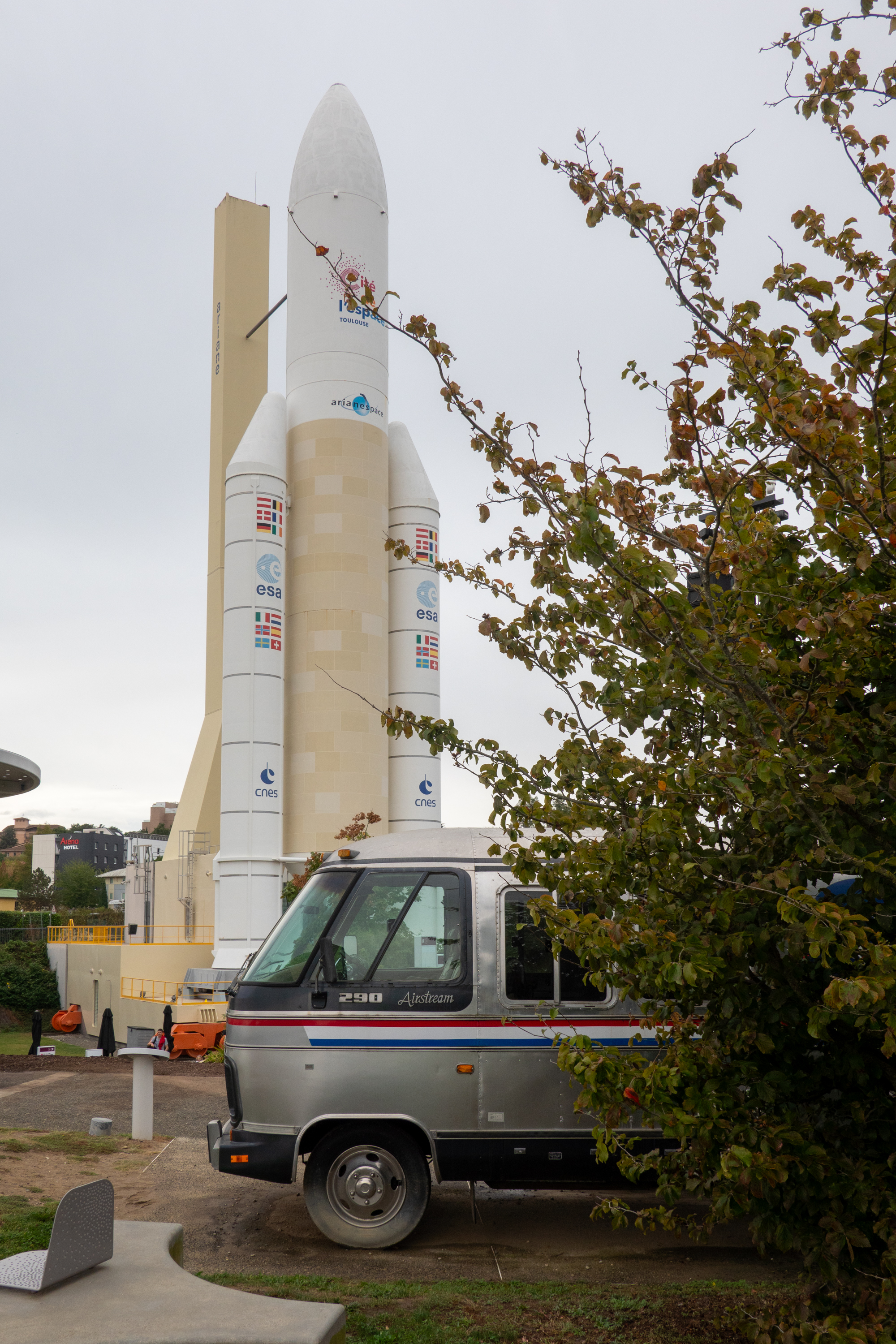
We saw an Ariane rocket and a replica of the US moon landing module.

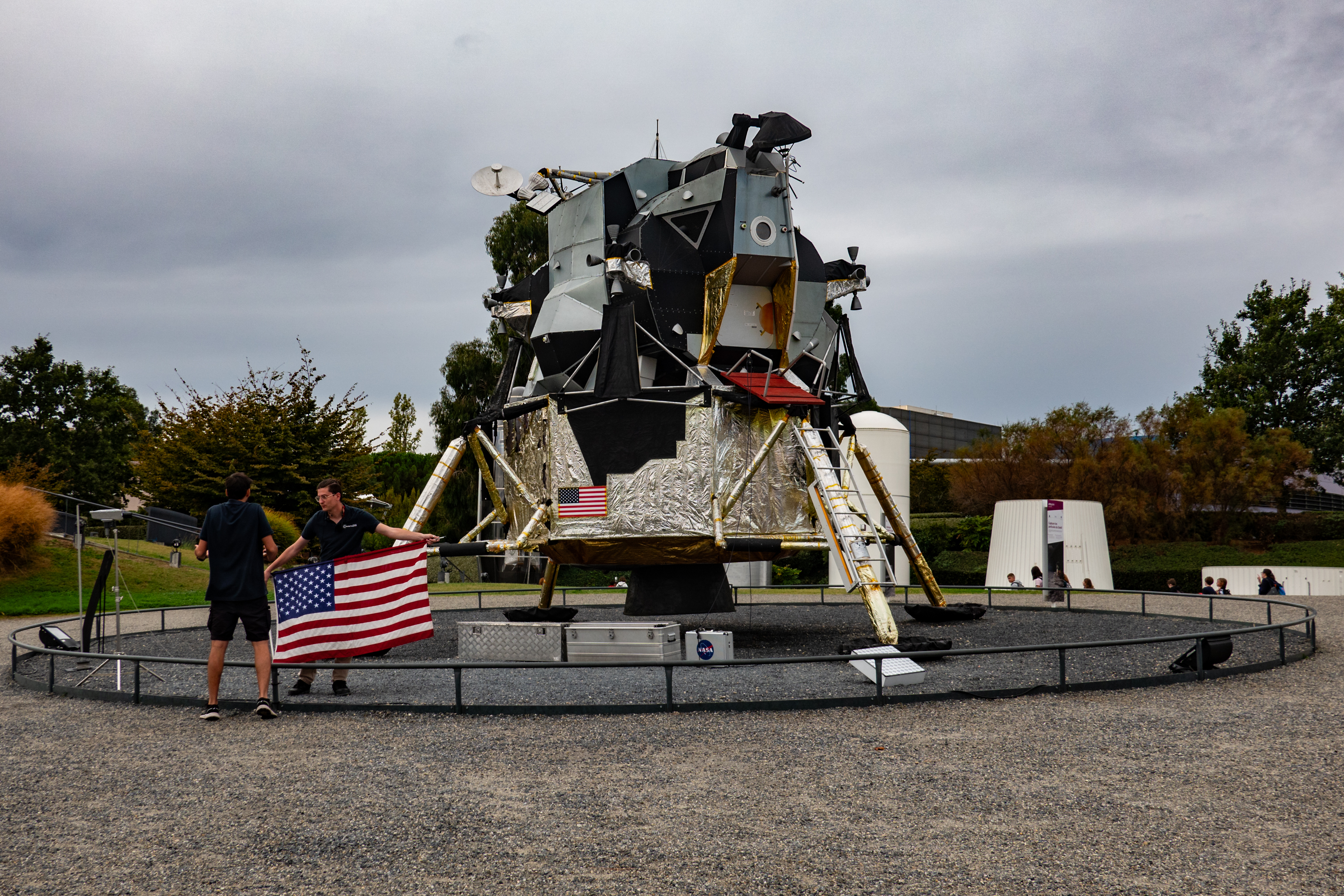
We kind of liked the RV connection of the Winnebago motorhome that was used to transport astronauts around Cape Kennedy.
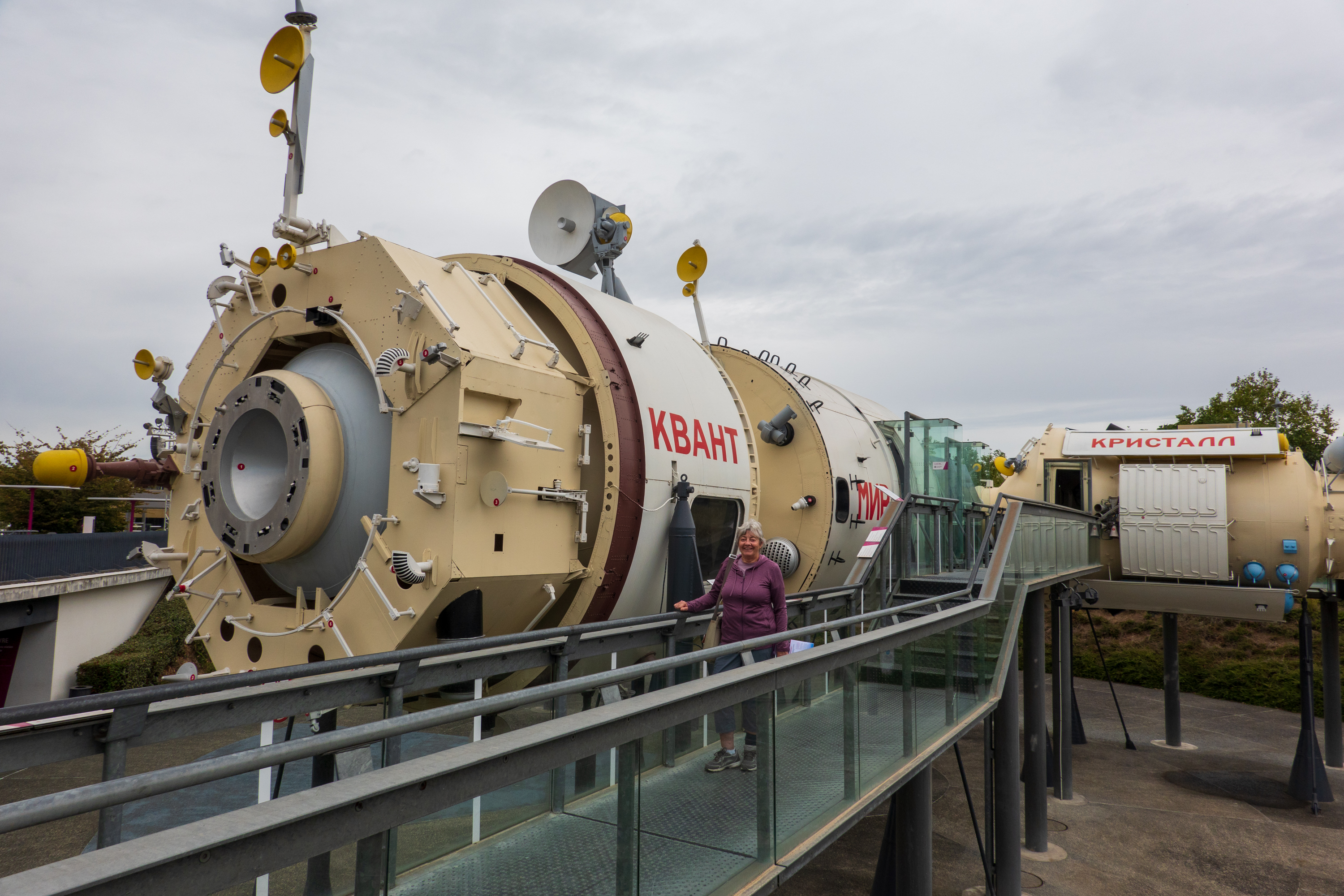
We wandered through a replica of the space station Mir.
There was an interesting presentation on the Mars rovers on a replica of the Mars landscape. It features radio controlled replicas of two Mars rovers, Perseverance (US) and, Zhurong (PRC).

Finally, we saw both a Planetarium presentation (blah) and an amazing Canadian 3D film about asteroids. The information on asteroids was exceptional and included where they are found, what they are made of, and various plans to deal with them if one should become dangerous.
There are also exhibit halls with lots of digital information and such fun experiences such as what it would be like to walk on the moon.

All in all, it was a great day. Cultural observation. We are in the off season, so the Cité de l’espace was running at reduced capacity. This meant that they shut down the snack bars, but kept the full service restaurant – sort of the opposite of what we might expect at a US attraction in the off season.
Moving into the past, we headed to Carcassone. Carcassone simply drips history: https://en.wikipedia.org/wiki/Carcassonne In popular fiction, the author Kate Mosse has written several books that touch on Carcasonne, the most famous being “Labyrinth.” Central to all of this is the Cathar heresy which resulted in the only crusade ever declared against Christians: https://en.wikipedia.org/wiki/Albigensian_Crusade Today, Carcasonne is a major tourist attraction.
The closest aire we could find was in the little town of Bram, about ten kilometers away. Bram was a castrum (old Roman fort site) in the Langue d’oc, When attacked in 1210 by French crusaders, 100 prisoners had their noses cropped, their lips cut off, and their eyes gauged out. One man was left with one eye so that he could guide the others away. With a hand on the shoulder of the one in front, and the one-eyed man at their head, a file of blind prisoners wound its way to Lastours (Cabaret), a visible demonstration of the ineffable mercy of God’s Christian Army. (Sarcasm alert.) Today there is no trace of the medieval fortifications, but the street layout preserves the traditional “circulade” or circular layout.
Both the aire and the town proved to be delightful. The aire is beside a lovely lake and beautiful views greeted us each day. We originally planned to take the train to Carcasonne, but discovered that we would have a major trek from the aire to the Bram station and from the Carcasonne station to the old city. As Denise has a badly sprained ankle, long walks were not optimal. Then we discovered a camper parking lot, just five minutes from the old town and, with the next sunny day, we were off.
Arriving at the parking lot, we were reminded that we are not the biggest dog around – not by a long shot.

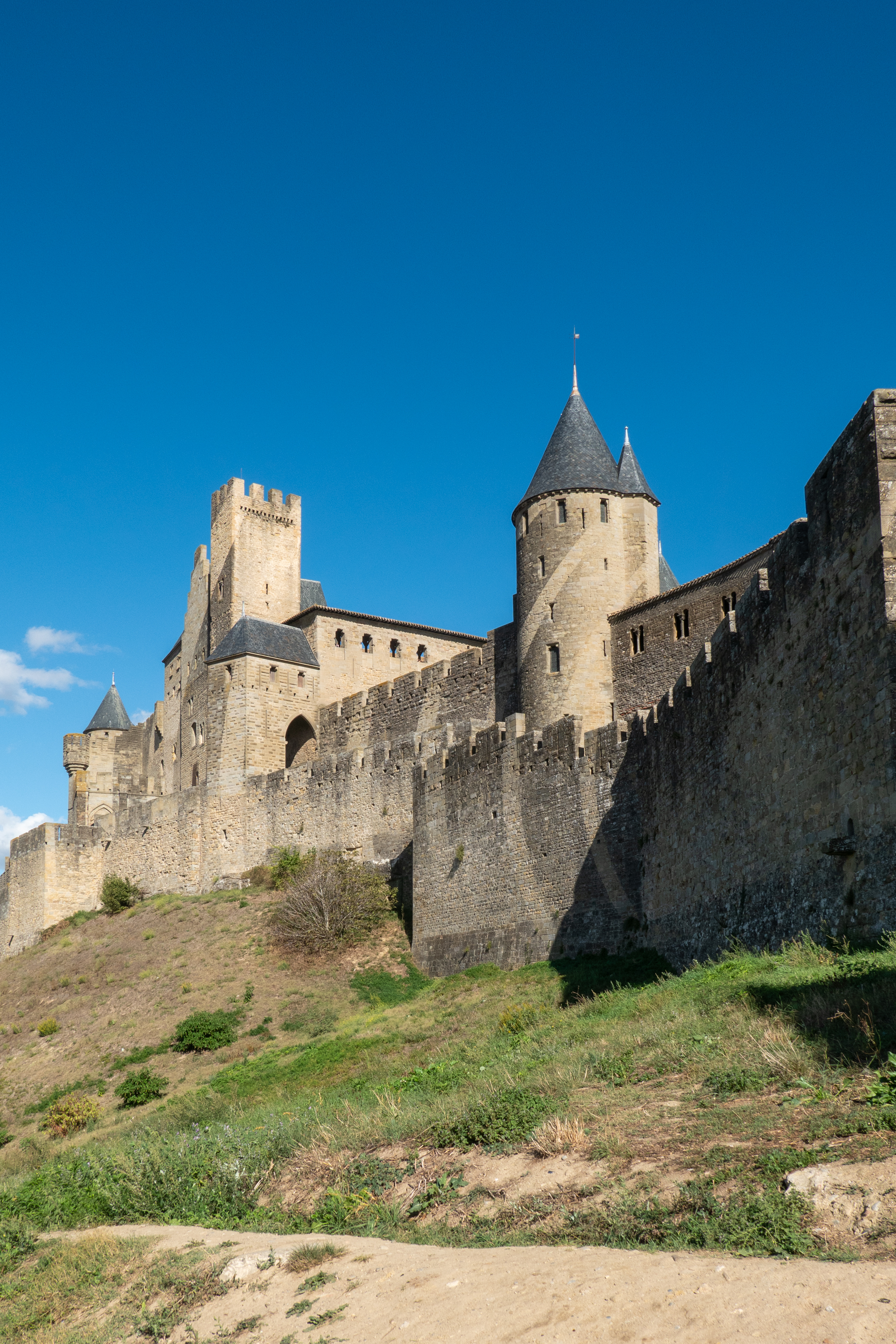
The approach to the old city is simply stunning.
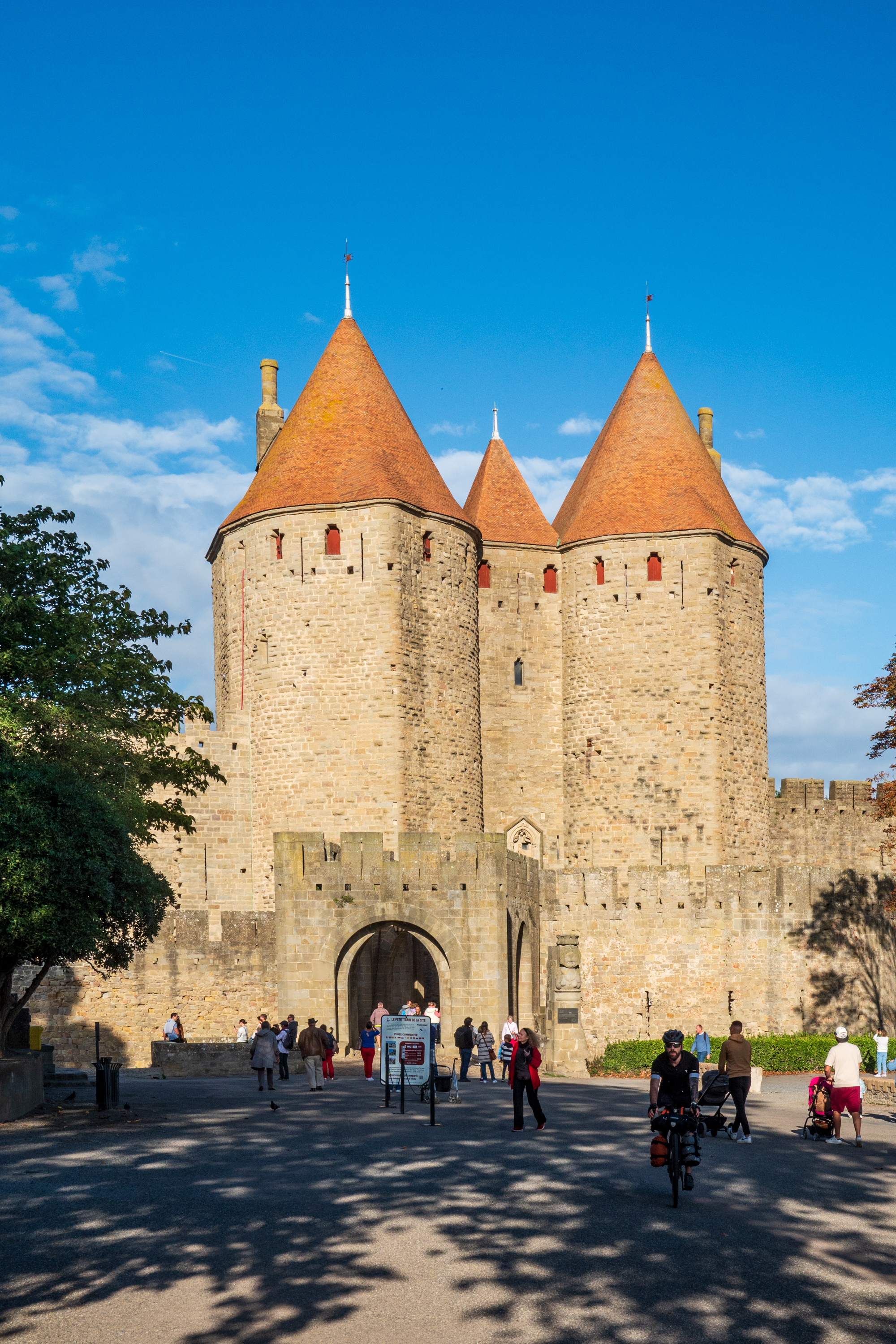

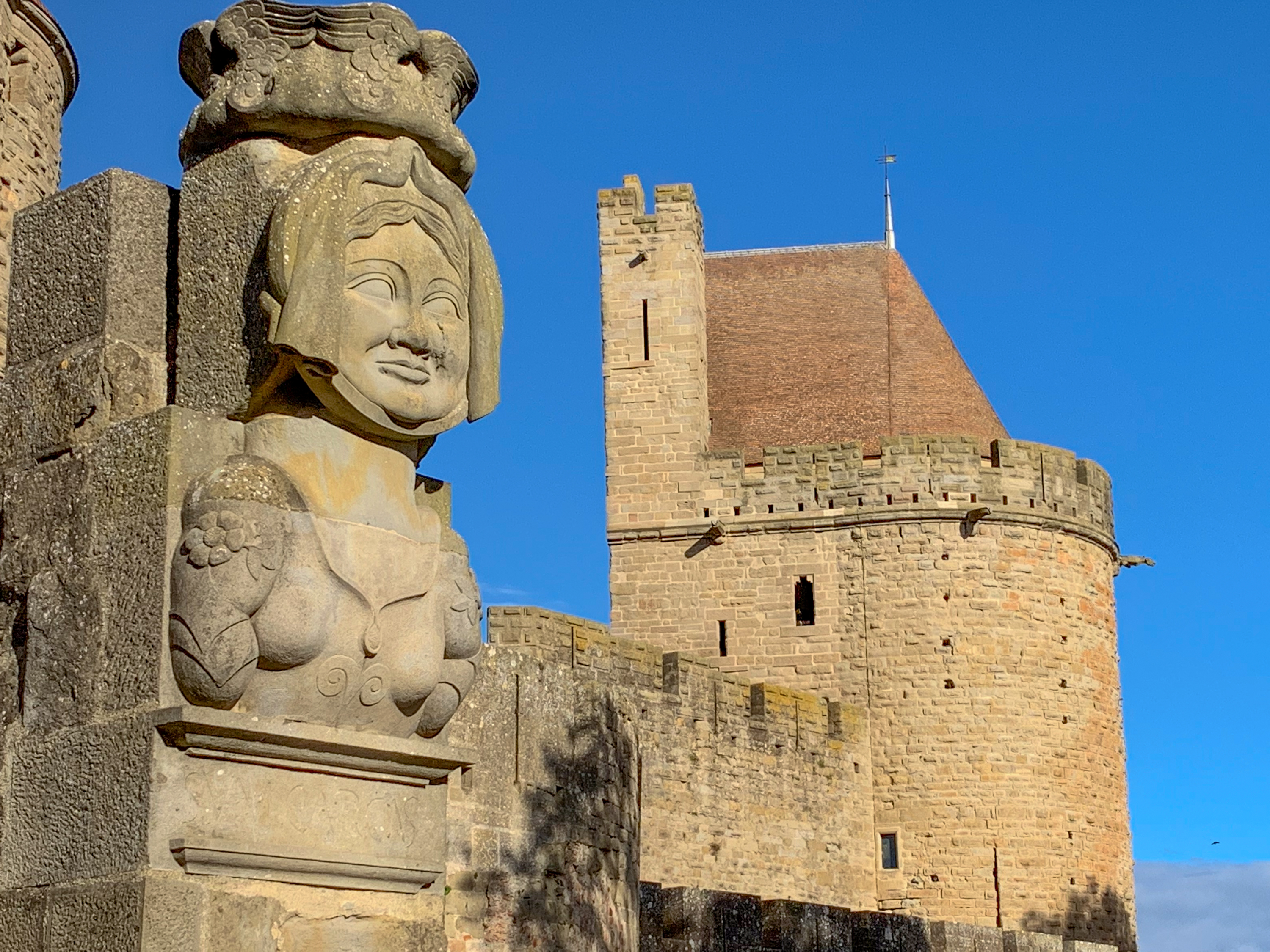
One of the legends of the origin of the name “Carcasonne” dates back to Charlemagne. At the time, the city was ruled by the Moors. When their ruler, Ballak, was killed fighting Charlemagne, his widow, Dame Carcas, held the city against the French. The French settled down to a siege.
After five years, Dame Carcas hit upon a ruse to get the French to give up. She fattened up some pigs and then had them thrown over the walls to the French, who, by this time, were feeling the privations of the siege as well. When the French saw that the Moors had so much food that they could give it away to their attackers, they gave up and lifted the siege. As they marched away, they could hear all of the bells ringing, thus “Carcas sonne!” (sonner = sound or ring, as a bell) Any truth? Probably not a lot, as Charlemagne would have only been about 17 years old and the French had already taken the city, but it was enough to name the city and reminds of the long history of conflict in the region. (And lets us continue our search for strong women in history.)
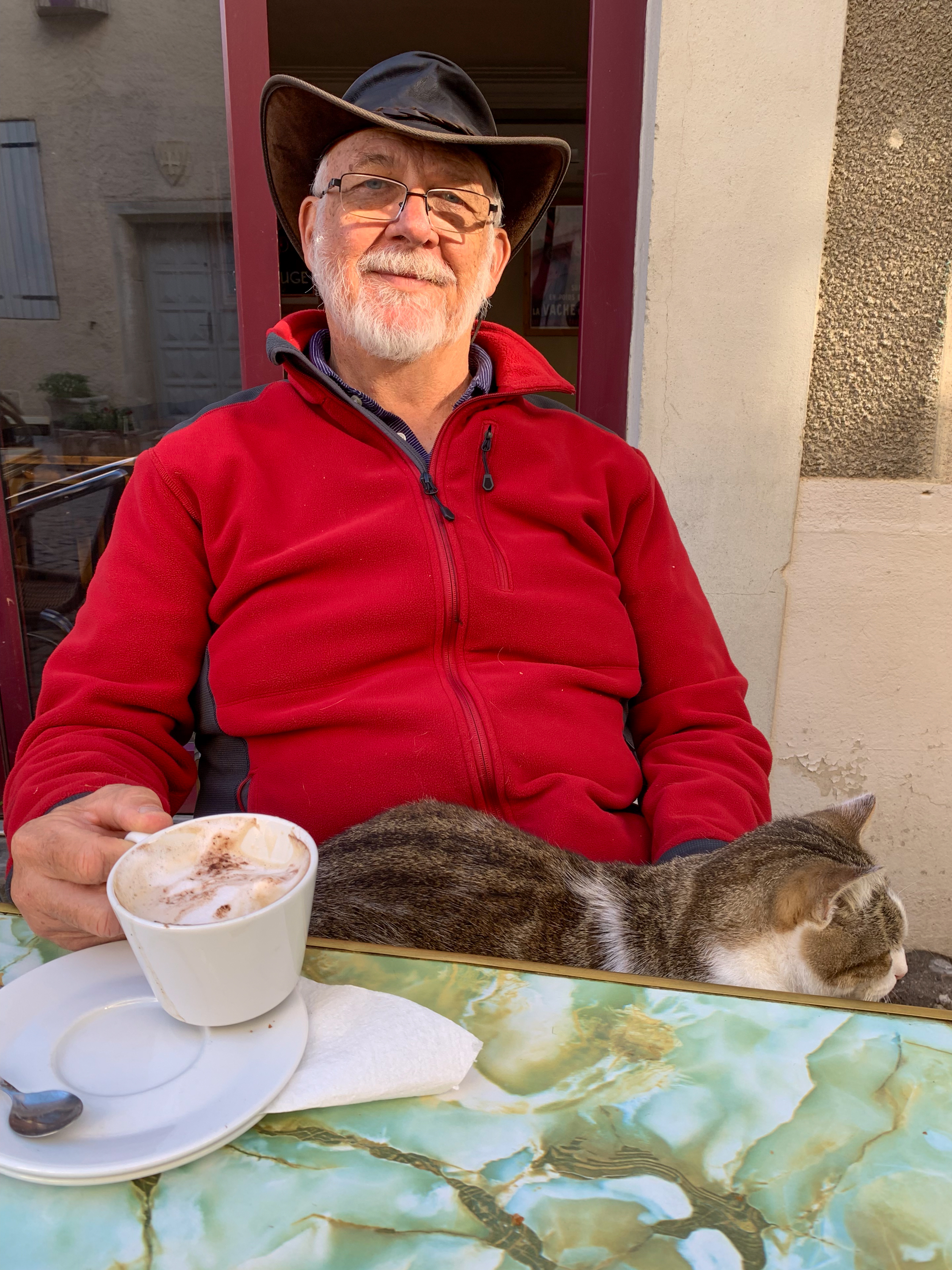
Naturally, we started OUR siege with a cup of coffee at a cafe, where a local cat came over instantly to meet Fred and take over his lap! Denise was afraid Fred would never leave!
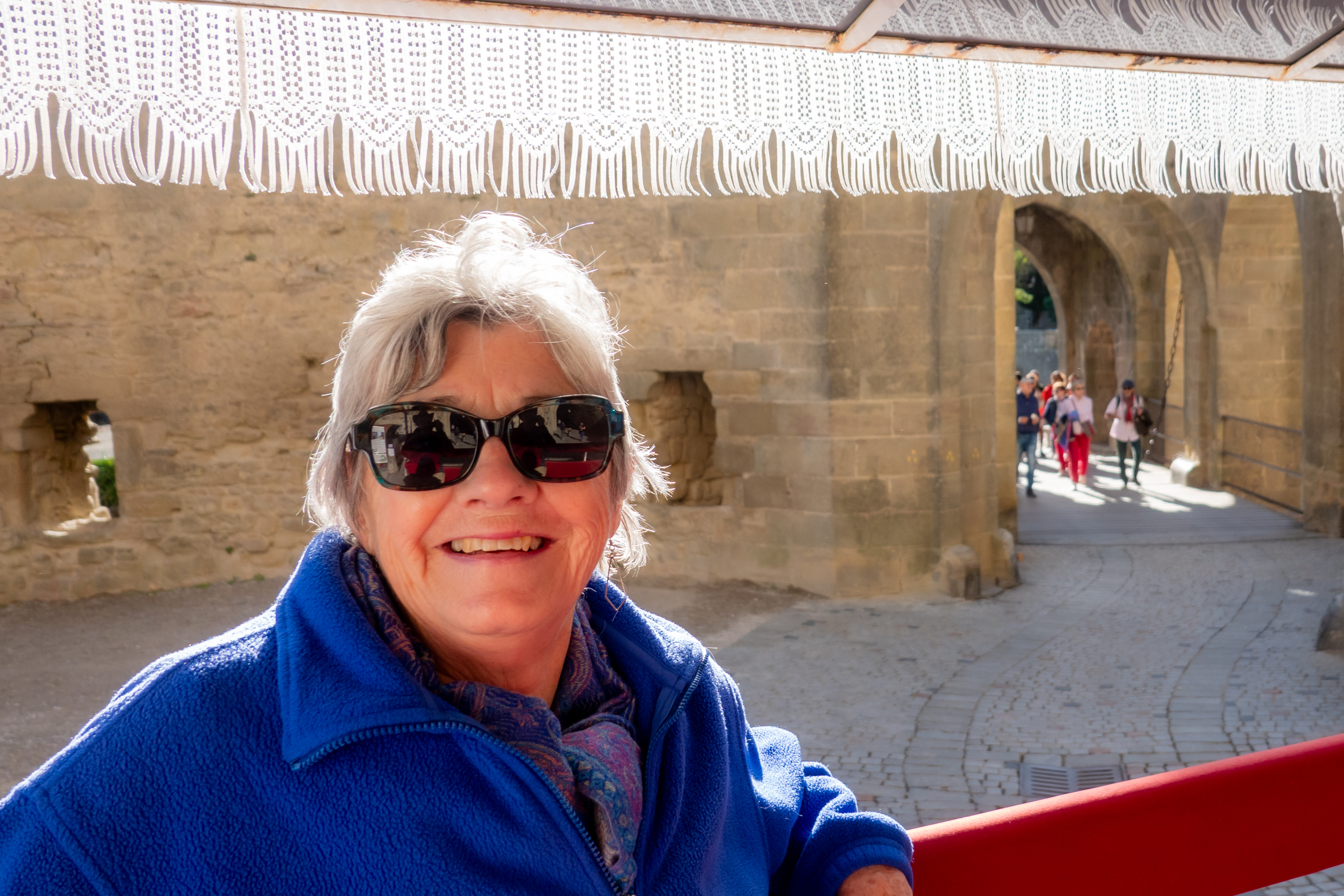
We then enjoyed a short tour in a horse pulled carriage and learned a lot about the ramparts and the different eras of their construction, beginning with the Gallo Roman one. We tend to be military/fortification nuts and it is rare to have a guide so well versed in the intricacies of medieval fortifications.

The ramparts had enclosed the old, and then only, city, before the “modern” Bastide St. Louis was created outside, during the seventeenth century.
We then tackled the ramparts ourselves, walking up and down multiple sets of steps to towers, which all had fantastic views.
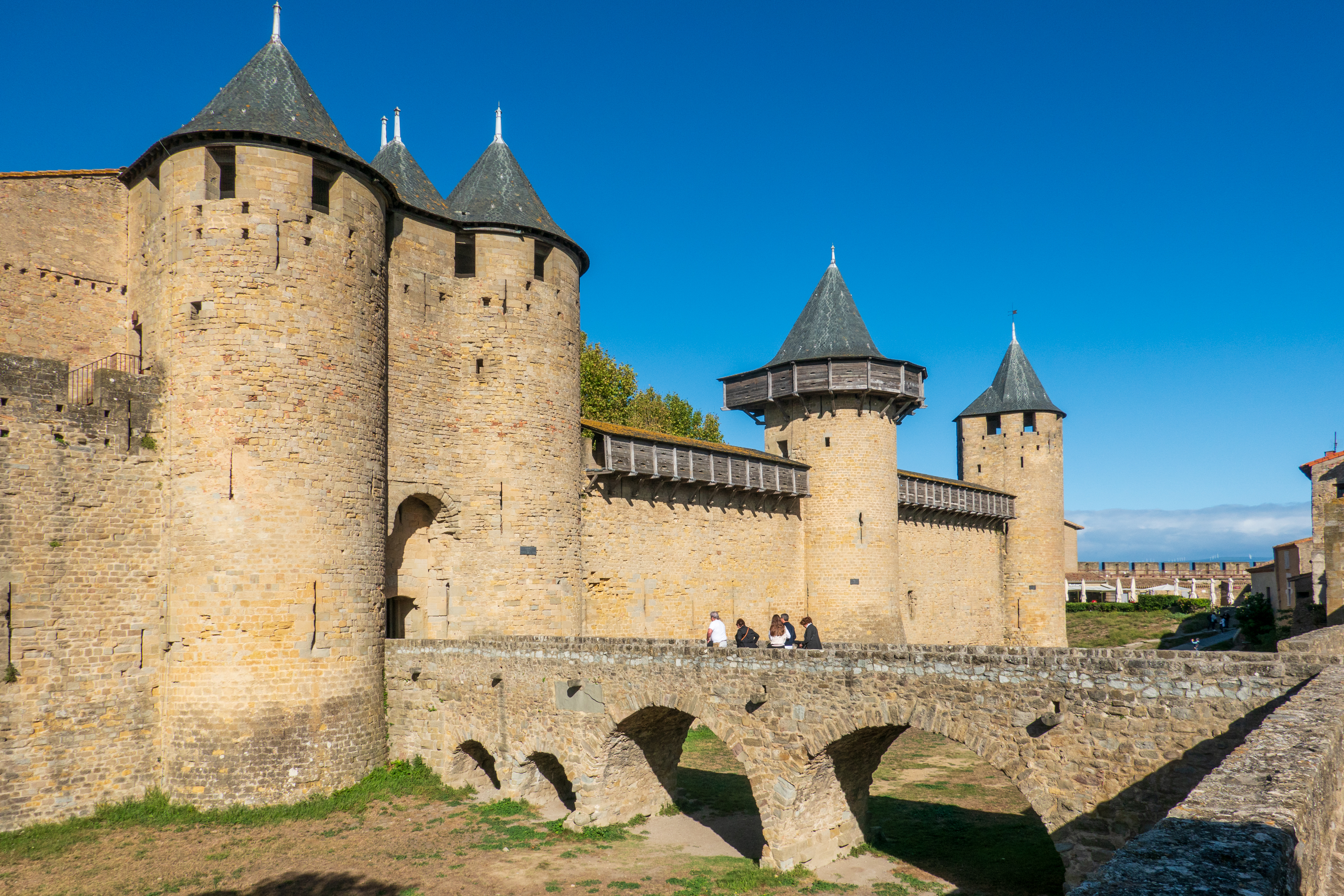
Fred has a bit of an obsession about the way that movies consistently fail to present medieval fortresses correctly, starting with the detail that they were usually plastered smooth and white washed or painted. They typically were not grey or craggy.
Another example is hoardings and they are beautifully reproduced at Carcasonne. Basically, hoardings are wooden structures used to protect defenders on the walls, conceal their numbers, and allow them to drop nasty things on attackers. (https://en.wikipedia.org/wiki/Hoarding_(castle))


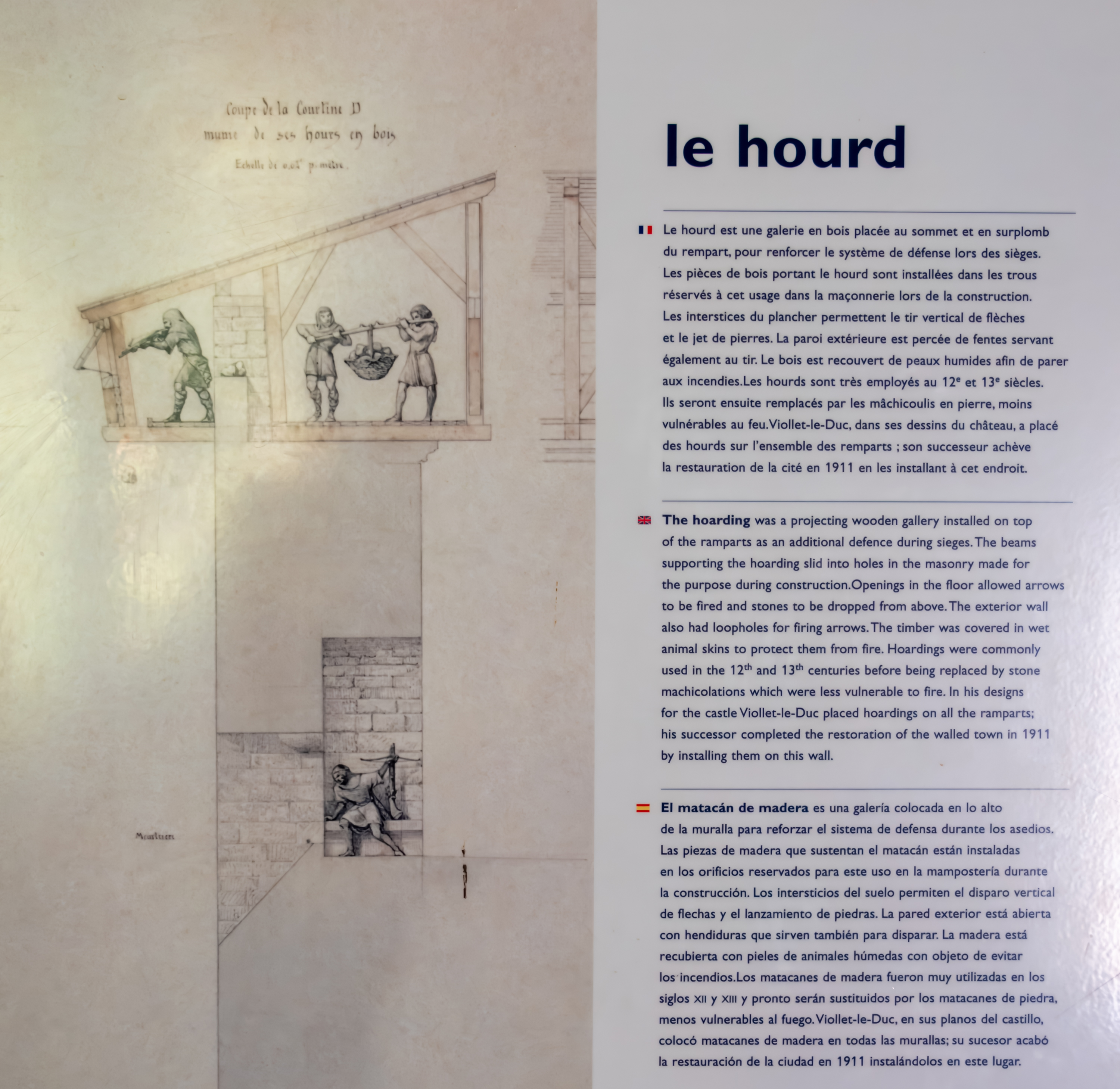
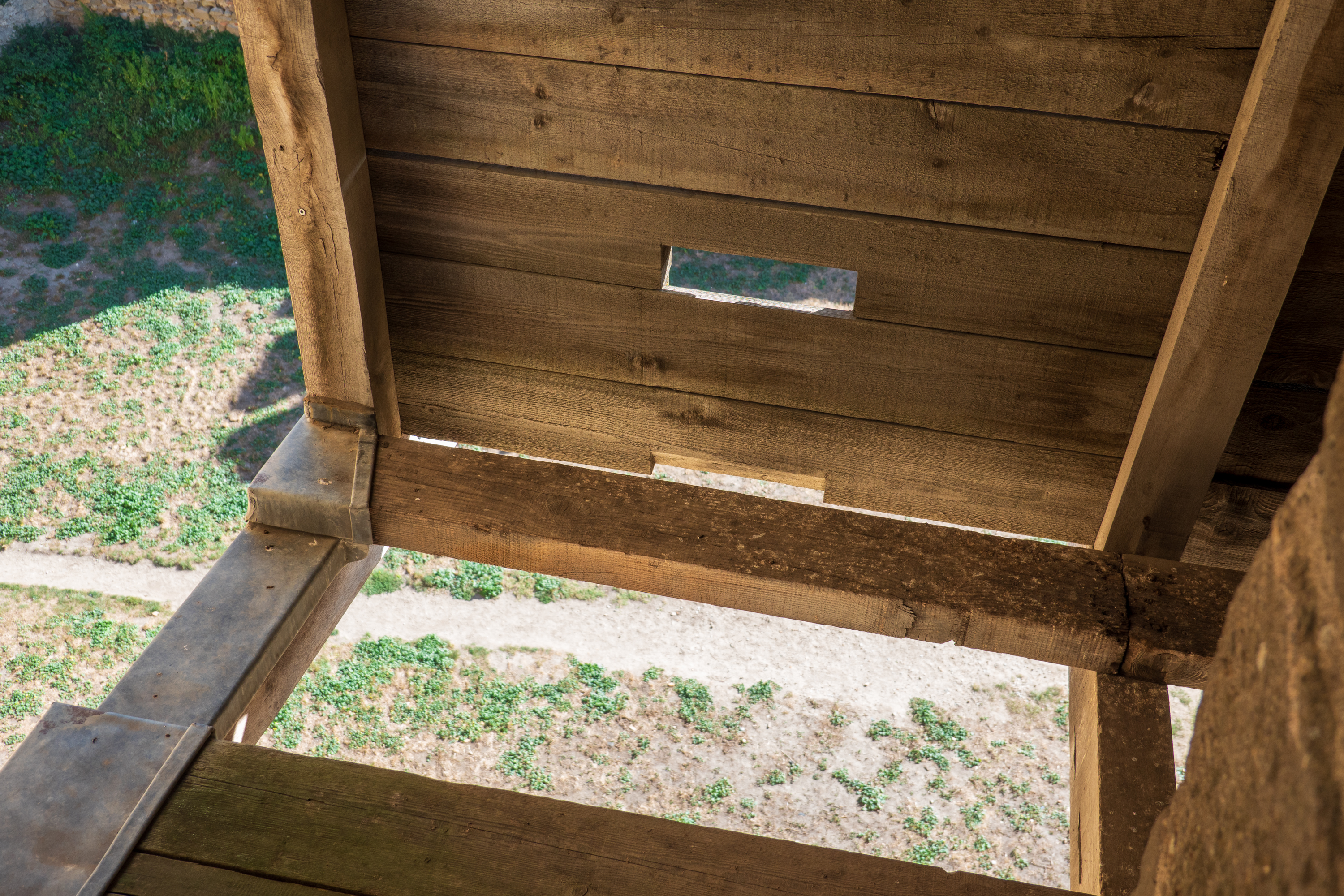
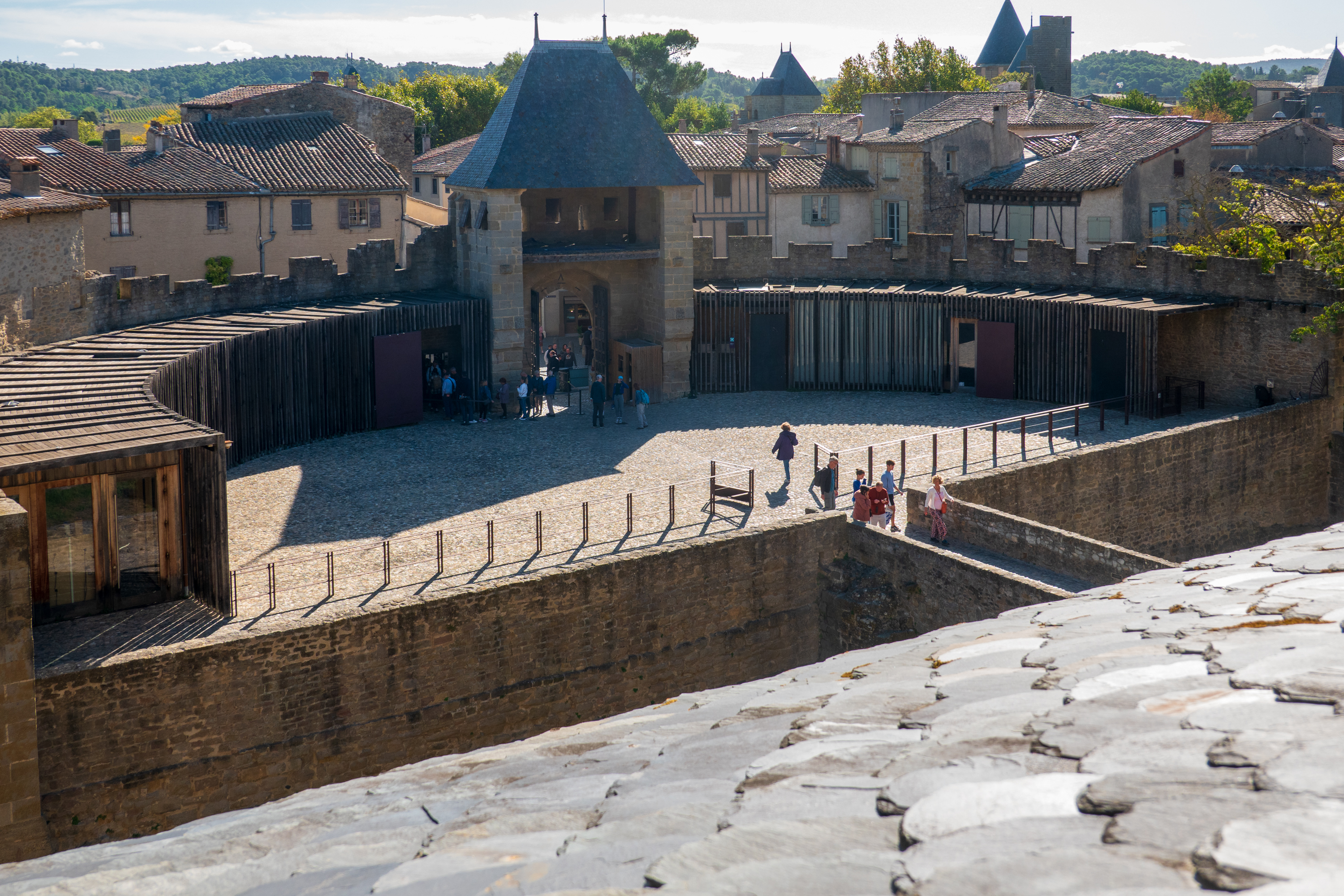

At various points in the ramparts were explanations of different history in small museums.
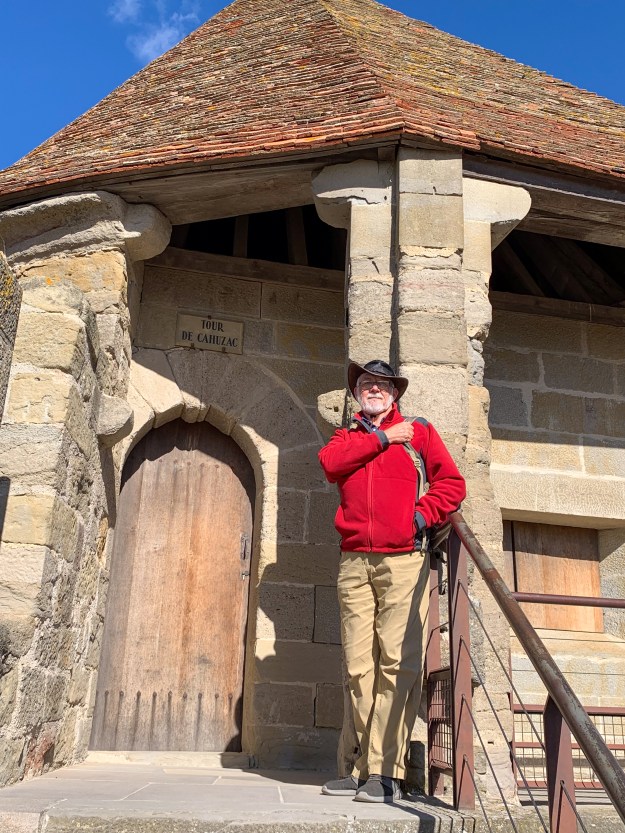


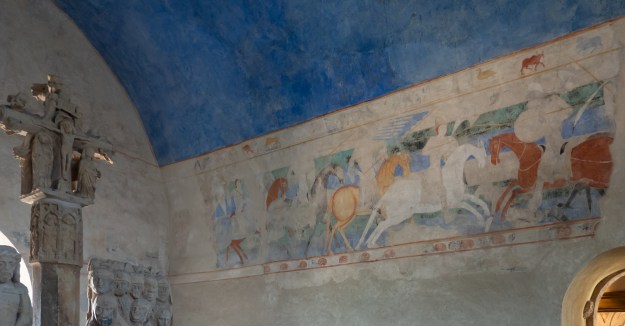
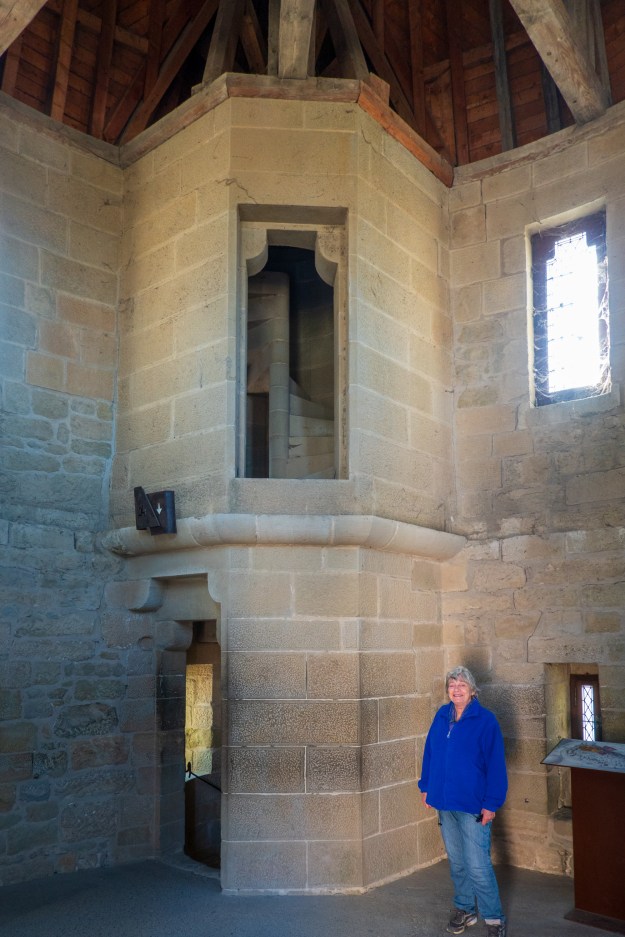
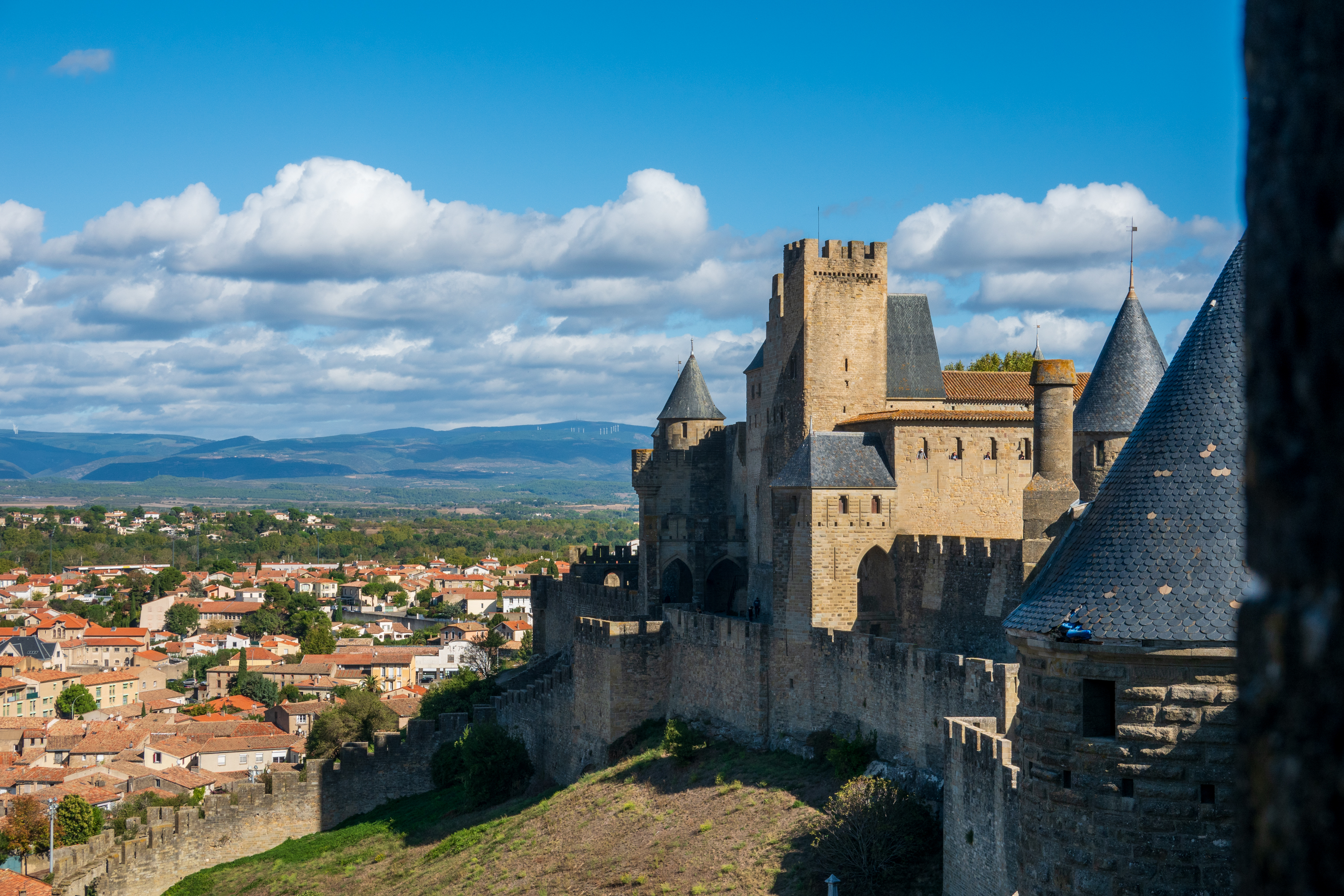
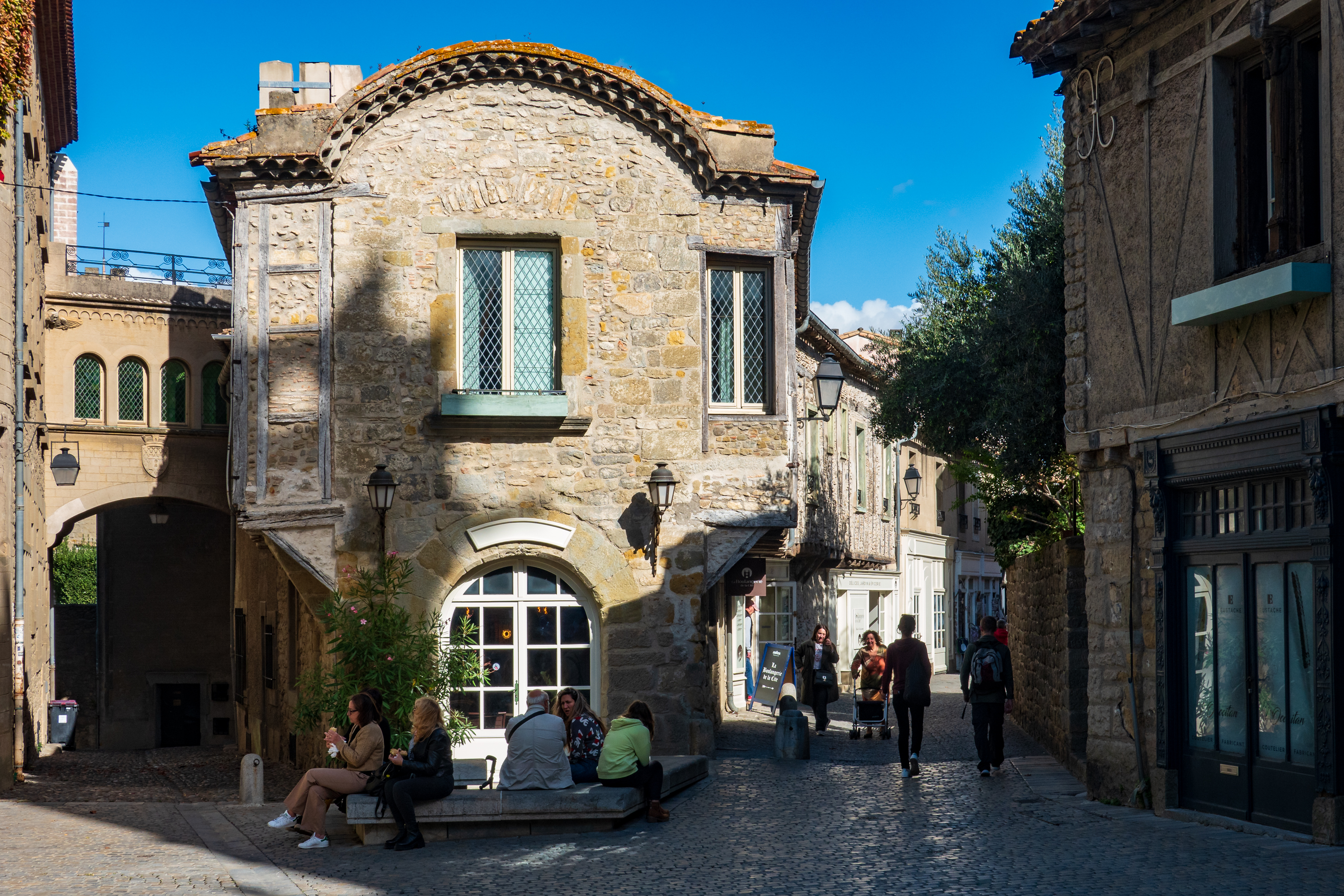
The walk around the ramparts took nearly 2 hours, by which time we were hungry. We headed back to our coffee site for a Cassoulet, which was excellent. We sat out in the rear on a lovely terrace. There was no cat, however! Fred was disappointed!
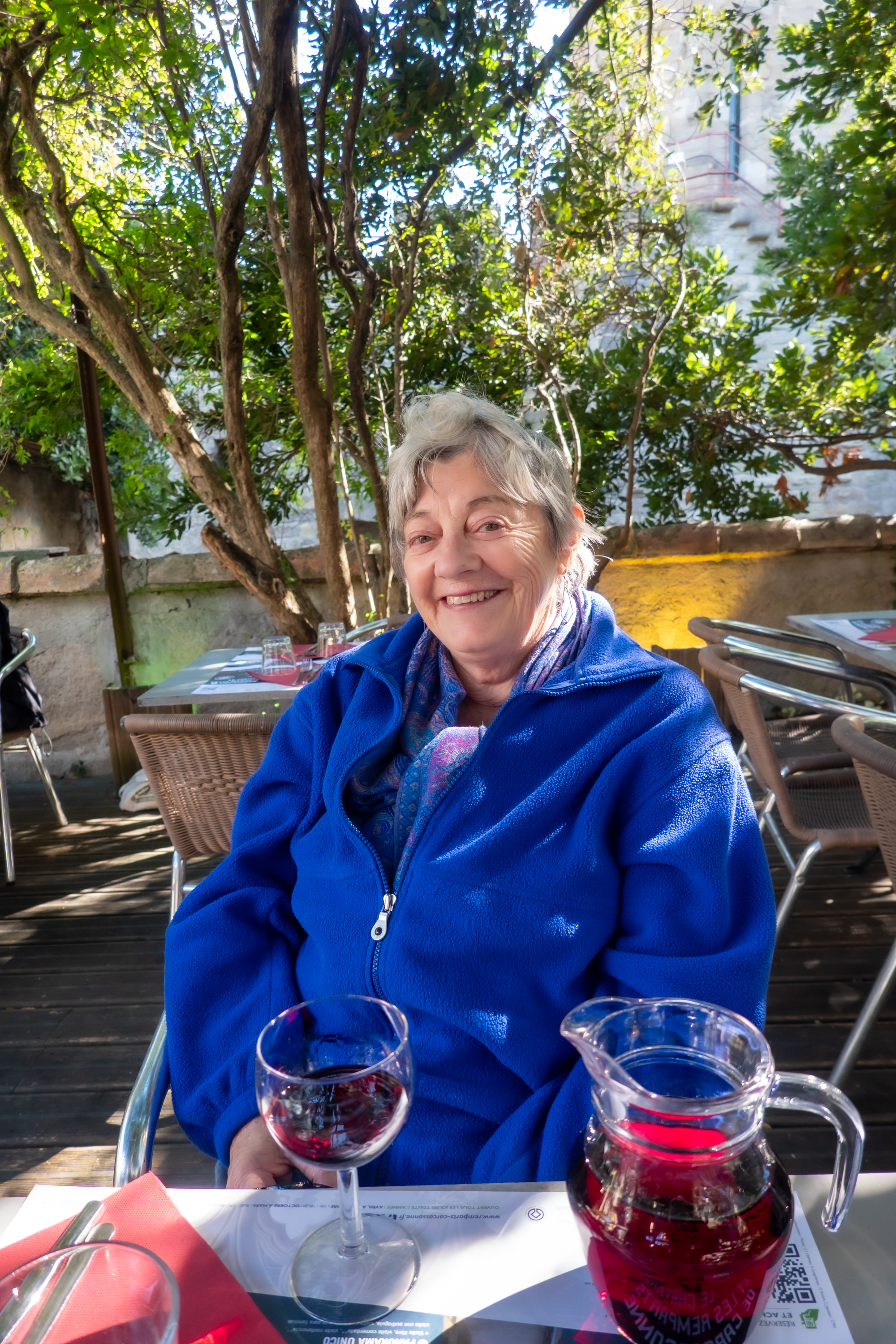
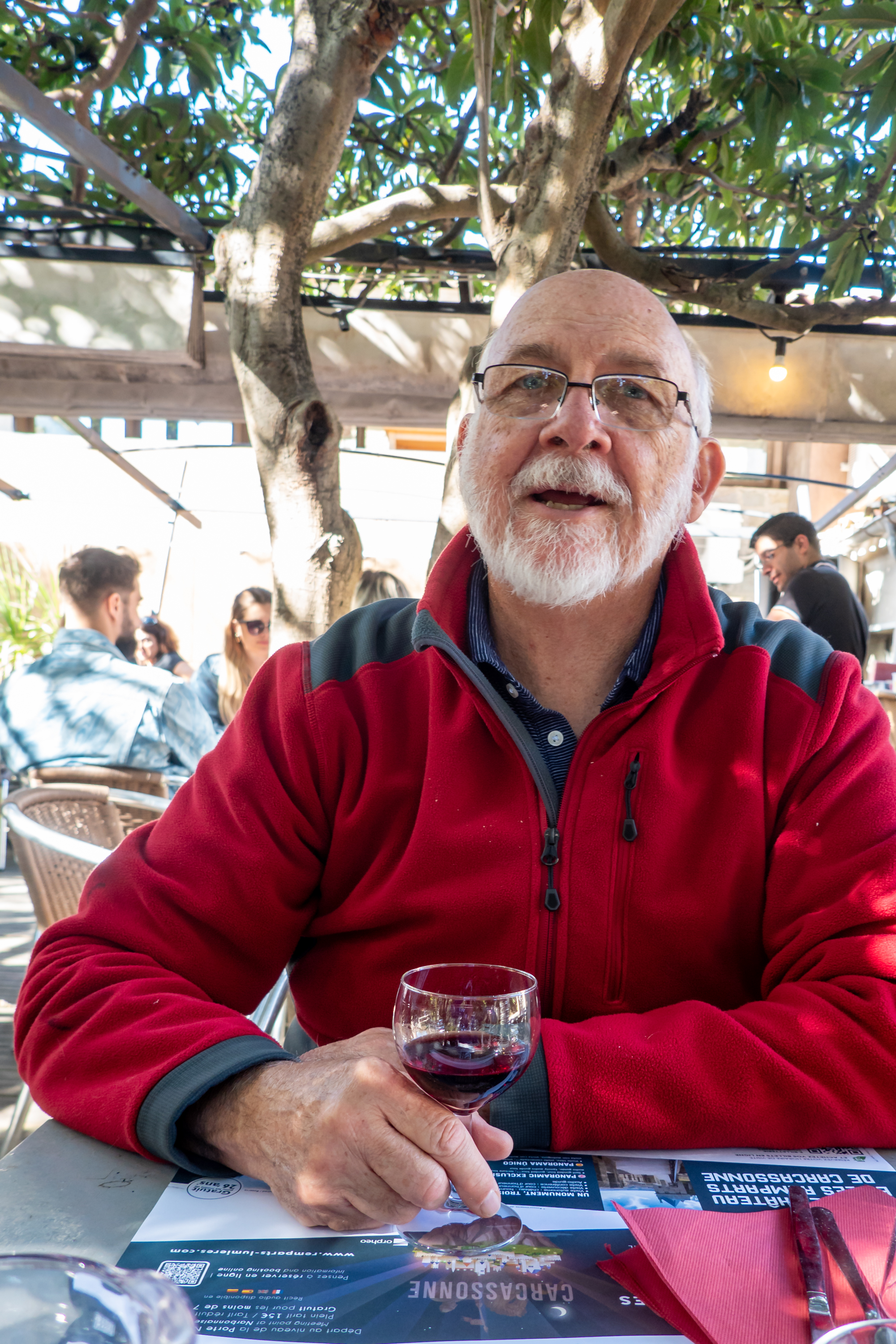
Finally, we took the Little Tourist Train, which ran past some of the ramparts and then into parts of the lower town. So we learned more facts about both. A great day.
The following day was much cooler but we did take our bikes into Bram. Bram lies on a plain, beside the Canal du Midi, with the Pyrenees to the south.

We admired the circular town center.

As it was Sunday, we were not able to visit the church but the curved streets were interesting. Lots of buildings looked abandoned.
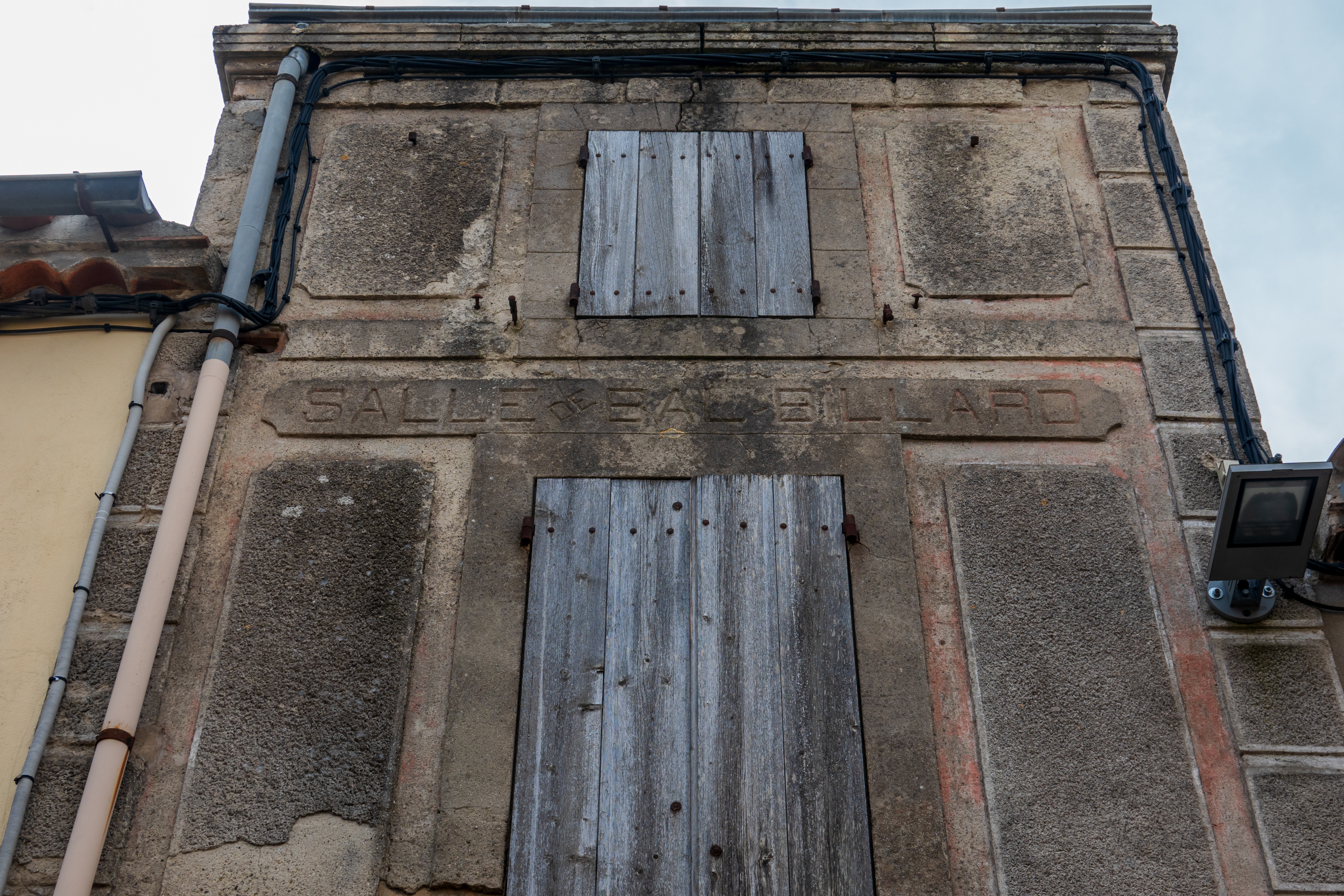
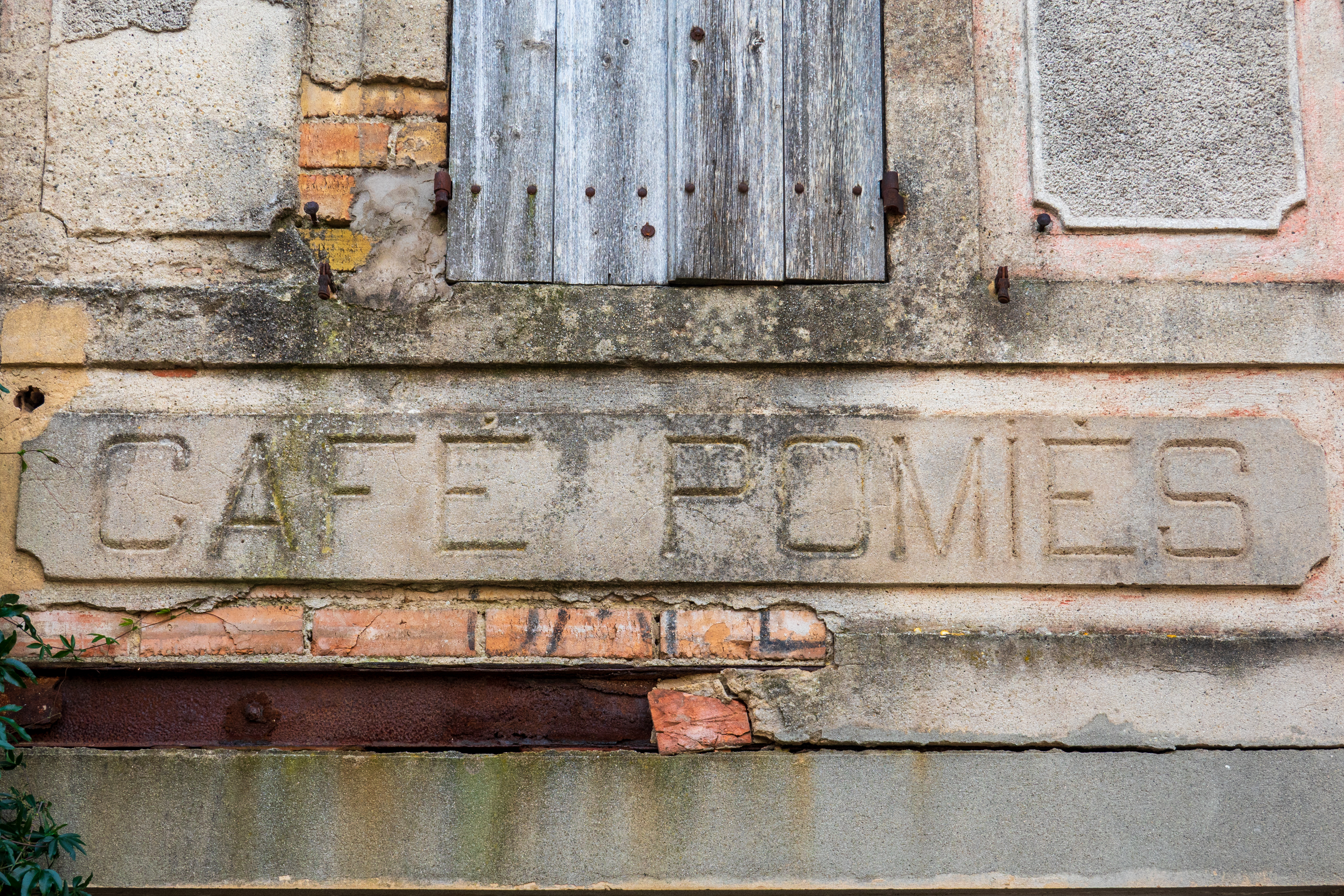
After a quick visit to view the Canal du Midi, we returned to the camper, ready for some warmth!
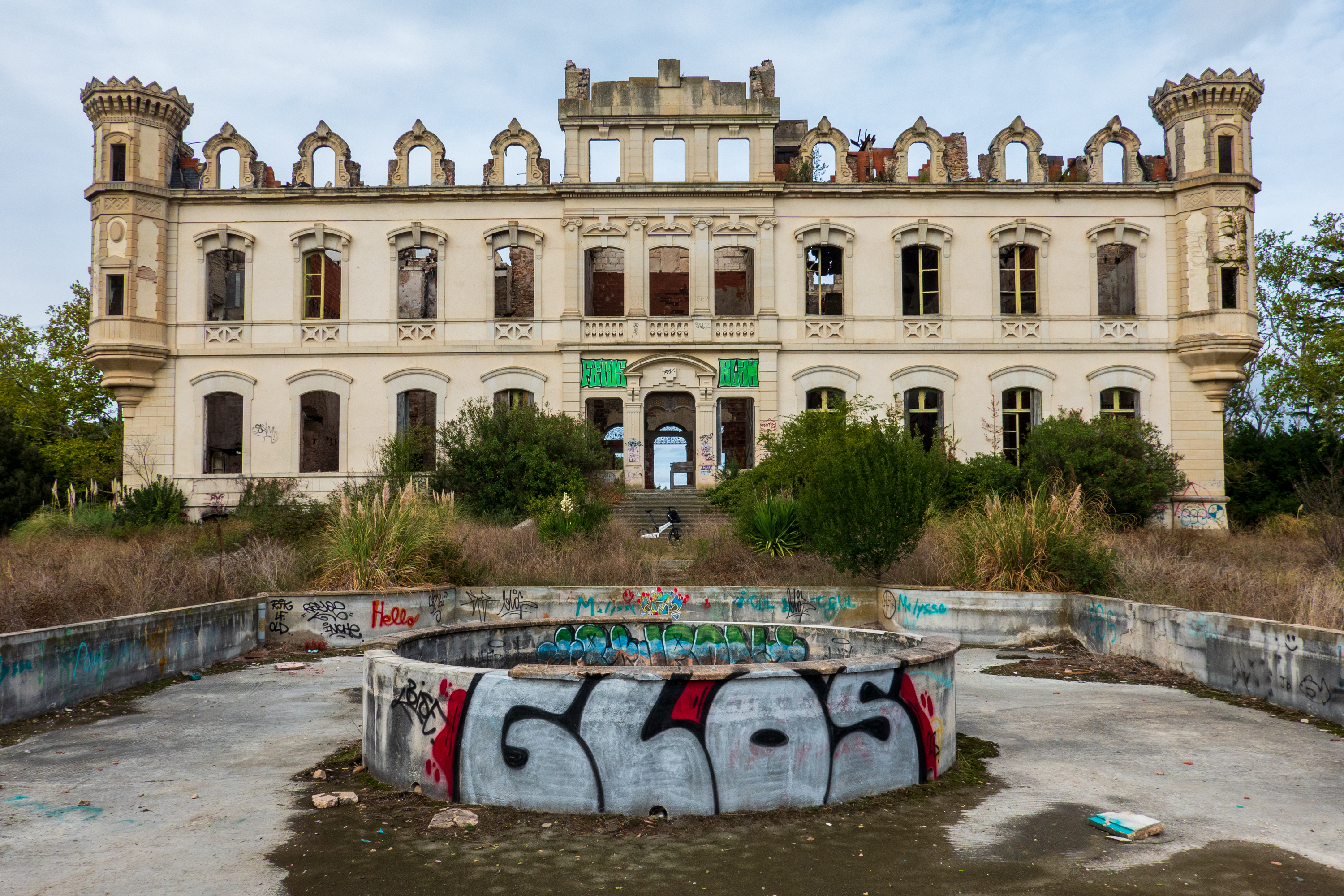
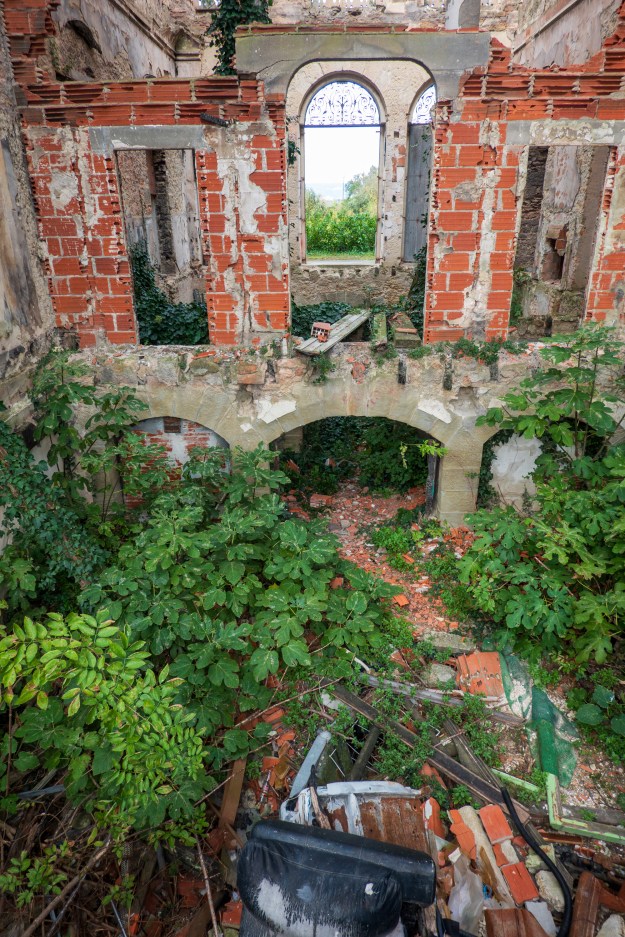
We found some interesting mentions of an abandoned chateau, the Chateau de Valgros, so Fred set out on his bike to find it.

And there it was, abandoned and the victim to two fires. A plan to make it into luxury apartments never panned out. Beautiful building, but a bit of a fixer-upper.


Next up, the search for wine and cheese.
 DiploStrat