
After leaving Ouarzarte, we headed down the Draa Valley through the desert plateaus of Jebel Tifernine, and through the hills of Ait Sauna. Then the road climbs through steep canyons towards the Tizi-n-Tinififft Pass. We stopped at the top of one of the long grades and had a most amazing shop with a roadside vendor. He had some really beautiful pieces, including a huge, decorated Tuareg cross. (Also called an “Agadez” cross, although each town traditionally has its own variation.)


There is always the question – is this authentic and what is it worth? Basically, it is worth what you will pay for it and what the seller will accept. And, unless you are going to try to sell it, what do you care? Authentic? Who knows, but it is hard to believe that anyone would go to the effort to fake this. Unlike the typical tourist junk found in the souk, this is a unique piece and very few non Tuareg would wear it. Denise loves it as it is another matching bookend to our trans-Sahara trip of 1974. The cross was on a typical, over the top, Tuareg necklace. Fred was impressed that it was strung with wire – should be strong. Nope. Broke. So now we have a winter project to restring a million beads! In the meantime, Denise has it on a simple collar.
This route we took is known as the Route of the Kasbahs and several large ones can be seen. They are however in various states of repair. We stopped at one but were told to leave as they were going to be using it for filming a British TV “Survivor” show. We were somewhat irritated as no filming was taking place and we were refused permission to even take pictures of the valley. Most unusual. The gentlemen working in the parking area were most apologetic. Fortunately, there is no shortage of kasbahs in Morocco.
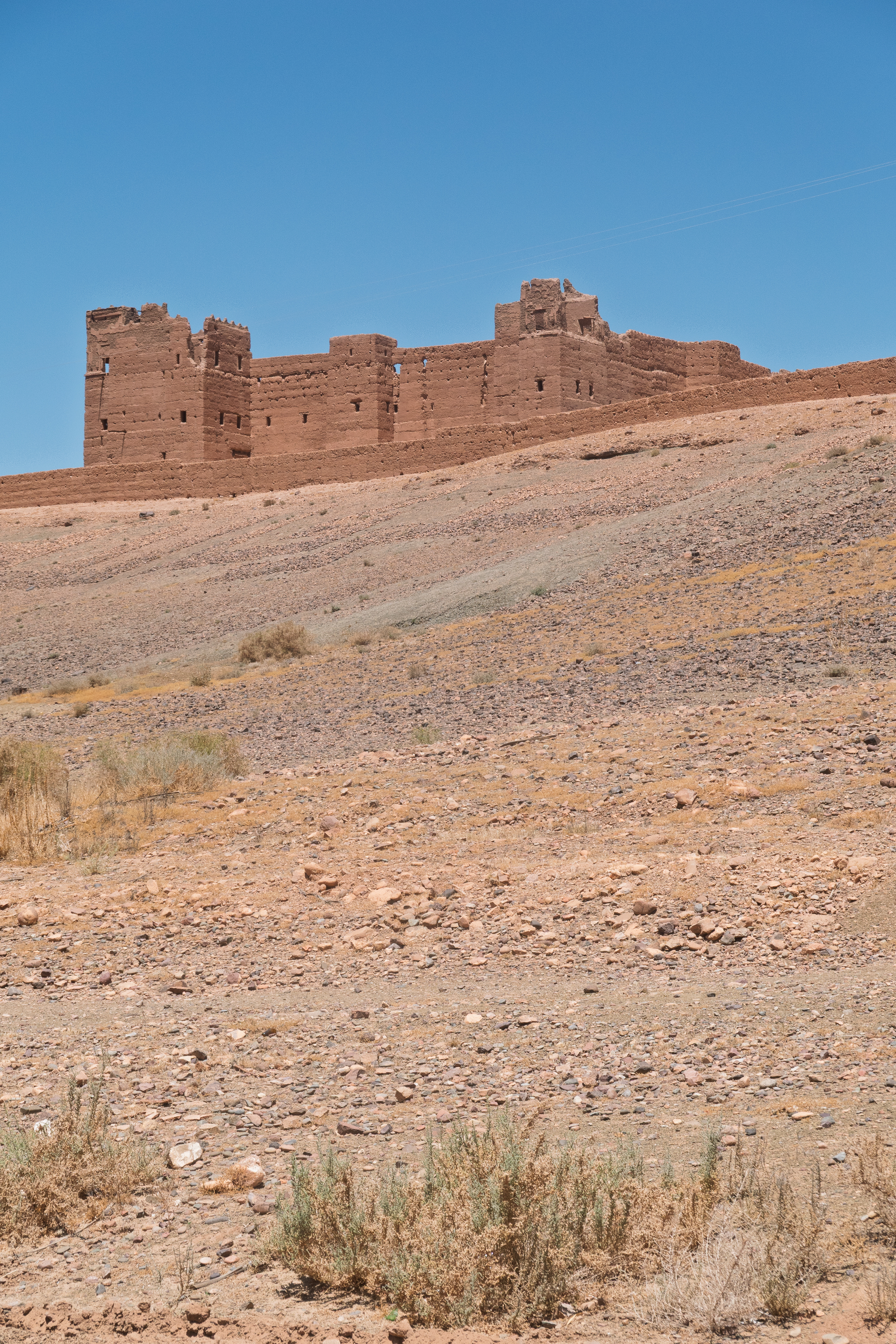


We spent the night at a campground in Zagora. We went into town to find an ATM. Our visit got off to a grim start as we watched a truck loaded with gas bottles run over a pedestrian. The ambulance was amazingly swift, but it looked to be too late. Sobered, we stopped at a supermarket before taking a taxi back to campground, loaded with groceries. We enjoyed an evening meal at the campground and chatted to the German tourists we had met along the way. Interesting the way we kept leap frogging some of the same people.


The next morning, we headed to Tamegroute, just in the south. On the way out of town, we had to stop and take the obligatory photo at the “Timbuktu, 52 Days by Camel” sign. Zagora was an important stop in the trade into Morocco from the Sahara and countries to the south of it. The trans Sahara trade dates back to ancient times and there were several eastern, central, and western routes. From below the Sahara came gold, ivory, slaves and other products. From north of the Sahara came salt, cloth, beads, metal and metal products, and more. By the colonial period, this trade had became a thing of legend – think “Beau Geste” and other tales of the Foreign Legion.
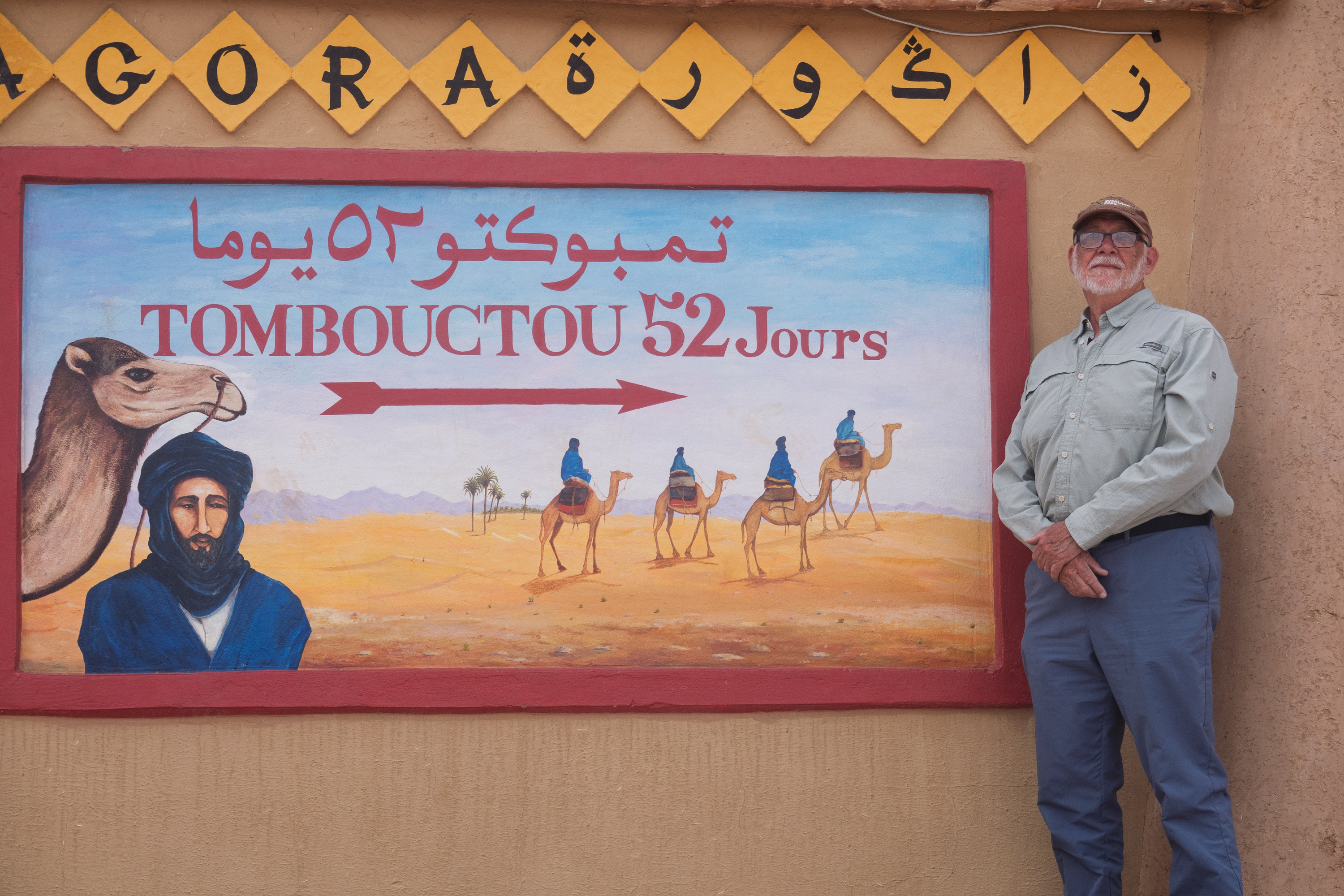
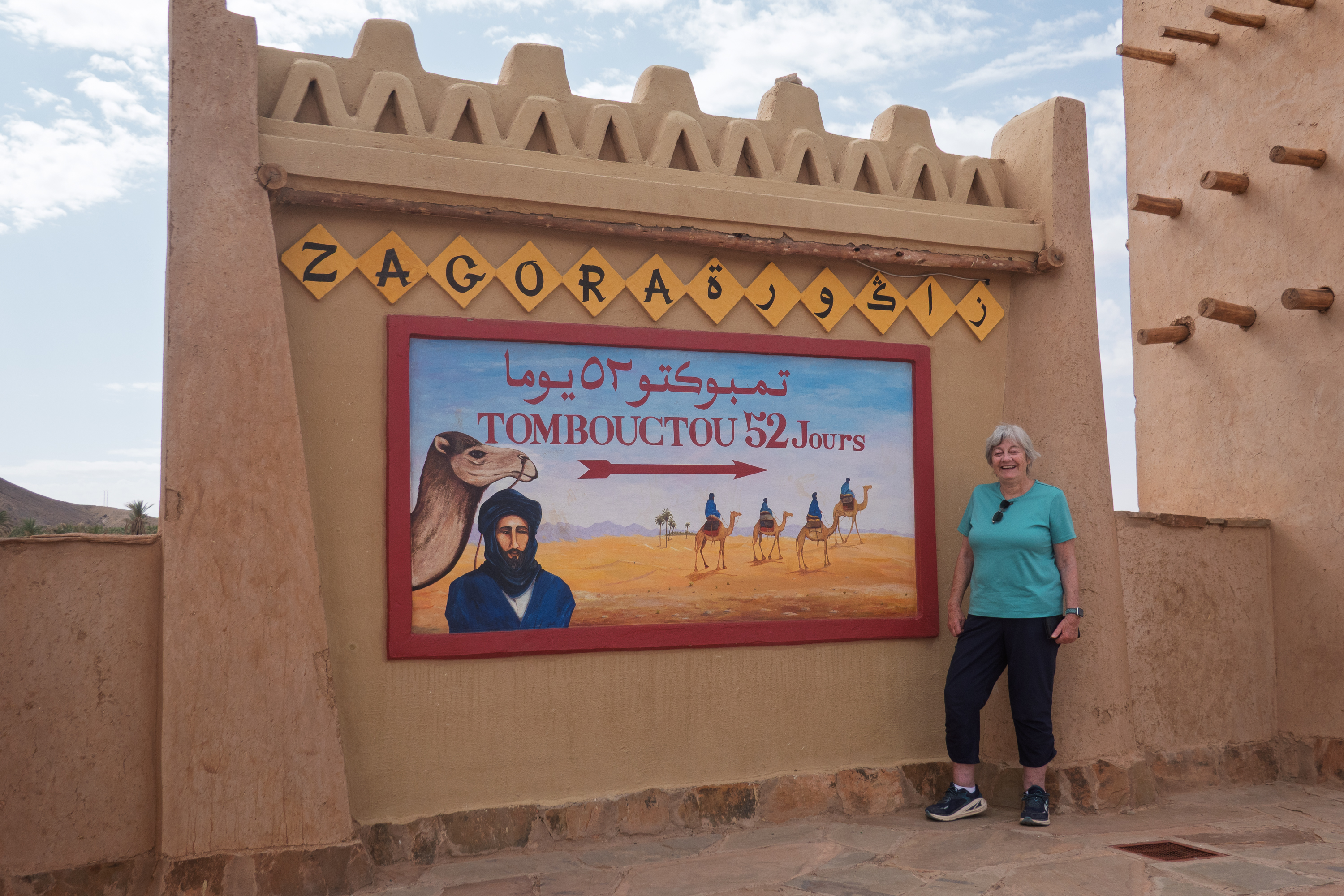
52 days by camel. Could we do it in the 917? Of course, except for a few details. You cannot cross the land border between Morocco and Algeria and northern Mali is home to a branch of Al Qaeda – the same folks who tried to burn all of the sacred books in Timbuktu. Sad; would be a cool trip.
Tamegroute developed into an absolutely fascinating visit. It contains the Zaouia Nassiriya, a center of Islamic learning, home to a Sufi order, tombs, and a Qu’ranic library dating from the 11th century. The library is believed to have once held as many as 50,000 books, but it is down to about 4,000, the rest having been spread all over Morocco. We started by taking a guide and going to see the library. The tour of the library was given by a scholar who explained the ages and types of Arabic script used. The library contains a Qu’uran from the 11th century with gazelle-skin covers. There is calligraphy with gold dust and saffron illuminations and treatises on algebra, astronomy and literature. All of the books are behind glass and, sadly, no photography is permitted. But all of them are amazing and some are simply beautiful. Readers may remember our visit to the “Book of Kells” at Trinity College in Dublin. Same idea, but sadly, on a much smaller scale.
The tomb of the center’s founder, Mohammed Bou Nassi, has become a pilgrimage site, especially for people with chronic illnesses who stay at the tomb, hoping for a cure.

We then moved on to the Ksar and we learned about the seven trades concentrated there, each with its own kasbah and mosque. He showed us where he lived, which looked like one main room with an outer small room where his wife was cooking fish over a small wood fire. He invited us to lunch but we declined. There was no way six little fish would feed five adults adequately. We felt that would be an imposition.


We were then shown the pottery section of the Ksar, in which seven families produce pottery with a traditional green glaze. We were shown all the stages of production, all manual, for the various platters, bowls, cups and plates produced there. It was emphasized that all pottery is for use in the house. Some pieces were decorated but all were usable as any decorations were made with herbal dyes and were quite safe for food.


And, as might be expected, we ended up at the back of the pottery cooperative store. But we were game and, after a cup of tea, we were on our way with (lots of) goodies. You can’t negotiate a decent price without tea.

Driving out of town, we shed a tear for the closing of USAID.

Looking for a place to break the trip we stumbled across a listing for a campsite, six kilometers off the road, literally nowhere. We had to try it.
Camping Serdrar turned out to be charming. (https://www.facebook.com/campingserdrar/) The owner, a recent graduate with a degree in marketing, explained that the site was on the family farm. With the drought, they could no longer make it as a farm, but as a camp/hotel/restaurant, catering largely to the motorcycle trade, they were doing well. We ordered dinner and it was very good.

We liked the place so much that we stayed an extra night so we could go visit the neolithic rock carvings at Ait Ouazik. The track was a bit of a grind, but the visit was really interesting. We saw cave paintings in our trans-Sahara trip of 1974 and it is always sobering to realize that the Sahara was once much wetter.
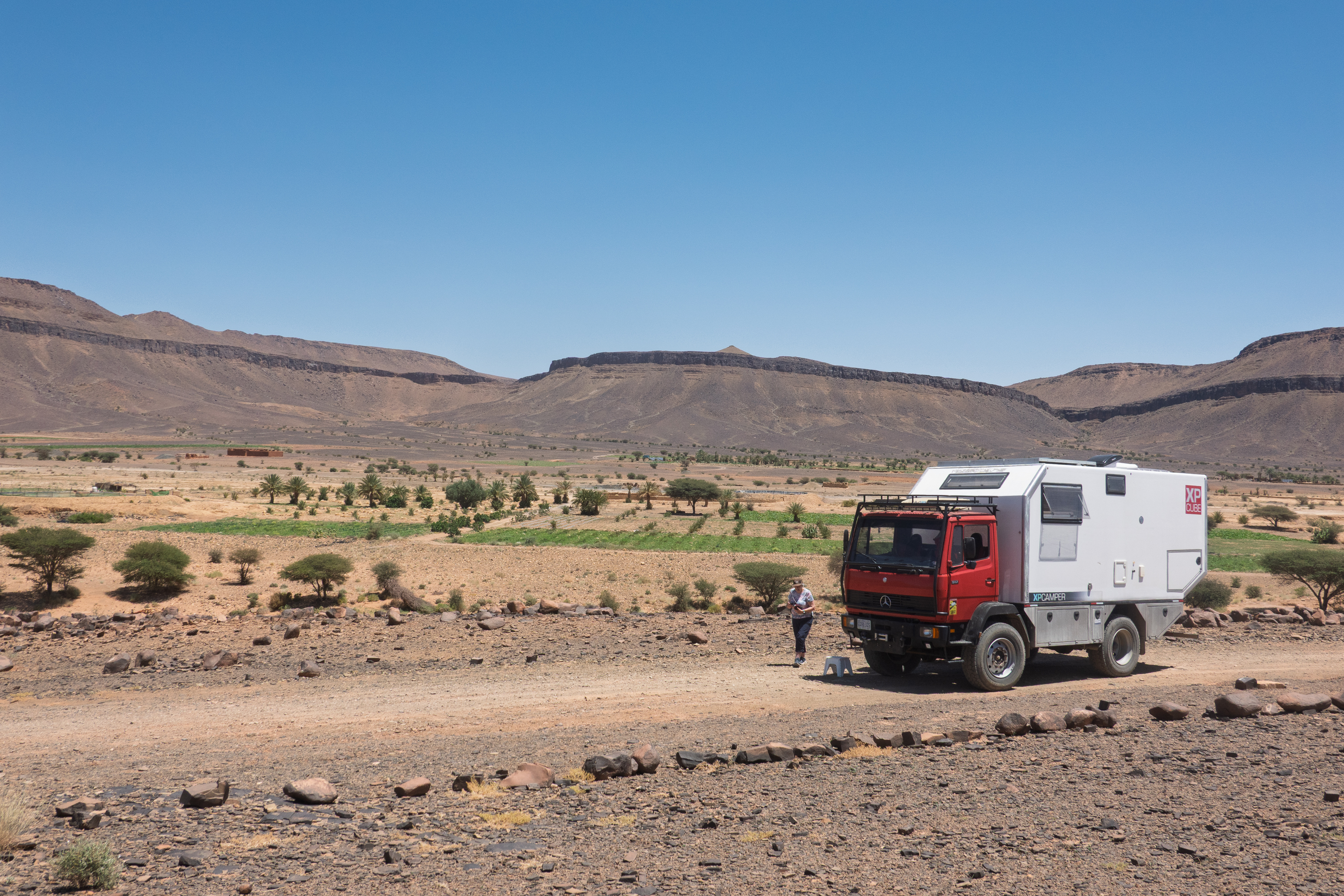


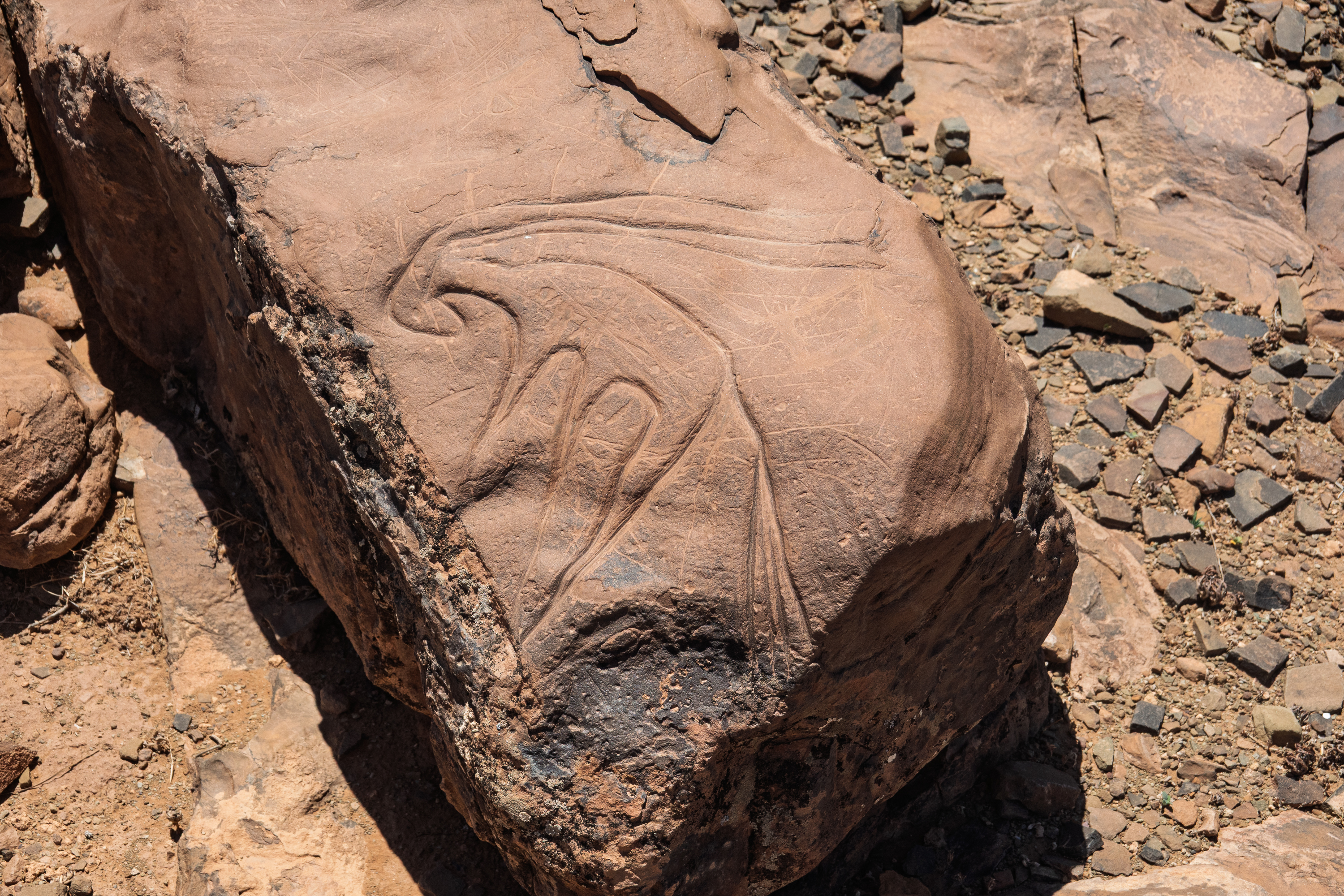


There is a guardian, living in a small building at the site. From the internet and from conversations with people who come to study the carvings, he is wonderfully well informed and really made our visit. Still, it must be a very lonely existence.
We then continued on towards Gara Medouar. Most Moroccan service stations are huge, beautiful places, usually with a restaurant or coffee shop, store, car wash and more. But sometimes the lunch options were more basic.

To be fair, Gara Medouar is a rather silly destination – a round mountain, in southern Morocco. And we were never really great fans of the “Mummy” franchise. But Fred was determined to see it and so we set it as our turn around point for Morocco. (https://sahara-overland.com/2022/12/05/g-is-for-gara-medouar-popular-film-location-in-southern-morocco/0)
There really isn’t much there – a nifty shaped mountain and two ancient walls.

All the rest, for example, the ramp, was added for movies and most of it has been removed. But you can really see why it has featured in so many films. (https://en.wikipedia.org/wiki/Gara_Medouar) Sadly, the site’s popularity for films and as a 4×4 destination has actually limited serious study.
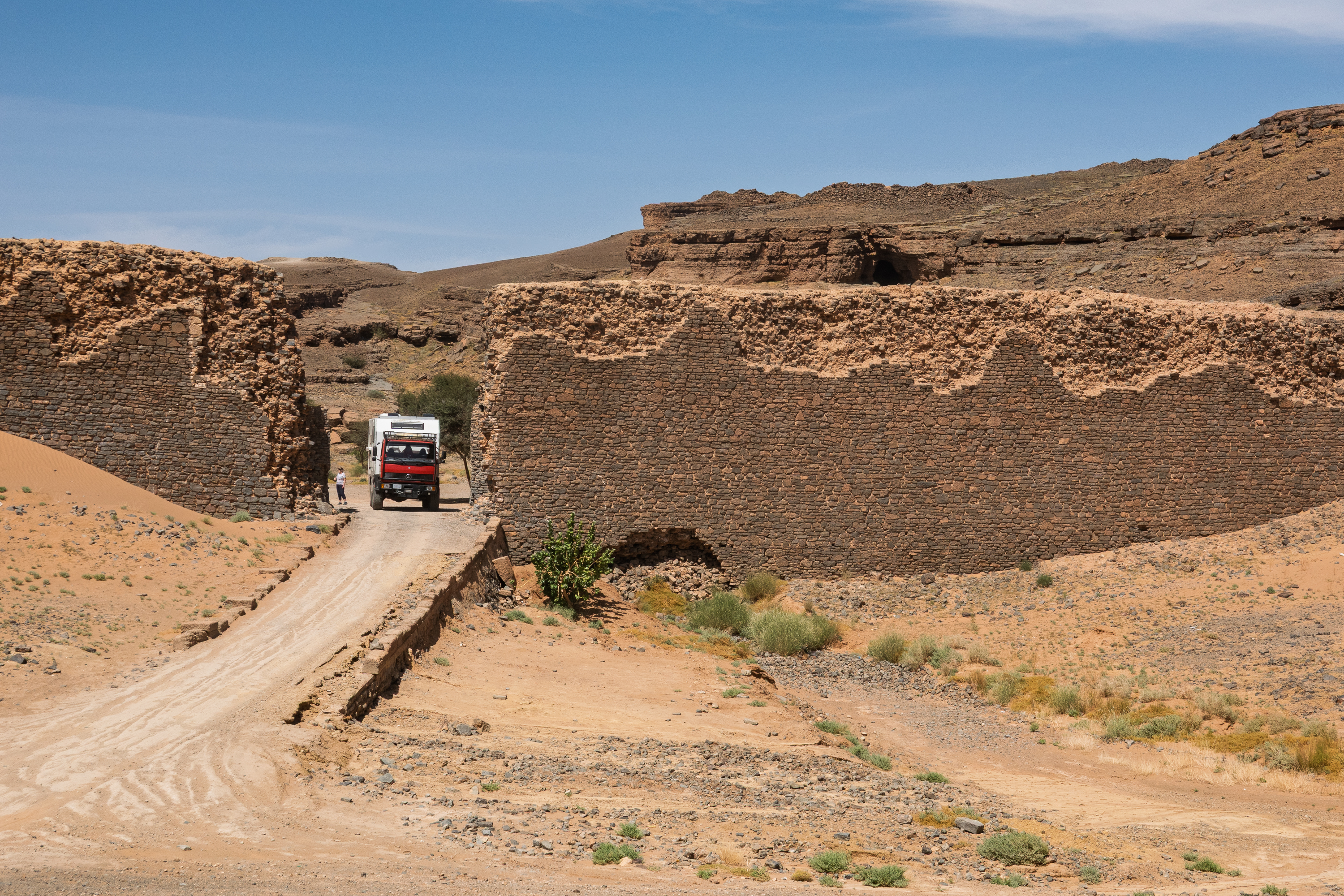
So we parked where the ruins of “Hamunaptra” once stood and explored a bit.
There is an easy walking/motorcycle track up to the top and stunning views in all directions.

And, despite the isolation, there was a souvenir vendor waiting for us at the top. We looked, but, unlike the gentleman on the road, he did not have anything of particular interest.

We did not do any real serious exploration of the top rim but admired the views. At the end of the day, the vendor got on his motorcycle and left the mountain to us.
It was dark, and we were careful not to open any ancient books.
The next morning, we continued on to Rissani
 DiploStrat