
“Eventful” is not a word that you ever want to use when describing part of an overland trip. Our drive from Sevilla to Cordoba was eventful. We stopped for fuel and discovered that we had a new air leak. We built up enough air to drive into the large lot behind the station and park. Fred went to the station to ask about the options for repair assistance. The short answer was “none” and less on the weekend. The answer was the same at the restaurant next door. Not good. An hour on the internet and phone get the same answers – it is the weekend, we don’t do trucks, call your insurance. Grr! This was not good. A friendly truck driver parked next to us confirmed that roadside repair was basically unavailable. He suggested that we needed an air line union, but he did not have one. Beginning to look like we might be stuck at Los Potros for a LONG time.
Just then a truck swung into the lot and blew his horn to greet two truckers who were parked on the other side of the lot. After he roared off, Fred wandered over to chat. He noticed that the two trucks had Moroccan plates. Maybe they, as foreigners, might have some good ideas. The drivers had swung down a camp kitchen at the back of one of the trailers and were fixing dinner. After exchanging greetings, Fred explained the problem. Might they have any ideas? Ideas? They had better than ideas. They dropped everything and raced over. We got out tools and tipped the cab. Fortunately, it was easy to find the leaking air line. The senior driver went back to his truck and returned with two air line unions of different sizes.

Once he decided that we need the 6mm size, he browbeat the junior driver into cutting the line, with a knife – not wire cutters! A final shot of WD-40 to clean everything up and the line was repaired and holding. Catastrophe averted, there was now only one problem – the Moroccans absolutely refused payment. Hmmmm. What to do?
So Fred asked, “Do you guys have wives? Kids?” Well, it turns out that they had both. “OK, so if you travel to a foreign country you have to bring back presents, no?” They agreed. So they could accept money to buy presents. Problem solved! (Fred also resolved to find a parts store to buy some air line and unions.)
In our search for cooler climes, we had found a campsite located in the hills above Cordoba. It rejoiced in the name of “El Lagar de los Perezones.” (The Vineyard of the Lazy Ones.) Sounded promising and had great reviews. (https://park4night.com/en/place/487523) Reaching Cordoba, we climbed about 10 kilometers up a very narrow winding hill to the site and opened the gate, which fortunately had a Park for Night sign on it, so we could recognize it. We drove through the 50 hectare site and eventually came to a patio with a stunning view of the city of Cordoba.

And there was even a beautiful pool! We picked our spot and settled in.
Five very enjoyable days followed. We relaxed, enjoyed the view, and swam in the pool. Fred borrowed a ladder and used our grey water to wash the solar panels. Our hostess offered us a meal typical of Andalucia one evening, which was wonderful. And vegetarian.

She also called a taxi for us, and we headed into Cordoba for the day. We were not up to playing with a twice a day bus.
Cordoba dates back to well before the Romans, but it reached its zenith under the Umayyads who made it a center of learning.(https://en.wikipedia.org/wiki/Córdoba,_Spain) To quote Rick Steves: “At its zenith, in the 10th century, it was the leading city of Western Islam and a cultural hub that rivaled Baghdad and Constantinople. In an era when much of Europe was barbaric and illiterate, Córdoba was a haven of enlightened thought — famous for a remarkable spirit of religious tolerance, artistic expression, and dedication to philosophy and the sciences. Jews, Christians, and Muslims had figured out how to live together more or less harmoniously. Everyone spoke the same language, cooked the same dishes, wore the same type of clothes, and shared the same public baths. It was one culture, with three religious traditions.” We loved Cordoba. It was probably our favorite visit in Spain.

Like most tourists, our first stop was the cathedral, universally referred to as the Mezquita, Spanish for mosque. (Possibly built on the site of an earlier Christian church, possibly built on the site of a Roman temple. You get the idea.) We were prepared to be impressed, but the reality is simply overwhelming.

The mosque is large, built to enable 20,000 to pray at the same time. But, in an incredible act of good artistic taste, rather than raze the building, the Christians simply built a cathedral inside the mosque. Amazingly, this actually works.


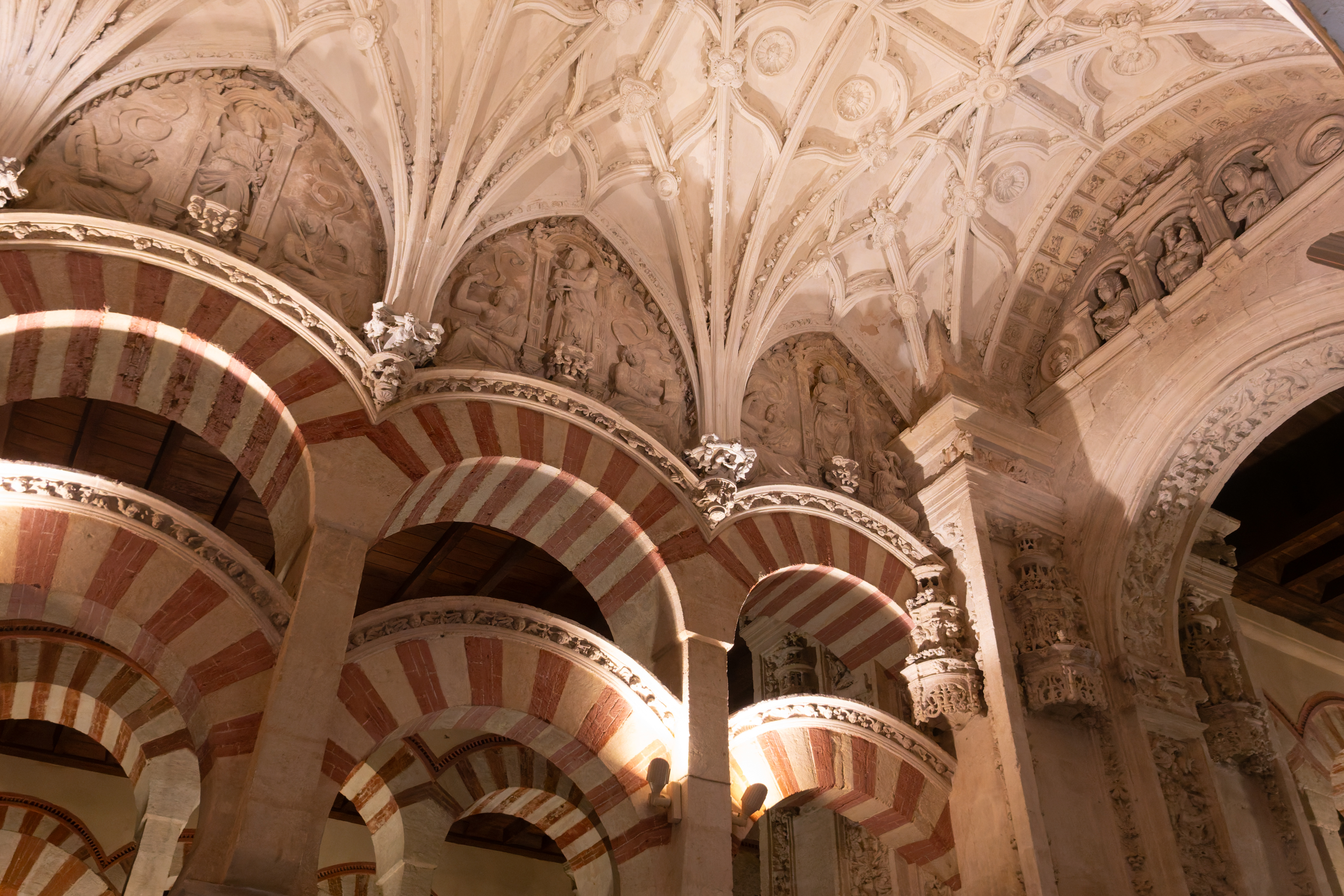

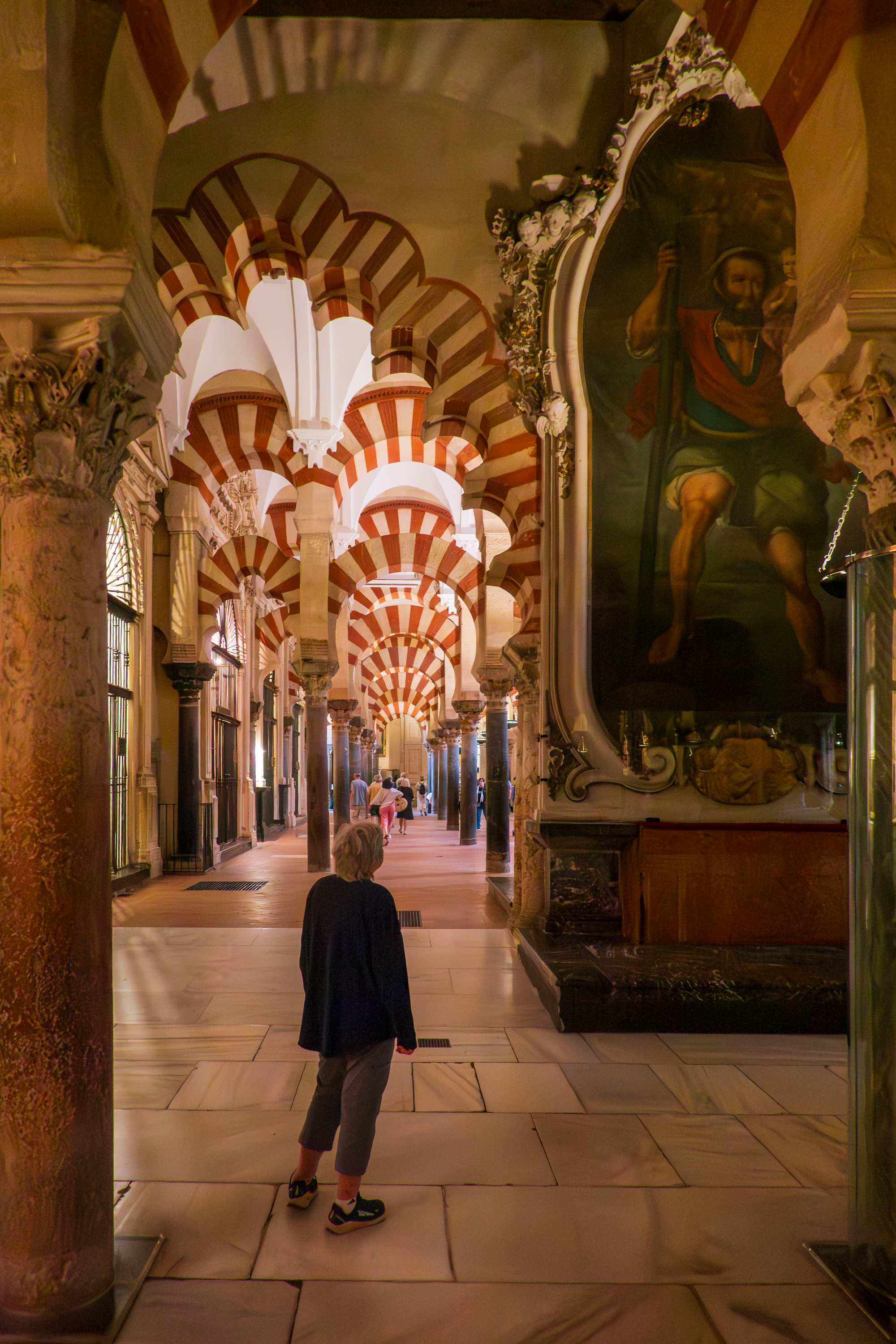

Normally oriented towards Mecca, in this mosque, This one is pointed further south. Much discussion of why.


The integration was tastefully done and we thoroughly enjoyed our visit. The spaces, the arches, and the light were moving in a way that is hard to describe.

We took a ton of pictures, but they cannot begin to convey the majesty and beauty of this building. Not your classic gothic cathedral! Not at all. Put it on your short list. (https://en.wikipedia.org/wiki/Mosque–Cathedral_of_Córdoba)
After the cathedral/mosque, we headed to the Jewish Quarter to explore, shop (less tourist junk), and visit the Casa de Sefarad. (https://sefarad-vr.com/en/sepharads-house/) The history of Jews in Spain is long and complex and well worth a least a quick study: https://en.wikipedia.org/wiki/History_of_the_Jews_in_Spain Spoiler alert: It does not reflect well on Christians. (But, to be fair, the rest of Europe was not doing any better.)


We enjoyed the visit, especially the three songs performed by one of the staff. We have a neighbor who plays lute in a Sephardic music group and it was fun to hear the music in situ. He sang in Hebrew, Ladino, and one other language.
Across the street is one of the few remaining synagogues in Spain. This tiny example was repurposed into a hospital, which is why it probably was still standing. It is the only synagogue in Cordoba which was not destroyed during the many persecutions of Jews in Spain. (https://en.wikipedia.org/wiki/Córdoba_Synagogue)
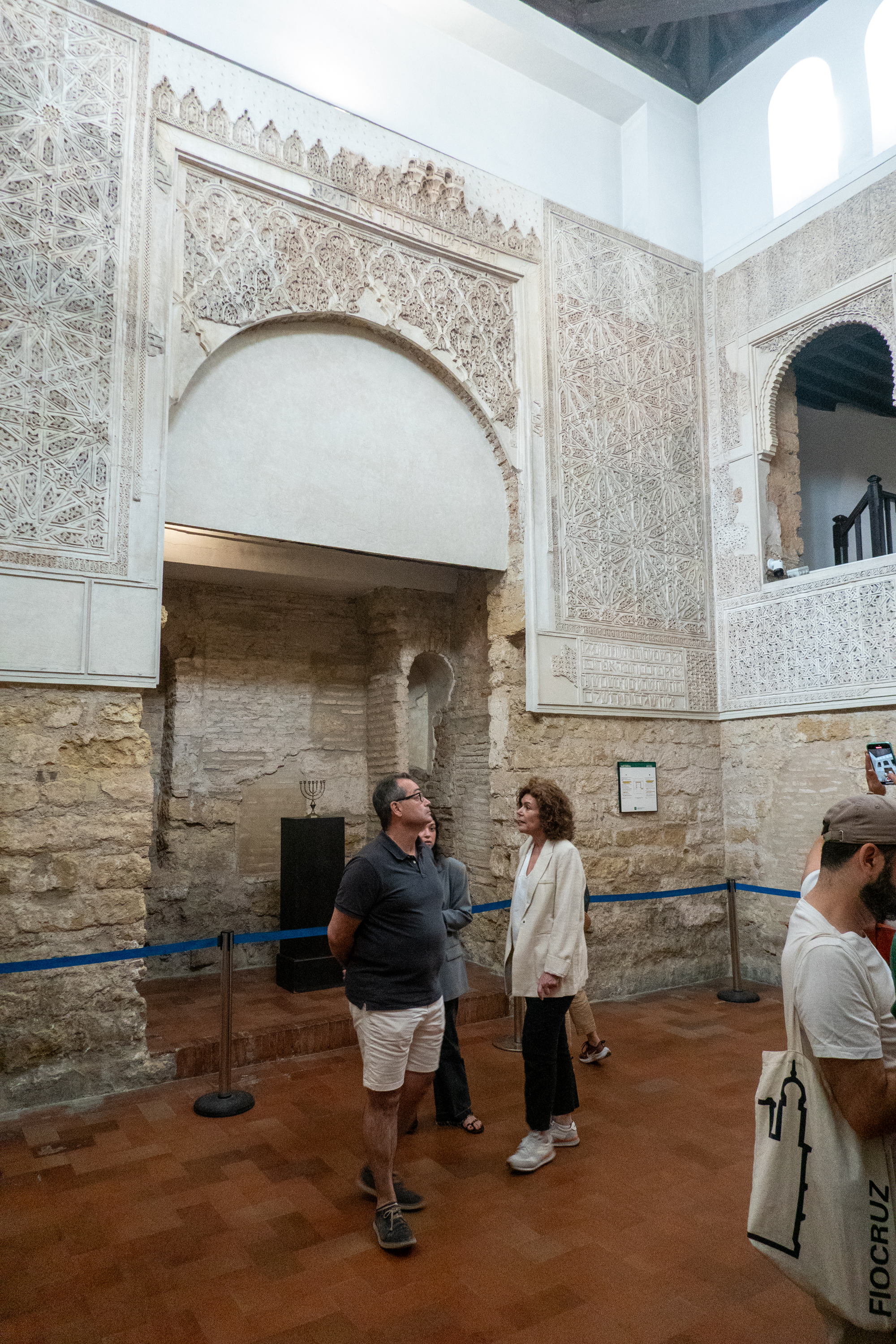
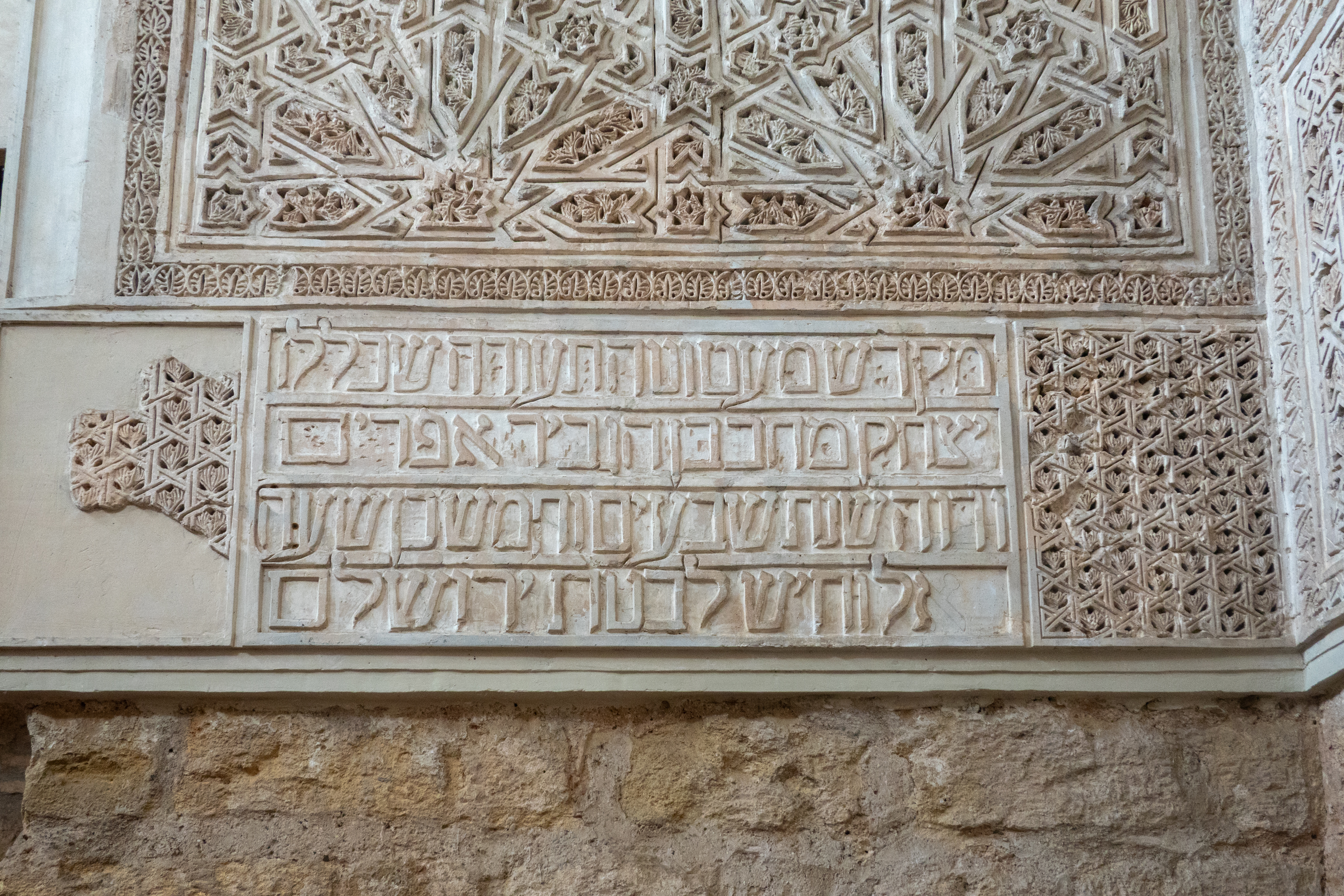
This is the dedication to the builder and a prayer for a return to Jerusalem.


After a pleasant lunch in a garden patio, and an ice cream (there is a pattern here!), we reconnected with our taxi driver and returned to our campsite.
Cordoba was, for centuries, the center of Muslim rule in Iberia. The Christian reconquest, “La Reconquista” was a long, long struggle, but worth understanding if you want to understand Spanish history. Here is an easy to follow history: https://www.youtube.com/watch?v=cMp3UCK2uwk
Let us close our visit with a nighttime view.

 DiploStrat