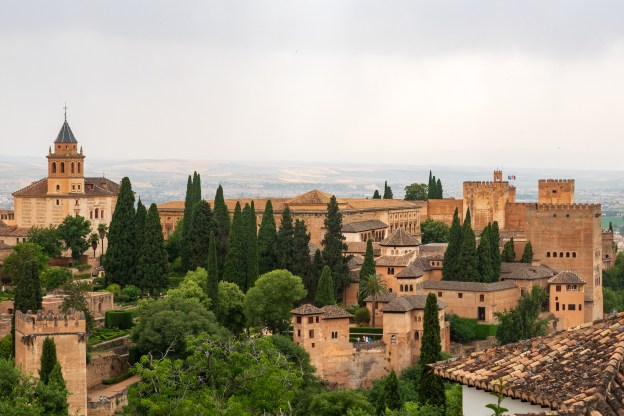
After we left the Cordoba campground, we began to think about whether we would be able to visit Granada and the Alhambra or whether we were looking at high temperatures like Seville. We went first to Ubeda, which had the advantage of a free city campground and a certain amount of altitude. Ubeda is a UNESCO town with an interesting archeological museum and a large Carrefour supermarket. What more could you ask?
The next morning we unloaded the bicycles and set off for the Carrefour to go shopping during the cooler part of the day.


Shopping accomplished, we went looking for the museum. The route to the museum was through the old town and the streets were some of the narrowest we have ever seen. Barely wide enough to bike through! But we found the museum, in an old Moorish style house. (https://www.museosdeandalucia.es/web/museoarqueologicodeubeda)

One of the best parts of the visit was seeing (feeling?) the classic Roman/Moorish model of housing in action, four two storey sides around a large enclosed patio with plants. And the patio drew in an amazing, cool breeze.

The museum is small and low key, but one exhibit simply jumps out and grabs you with a direct link to the people of an ancient time.

This is a funerary stele or commemorative stone. There are lots of these around, usually of reasonably famous people or, as in Roman forts, those of soldiers. But this one is for a 25 year old slave woman. Who died in child birth. And it carries a poem, which, between abbreviations and gaps in the stone, says:
“Gemina, slave of Decio Publicio Subicio, aged 25, lies here, having died in childbirth. Gaius Aerarius had the marker put in place.
You would be my Fates if you carried me from where I am with the strength of a winter amethyst. If you loved me, take me from here to Tag …
May the earth be light upon you.”
Who puts up a stele for a slave and announces such love? Seems that while rare, it was certainly not unknown. And who was the father? Decio, the owner, or Gaius, who put up the marker? Probably the later. No idea where “Tag …” might be. Her homeland? a paradise? We will never know. But we do know that someone loved her very much and wished her easy repose. Here is an interesting link to a similar stele in Germany. Note that the “earth be light on you” phrase is common to Spain and to to other places. (https://dottietales.wordpress.com/2024/07/20/a-memorial-to-a-roman-slave/)
Finishing our visit, we then headed for a nice sidewalk cafe and enjoyed coffee and ice cream.

The next day we headed a bit further south to a fascinating place, Cuevas Andalucia. (https://www.cuevasandalucia.es/es/vacation-home-rentals-unusual-ecolodges-responsible-andalusia-cave-house) Built around a series of artificial cave houses, this holiday rental has expanded into a campsite. It is run by a charming Belgian couple.


It wasn’t cool, but it did have a small pool and laundry. (No need for a dryer!) We might have booked a room to escape the heat, but they were full. We did have one rainstorm which really helped!
On our last night we joined everyone in a meal, typical of Andalucia, “Migas” or “crumbs”, prepared by a professional chef. (https://en.wikipedia.org/wiki/Migas#:~:text=Migas%20(Spanish%20pronunciation:%20%5Bˈmi%C9%A3as,Mexican%20and%20Tex%2DMex%20cuisines.) A fun evening in a bewildering collection of languages! The day we were leaving our host suggested we call a friend of his who was an air-conditioning specialist in Playa Mojacar. Perhaps he could do something with our broken air conditioner. The temperature had dropped just enough that we felt we could manage one night in Granada so we could keep our reservation to see the Alhambra Palace. We set up a visit to Mojacar to visit the air conditioning specialist in a couple of days and headed to Granada.
The campsite in Granada proved to be pleasant and even had a little shade. It was carved out of the parking lot of a restaurant and they were working to upgrade all of the facilities. The restaurant looked quite good, but it was closed. We settled in and then took a taxi into town.
We had some time before our 7 PM appointment so we took a ride on the Little Train. This gave us some feel for the town and an easy way to get up the considerable hill to the entrance. Granada is a big, modern town, but the Casco Viejo, the old town, featured classic architecture with narrow lanes and steep hills.

We stopped for some liquid refreshment (squeezed fresh orange juice, “zumo” and a bottle of sparkling water) and then entered the Alhambra complex. The Alhambra was built very late in the Moorish era and was taken over and used by Fredinand and Isabella, the (im)famous “Catholic kings.” (https://en.wikipedia.org/wiki/Alhambra) It was here that Cristobal Colon received his commission to look for a new route to the Indies.
The Alhambra is huge and there are many different sites to visit. Trying to outmaneuver the crowds, we started in the gardens which were very beautiful.
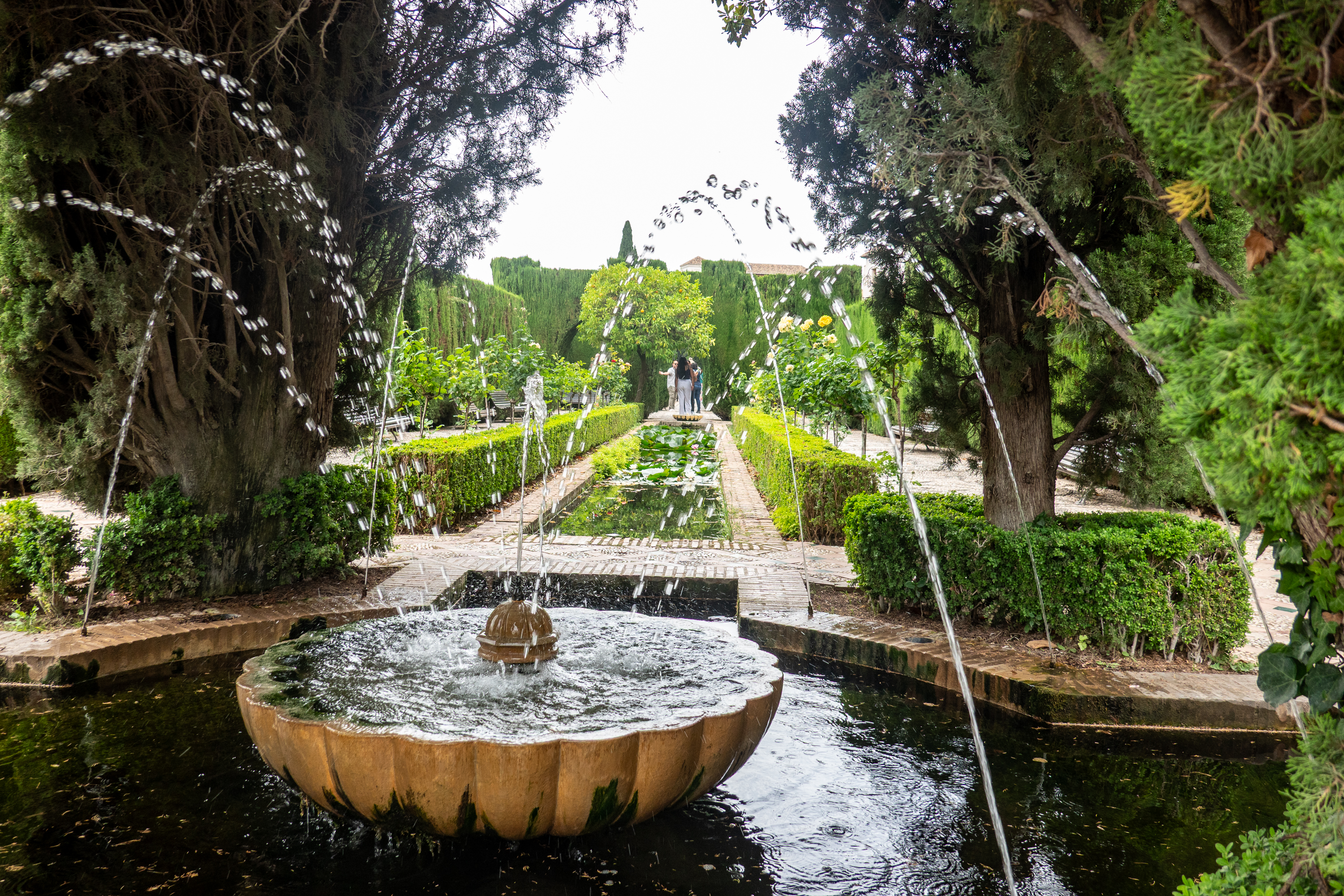
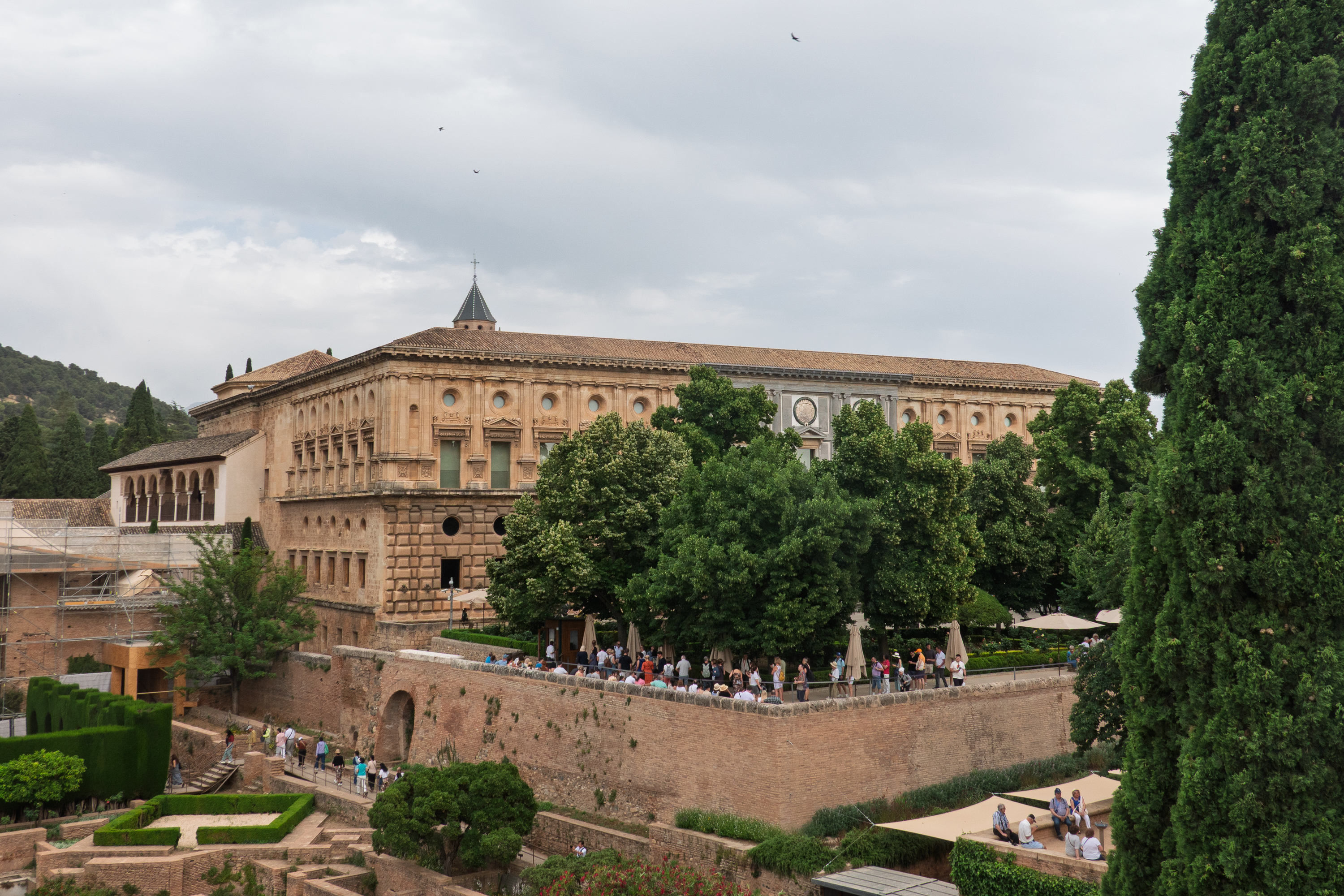
We then worked our way down past the church and the fortress to the main square and we were in the line for the 7 PM entry to the Nasrid Palaces at the right time.




These ceiling paintings are rather odd. They date from the Muslim era, but were clearly done by Christian artists as most Muslims will not make a representation of any living thing. Also note the most of the clothing is more Christian than Muslim. They were done on sheepskin and attached to the wooden ceiling.


We have never been great fans of the “Reyes Catholicos” as, among other things, they launched the Inquisition against the Muslims and Jews in Spain. But in one area, they were way ahead of their time.
Although scholars debate the exact details (https://en.wikipedia.org/wiki/Tanto_monta,_monta_tanto,_Isabel_como_Fernando) it appears that Ferdinand and Isabella held that what either said, held for the other. A huge step for women’s equality in an area where queens were often married for political purposes and then relegated to the nursery.


Because of our Morocco experiences and visits in Seville, we wondered if the Alhambra would live up to its hype. In the end, we were pleased – the Alhambra really was quite spectacular. We recognized the Moorish origins but the admixture of Christian elements, creating what is called “mudejar” made it different. A great experience.
We were tired by the end of the visit and went to eat in the “tourist” restaurant across the road. (Recommended by Rick Steves. https://www.jardinesalberto.es/en/home/) They were busy, but found us a lovely table. Our waiter was a charming gentleman from the Dominican Republic, so much Caribbean banter ensued. We selected Nasrid dishes and they were very good.
We were then fortunate enough to find a taxi right outside to take us back to the campground.
 DiploStrat