After finding our bearings on day one, we had a better idea of what we wanted to see on day two. We started by taking the Hop On Hop Off bus on its second route.
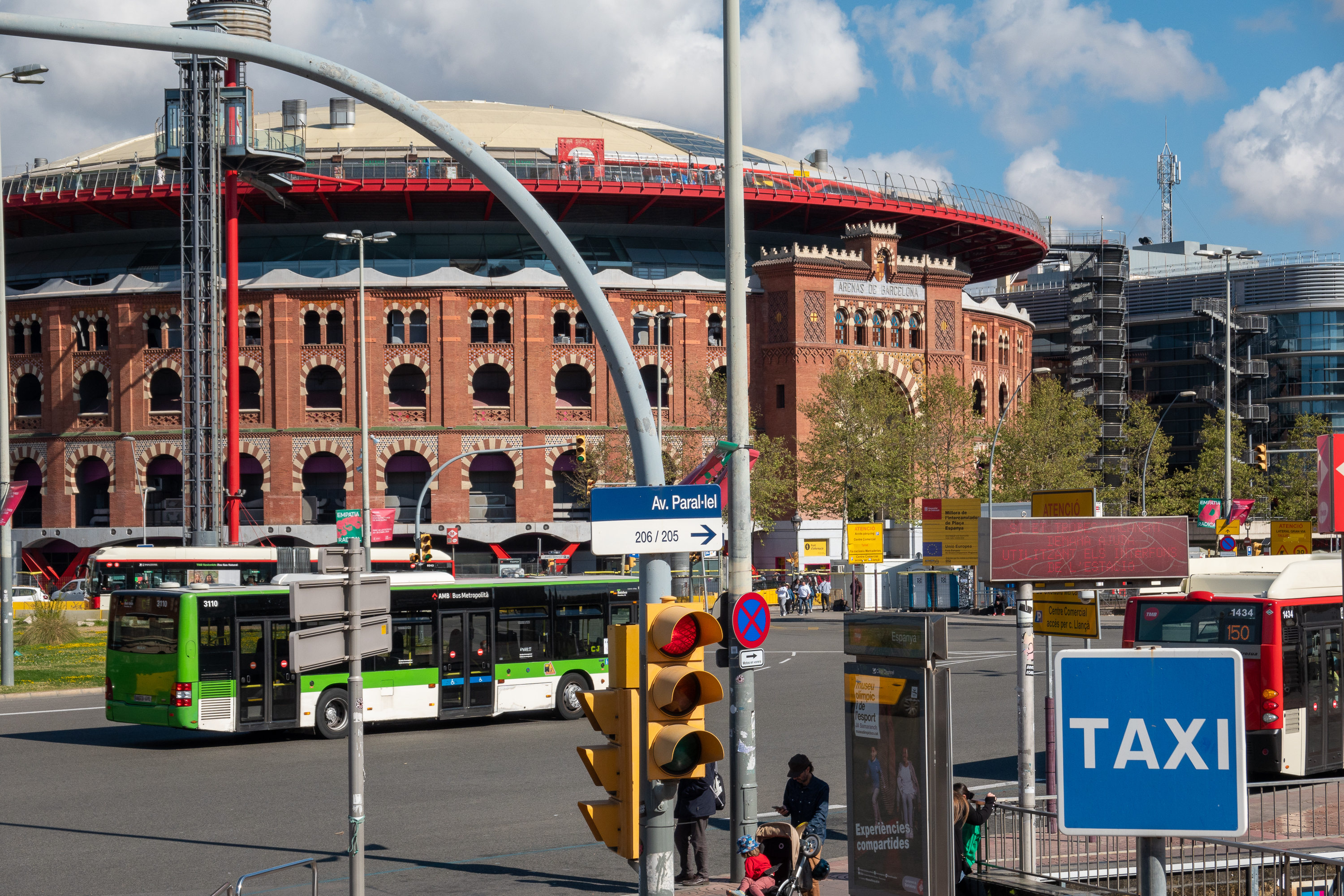
The arches on the bull ring harken back to the Romans and the Moors.
American Cultural Imperialism!
Everyone recommended the Barcelona Maritime Museum (https://www.mmb.cat/en/) So we “hopped” off the bus at the front door. It is an amazing place with a full size reproduction of the galley “Real”, the flagship of the Holy League Fleet at the Battle of Lepanto. (1571)
This beast is massive and, for fans of classical galleys, note that the ram is now well above the water line. This allows the ship to be faster than a Greco/Roman galley. These ships were fitted with cannon in the bow.
The world is divided into two types of people, normal people who have never heard of the Battle of Lepanto and geeks like Fred who love this stuff. (https://en.wikipedia.org/wiki/Battle_of_Lepanto) He remembers a young adult book about the battle which turned on the adventures of a young fisherman who was there, met Miguel de Cervantes, the Spanish author, and had other adventures. Cervantes was badly injured during the battle.
Fred needless to say, knew all about this and was absolutely fascinated by both the small scale model and the full size reconstruction, which had been built for the 300 year anniversary. (Build a few more and we could make a great movie!)
Large scale model
Displays about the life led by the enslaved rowers were interesting, if depressing. While there were some paid rowers, as in Roman times (sorry, Ben-Hur is wrong), most were slaves who spent all their time chained four or five to the oar. When not in battle, the ship was typically rowed by only a quarter of the rowers at a time, but they never left their oars, day or night, while at sea. Moslem scholars noted that you could smell a Christian galley before you saw it.
Denise showing off the fine lines and shallow draft. (Of the galley.)
The Ottoman admiral (amir al-bahr, now you know where the word originated – literally the commander of the fleet), Ali Pasha is supposed to have told his Christian galley slaves, “If I win the battle, I promise you your liberty. If the day is yours, then God has given it to you.” John of Austria, more laconically, warned his crew, “There is no paradise for cowards.”
The building housing the Maritime Museum is itself of great historical interest. It dates back to 1500 and was built as a multi-lane shipyard, where the original ship was built.
Each of the galleries in the shipyard is huge. Amazing to consider that most of the Spanish galleys at Lepanto were built in this very building.
History records that by the Battle of Lepanto in 1571, the galley was being replaced by the galleass. (https://en.wikipedia.org/wiki/Galleass) Most scholars attribute much of the Holy Leagues success against the Ottomans to placement of six galleasses at the front of the fleet where their unique ability to fire broadsides devastated the Ottoman galleys which could only fire forwards.
The reconstruction is beautiful.
By the Battle of the Armada in 1588, almost all of the ships used were galleons with no oars, but lots of cannon on the sides. But, it is reported that there were four great Venetian galleasses that were seaworthy enough to cross the Bay of Biscay.
Outside of the museum, the paving was being repaired. And right underneath was ancient paving. Roman? Medieval?
On a nice bright sunny day we took a cable car from the port up a hill to the south of the city. The views were spectacular and included full city views (See pictures at top of page) plus the loading of a ferry to Morocco. We even saw a Unimog camper being loaded. And enjoyed a nice cappucino coffee with our view!
These ferries go all over the Mediterranean; Italy, Morocco and beyond.
We visited more museums while in Barcelona. The first was the Picasso Museum. The mature Picasso is a specialized form of art. But we had learned that the Picasso museum featured his early work as well, and that aspect of the museum was absolutely fascinating – to watch him evolve from a superb, but very “classic” painter into an avant garde artist. While Fred is not a fan of the avant garde, it is clear that he would never have become as famous had he continued in the traditional vein. (No photos)
But our taste runs to music rather than Picasso and after another wonderful tapas dinner, we enjoyed an excellent Flamenco guitar and dance concert at the Palau de la Musica. The guitarists were stunning and we even bought a CD! (https://www.barcelonaguitartrio.com/en/bcn3-2/) They are a local group and the audience clearly liked and supported them.
Incredible ceiling
The hall was beautiful and had a definite Barcelona/Gaudi vibe.
Your photo with the band.
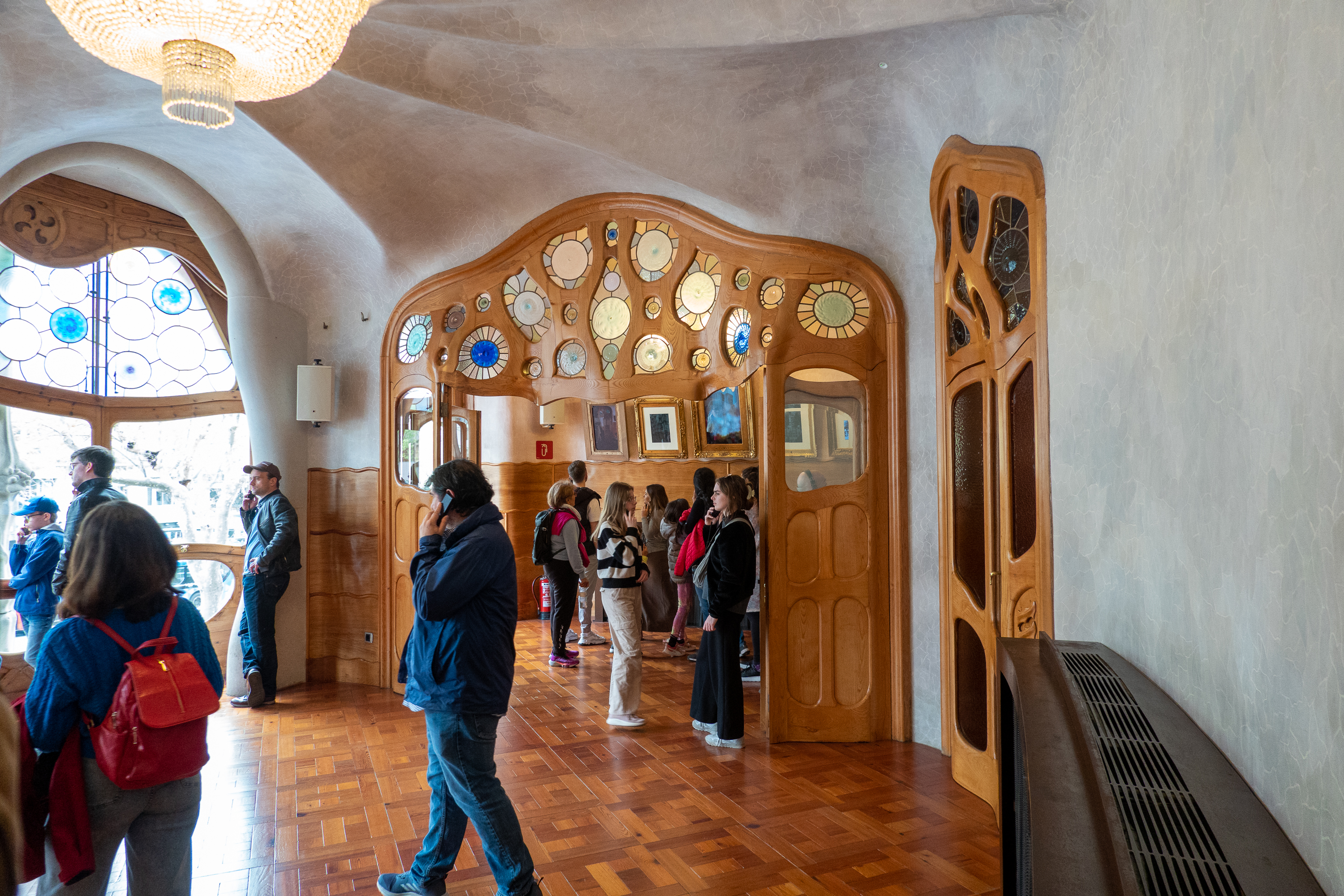
The second Museum was the Casa Batilo, remodeled by Gaudi with a free hand and deep pockets. The result is an absolutely different house design, though based on some very interesting science, with no straight lines anywhere. (https://www.casabatllo.es/en/) Casa Batilo means “bat house” but sometimes it seemed more batspit crazy!
Even the exterior is unusual. Not unique, as there are many buildings in Barcelona with the fantasy curved lines.
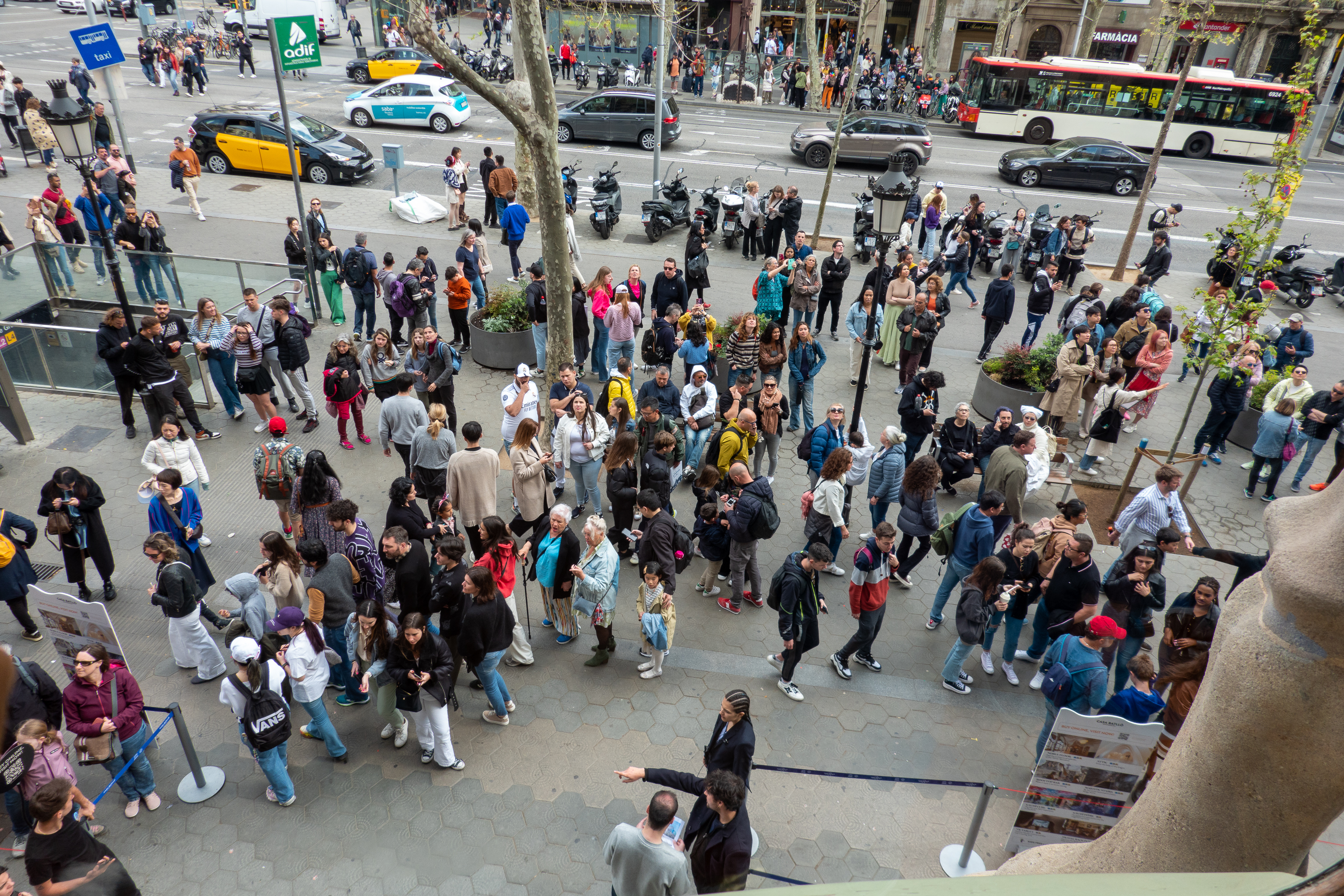
Big crowdBent walls and underwater colors
Wild colors, but this air shaft is actually practical.
Denise, debating whether we need a new front door.
The last hurrah of the visit is a hallucinogenic light show. The ’60’s live!
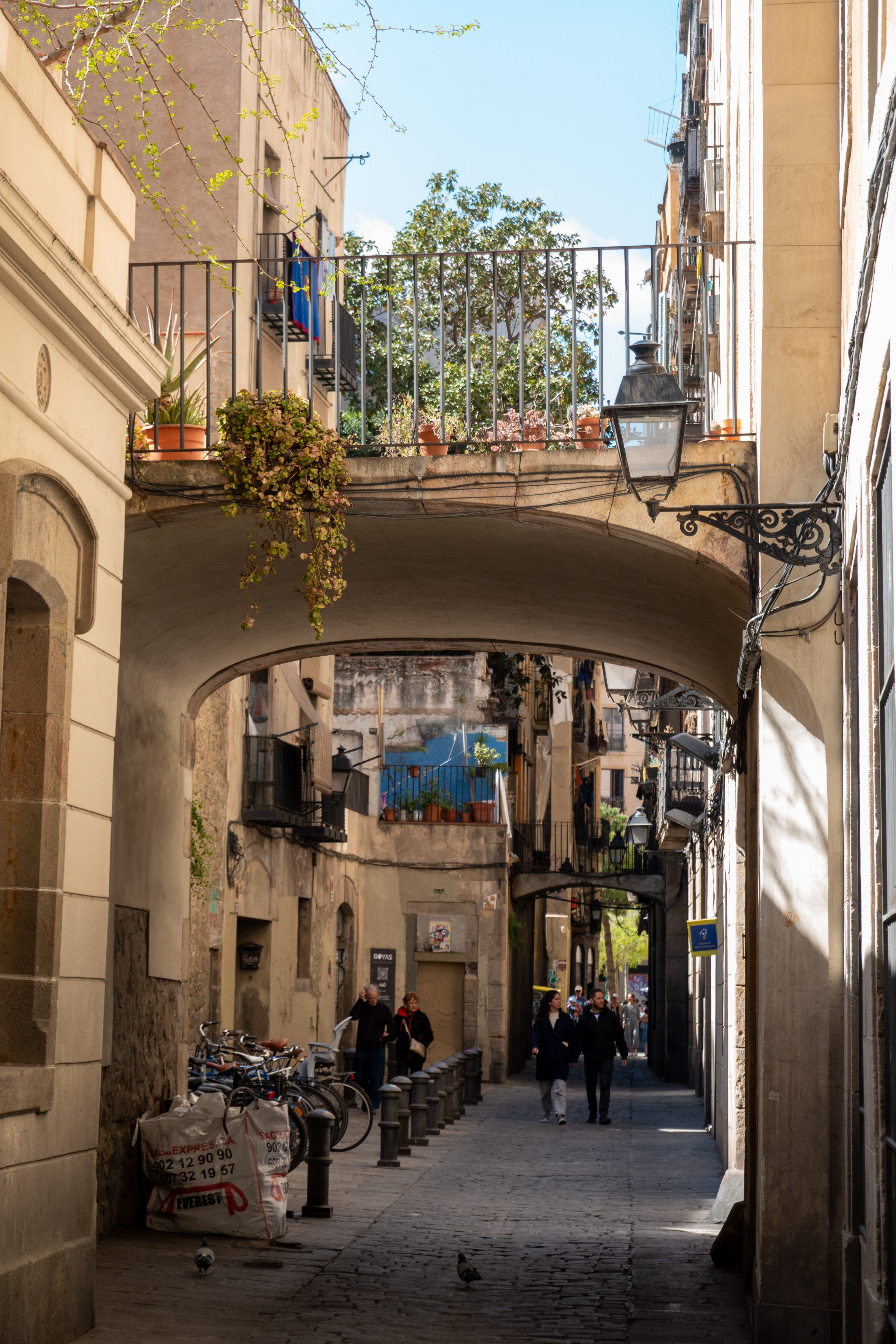
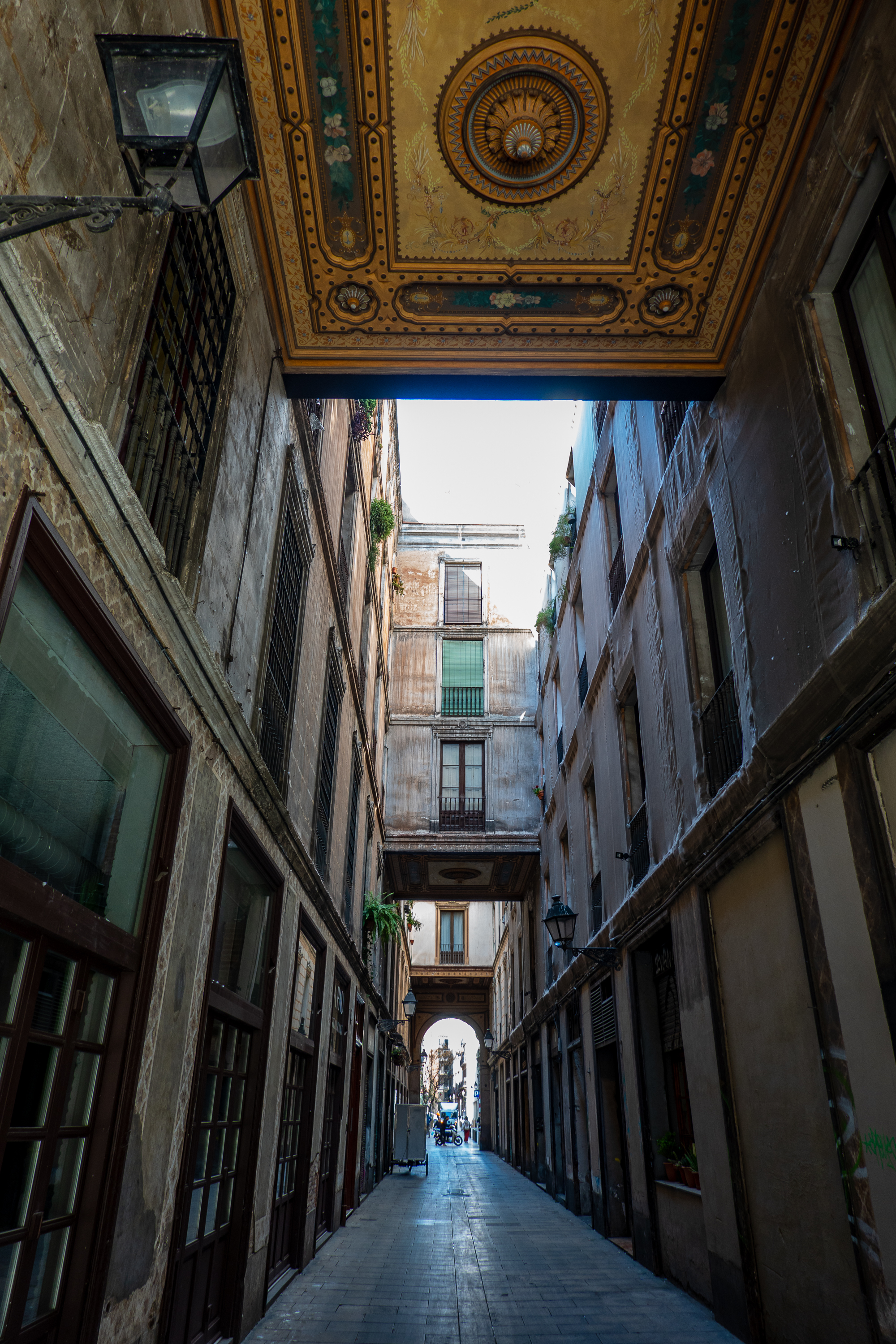
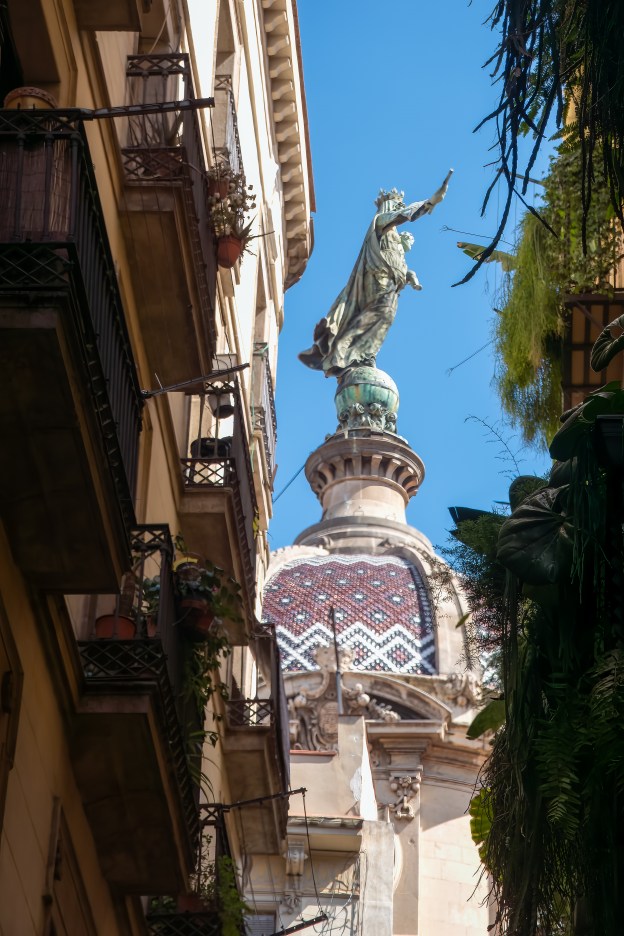
Lastly, we simply enjoyed wandering the tiny streets of the Gothic section near our hotel. You never know what you will find….we found ice cream shops (with wonderful ice cream inside), apartments and bridges built over the streets.
SavorySweet
Sadly, the cathedral was covered with wraps.
A confusion of walls and arches. Always reuse what is already there.
A seminal event of modern Catalan history was the Siege of Barcelona during the War of Spanish Succession. (https://en.wikipedia.org/wiki/Siege_of_Barcelona_%281713%E2%80%931714%29) The results were far reaching in many spheres, and one result was the leveling of the Born district to make a clear fire zone outside the city walls.
When it was restored, a large, modern steel market was built.
And when it reached the end of its commercial life, it was to be razed. When this started it was discovered that the market sat on an extensive range of ruins and, even better, because of municipal records, the exact details of almost every building were known. (https://elbornculturaimemoria.barcelona.cat/)
And, with that, it was time to pack for the flight to Gatwick.
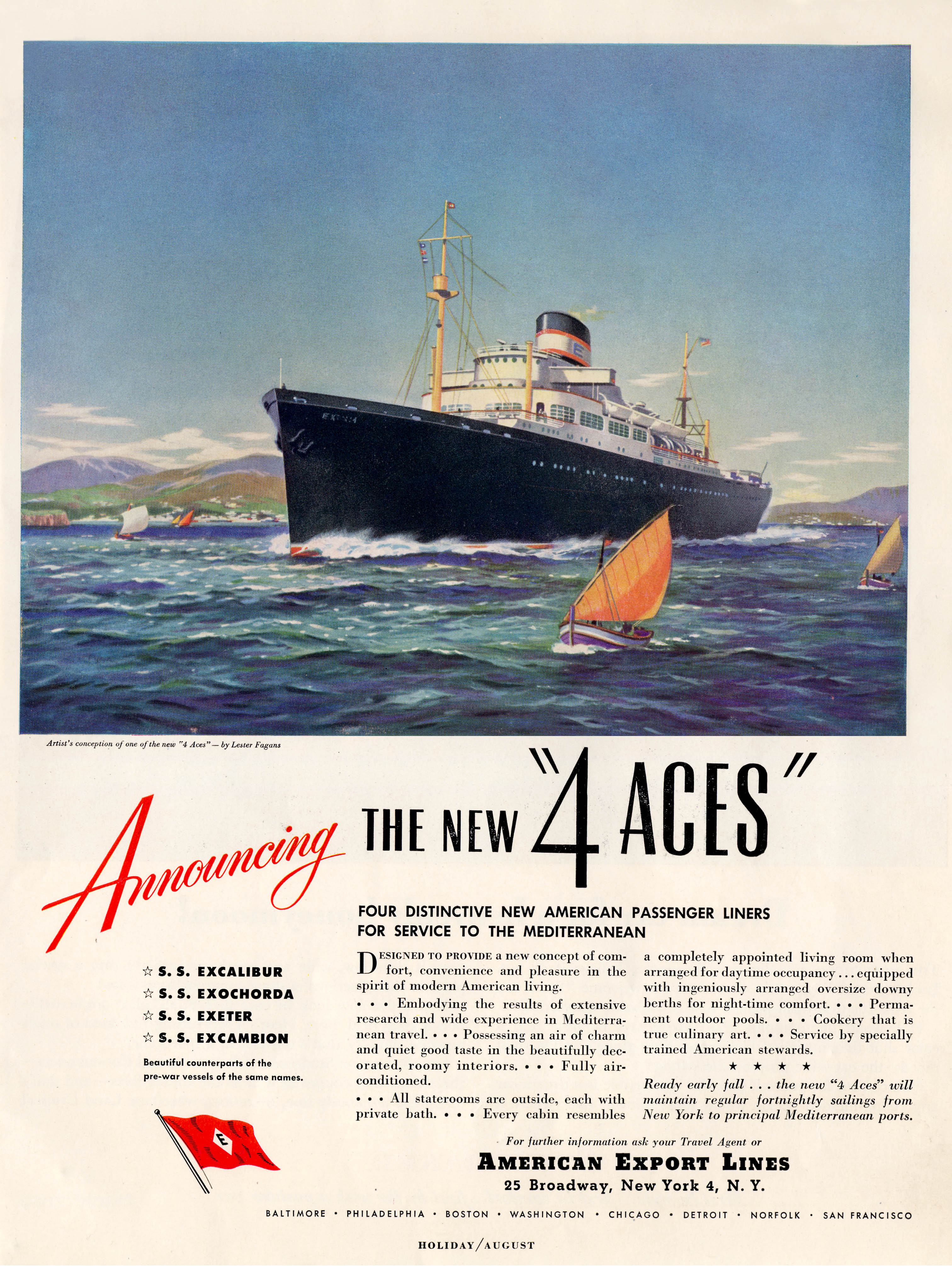
In 1955 the S.S Exeter sailed into Barcelona harbor.
On deck was a five year old Fred who remembers to this day – Spanish railway cars have four big wheels and not eight small wheels like US trains, and that the clamshells on dock cranes don’t have teeth so they don’t puncture the hulls of ships as they load and unload things like coal. His father took two pencils and some string to explain how cargo booms can more items between the pier and a ship. Useful things for a five year old to understand!
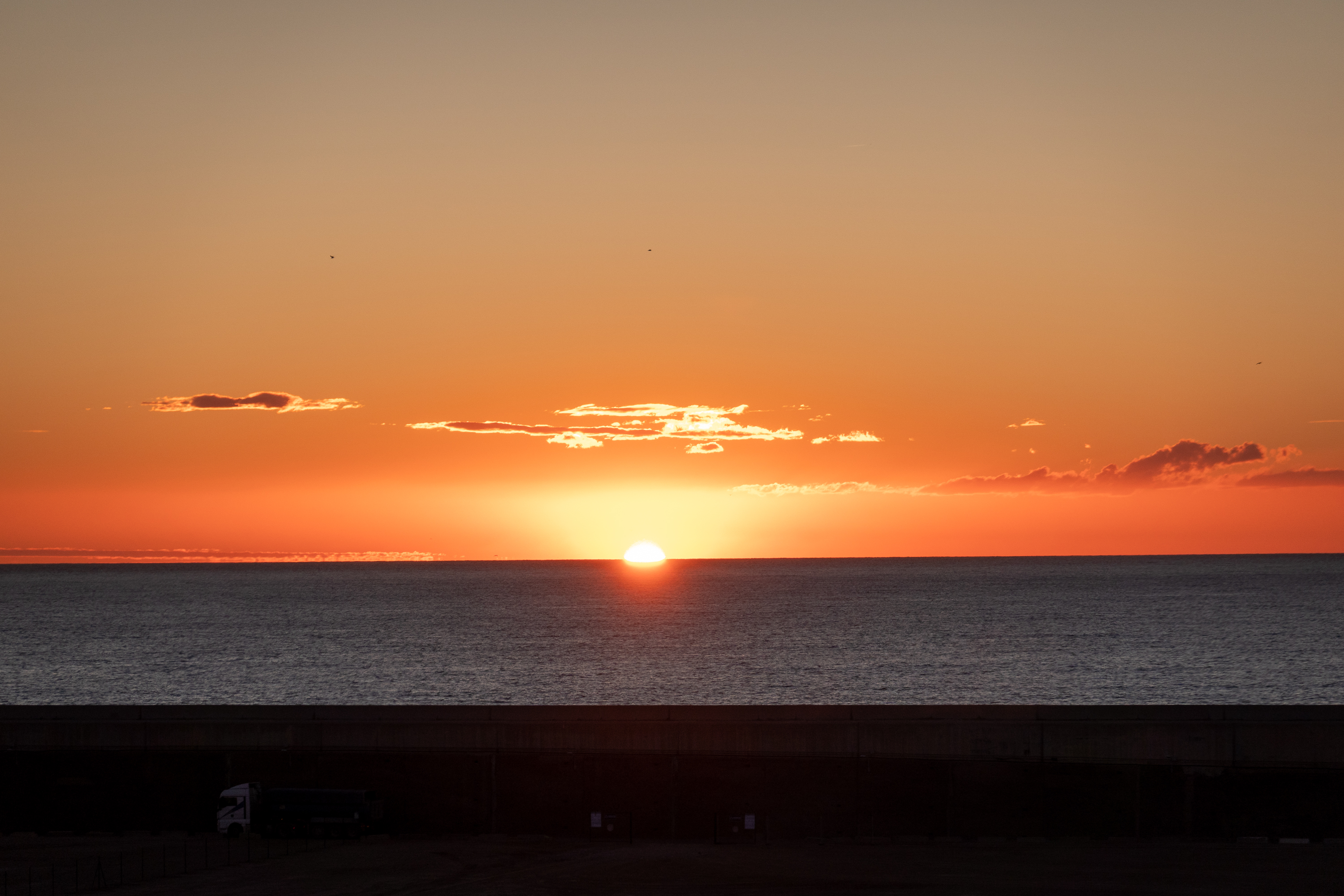
Our arrival in Barcelona began with a pretty sunrise.
Barcelona harbor is still busy and now has a huge section devoted to cruise ships and ferries. We disembarked and grabbed a taxi to our hotel, conveniently located down near the water and deep in the gothic district, aka, tourist central.
Hotel Colonial, originally build as a bank, in the 1880’s.
We like the hop on/off busses available in many cities as they allow you an overview and can help you to get an impression of a city and to start to get your bearings. We bought a two day ticket and set off. We had thought to get off and admire the new Familia Sagrada (Sacred Family) cathedral, but the crowds were huge and it was not clear that we would be able to get on the next bus.
So we got off at the top of La Rambla, the main tourist strip and inspiration for the title of this post, and went looking for lunch. This turned out to be a nice little restaurant in an ancient cellar. A tourist trap to be sure, but a very nice trap. (https://julivertmeu.com/)
Lunch is down here
Denise and paella
Fabulous wash stand
Hams and sausages in the market.
After lunch, we continued back to the hotel, admiring (?) the crowds.
Dinner was a wander through the neighborhood in search of tapas. We especially enjoyed the Chorizo Napalm.
We loved this apartment, built over the street.
Xorizo flambéGlorious views down every street. (Santa Maria del Mar)
As 2020 opened, we began to get serious about our plans to spend a year or three traveling in Europe and North Africa in the 917.
The idea was fairly simple – ship the truck to Europe and start traveling in a part of the world that had mostly been fly over countries for most of our lives. Then came COVID.
Now, in 2023, it was time for another look. Several things had changed – the increasing enforcement of the Schengen Agreement which limits time in the European Union to 90 days in, followed by 90 days out, was a major complication. Although there are reports that enforcement is variable, the penalty for overstay is a ban from entering the EU for three years, so this is not something that we want to risk. So this means that we will be traveling in and out of the UK, where we can get 180 days at a time, and then dropping into the EU.
So we launched into a siege of repairs and upgrades, picked a shipping company, and made a reservation. Denise found a repositioning cruise on Viking with very low rates, so we chose that as an alternative to flying. In the end, as the ship carrying the truck is running about two weeks late, this was probably not a good idea for the initial trip – would have been better for subsequent returns to the UK, but it was a lot of fun. And an interesting opportunity to compare/contrast with our almost identical trip on Seabourn.
We drove up to Baltimore to drop off the truck, to almost exactly the same place where Fred recovered his Blazer in 1975, after the trans Sahara trip. (https://pbase.com/diplostrat/sahara) When Fred received the truck in ’74 it had been completely looted – here’s hoping that we do better this time!
The 917 settled in with new neighbors on the pier. Ended up sitting there for two weeks.
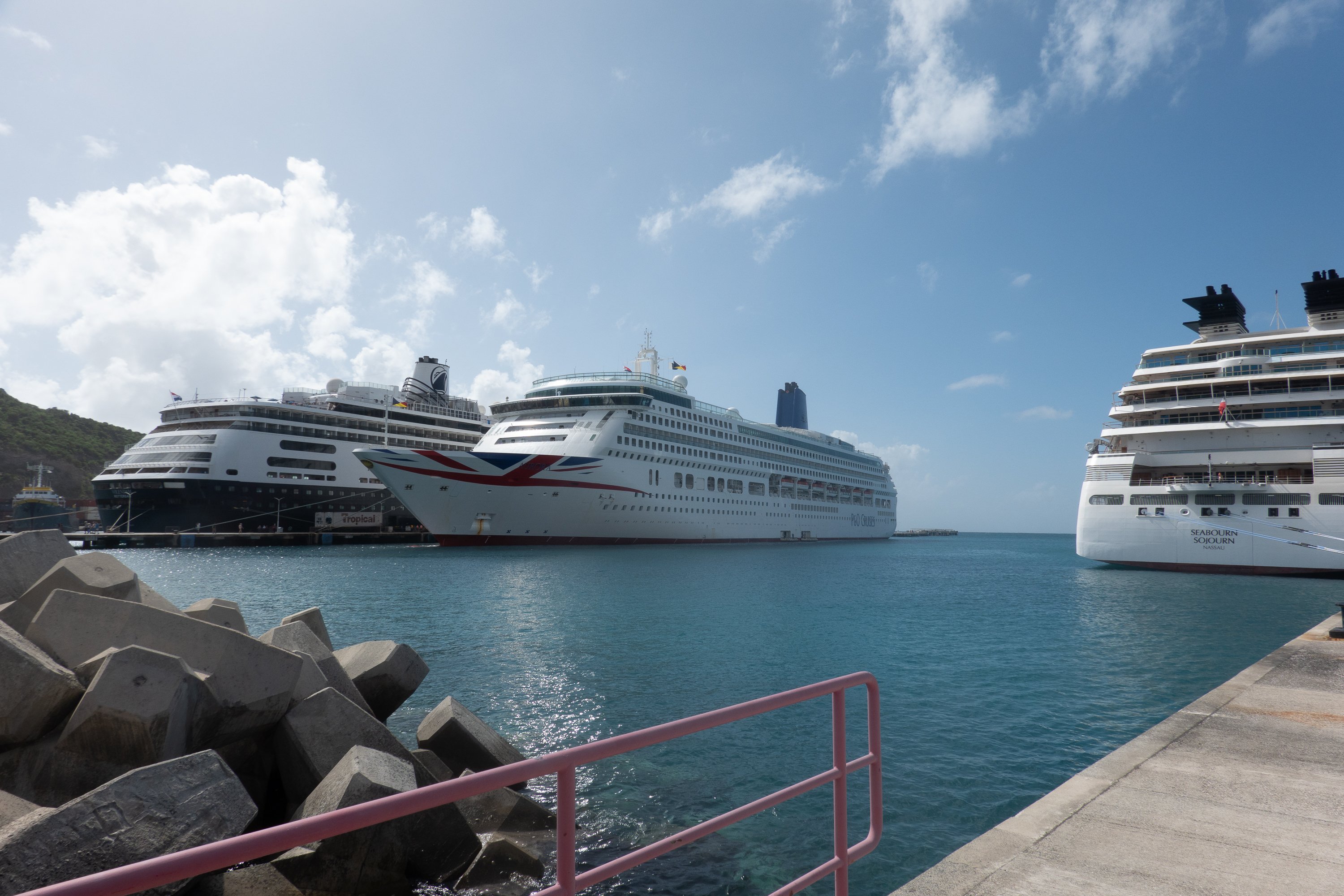
We flew to Fort Lauderdale to join the Viking Star. Boarding was easy and we set out to explore the ship which, while larger, was almost the twin in layout to the Seabourn Sojourn. It was fascinating to note what was the same and what differed from the other ship. In the end, they were more alike than different.
In the old days, you boarded from dark, dingy pier warehouses. Now you use the same type of jetway as an airport.
Home for the next week.
Viking has wonderful baths on both their river and ocean ships.
Looking around the harbor we noted a RoRo of the type that would take the 917 to England.
After an easy departure, the Pilot went ashore and, later, we waved goodbye to Miami. We were finally en route.
We settled into the routine at sea. And we enjoyed the wonderful weather.
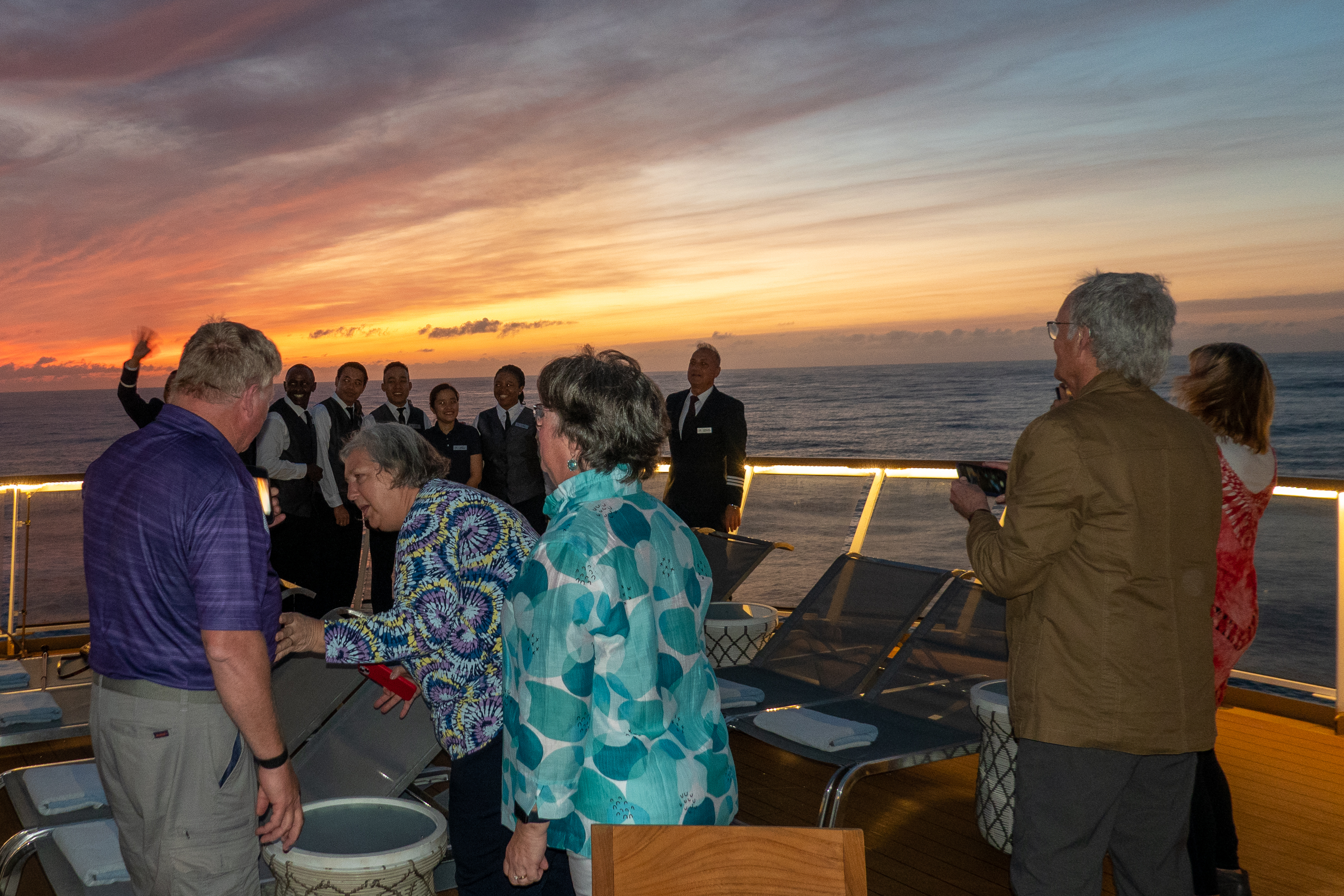
Passengers gathering to photograph part of the dining staff against the sunset.
The formal portrait. (I sent it to the chief of restaurant services, the gentleman on the right.)
We skipped going ashore in Phillipsburg, but were looking forward to Madeira, a kind of magical place. It is easy to see why it it is so high on the European list of vacation spots. With only a four hour visit, we skipped the the packaged tours and set off into town to in search of coffee and a visit to the cathedral.
Funchal is really pretty.
Our first stop was the park where we admired a statue of Bolivar and had a chat with a lovely lady who had just moved back to Madeira after living in Venezuela for years.
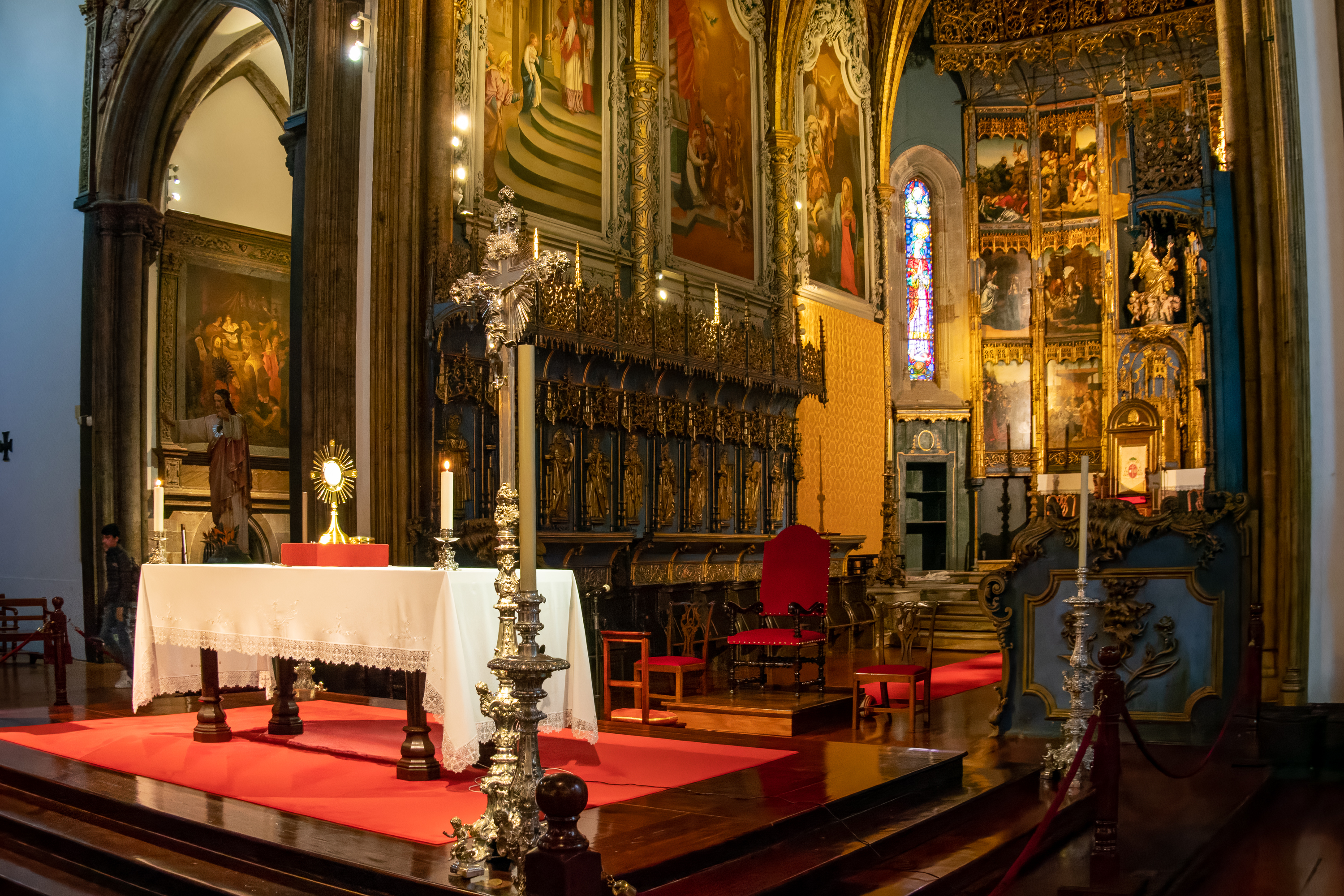
Fortified with and espresso and a gelato, we visited the cathedral, a rather plain, gothic building, dating from the late 16th century. One of the few intact buildings from the early colonial period.
Nowhere near as large or gaudy as some the the large European cathedrals, Funchal is still very nice.
The ceiling was spectacular.
Galleon style tour boat, sailing in front of the downtown.
Sailing away from Funchal we passed Kong’s island. 😉
(Kong was not receiving visitors.)
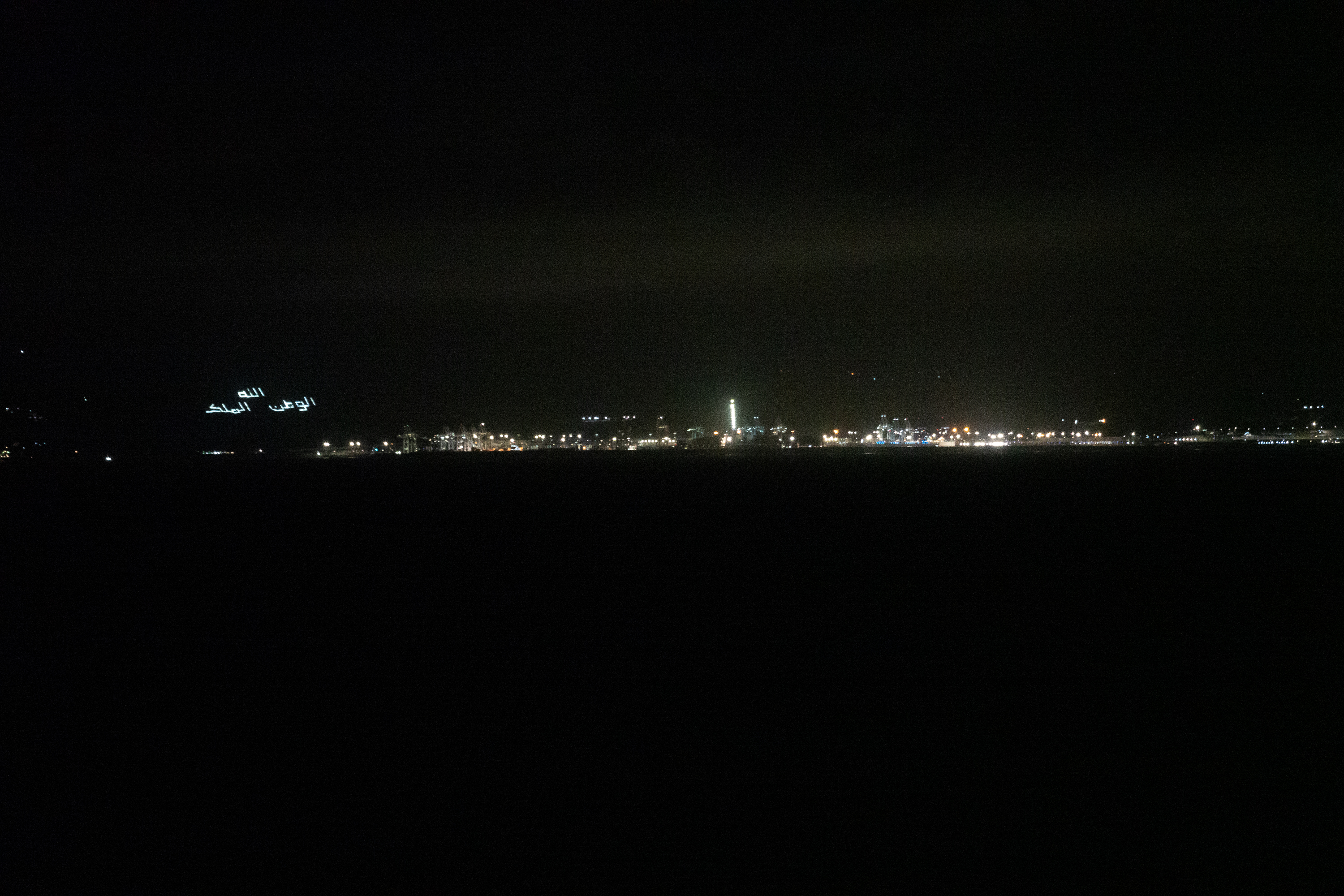
Sadly, we passed through the Straits of Gibralter at night.
Allegedly, the Viking Star is very “green” and most of this is water vapor.
We passed on the Moroccan side.
The next day we sailed up the Mediterranean coast of Spain towards Barcelona.
The Penon d’Ifach (A really big rock)
As the sun set, we passed Ibiza. Barcelona tomorrow morning.
In the latter part off 2022, Denise’s brother wrote that he and his wife were going to take a repositioning cruise from Lisbon to Miami and then continue to make a circuit of some of the lessor known Caribbean ports. Would we like to meet them in Miami or join them for some or all of the trip? Didn’t take long for us to decide that we were hooked. So, in early November 2022, we boarded a flight to Lisbon, via Zurich. The day after our arrival in Lisbon, we were off to Porto in the north, via a stop over at the Shrine of Fatima. https://en.wikipedia.org/wiki/Sanctuary_of_Fátima
Some of the faithful make their approach to the shrine on their knees.Denise was pleased to see an old English style letter box.
Panoramic view of Shrine
Arriving in Porto, we checked into an amazing hotel. The bad news is that it is on a pedestrian street, so we had to schlep our suitcases over the cobbles, the good news was that the hotel is a repurposed 16 th century townhouse/palace, with a new, modern building on the rear. So the public areas had parts that even included Roman constructions, while the hotel rooms were completely modern.
The hotel was up the street to the right.
Old fountain in the hotel hall
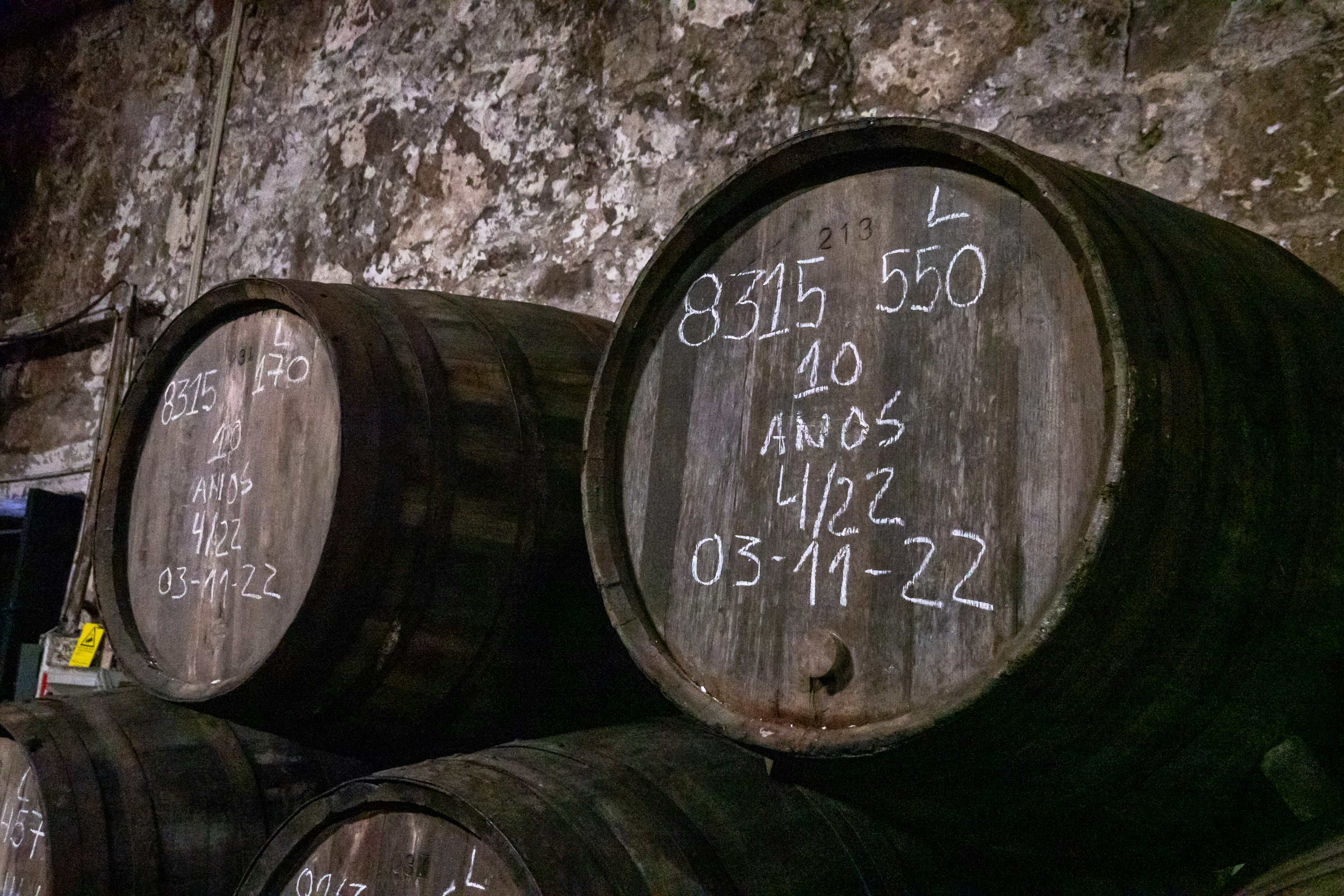
We were lucky to have superb guide. A former air traffic controller with the Portuguese Air Force, his English was better than ours. We started wth a visit to a port warehouse.
There are several varieties of port aged for different times.Each port tastes even better than it looks.
We then travelled up the Douro valley into the wine country.
We stopped to admire a small country church and a classic stone bridge as we continued up the valley. The views were beautiful.
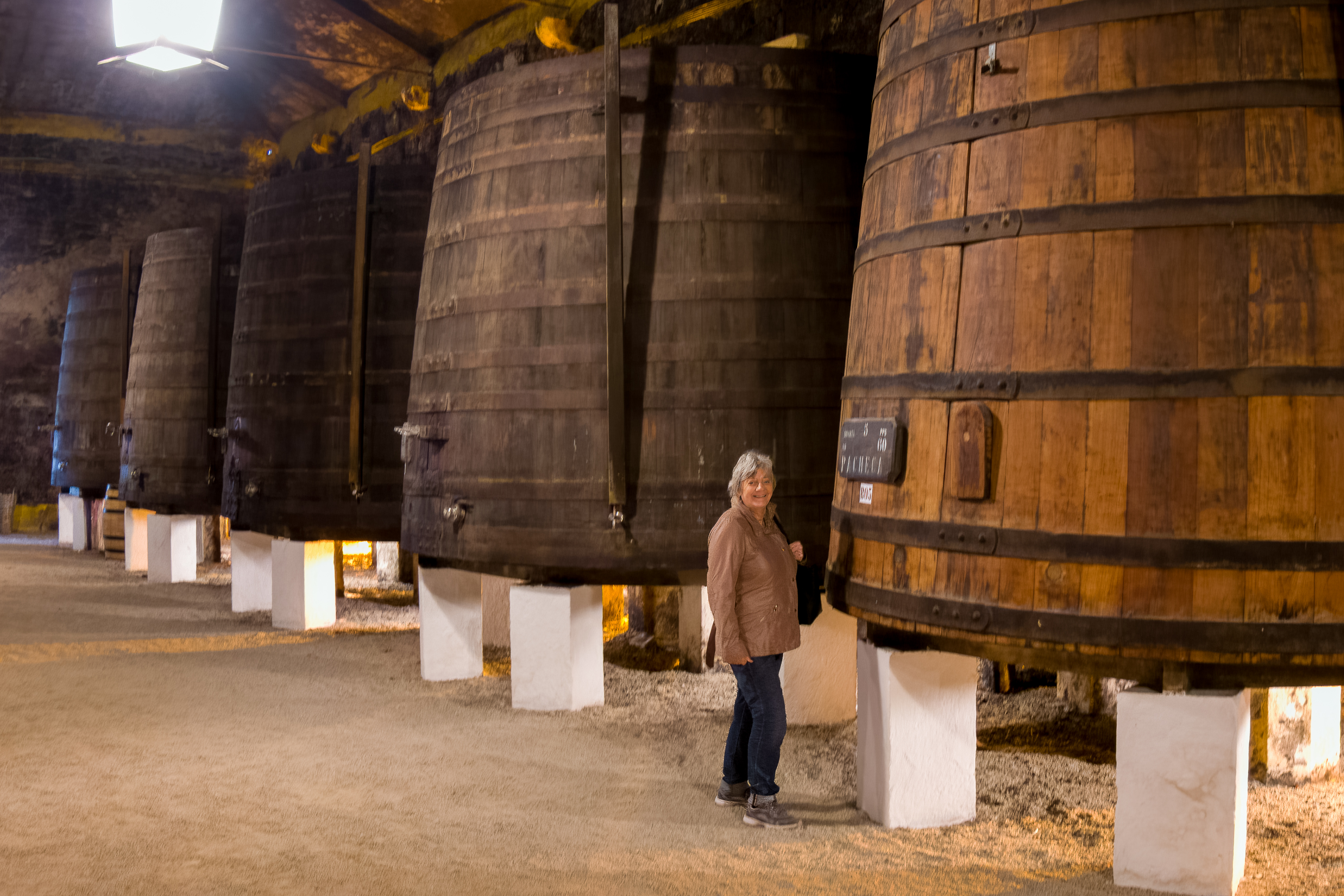
We stopped at the Pacheca winery for a tasting and a fabulous, multi-course lunch with a different wine for each course. (The Pacheca Winery is spelled “Pacheca” and not Pacheco as it is woman owned.) For those of us who don’t usually drink port, it was fun to discover a new variety of wine. (https://quintadapacheca.com/)
Peacocks admiring tourists.
The neighbors, the Sandeman winery, is much more famous.
Denise planning to fit a small container of port in her suitcase.
Leaving Porto, we drove back to Lisbon, stopping in Coimbra to sample pastel de nata, custard pastries which were developed by nuns with too many eggs and are simply delicious.
Lisbon Cathedral
Wine with a view; it comes to you!
Belem tower, 16th century defense of Lisbon
After a quick windshield tour of Lisbon, [we will have to return,] we arrived at the pier just as Trevor and Sheila pulled up from their flight from UK. Check in/boarding is instantaneous, other than Fred having a momentary panic that he had lost his phone – found to be in his hand. (!!) Our actual sailing was delayed due to a heavy swell at the mouth of the river.
Lisbon skyline as we sail down the river.
The next morning we plowed into the mid Atlantic swell and settled into shipboard life. We much much prefer longer crossings to daily visits to ports packed with duty “free” shops and other tourist traps. The ship was simply lovely and we quickly discovered that every day had to begin with a visit to the gym if we were to still fit into our clothes.
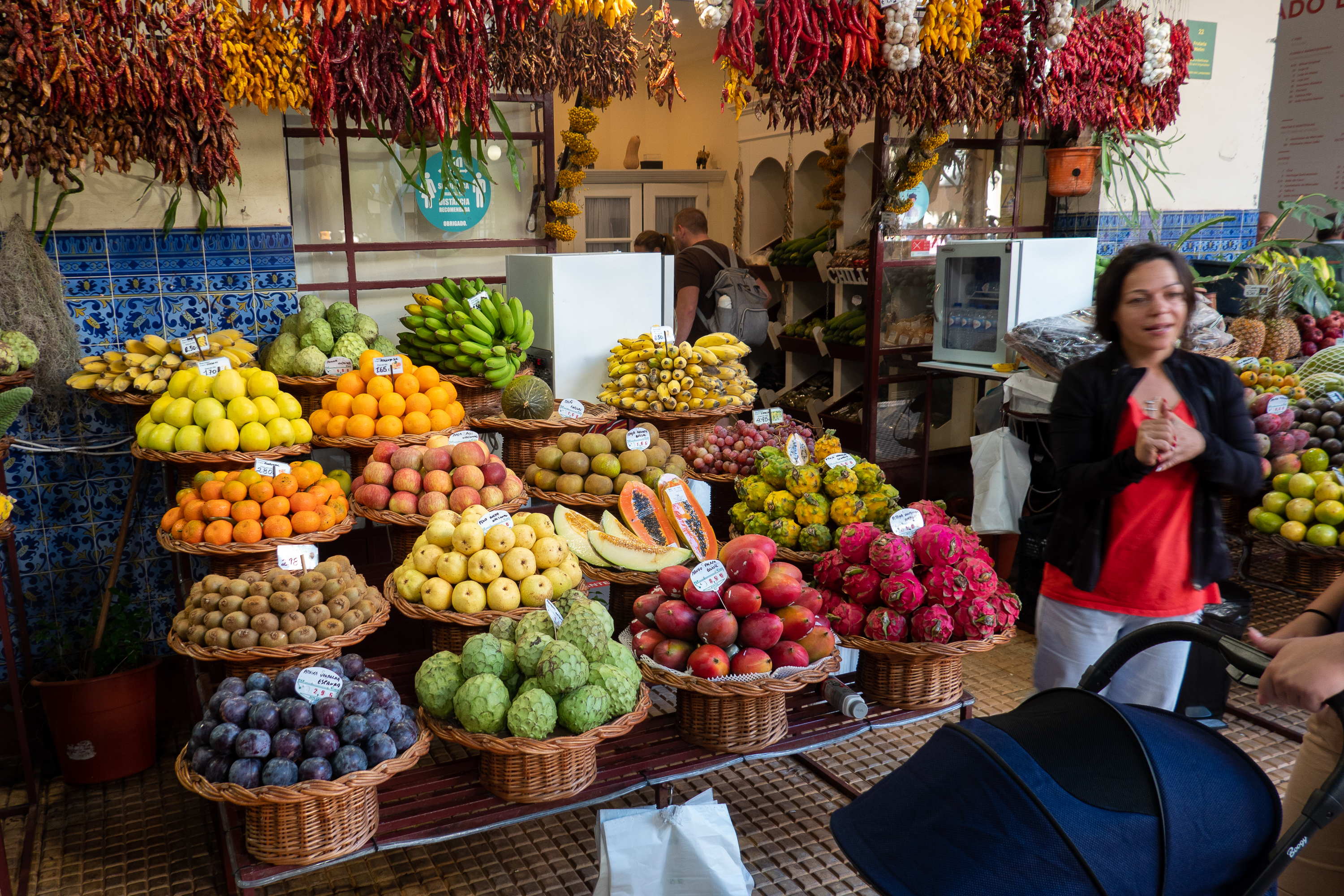
Our first stop was Funchal on the island of Madeira. Madeira is one of the rare islands with a self sustaining economy. That said, it also owes much to the transatlantic trade, all the way back to the 1500’s. Because of the prevailing winds and its westward location, it was a crucial provisioning point for ships sailing west. We started our visit at the market.
The fruit was a riot of color.
The flower sellers wore beautiful, traditional outfits, and, as far as we can tell, this is for real – there weren’t many tourists about.
Cable car to the top
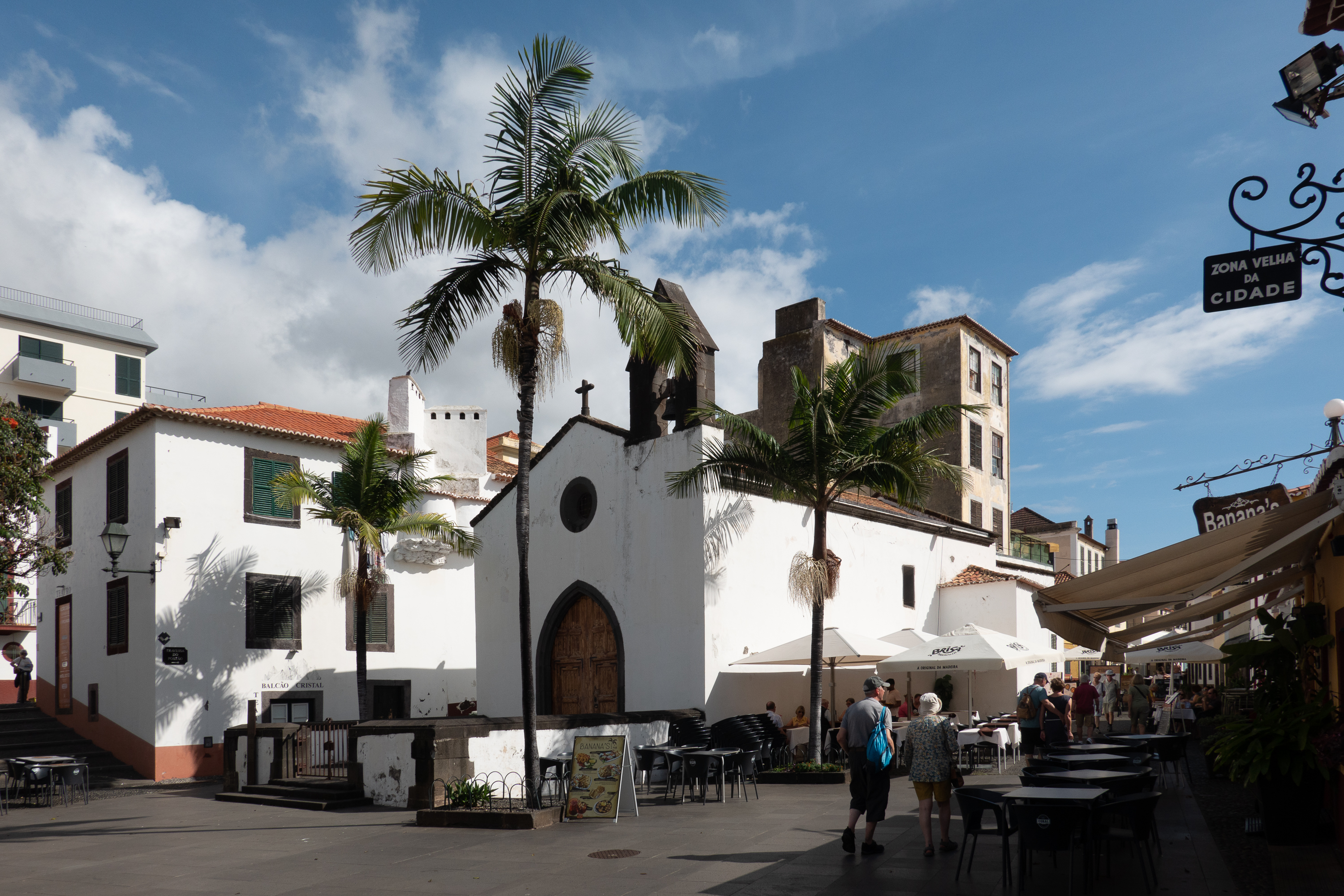
Colonial archiecture
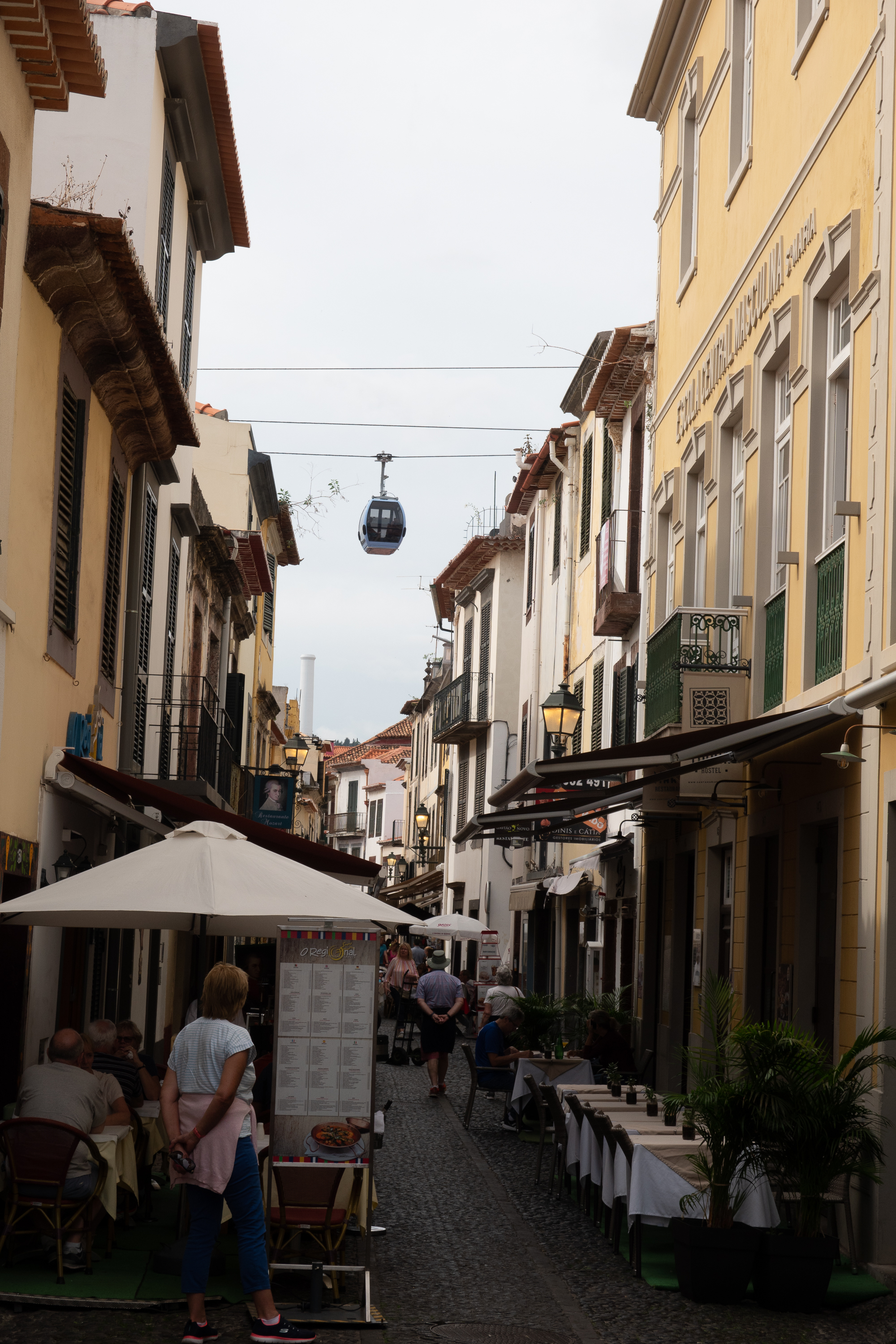
Cable car over narrow streets.
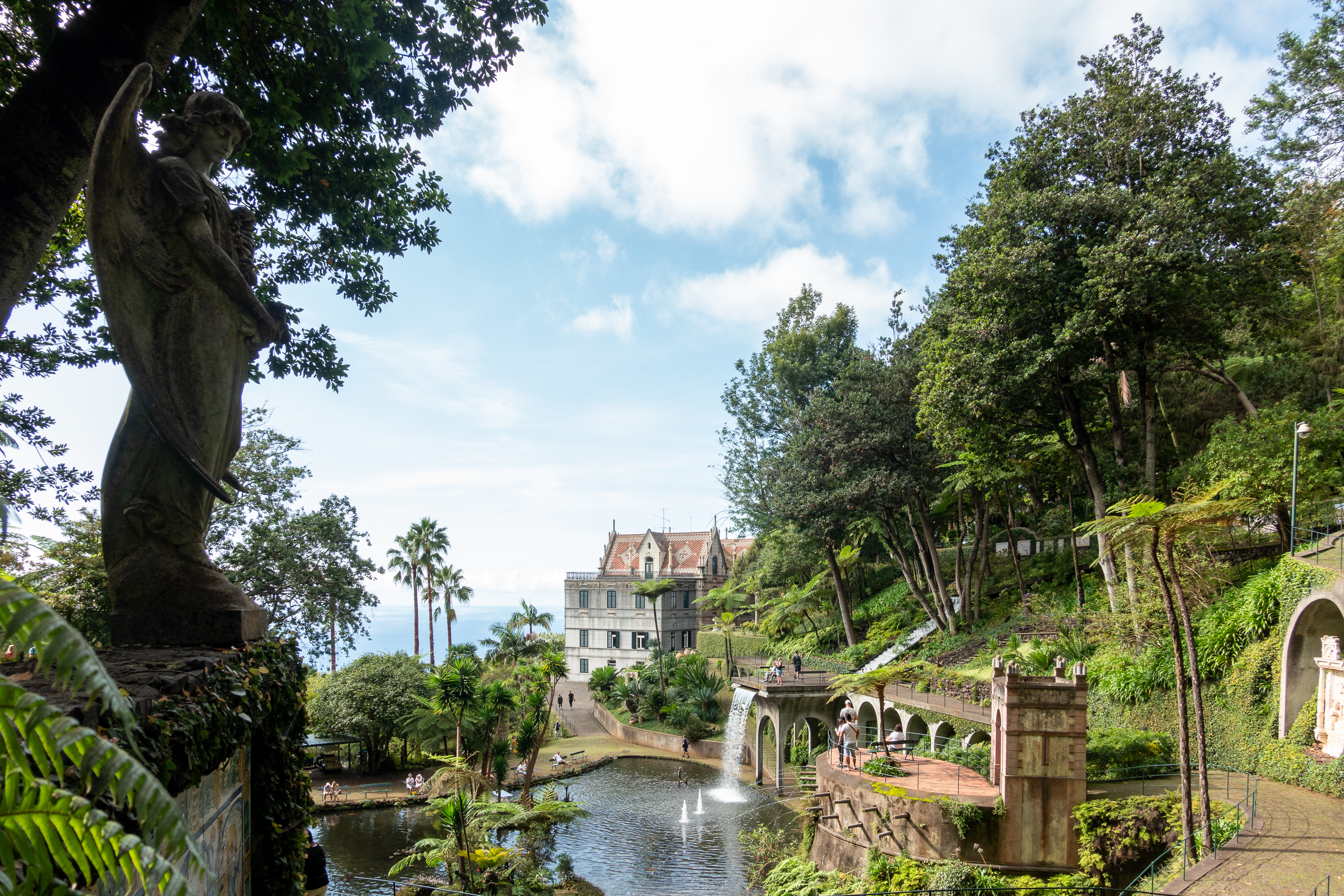
The gardens at the top of the cliff are simply stunning.
We enjoyed a cable car ascent, and visiting the market, glorious gardens, and a drug store for some essentials.
We left Funchal at sunset and set out for Miami.
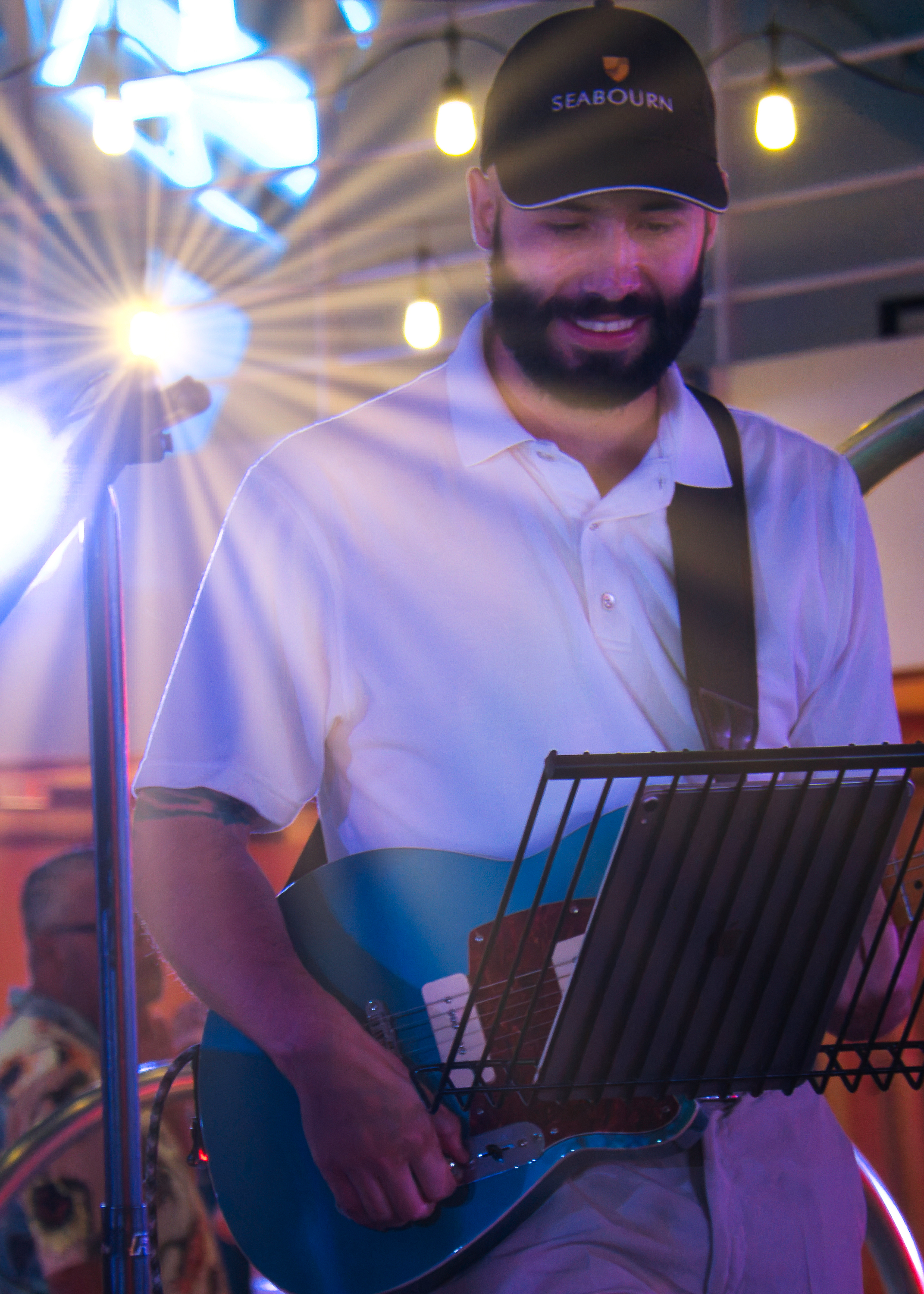
Fred made friends with the two guitarists working on board, one a Colombian who played in the stage band, and the other a Brit, who played in the jazz combo. Both are conservatory graduates and the Brit noted that this is the only job he has had since graduation a few years ago. And yes, both read music very well and are jaw droppingly good.
The crossing was wonderful and we soon arrived in Miami for the turnaround for the Caribbean part of the trip.
Approaching Miami, we saw the “Obesity of the Seas.”
Freedom Tower, Miami
Miami skyline by night
Denise and Fred have lived around the Caribbean for years; Panama, Cuba, Venezuela, and Fred has done several temporary duties in the area, Haiti, the Dominican Republic, Guyana, Trinidad, and even a short, post-hurricane Ivan visit to the Cayman Islands, (https://pbase.com/diplostrat/cayman) but we have never done the classic tourist circuit.
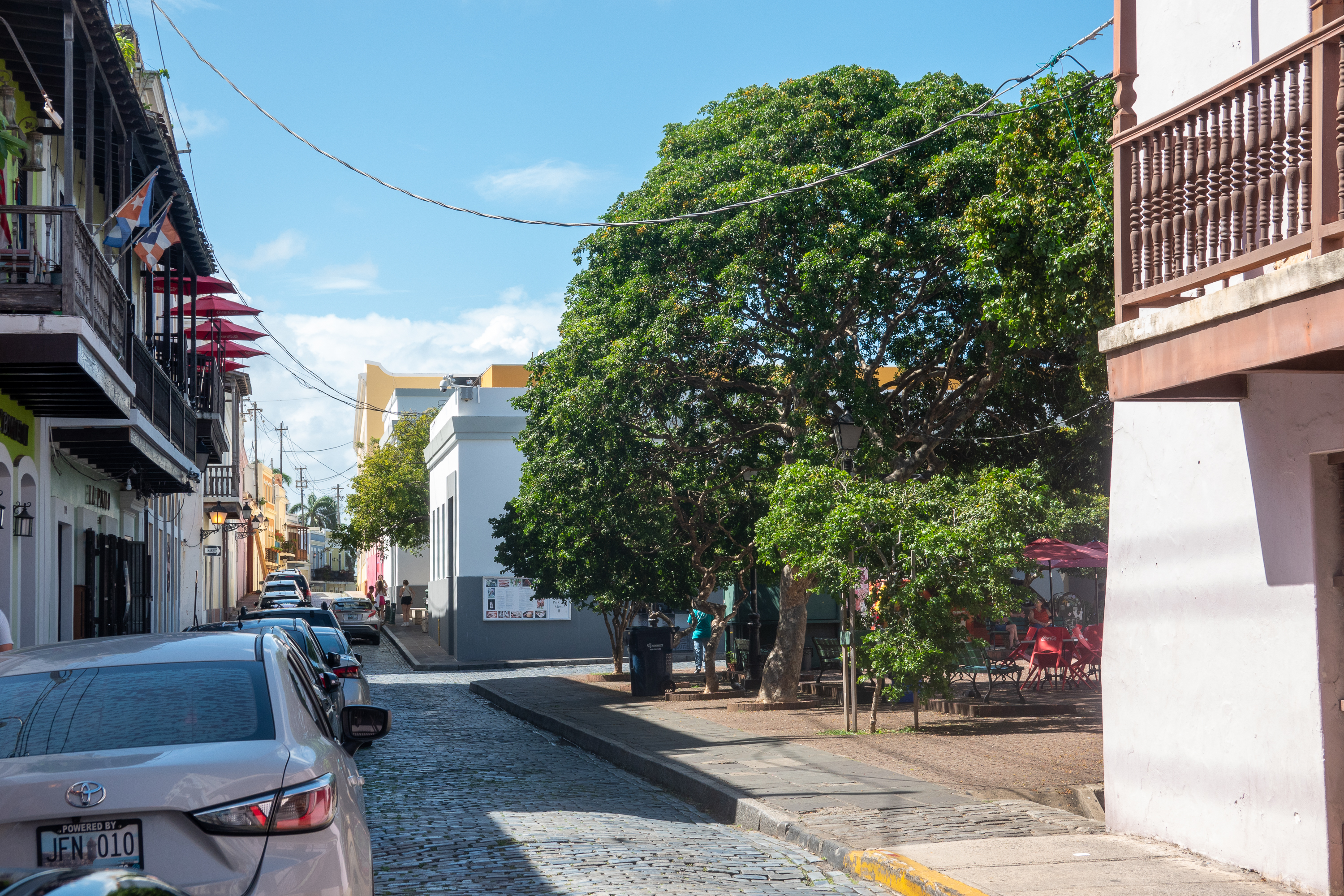
First up was Puerto Rico and here we felt most at home. Not surprisingly Puerto Rico feels much like Ecuador, Venezuela, or any other former Spanish colony.
El Morro (from the sea)
More Morro (from the land)
Classic colonial streets
Our first view of the classic Caribbean mass tourism.
Our next port was Sint Maarten, an island shared, since 1648, between France and the Netherlands. The history of the island follows many of the same trends of other Caribbean islands – massive importation of slaves and indentured workers to grow sugar, cotton, tobacco, and salt. Fabulously wealthy colonialists and many, many slave revolts. Today, tourism is the life blood of the island and its airport is one of the busiest in the area, famous for a beach and road right at the end of the runway. We hired a taxi for a day trip ‘round the sights and a lunch in the market on the French side.
Storm shattered resort
The orange iguana was named “Trump.”
Market on the French side of the island. Fort Louis on the hill.
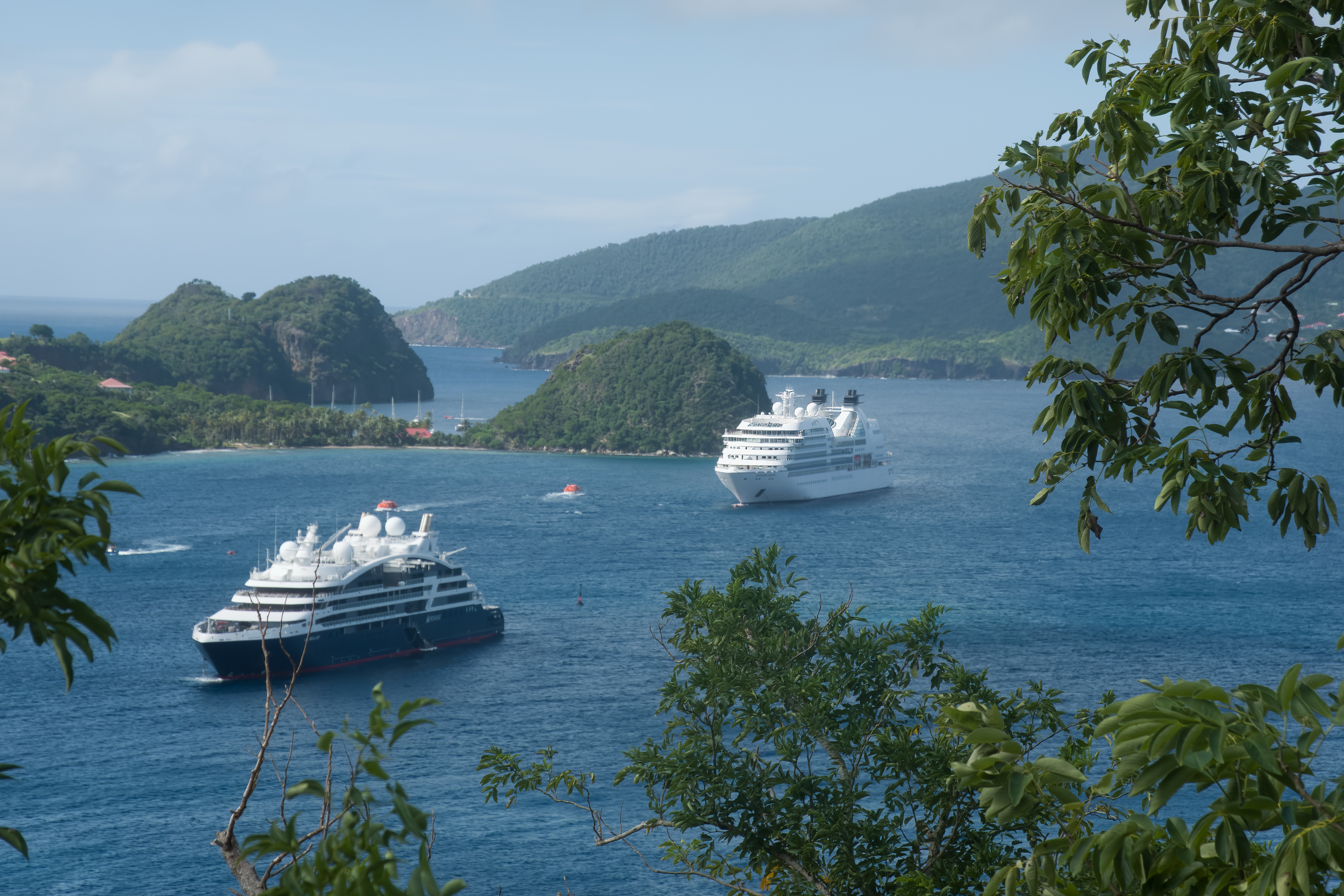
We had a rainy day in Guadeloupe. We hiked up a knee poppingly steep hill to Fort Napoleon. The views were tremendous and there was a surprisingly comprehensive little museum inside the fort.
The fort was named for Napoleon, but he never actually visited.
The for has lots of iguanas, indeed, they are so common that they are in the decor.
Denise celebrates the top of the hill.
Cafe Creole, the local Irish Coffee
Our next island visit was to Antigua and again we chartered a taxi and visited the famous Nelson’s Dockyard. The dockyard has been rebuilt as a tourist attraction, but has several reasonable exhibits on Napoleonic era sailing and naval operations.
Nelson? Well, it is called Nelson’s Dockyard today, but he was roundly disliked by the Antiguans, who resented his upholding the Navigation Acts which prohibited trade with the new United States. They even held up his promotion for years. In return, he dismissed them as worse than the American rebels. Still worth a visit.
The sugar trade, especially, made the Caribbean Islands as valuable as any gold mine or oil well for hundreds of years and most changed hands many, many times following bloody raids and sieges. Hence the proliferation of forts you can visit. Like many other islands, Antigua’s list of resident/vacation home owners is a real who’s who of Anglo-American actors, musicians, and other personalities. You might be hard pressed to name one who doesn’t have a place on Antigua.
A classic cruise ship moment, a steel band. (And yes, they were excellent.)
St. Kitts is about as small as they come. Traveling around the island you are struck by the use of the singular; there is often only one of a facility on the whole island – “This is our …” Bank, hospital, car dealer, etc. Note that this is emphatically NOT the case with churches; here the quantity and variety is infinite. At the end of the 19th century the sugar trade was dying out and the plantation owners were eager to cut their costs. One solution was to build a narrow gauge railroad to link all of the major plantations and allow them to consolidate their harvests at one, modern sugar mill, as opposed to using windmills at each plantation to crush the harvest. In the end, it didn’t work, and today the bumpy tracks are used to to tourists around the island at the blazing speed of ten miles per hour. And even that is rough! But lots of fun.
Rough Atlantic to the left and calm Caribbean to the right.
The track was as rough as it looks, but a lot of fun.
Seabourn was very proud of its picnic in the surf.
From St. Kitts we sailed back to Miami via the British Virgin Islands and flew home.
Traveling in these COVID times is somewhat challenging but we feel a little safer when in our camper. A trip to Florida in November 2020 proved harrowing a couple of times but we survived and even had a wonderful time.
We try not to travel for more than four hours a day if we can help it, so our first night’s stop was a most pleasant vineyard, Hinnant Farm Vineyard and Winery in Pine Level in North Carolina, courtesy of Harvest Hosts. (Home – Hinnant Vineyards) This was our first taste of the muscadine family of grapes which grow well in the south. We much prefer dry wine but found the sweeter wines novel.
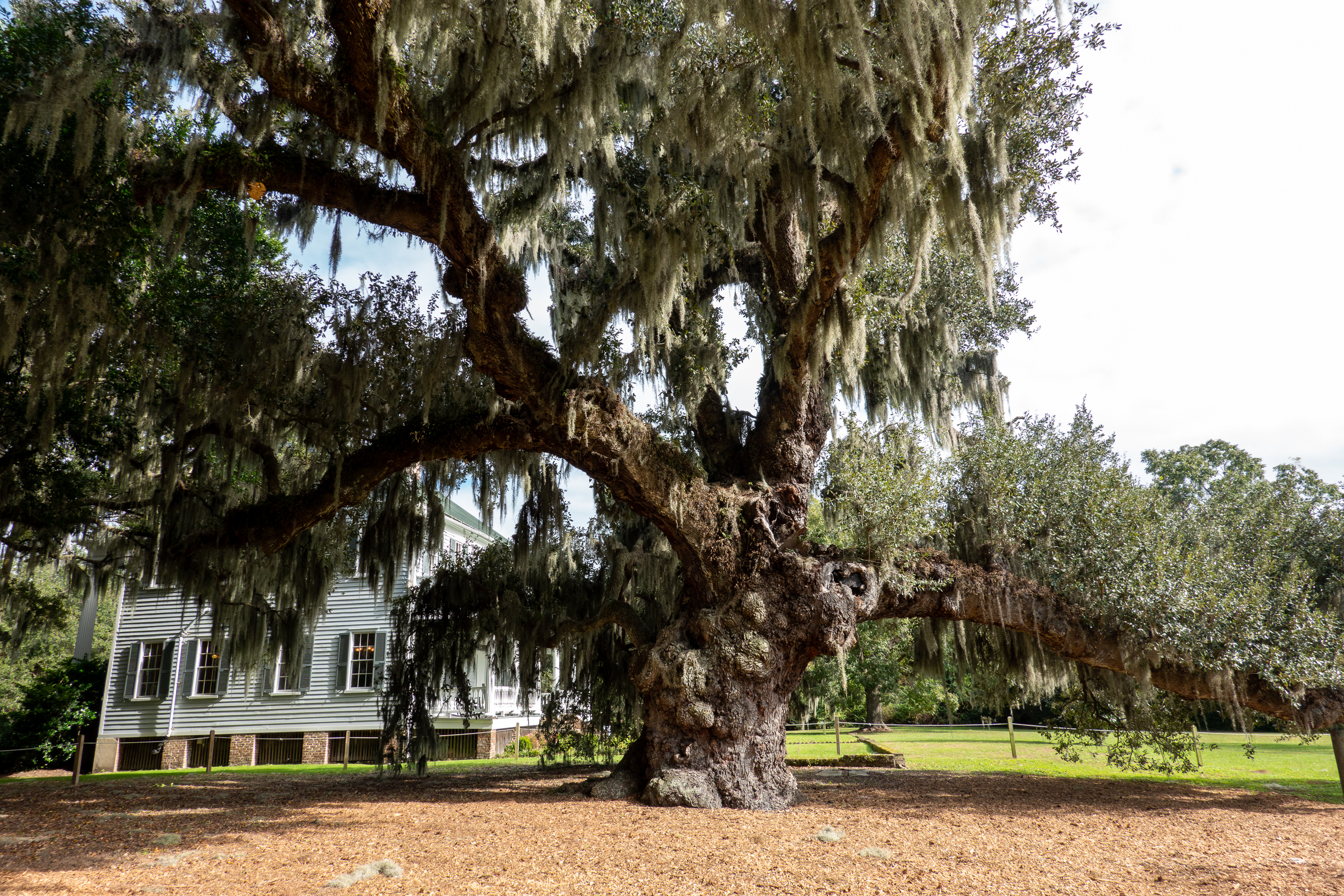
This is a former cotton plantation with a Georgian-style mansion, slave cabins and tours. It is one of the very few original plantation houses around Charleston. Most were burned by the Union Army during the Civil War, but this was commandeered to use as a headquarters.
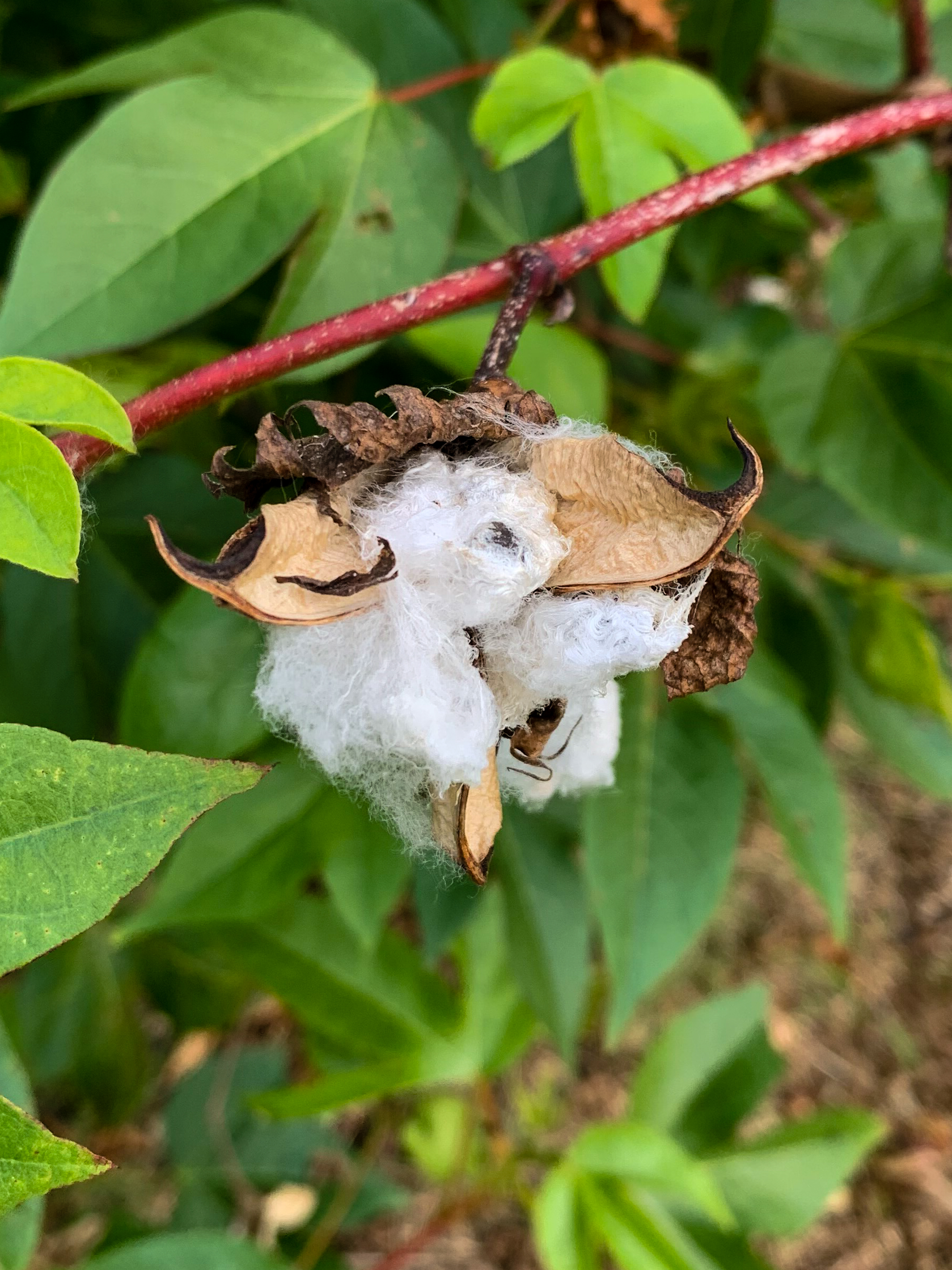
We were interested in the history of the Gullah people of the area. We first heard Gullah in a museum in New Orleans and were stunned; Gullah sounds almost identical to the West African Pidgin that we knew in Cameroon. We were lucky enough to have a tour guide with Gullah origins, who had grown up in Beaufort nearby. He was a wonderful source for information about the unique sea island cotton grown previously at the plantation. This cotton is finer and softer even than Egyptian cotton and is exceedingly expensive. As a boy, our guide had worked in the cotton fields, so he was able to give us first hand memories.
The wealth of the plantation owner depended on the people who lived in these quarters. After the Civil War some of these buildings were reused as churches and schools.
Ancient Tree
Sea Cotton Boll
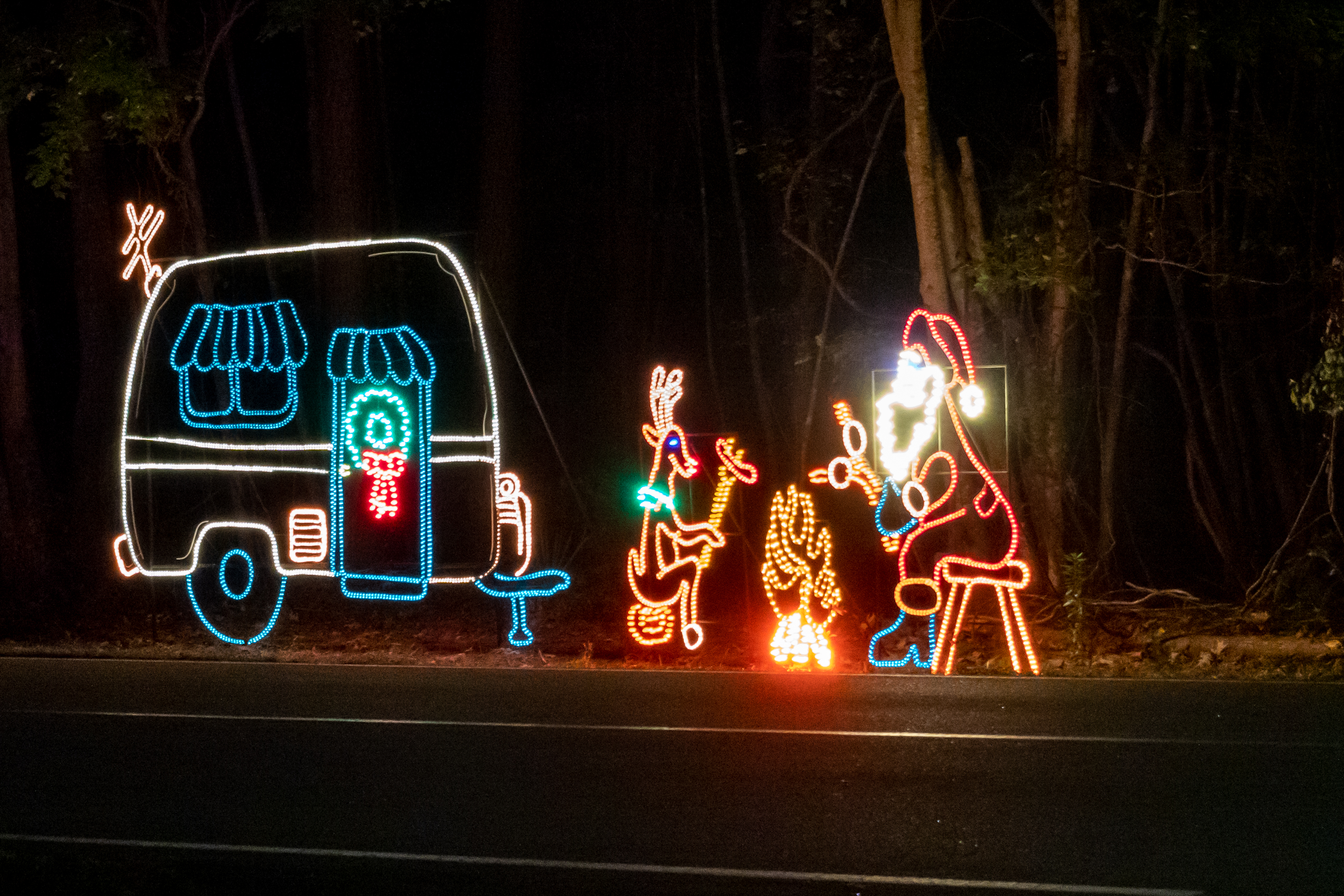
We stayed at the Campground at James Island County Park, which proved to be a real find. (The Campground at James Island County Park | Charleston County Parks and Recreation (ccprc.com) Although a large campground, it was designed for maximum privacy with foliage separating campsites. There was also a shuttle bus to the Macleod Plantation, (which is also part of the County Park System), which proved useful in the rather heavy traffic. The park had also just opened its drive through Holiday Light display all around the campground and beyond. We took advantage of our location and drove through!
Our final stop, on the way to Orlando, was the Adamson Oaks Farm, again courtesy of Harvest Hosts. Here we enjoyed a farm tour and saw a variety of animals including horses, sheep, goats and llamas. But the highlight was the recent pecan harvest and the wonderful pecan pie, which we purchased! Friends all received fresh pecans for Christmas!
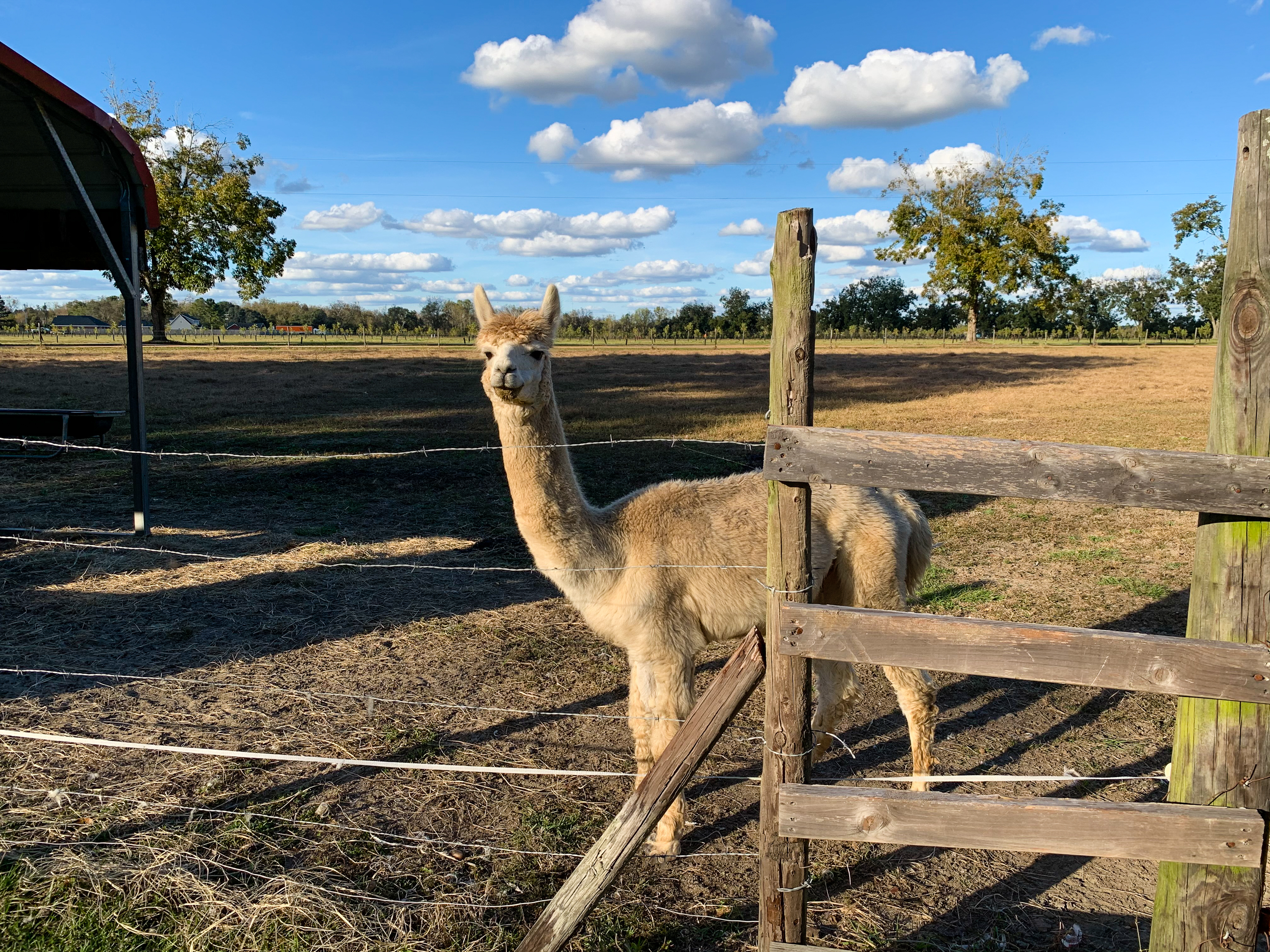
At a llama farm, you pet the llamas!
Our visit to Orlando included a visit to the Lakeridge Winery. (Welcome to Lakeridge Winery) Lakeridge is a huge winery complex with several sites and a selection of wines from locally grown muscadine grapes and blends using west coast juices. Again, the sweets predominated, especially with the local grapes. It was a lovely afternoon out as the grounds are extensive and the weather not too hot.
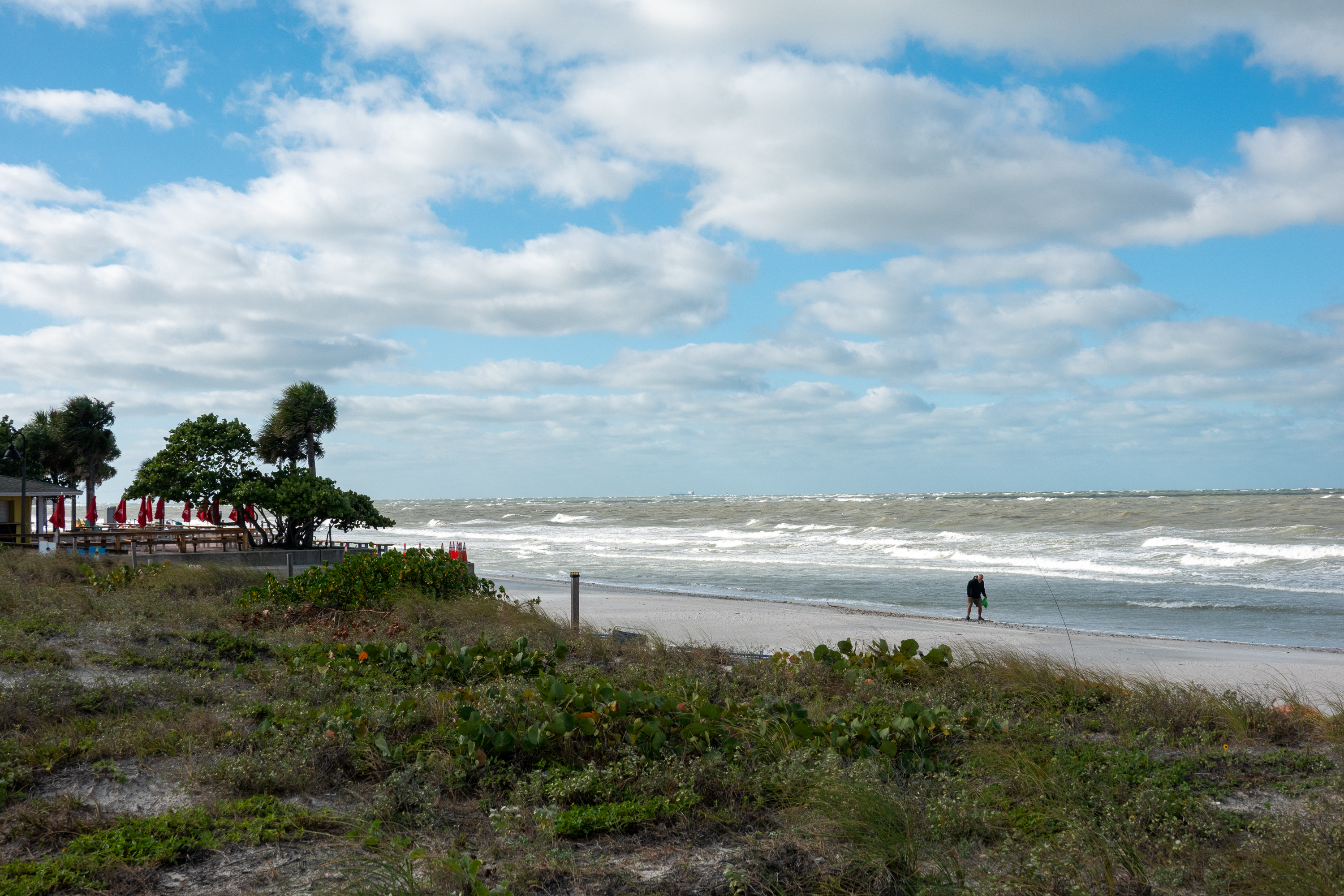
After a quick visit to St. Petersburg, where it was cool and windy and rather spoiled Denise’s beach walking plans, we headed north by stages.
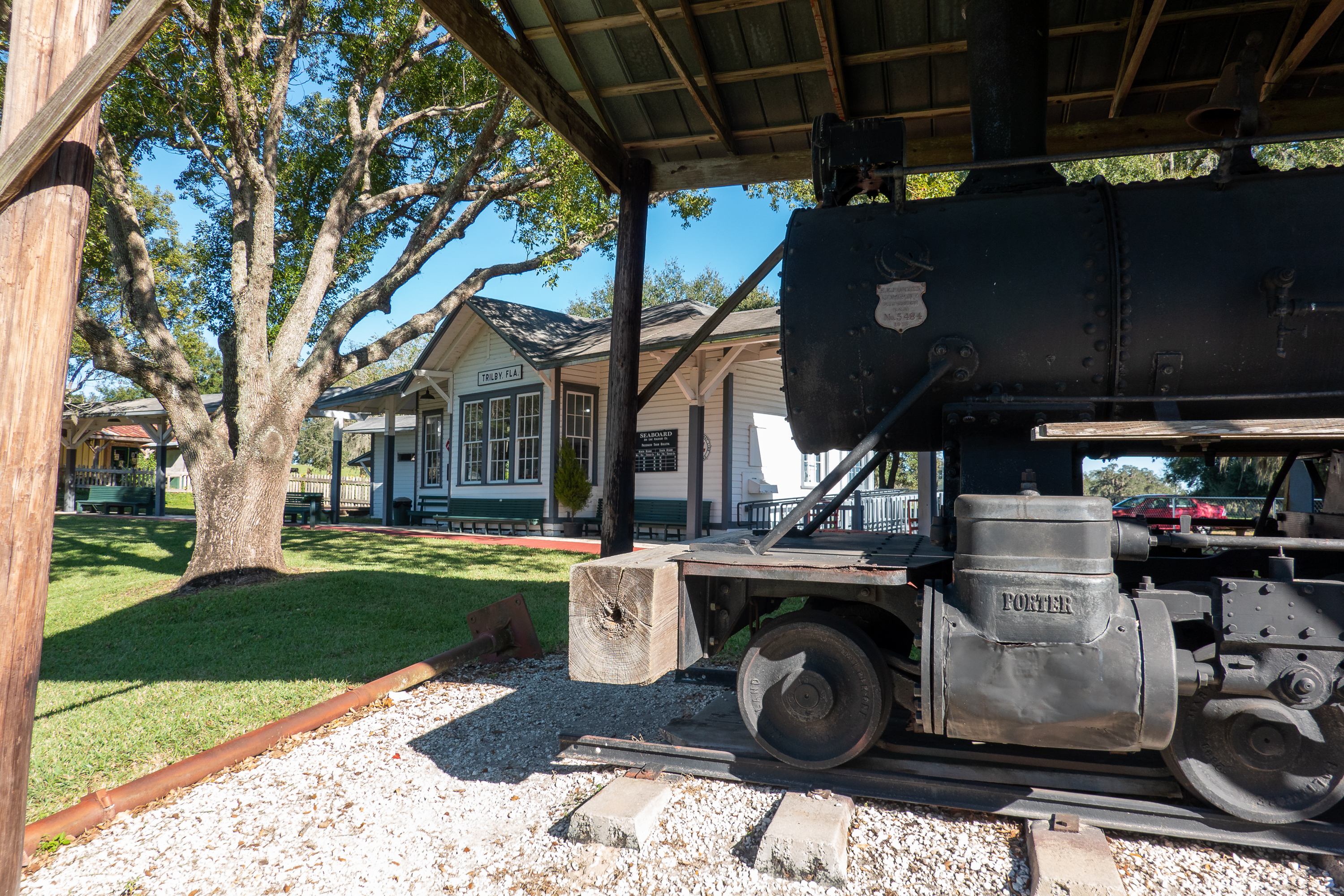
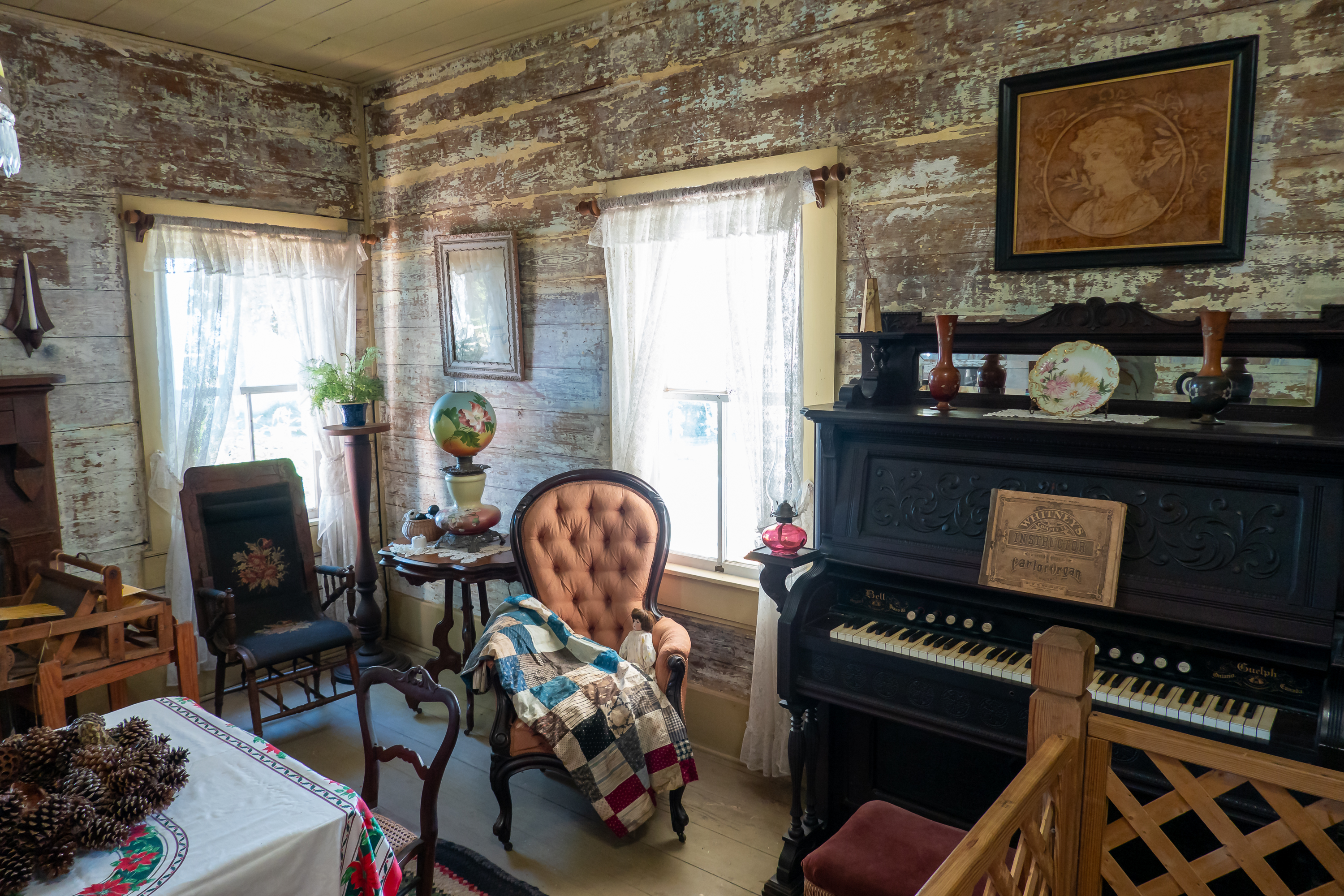
Our first stop was the Pioneer Florida Museum, near Dade City. A low-key, open-air collection of historic buildings. Some nice insights into the old citrus industry and an insane collection of old Lionel electric trains! (Fred always had American Flyer, but, you get the idea.) (Pioneer Florida Museum, Dade City, Florida)
Trains moved citrus and timber
Citrus Packing Plant
We always visit the old houses
Then on to to Colt Creek State Park to relax and do some bicycling. It proved to be a lovely spot and we enjoyed it although again, it was surprisingly cold.
Fred is getting to the point that he can assemble both bikes in about 20 minutes.
Out of Florida, we stopped at Fort McAllister State Park, just over the border with Georgia. (Fort McAllister State Park | Department Of Natural Resources Division (gastateparks.org) We have stayed here a couple of times and enjoy bicycling around and visiting the fort. Finally, after with another quick overnight at Hinnant Farm Vineyard and Winery, we were back home in Arlington.
Our initial plan was to go to the Hovenweep ruins as we headed west, so we went south to a very nice campsite on the edge of the Rio Grande to catch up on chores and evaluate the tales of heat that we were hearing from the news and friends in the west. After considerable research, we decided that this was not the year to head west and that the Upper Peninsula of Michigan sounded like a better idea. So, we retraced our steps and, after another night spent outside Leadville, we headed north-east to a town campground in Brush, Colorado. Surviving this night proved our decision was wise. It was hot, over 100F, and the Blue cat was so distressed that we had to hold him under the tap and cool him off in front of his personal fan. All the while, our air-conditioning labored to bring the temperature down to 85F inside the camper. It was an unpleasant evening, and we were happy to continue heading north the next day.
Moving on into Nebraska and Iowa, we again used Harvest Hosts for some fascinating overnights. The Anchor Meadow Farm in Milford, Nebraska, raises a specialized breed of pig and chickens and we enjoyed roaming, watching the evening feeding as all the pigs rushed to the meadow fence at 5:00 PM. (Be impressed; our first attempt at embedding a video.)
Blue cat met chickens for the first time and was not impressed. Our generous hosts gave us power for the night and we enjoyed a night of air-conditioning. The meat and eggs we purchased were wonderful. While in Nebraska we stopped at the Homestead National Monument. Who knew that homesteading started with Abraham Lincoln and continued until 1969? Quite fascinating.
The museum looks out over the prairie. Very symbolic.
Homesteader’s cabin.
In Iowa, we stayed at the Wolf Creek Trail Ranch in Anthon, where it was wonderfully cool at last! We also enjoyed a highly caloric visit to Le Mars, Iowa, Ice-Cream Capital of the World, and specifically to the Blue Bunny Ice Cream Parlor. Every Blue Bunny flavor was in view and the number of sundaes and milk shakes available quite made it difficult to choose. But we did, and sat down to enjoy it! It was well worth the visit!
Tasted as good as it looks.
On into Minnesota, we saw our first lake at the Split Rock Creek State Park in Jasper, Minnesota. Well, it is supposedly the land of 10,000 lakes and we did see many more! The state park was small and pleasant, and we enjoyed our stay. We admired the Prairie Hill, which inspired the park’s creation, and which is believed to be an authentic prairie hillside. We visited the Pipestone National Monument nearby, the source of sacred red pipestone quarried by many Indian tribes for making pipes.
We wandered the trail, admired the quarry rock face, the prairie area and visited the waterfall.
You can see the red sandstone everywhere.
Fred marveled at the inscription left in the 1800’s.
The explanation helped a lot.
We made a brief stop in New Ulm, Minnesota, in search of German food. We were not particularly successful, but but we visited the Hermann (Arminius – hero or villain of the Teutoburg Forest victory/massacre ) (https://en.wikipedia.org/wiki/Battle_of_the_Teutoburg_Forest) Fans of the TV series “Barbarians” will know at least one version of the story. New Ulm was a “Turner” community, founded by German socialists in the wake of the revolutions of 1848. (https://en.wikipedia.org/wiki/New_Ulm,_Minnesota) We visited the Carillion and the Hermann Heights monument.
Our next stop was Minneapolis so Denise could ride the river boat at Sweetwater. We ended up taking a most pleasant evening supper cruise and even found a parking lot beside the river where we could park to ride our bicycles.
New Bridge to Wisconsin.
We returned the following day and, as rain threatened, we rode across the new bridge into Wisconsin, took the bike trail back to the old bridge, and crossed back to Sweetwater for a pleasant outdoor lunch. We got back to the truck and loaded up just as the rain began!
Our next stop was to be Duluth but we were unable to get a camping reservation for the Saturday night, so we headed back into Wisconsin for another winery stay, this time with live music. We should have stayed here in the first place!
Play that funky music, ol’ boyz! And the gentleman on the right even has an Ovation, similar to mine. (He just plays it better.)
We continued to Duluth on Sunday to the Waterfront RV Parking at the Lakehead Boat Basin. (http://www.lakeheadboatbasin.com/rv.html) This proved to be a wonderful find, a marina with RV parking on the water. During the winter, the space is used to store boats, but in summer it was an amazingly pleasant little park.
Our stay included a great Italian meal, bike rides along the lake, and lots of ore carriers going through the raising bridge with loud horns on both the bridge and the passing ships.
Bridge down.
A couple went through at 5 AM which was exciting. We loved it!
The ore carriers are enormous and sized to fit the locks exactly. Lake ships are divided in to “Lakers” and “Salties” – ships that go all the way to the Atlantic.
We never pass up a railroad museum. Duluth’s museum is a bit different as it has exhibits dedicated to all of the women, wives and fiancées, who came as immigrants to join their husbands and boyfriends working in the mines. They were detained at the station until someone came to pick them up. And, of course, great trains from different ages.
The classic 4-4-0.
Dinner is served.
We had decided to come to the Upper Peninsula of Michigan (UP) seeking cooler weather. But, without camping reservations. This proved to be a bit challenging, and we found ourselves constrained by reservation options. All the State Parks and most of the town camping parks were full. But it all worked out. As Canada was still closed, we headed east to Ontonagon Township Park, where the campsite assured us that if there was a space available, they would save one for us! A little nerve racking but we drove there as quickly as possible with our fingers crossed. And indeed, we were given a space, not beside the lake, but close by in the forest. We biked into the town a couple of times and had a great visit to the Adventure Mining Company copper mine in Greenland. (http://www.ontonagon.net/adventuremine/) It was our first visit to a copper mine, and we learned all about it! Amazing to consider that the copper can actually be too pure and the nuggets too large.
Narrow Gallery
Large Room
Air Drill
We made a brief stop in Marquette for a wonderful Mexican lunch on the deck overlooking the town, a visit to the first ore dock, the one that established the standards for ore transport on the lakes.
The railway tracks led to the top. The train dumped its ore and then, when ships tied up, the ore flowed by gravity through the chutes on the sides. Simple, fast, and effective.
We then drove on to our next stop, Munising. We had managed to get a reservation for several nights, including July 4, at the KOA campground, albeit in two different sites. The weather was still quite hot, but the sites were fairly shady, and we were able to keep Blue cool. Munising proved to be a great base and we enjoyed our time there. The only pity is that the campground was on a narrow, very busy two-lane road with rumble strips on the shoulders, which made us reluctant to use the bicycles.
Two boat rides, one to look at various wrecked boats and another one to view the Pictured Rocks National Park from the water were fun. (Click for captions and full size images.)
The boat ride to the Pictured Rocks proved to be the right choice as you cannot really see the colors from the cliff tops. (https://www.nps.gov/piro/index.htm) We also visited a waterfall or two and enjoyed miniature golf for the first time in years. The ice-cream shop at the miniature golf course sold us an ice-cream flight which was a wonderful idea! We also tried the local specialty, a pasty, which we found rather heavy. We much prefer the ones sold in Devon and Cornwall in the UK. On the other hand, we loved the white lake fish and chips we bought from a food truck(!) – it was simply amazing.
Fred wanted to go to the Great Lakes Shipwreck Museum in Whitefish Point. And as we did not want to drive there and back, we found a most interesting campground called Kritter’s Northcountry Campground. (https://www.northcountrycampground.com/ ) Although full, they agreed to give us a tent site, so before our arrival there, we seized the day to visit the Seul Choix Lighthouse. (http://www.greatlakelighthouse.com/) Unfortunately, the ghosts took the day off, but it was a most interesting visit and we climbed to the top of the tower to admire the view.
We also went to Palms Book State Park near Manistique, where a Big Spring (Kitch-iti-kipi) has a large raft which can be moved across and back by means of a large wheel and some tourist muscle power. (https://www.michigan.org/property/palms-book-state-park)
We were early enough to walk onto the raft though by the time we left there was a considerable line. (Did we mention the crowds everywhere?)
The Great Lakes Shipwreck Museum has displays of various shipwrecks including the Edmund Fitzgerald, which has always interested Fred because of the song by Gordon Lightfoot. We were there nice and early and were absolutely stunned by the number of people who found their way to it.
By the time we left, it was packed with people and parking was difficult. (https://www.shipwreckmuseum.com/) (And yes, the Edmund Fitzgerald is still sunk.) We then wanted to visit the Taquamenon Falls and could not even get into the State Park, let alone park there. Cars were lined up on the entry road outside. It was becoming clear that after the July 4 holiday, tourism had increased in the area and that it was time for us to head south and home. Also, the weather had turned rainy and cold, and we crossed the Mackinaw Bridge, saying goodbye to the UP.
We stopped in Petoskey, Michigan to spend the night at the Boyne Valley Vineyards. (https://boynevalleyvineyards.com/) What an amazing place! Our designated camping spot was deep in the woods and we happened to hit the night when the Petoskey High School Alumni Steel Band was performing. So, not only did we enjoy tasting great wine and flatbread, but we got to hear a wonderful concert (and a free hotdog!). Altogether an amazing experience. Oh, and the wine was good as well.
We stopped off at the Historic White Pine Village and had a great time learning about the lumber industry and chatting with Civil War reenactors. (https://historicwhitepinevillage.org/)
After another night spent at Christofferson Fruit Farms in nearby Ludington, we continued south to the Detroit area, where Fred had plans to visit a guitar playing friend.
Running early, we stopped off at an outlet mall for some shopping. As we were leaving the clutch suddenly dropped right to the floor – we were immobile. Panicked telephone calls to our mechanic friends (Thank you, Rob!) ensued. Worse, all of the local tow companies told us that, as it was a Saturday night, tows weren’t available. In the middle of all of this, a gentleman walked up and said that he owned an expedition camper company, about a mile away. His company turned out to be Adventure Mobil and he had even visited our Tiger at a show some years ago. (https://www.advmobil.com/) Would we like some help?
Would we? We jumped at the kind offer. So, his friend, visiting from Tennessee quickly pulled the cab apart and diagnosed the problem as a small, broken piece of plastic in the clutch linkage. What to do? “Oh, I’m good at speed shifting, I’ll just drive the truck to the shop and we can fabricate a new piece.” And he was a good as his word. Denise was impressed, hills and crossing a four-lane road notwithstanding, he only stalled once. (Fred is now practicing speed shifting!) Once at the shop, the troops turned to and, in an hour or so, had fabricated a replacement part out of a billet of aluminum – even stronger than the original! As they refused any payment, we took the troops out to dinner.
After the repairs were finished, they offered us a wonderful overnight camping spotand we all settled in for a snooze. Sometimes the overland gods are kind!
As we decided to travel in the US again this year, we set off at the end of May, full of plans to visit Colorado, Nevada, California, and perhaps, Oregon, before returning via Canada. Enough said! Some of that worked, most of it did not, but we had a great trip anyway!
We started out a bit late, at the end of May, due to some commitments in Arlington and headed west. Our first two nights stays were courtesy of Harvest Hosts and we enjoyed sampling the wine at Christian W. Klay Winery http://www.cwklaywinery.com/wines/and Ravens Glenn Winery https://ravensglenn.com/. We also paid a visit to the Fort Necessity National Battlefield https://www.nps.gov/fone/index.htm.
A reconstruction, of course, but it wasn’t much when it was built. Depending on who you believe, George Washington may have single handedly started the French and Indian War here.
As a friend of ours put it, there is not much there! But we enjoyed our visit to the reconstruction of the site and to the excellent visitor center, and we chatted with several of the rangers who came to see our “strange” camper.
The French lines are believed to have been at the present tree line.
Next up was a visit to friends in Columbus, Ohio. We then continued our trip west with a night at the Tuscan Hills Winery https://www.effinghamwinery.com/. And on into Kansas which can be such a big state to cross! The fan in the bathroom died at this point, which was annoying as we use two fans to keep the camper as cool as possible for Blue, our cat. So we went to a Camping World, found one last fan on their shelves and bought it quickly! We then spent a couple of nights at the Kansas City East/Oak Grove KOA where Fred spent an entire day removing one fan and installing the new one. Murphy was, as usual, alive and well, but was vanquished in the end!
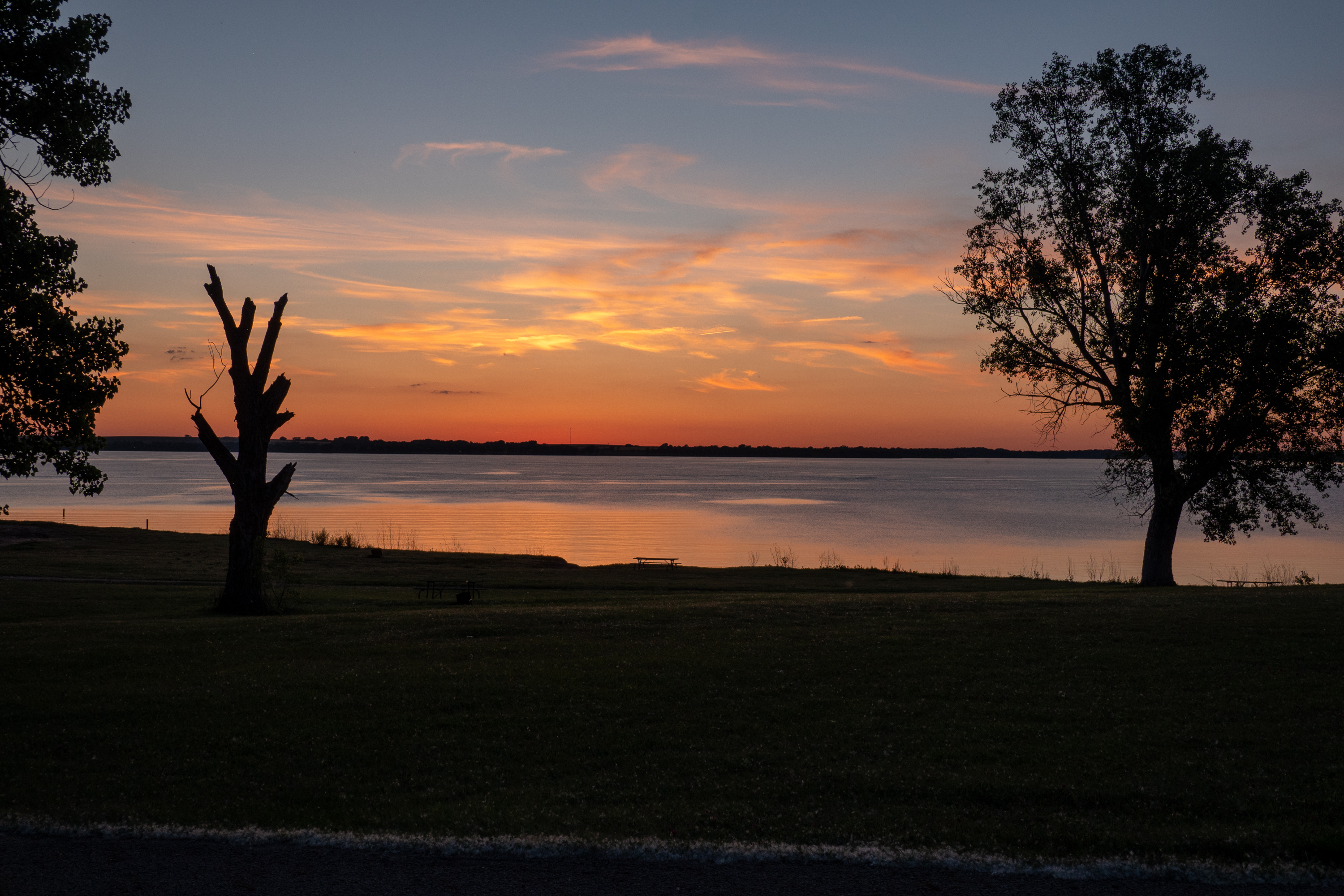
After this trauma, we gave ourselves a break and camped for two nights at the Kanopolis State Park in Marquette, Kansas. Our campsite had a beautiful view of the reservoir and sunsets looking across it.
Yes, we really are in Kansas!
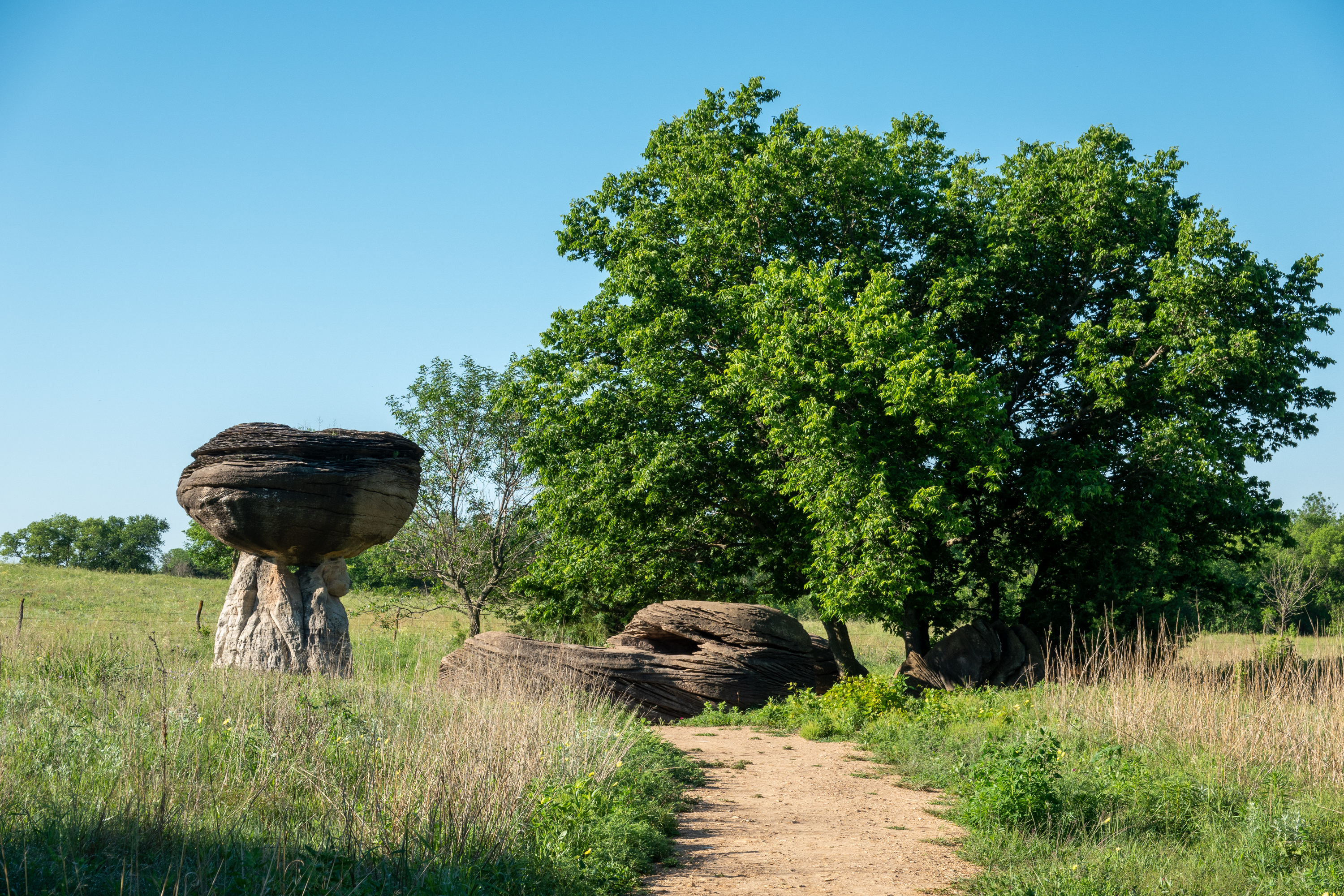
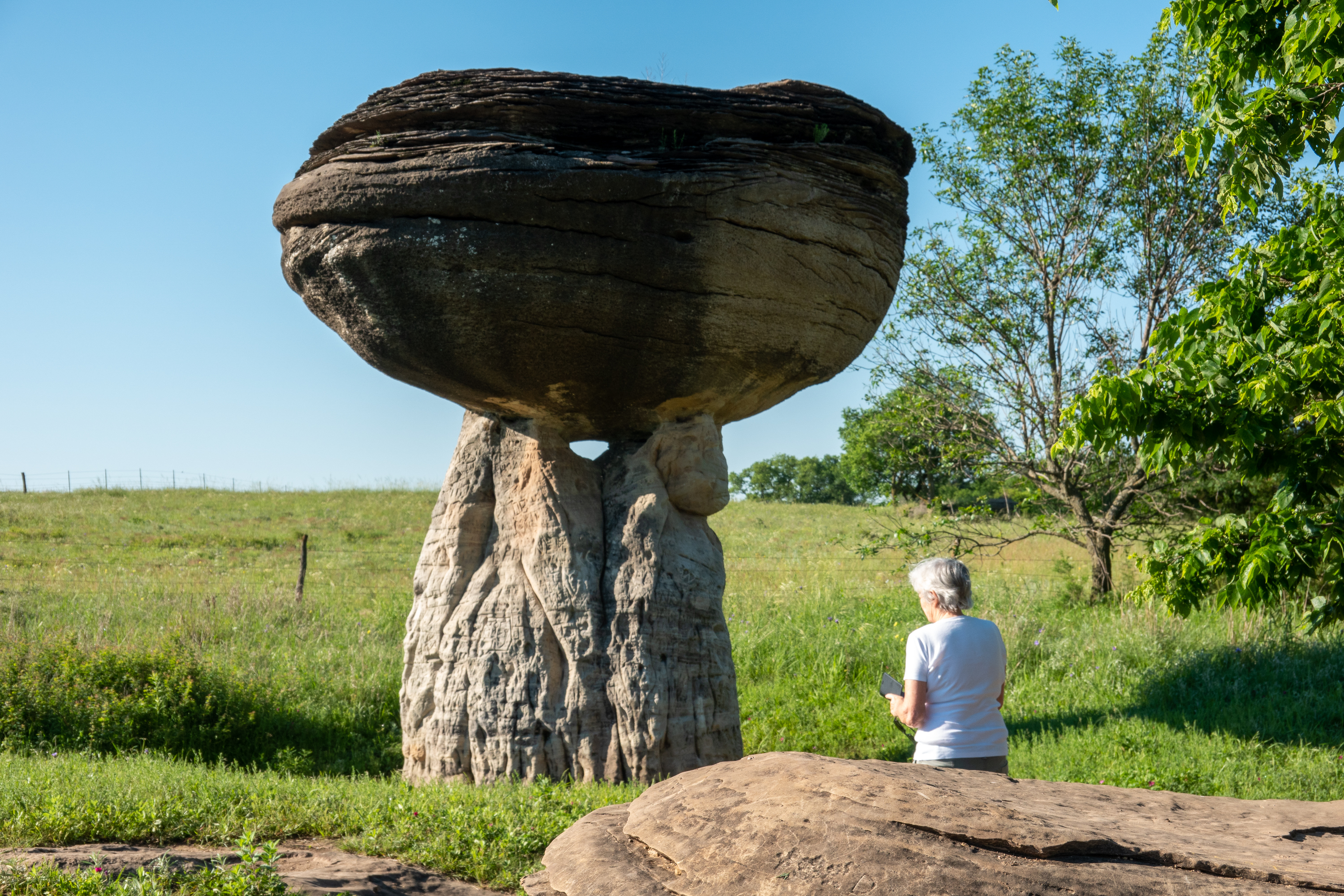
We enjoyed some bicycling in the park, especially the ride across the dam. As we headed out, we also visited Mushroom Rock State Park. Just up the road but, unfortunately, too far to bicycle. This is a very low-key park with some amazing rocks that look like, well, mushrooms! Quite fun.
Denise contemplates a magic mushroom.
There were actually people wild camping here. It was really very pleasant.
Still enroute for Colorado, we set off again and were horrified to discover a window had been sucked out of the camper by a tractor trailer which cut in close while on the interstate. We can only suppose that we had not latched it correctly. A trip to a wonderful and helpful ACE hardware store in Colby, Kansas (https://www.acehardware.com/store-details/17353) produced a sheet of plexiglass to fill the hole until we can obtain a new pane. (Three months later we think we have found a vendor in the UK and we await shipment, we hope!! Further update – the windows arrived in time for Christmas.) So, minus an important window for cross ventilation, we continued onwards. (Months later we realized that we should have swapped the good window from the passenger side, where the door limits its opening, and put the plexiglass in its place! Duh!)
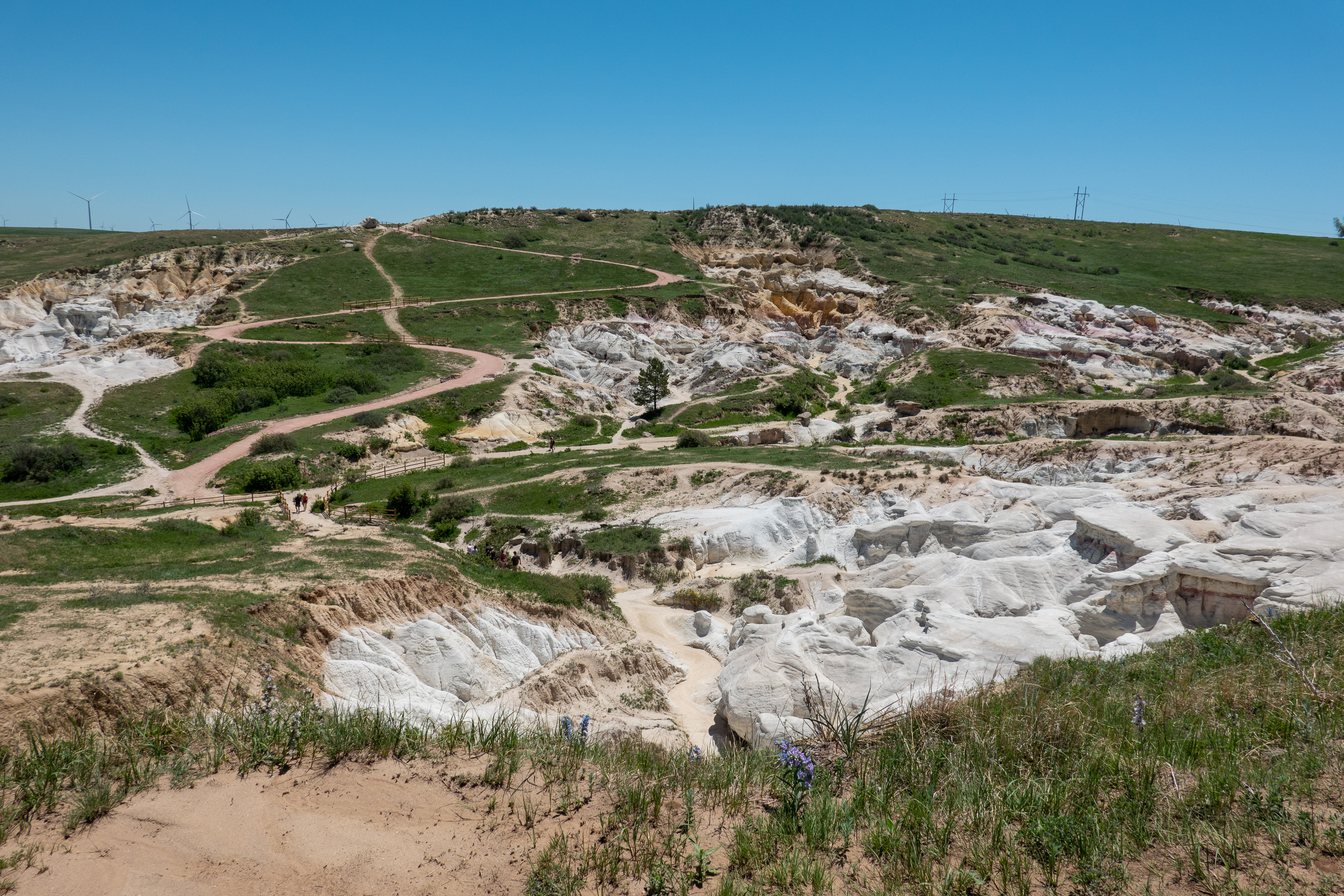
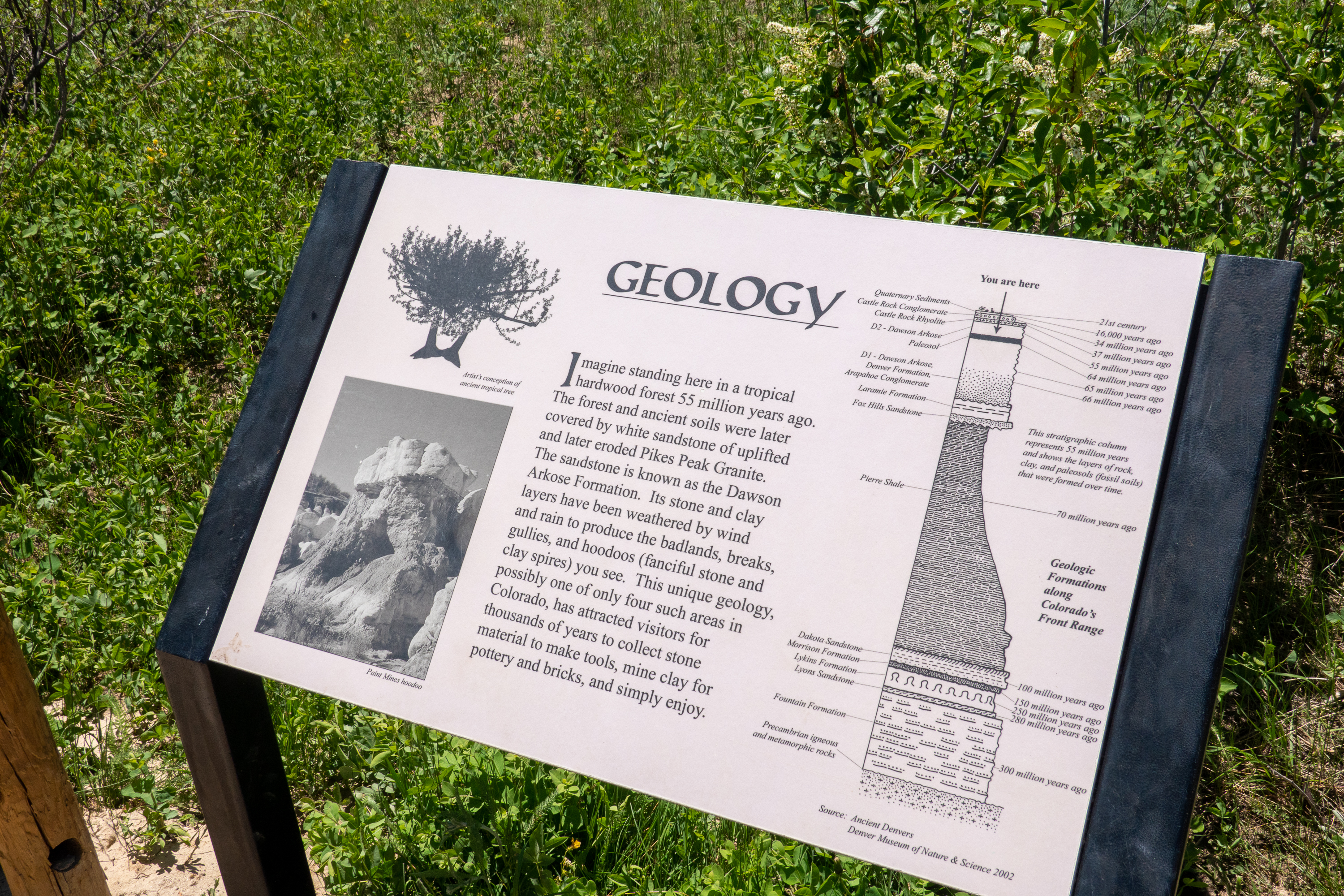
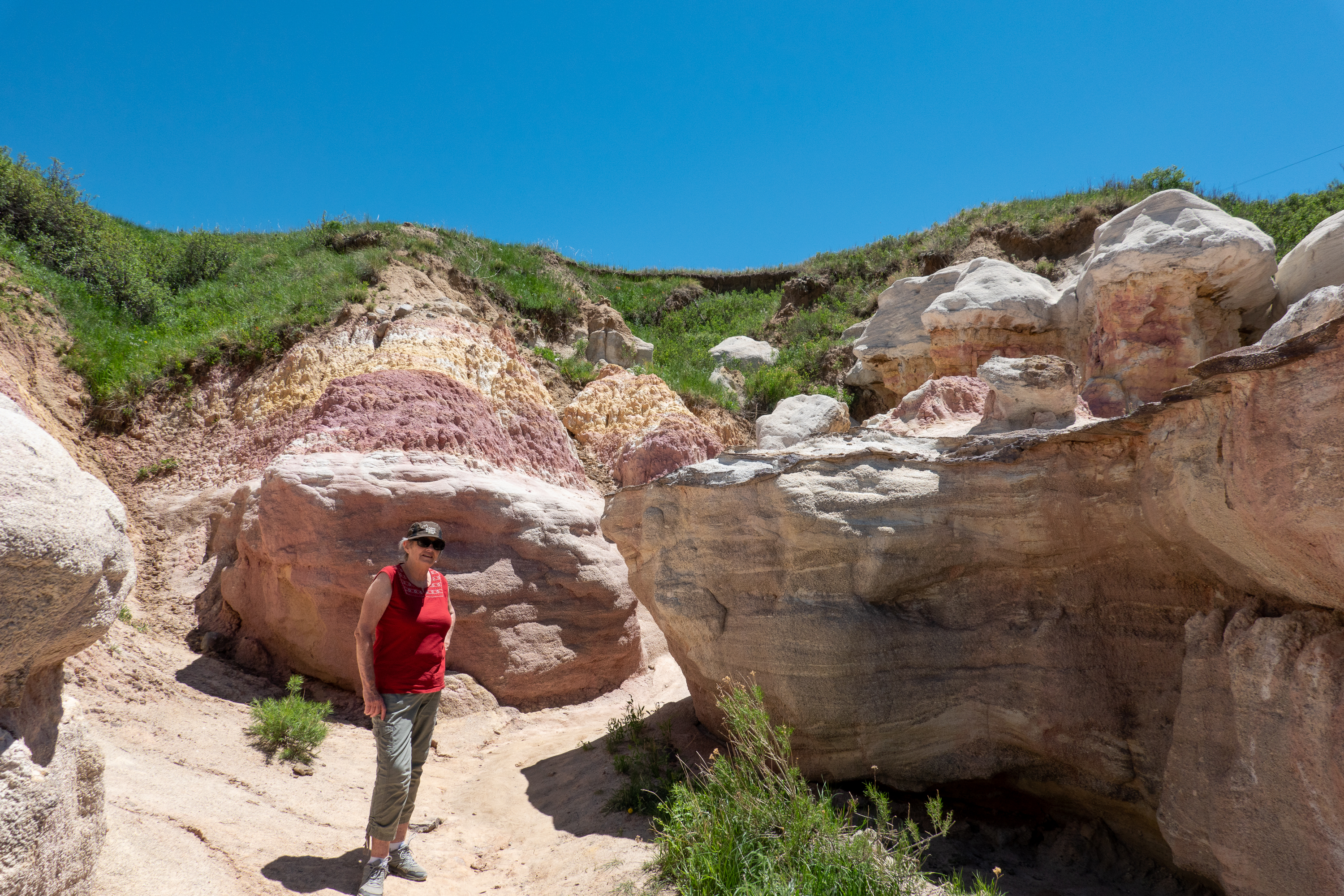
As we approached Colorado Springs, we spotted the Paint Mines Interpretive Park on the map and, as lunch time loomed, we decided to stop and explore. (https://www.visitcos.com/things-to-do/outdoors/parks-trails/paint-mines-park/) It proved to be an amazing place, a little like the Painted Desert National Park in miniature, but with stronger colors and various trails to explore throughout. A great find. Lunch was good, too.
The entire area was not that large
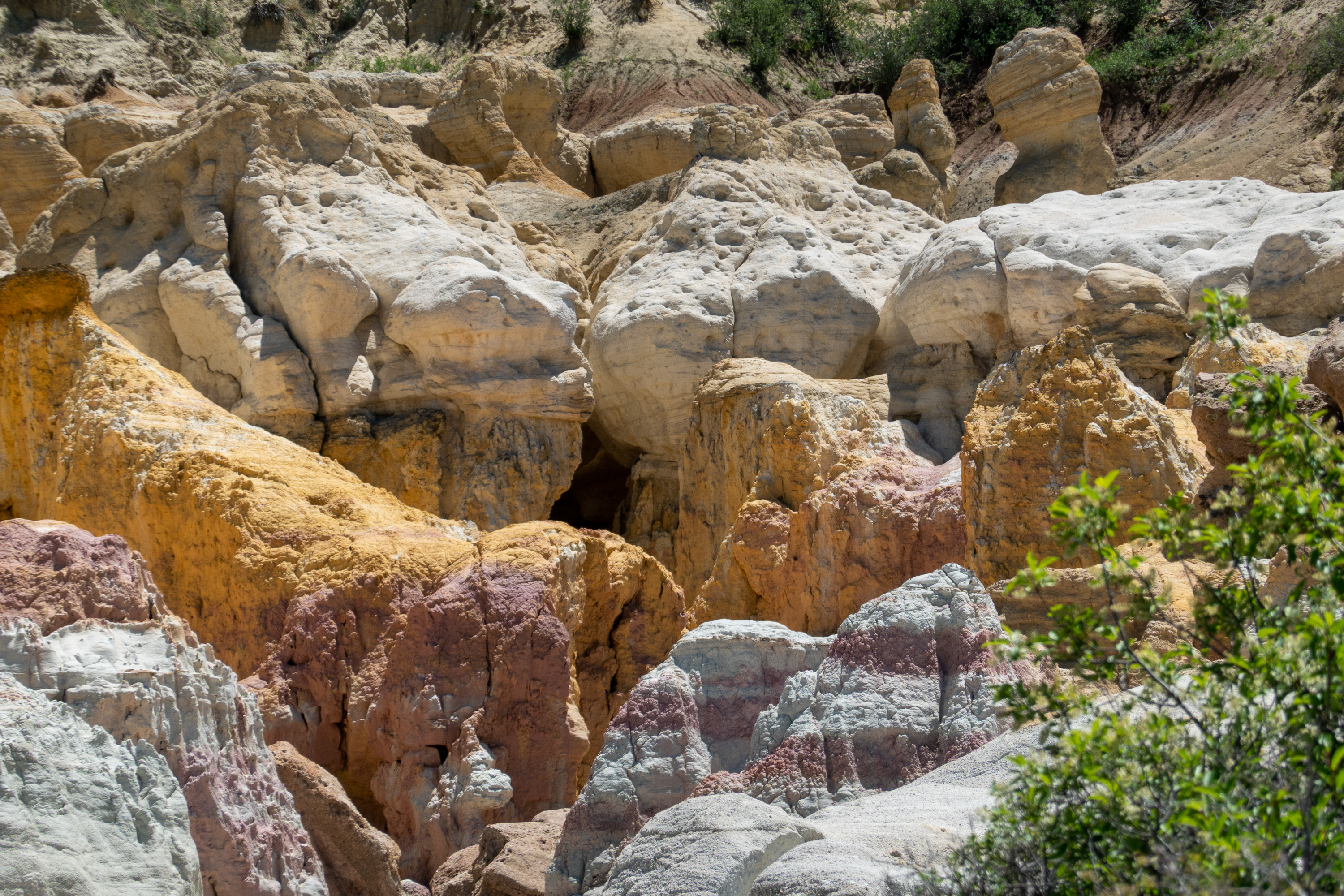
The colors were deep and amazing.
We were staying in Manitou Springs at a Boondockers Welcome site. (Boondockers Welcome has been acquired by Harvest Hosts. https://harvesthosts.com/) It is in Crystal Park, a gated community, up a steep and winding mountain road with incredible views toward Colorado Springs. It actually rivaled roads we had driven in the Andes, only there you must use your horn on the blind corners. This was not encouraged here!
Back in the 1930’s you they ran touring cars up the road which was so narrow that they used a turntable to turn the cars for the descent. But we made it up the mountain and met our wonderful hosts and settled in. We were already feeling the effects of a warm summer when in downtown Manitou Springs but found it delightfully cool at our 8,000-foot-high camping spot.
Looking out towards Manitou Springs.
An afternoon visitor.
Touring car turntable.
We had already booked seats on the Pikes Peak Cog Railway and once we sorted out the logistics of where to park the camper and where to take the shuttle, we spent an enjoyable, bright and sunny day on the mountain.
Colorado Springs below Pike’s PeakThese diesel railcars from Switzerland replaced the old steam engines.
We also visited the Garden of the Gods, with its interesting rock formations. A special treat was a concert by the Peak Horn Ensemble and Woodland Park Wind Symphony, to which we were invited by our hosts, one of whom was playing French horn in the concert. A wonderful evening which made our stay even more memorable. A tour at the Cave of the Winds completed this visit to Manitou Springs and then we headed to Leadville for the Tiger Rally.
We always enjoy Leadville and this time was no exception. We camped in the diverse camping area just outside Leadville, where the cell phone reception is great(!) and then met friends in town for lunch one day before heading to Camp Hale. Some will recognize Rick and Kathy Howe, (http://www.travelin-tortuga.com/Travelin-Tortuga/index.html) and Ron and Ton Corbin. (https://travelintiger.com/) It is always fun to meet up with old friends who share our silly passion for travel.
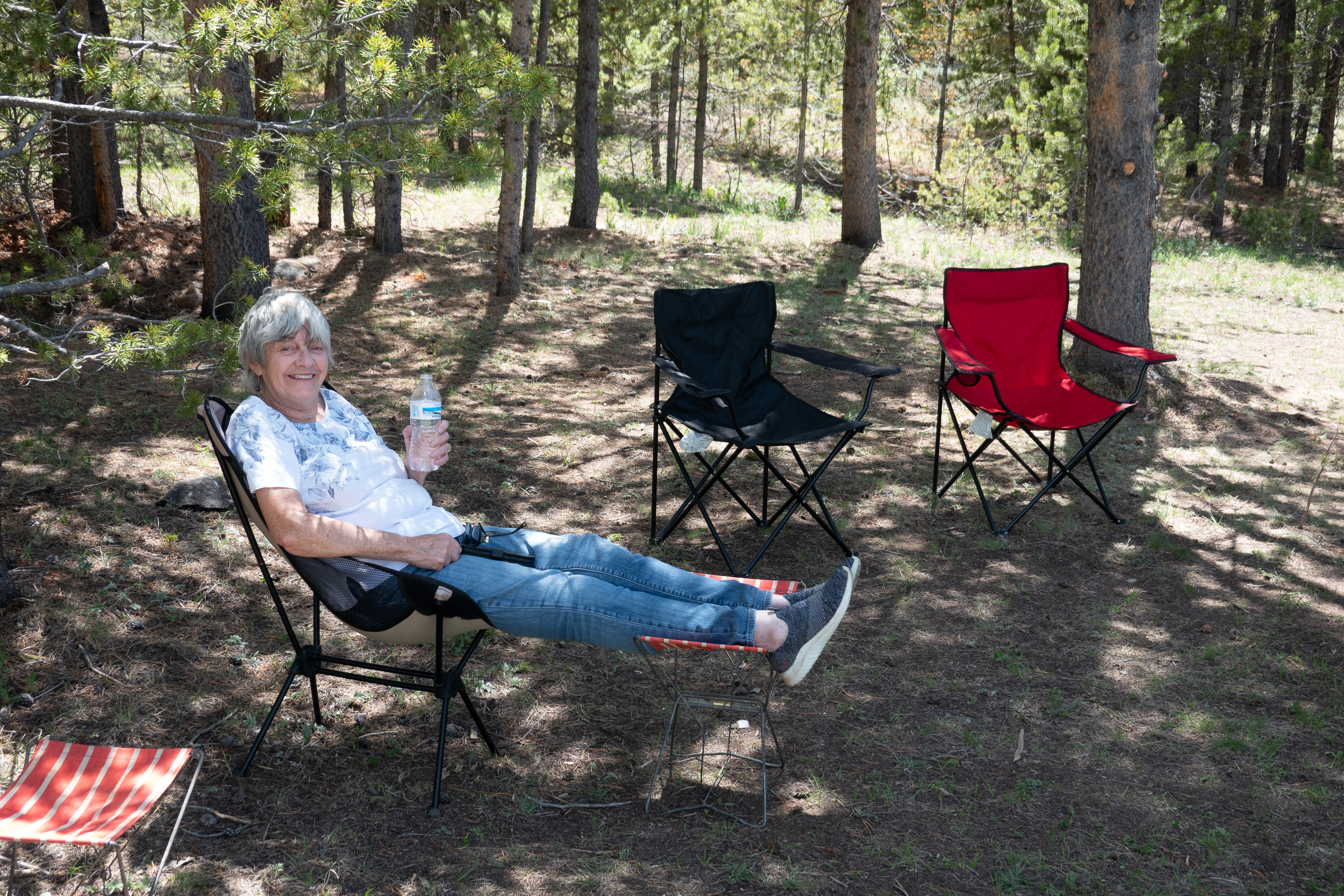
Denise keeping hydrated.
We were prepared for the weather to be chilly but to our surprise, it was warmer than we expected in Leadville and much warmer in Camp Hale. No coats or hats need apply; t-shirts were the order of the day. We enjoyed meeting old friends and current Tiger owners and hearing their news. Fred led a couple of discussion groups on batteries and how to manage them. Then it was time to head out.
Our first trip took place in early July. We went to Western Maryland where we stayed in the nicely shaded, and almost deserted campground of the Fort Frederick State Park.
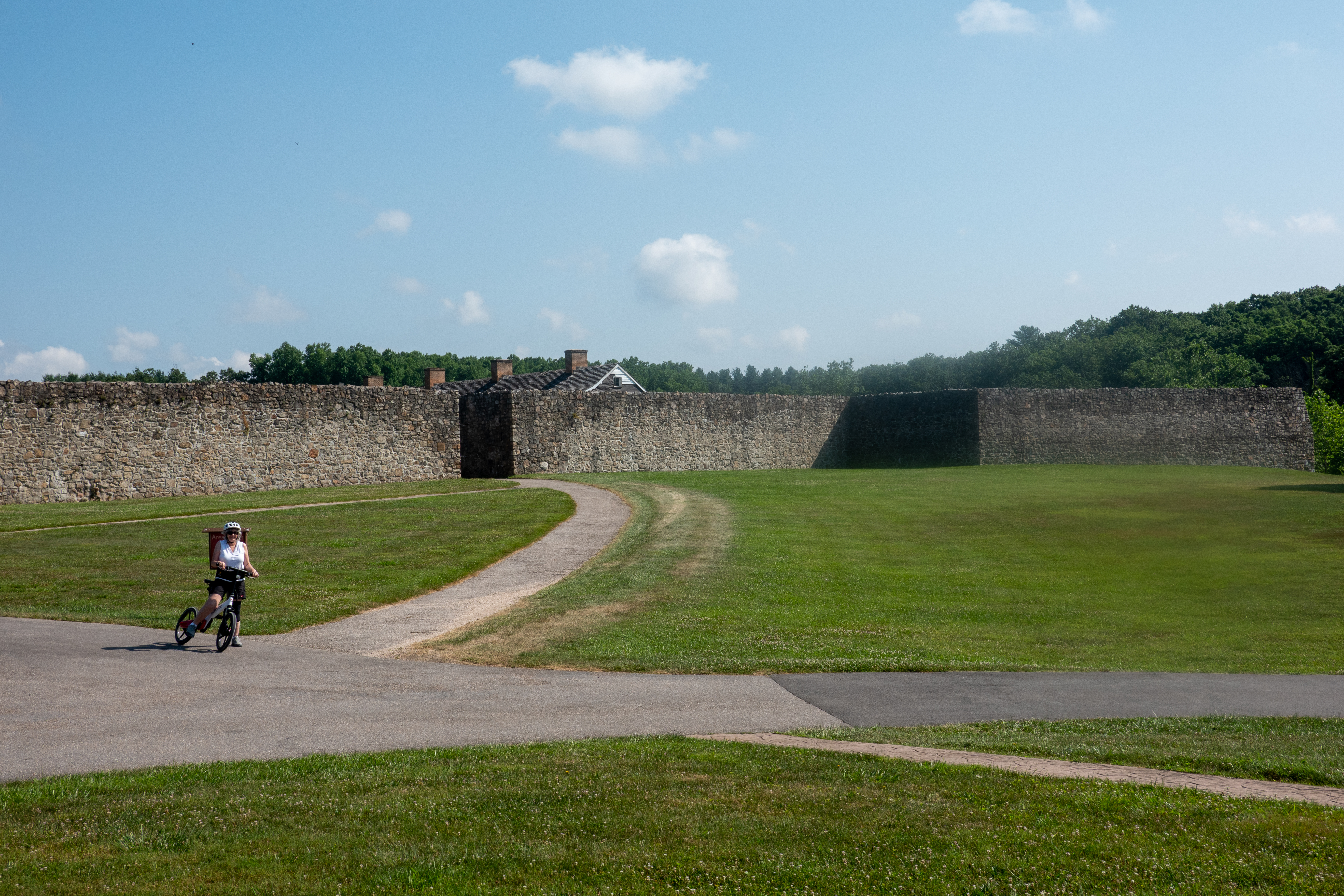
Fort Frederick was built during the Seven Years/French and Indian War. It is an amazing stone structure.
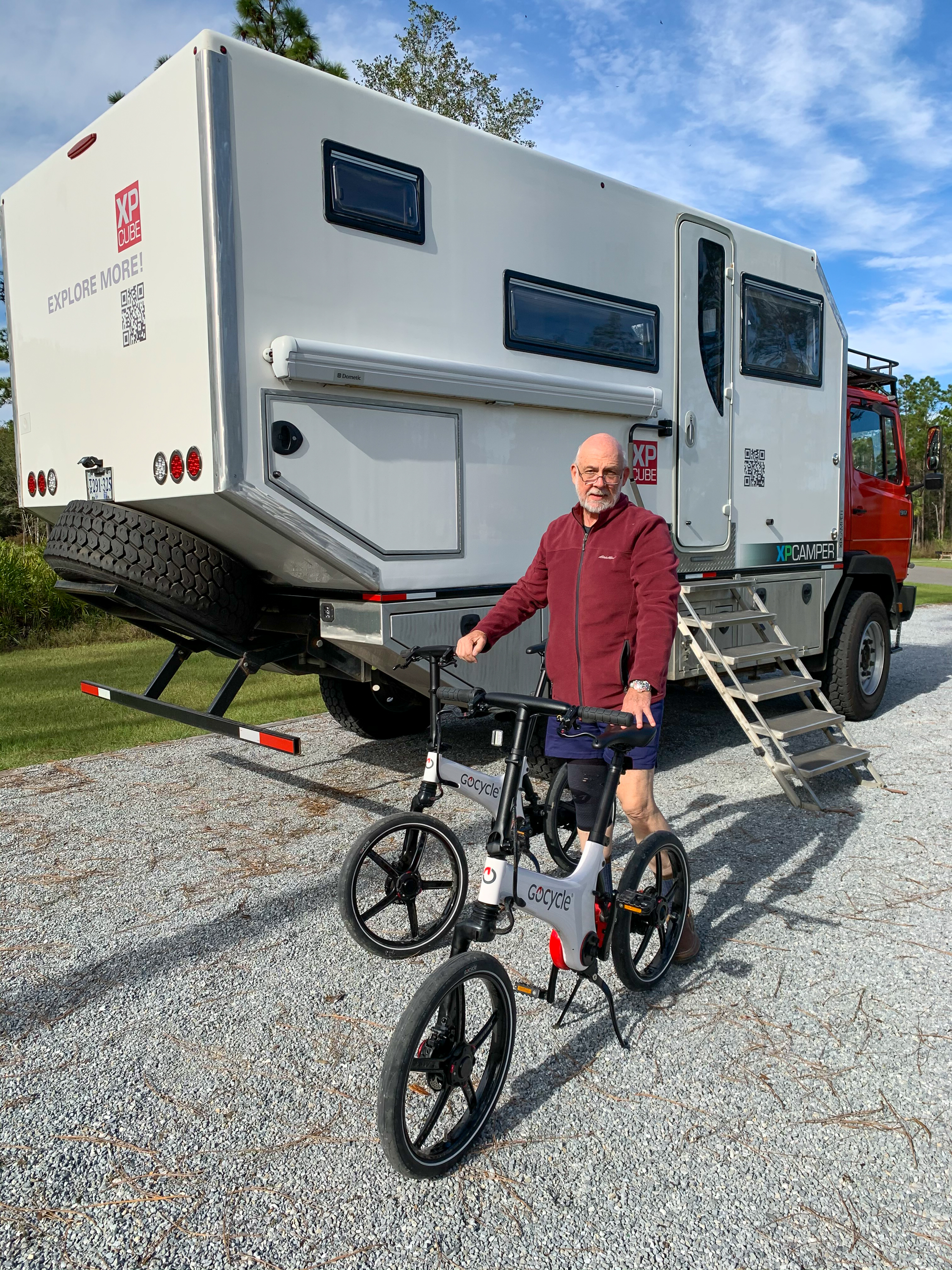
We wanted to try our new electric assist Gocycles on the West Maryland Rail Trail. We rode as far as Hancock, about 13 miles distant, on the Rail Trail which was paved and flat.
Lovely, smooth trail – except for the roots!
Knowing we would need sustenance before returning to the campground, we were interested in something cold to drink and ice-cream at the very least and possibly lunch. We found all three at Buddy Lou’s, right beside the Rail Trail in Hancock, MD. (Buddy Lou’s – Eats Drinks & Antiques) The food was amazing, both the chicken sandwich and the crab cake sandwich. And the lemonade and soft ice-cream were good too! Next time we are anywhere near Hancock we shall return! We rode back along the C&O Canal, which is also flat but unpaved, so a bit more challenging with loose rocks and roots.
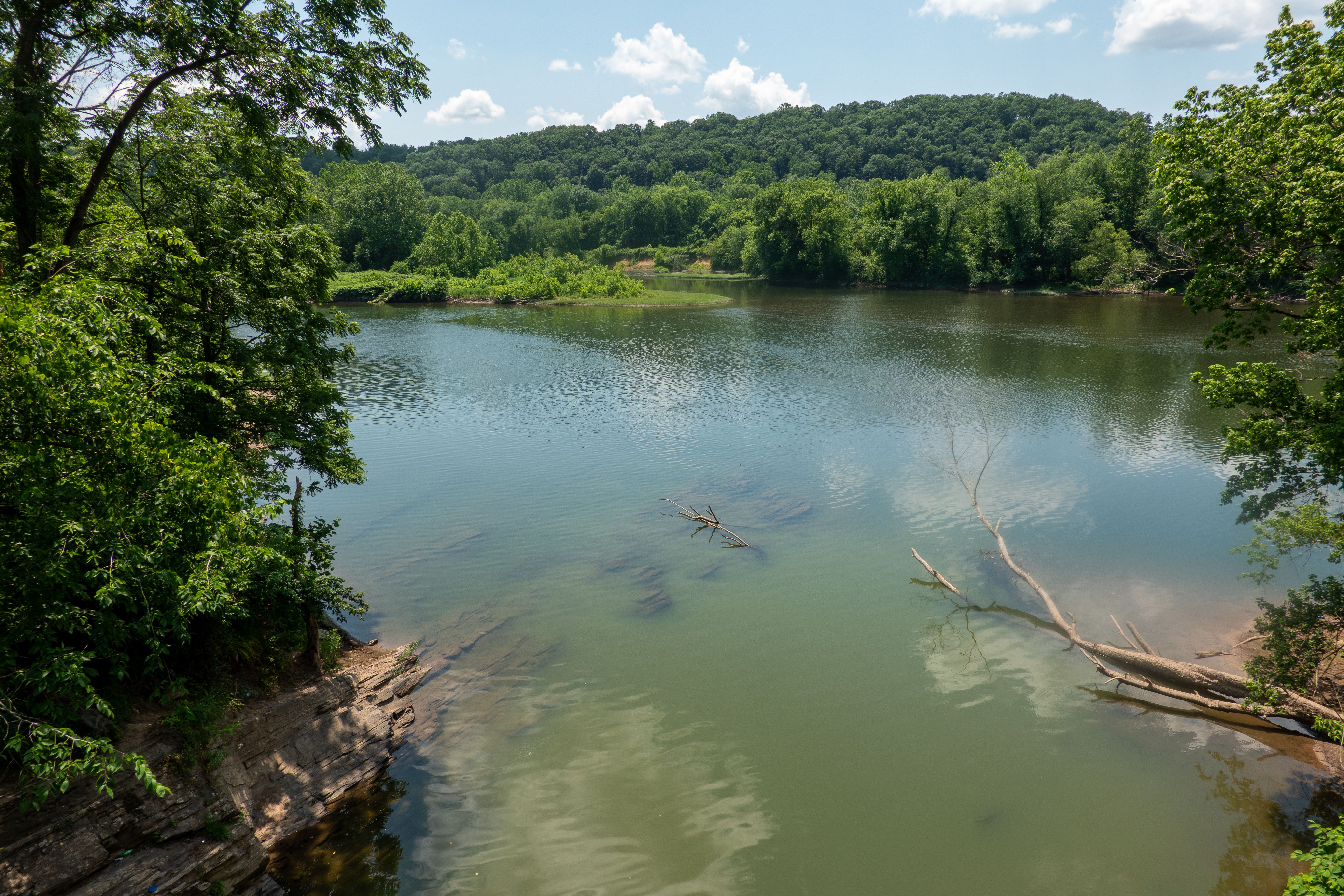
Beautiful views of the Potomac River.
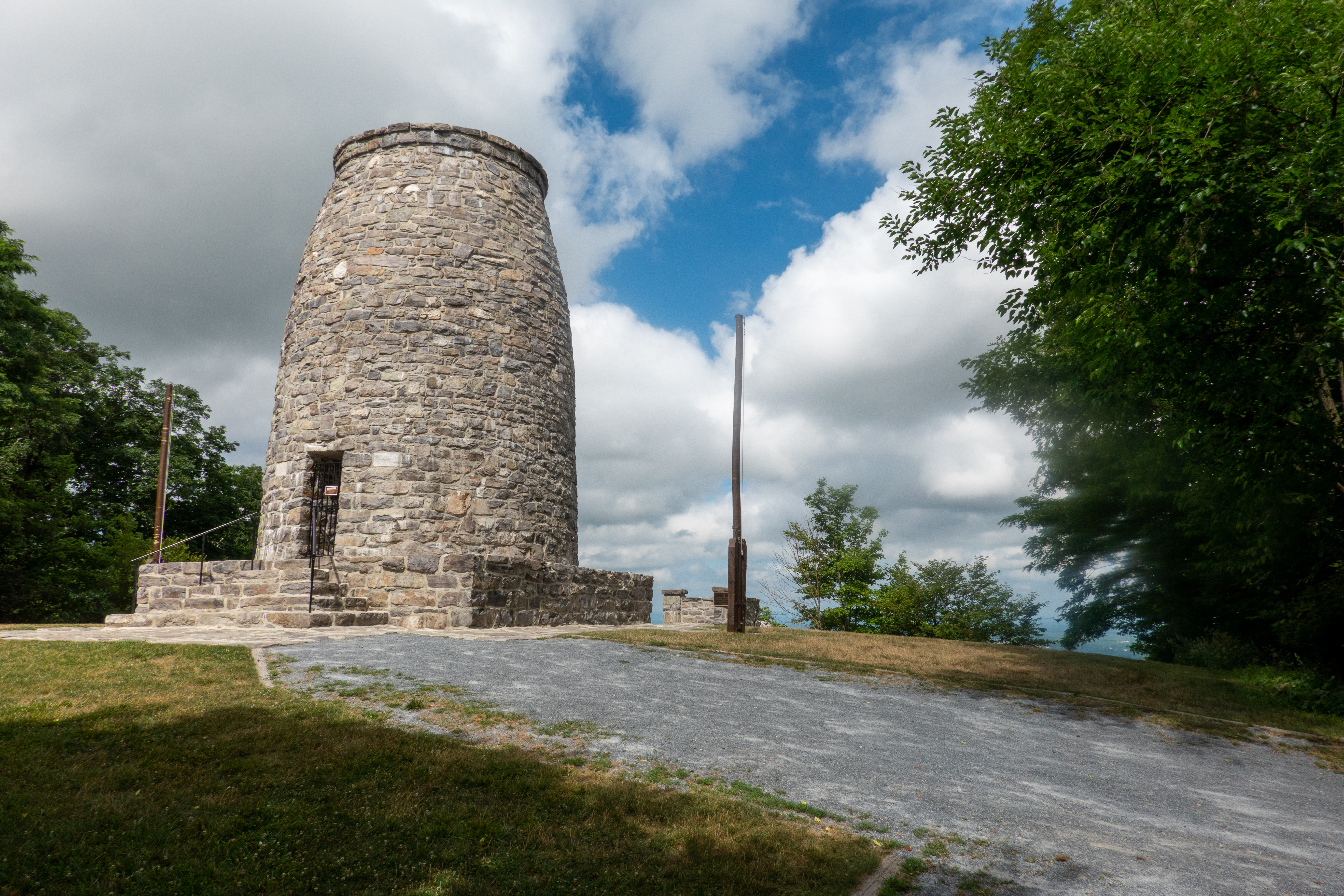
The bikes performed well and we made it back successfully. We then realized that the shade had reduced the amount of solar charging into our batteries. This was a manageable problem for the short term and we have since taken steps to improve the situation! On our way home we even stopped to visit the original Washington Monument and enjoy the view.
Believe it or not, this is the original Washington Monument.
Denise enjoying the view of Boonsboro.
Discovering West Virginia
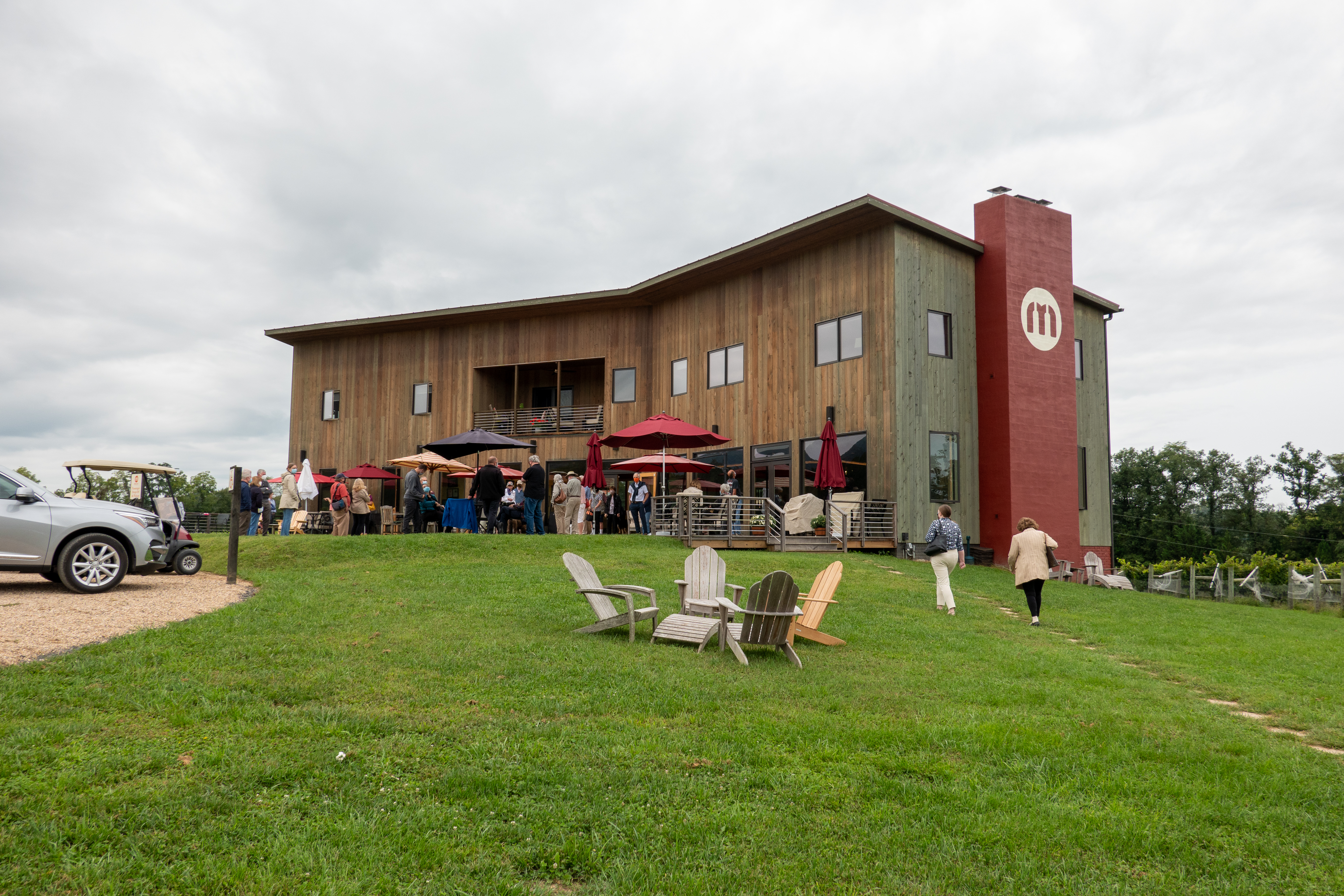
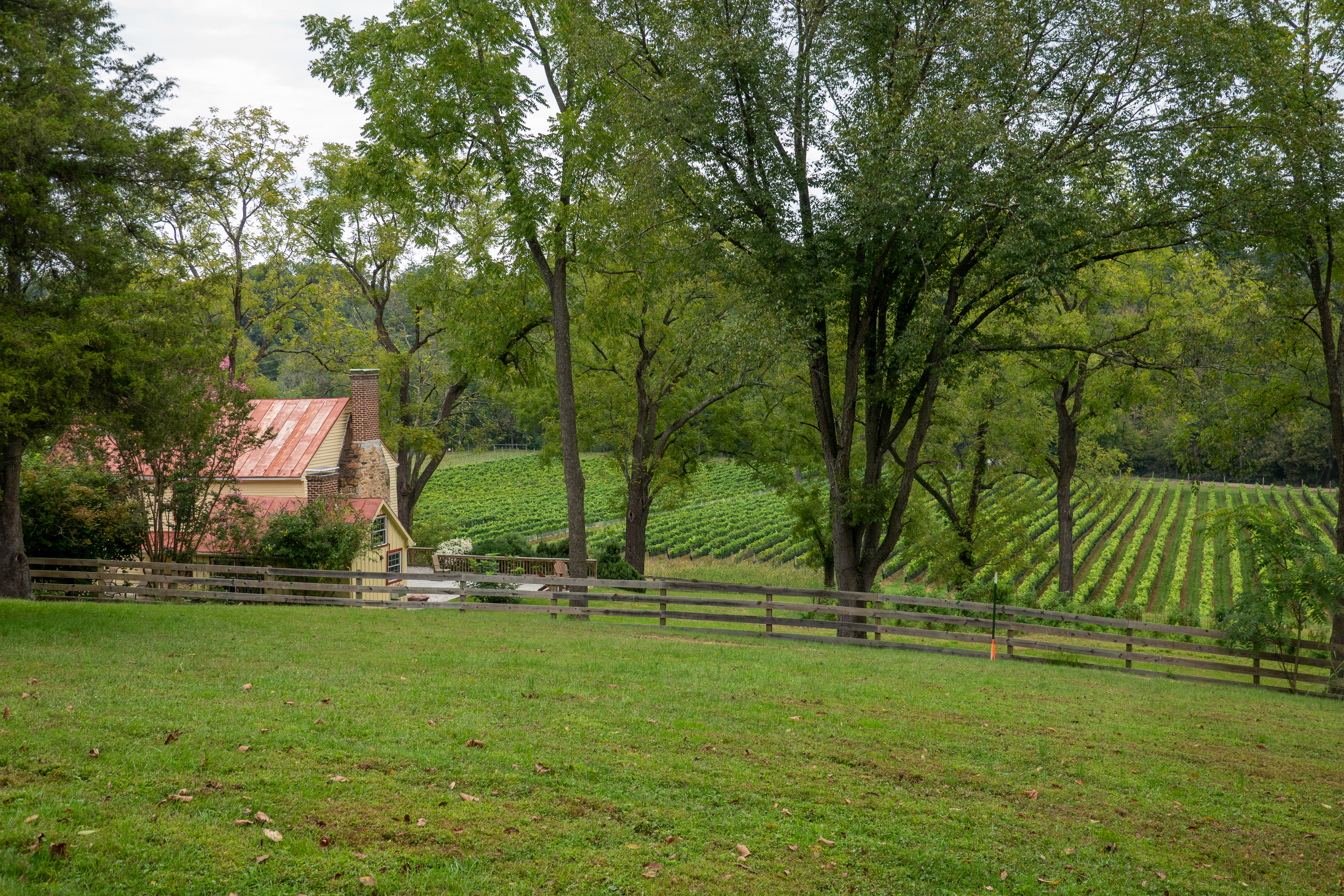
By September, we decided that we needed another short trip for our mental health, so we planned a week away with primarily outdoor activities. We started our trip at the Muse Winery in Woodstock, Virginia (Wine Tasting Near Me | Day Trips DC | Things To Do Shenandoah Valley | Muse Vineyards | Wineries Near DC | Vineyards Near DC | Wine Tasting Near Me) to take part in a lunch and tour hosted by the Foreign Affairs Retirees of Northern Virginia (FARNOVA), of which Fred is a member. It is a delightful winery, owned by a former Foreign Service colleague. It is at the end of an unpaved narrow road, with a tight, right-angled turn onto a bridge. We had been warned about the access but we had no problem negotiating it – the joys of a really short wheelbase! The wine was excellent, and of course, we bought some for our “wine fridge”.
Bunch of old Foreign Circus types.
One of these things is not like the others …
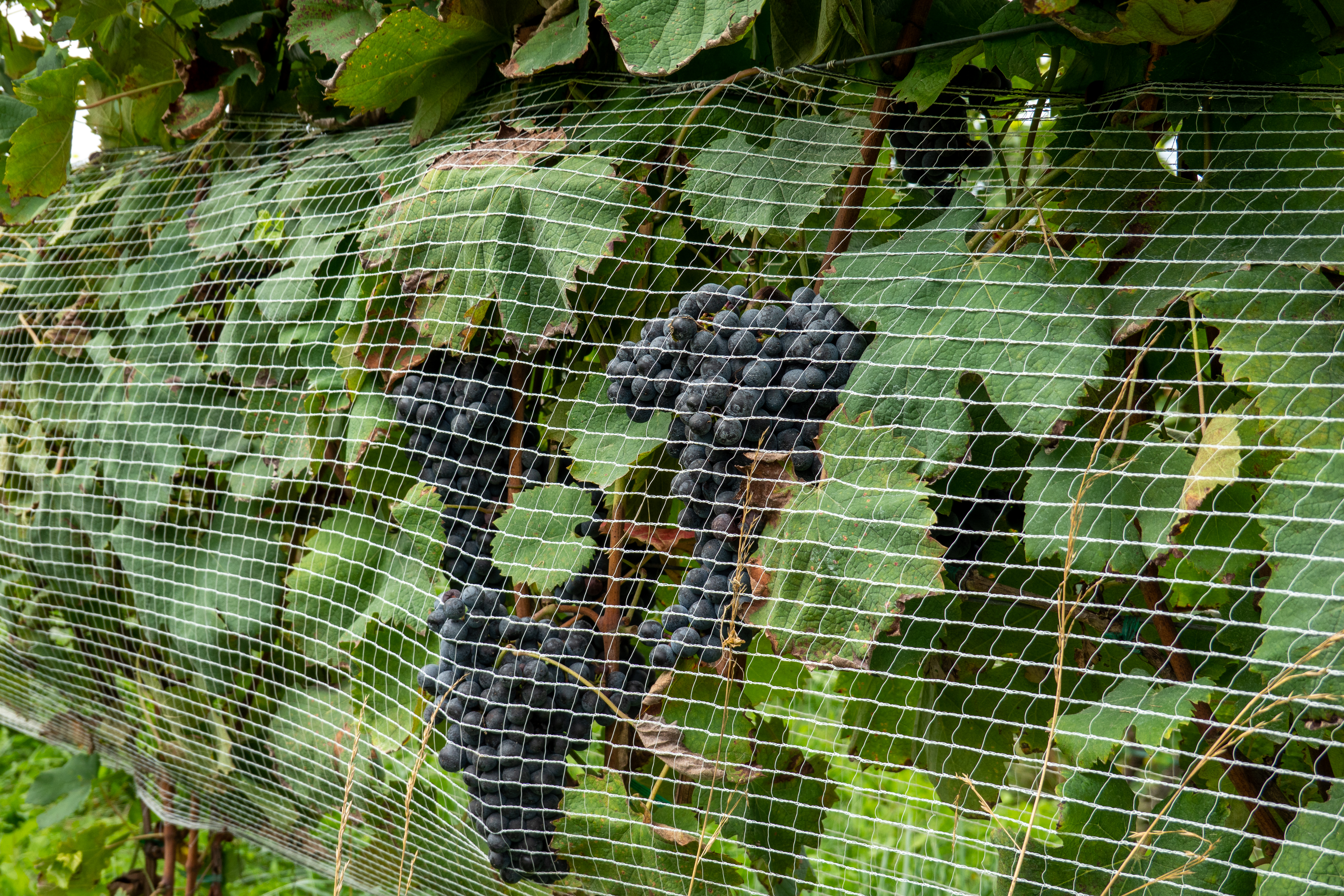
The racoons know when the grapes are ready for harvest.
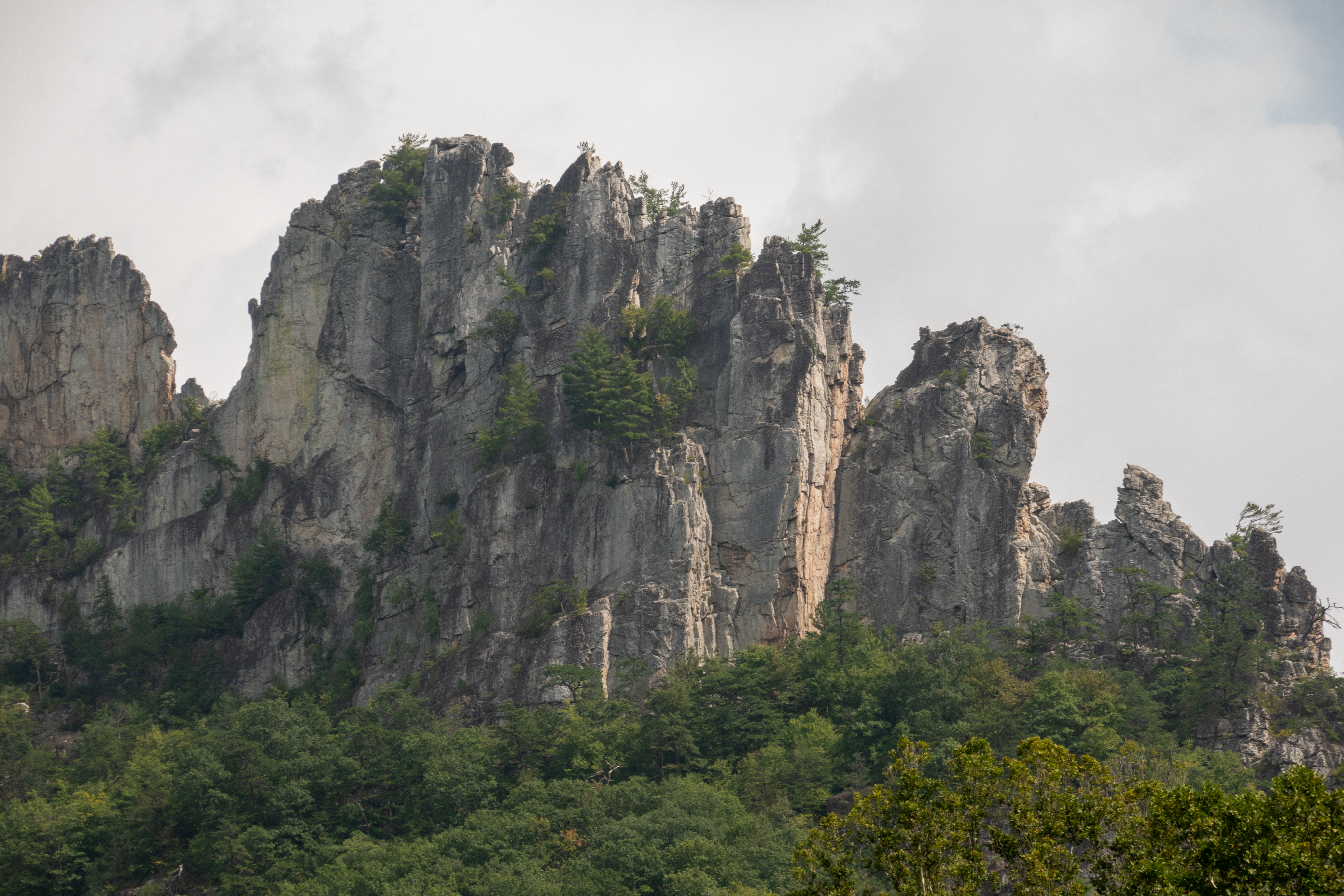
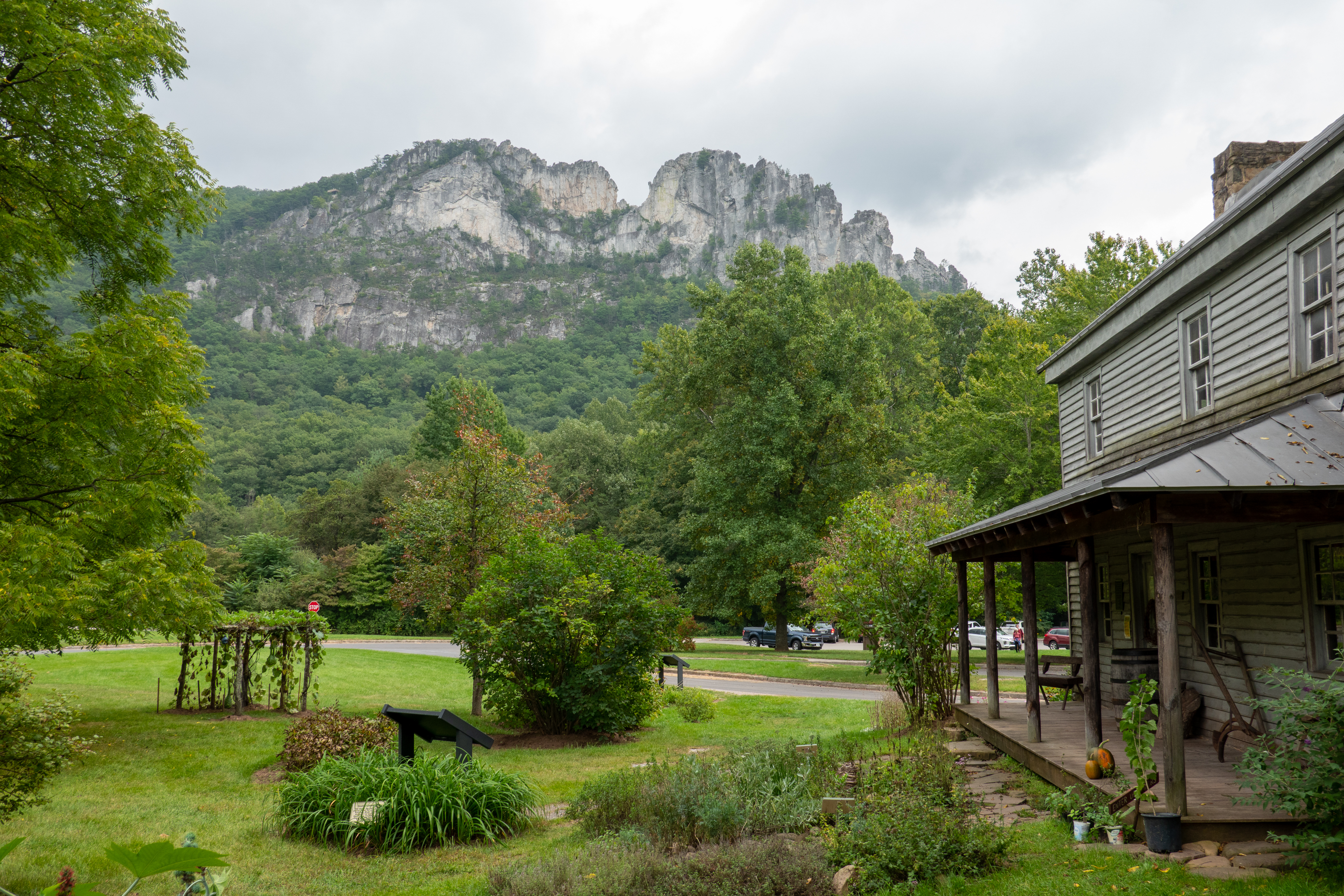
We then headed into West Virginia and spent a somewhat rainy night camped at the Wolf Gap Recreation Area SR 675 in Wardensville. The campground is free but has only 10 sites. We fortunately were able to grab the last one! We then headed towards Cass, West Virginia where we planned to ride the Cass Scenic Railroad from Cass to Bald Knob. (Cass Scenic Railroad State Park – West Virginia State Parks – West Virginia State Parks (wvstateparks.com)) We stopped en route at the Seneca Rocks in the Monongahela National Forest. The cliffs are much climbed but we admired from a distance. We also enjoyed the old cabin, which had been expanded into a house in the late 18th century, complete with historical garden.
The rocks. (Don’t think I caught any climbers, but you can zoom in and search.)
The Seneca State Forest campground was our home for the next couple of nights. We were in the overflow camping area, which was close to the children’s playground and provided what we needed, a flat space to park. We did take on water before leaving West Virginia but fine sunny, cool weather meant we had no power problems.
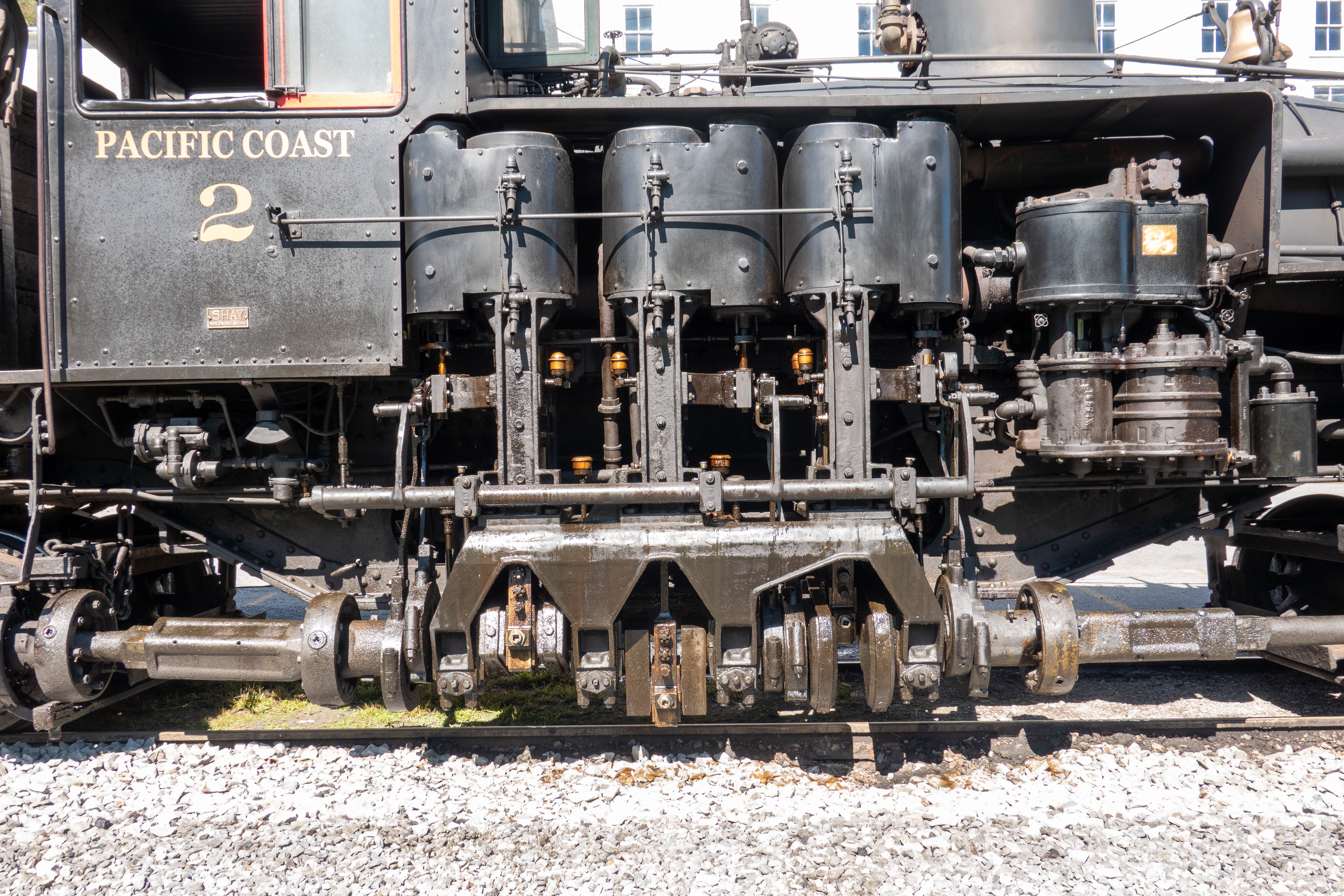
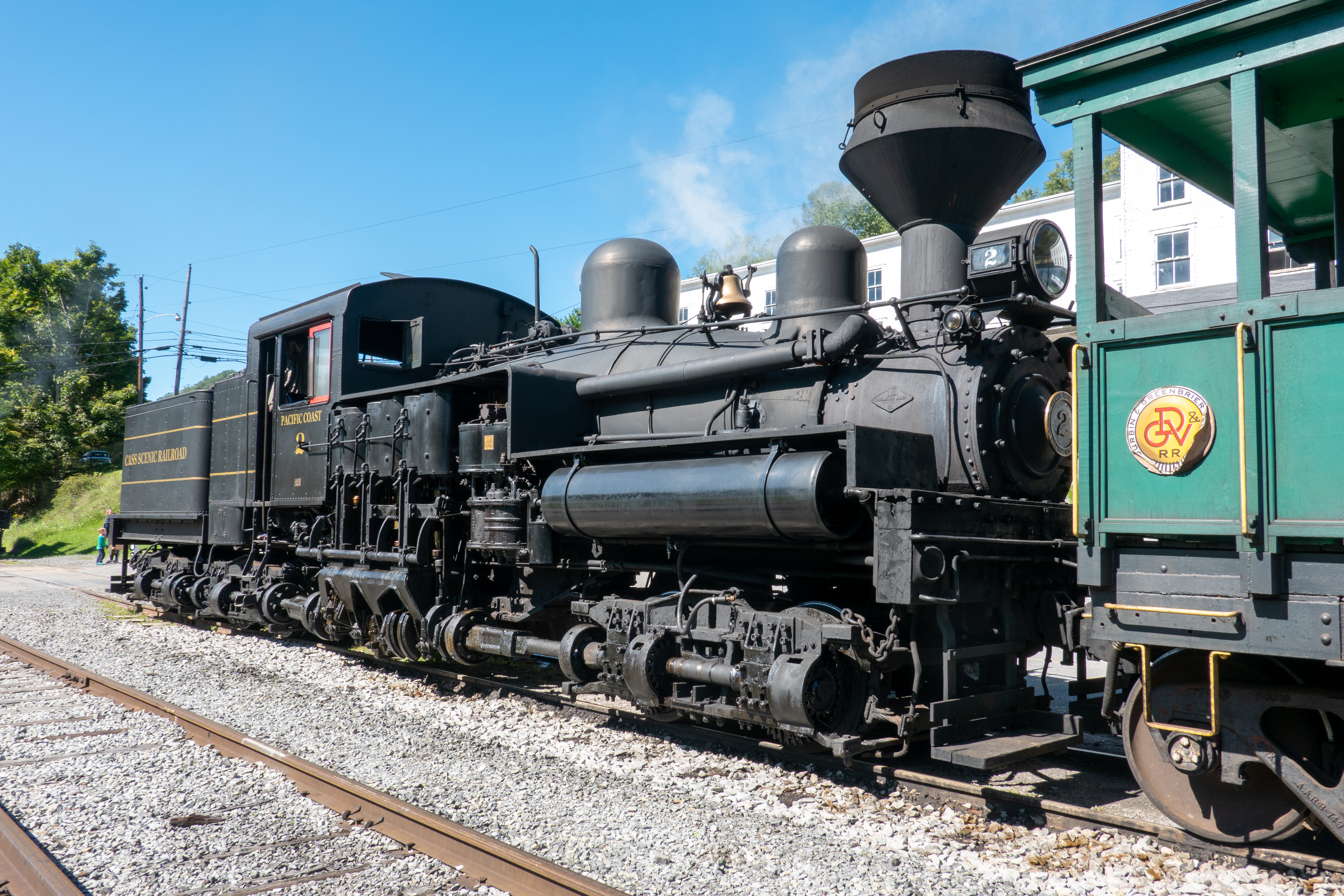
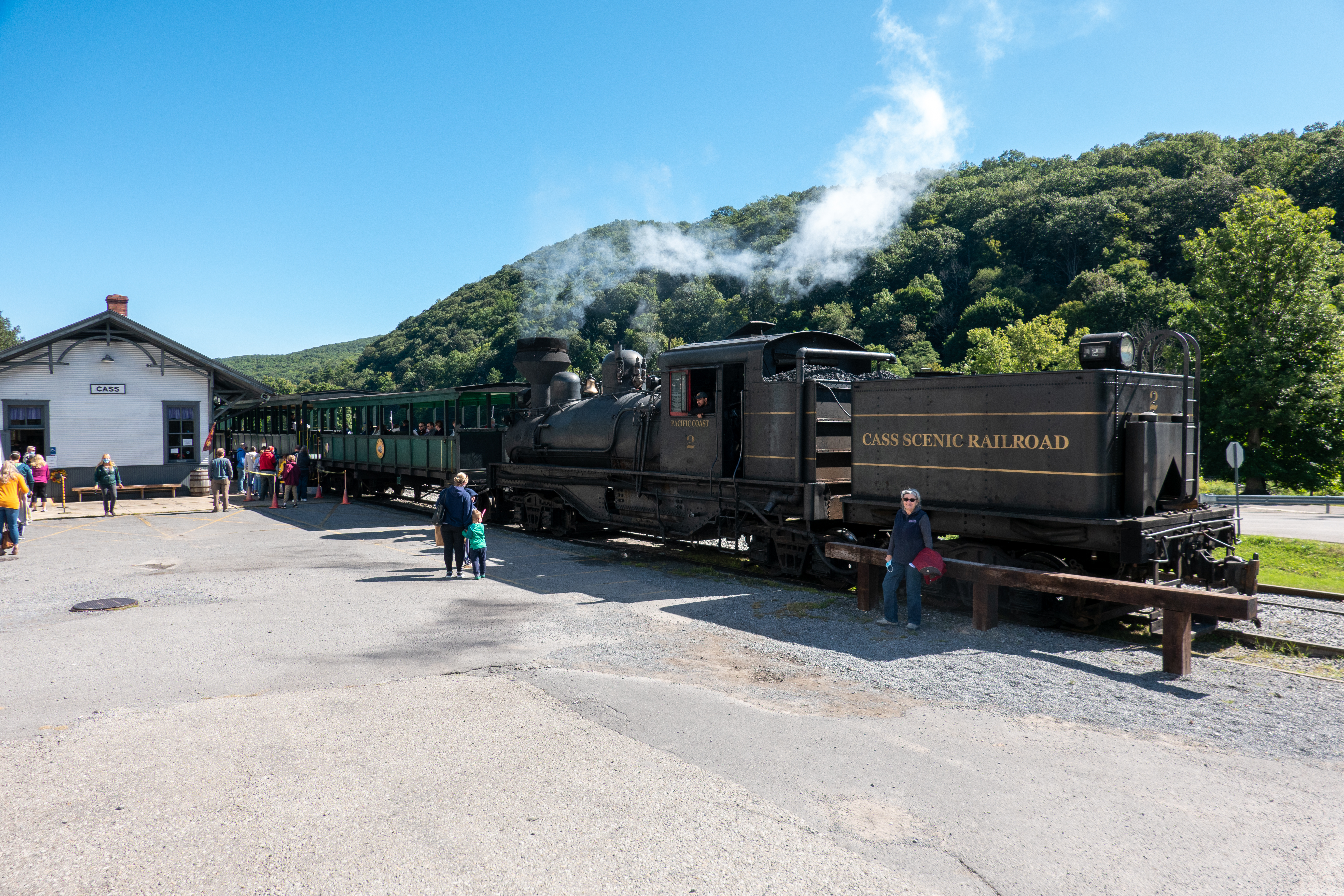
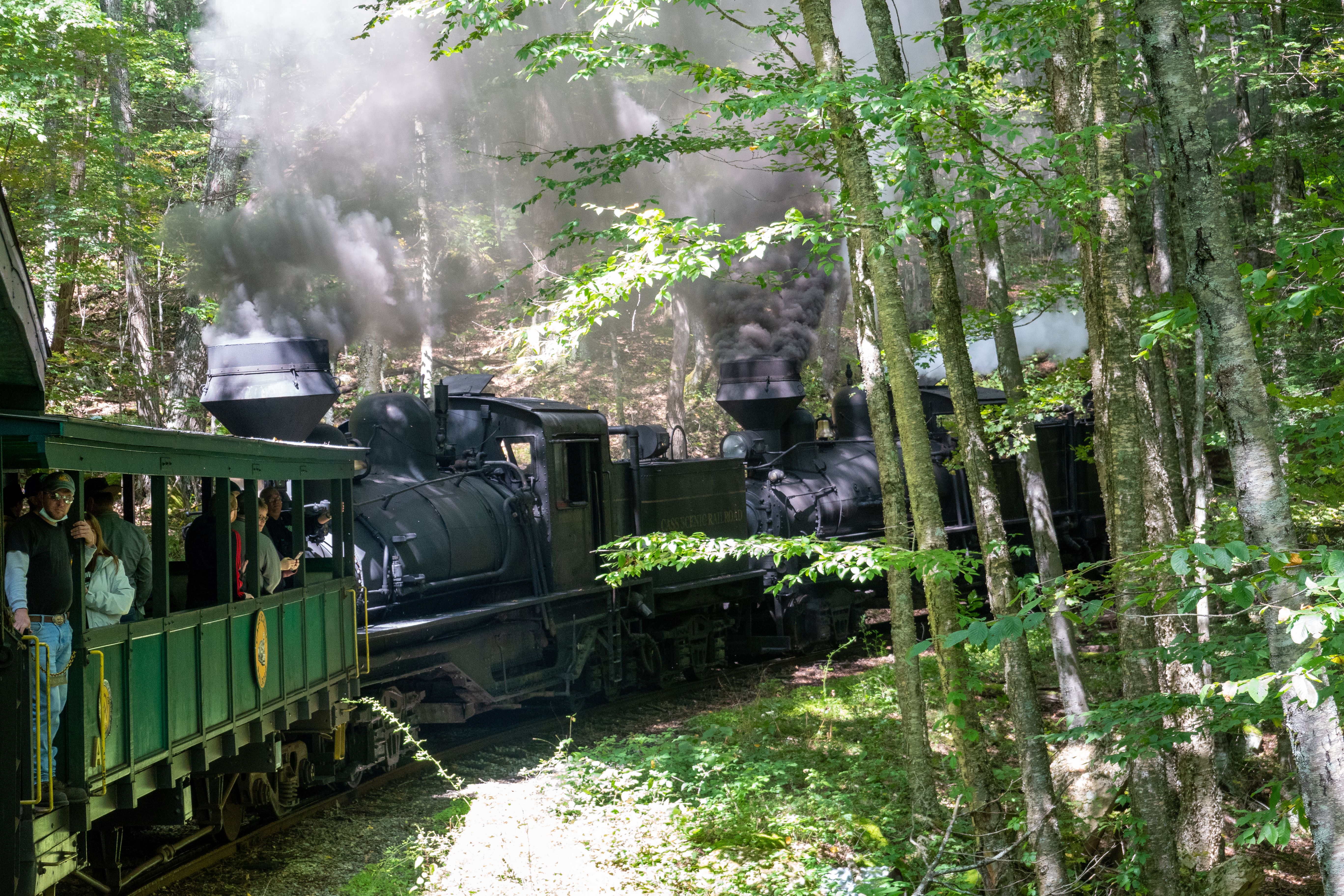
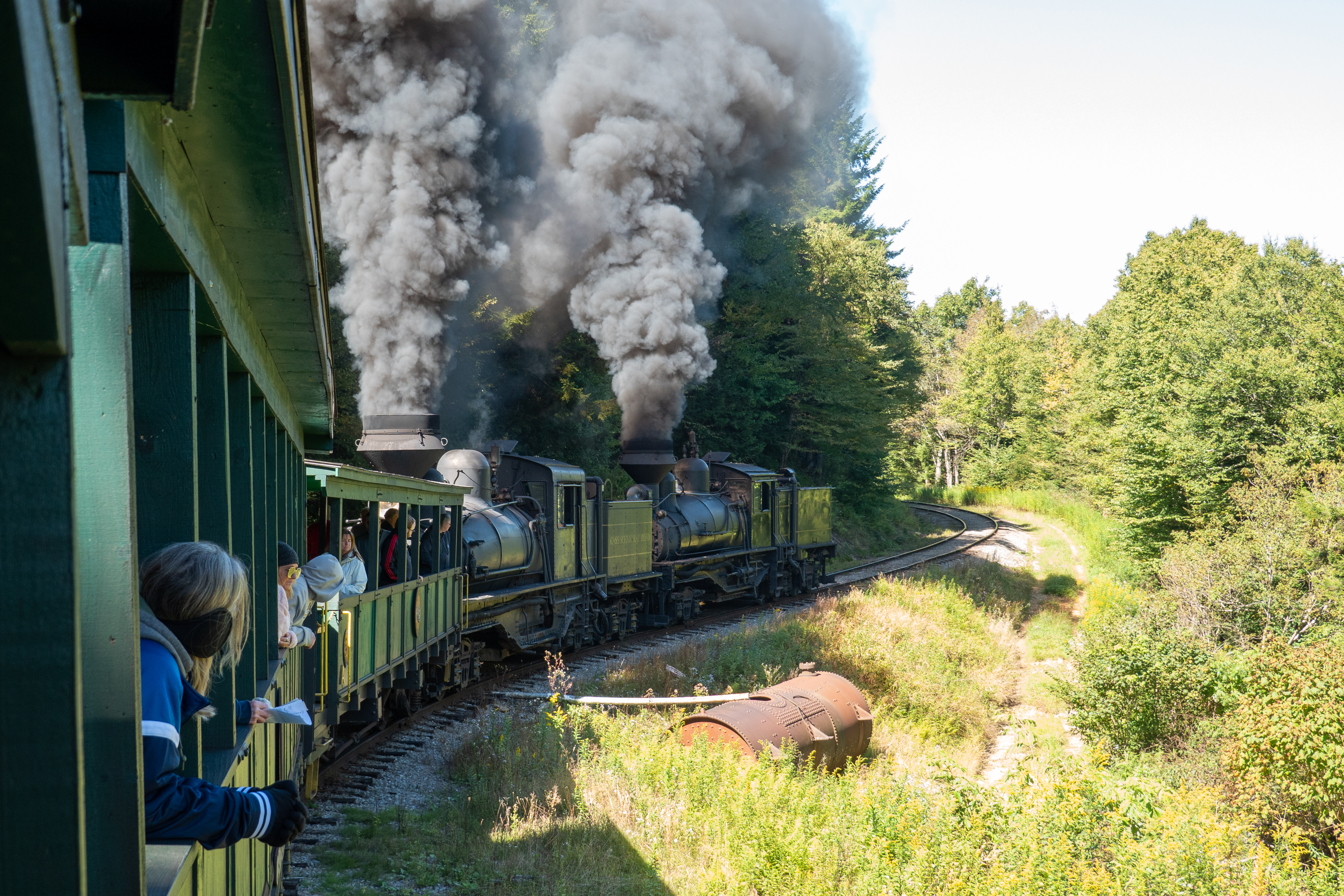
Off to Cass the next day, we boarded our open-air carriage and rode up to Bald Knob pulled by two Shay steam engines.
These engines are specially built for steep slopes and were used in West Virginia in the logging industry.
The magic of the Shay, the side geared drive that engages all of the wheels.
Settled in for the climb.
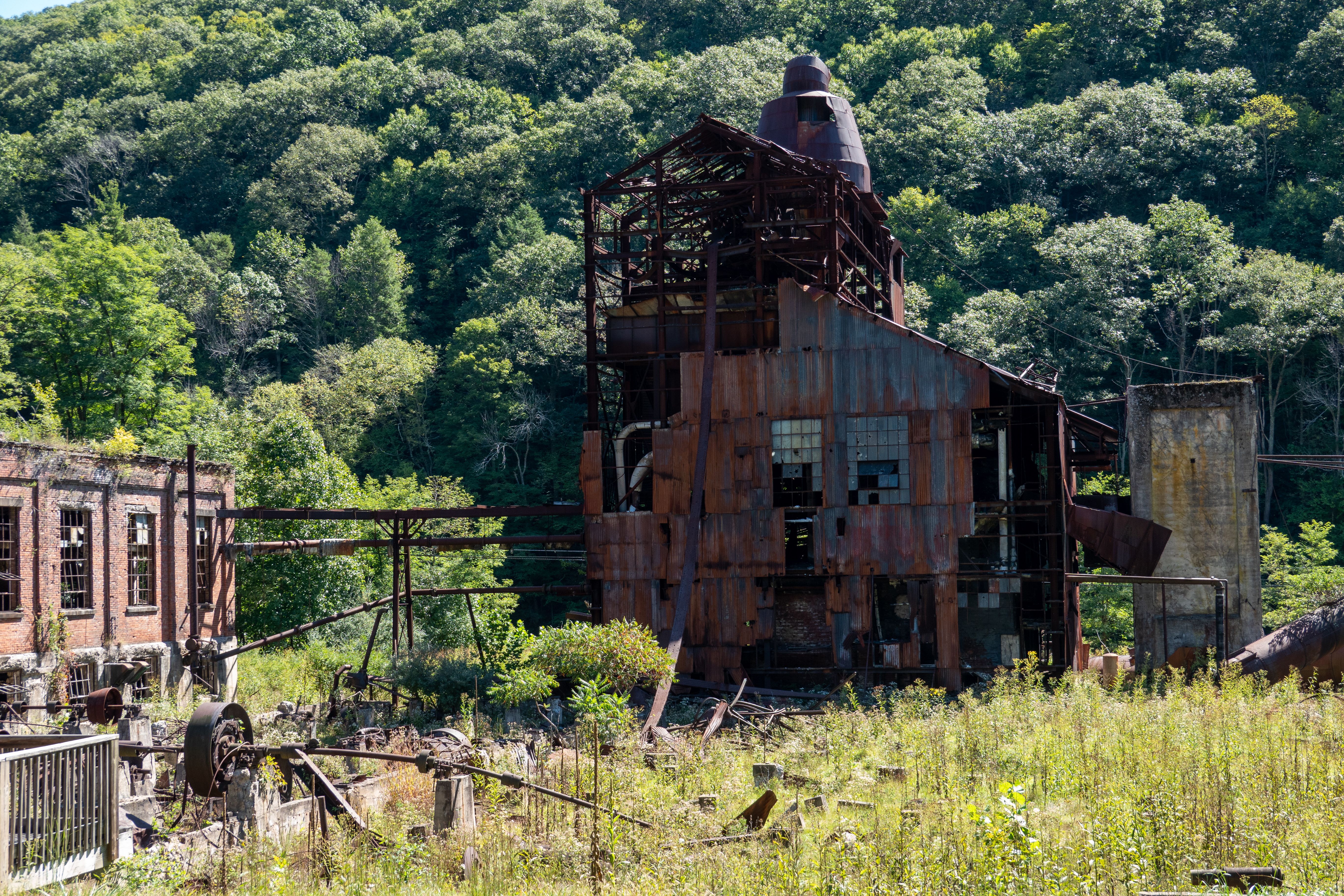
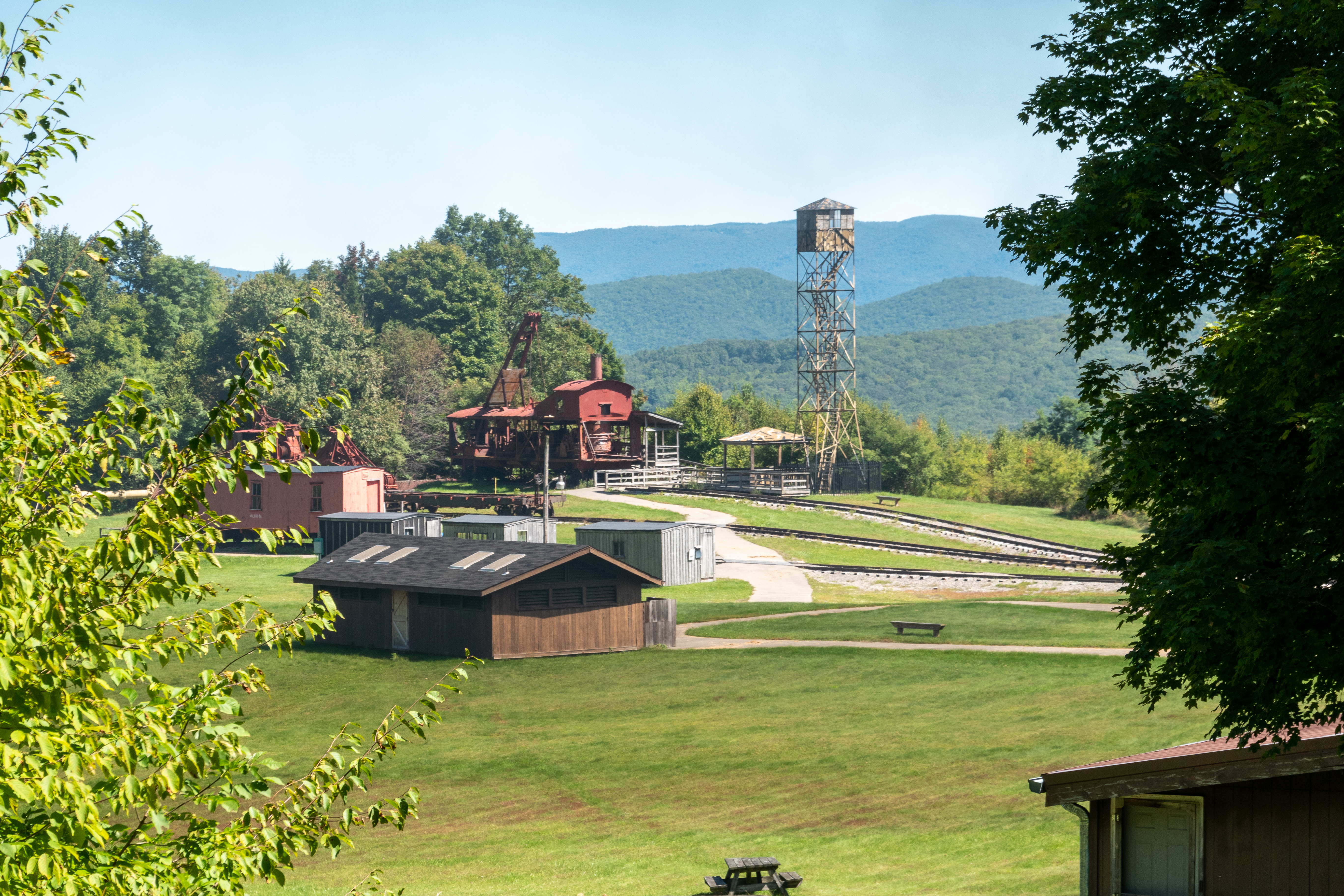
Ruins of the old sawmill.
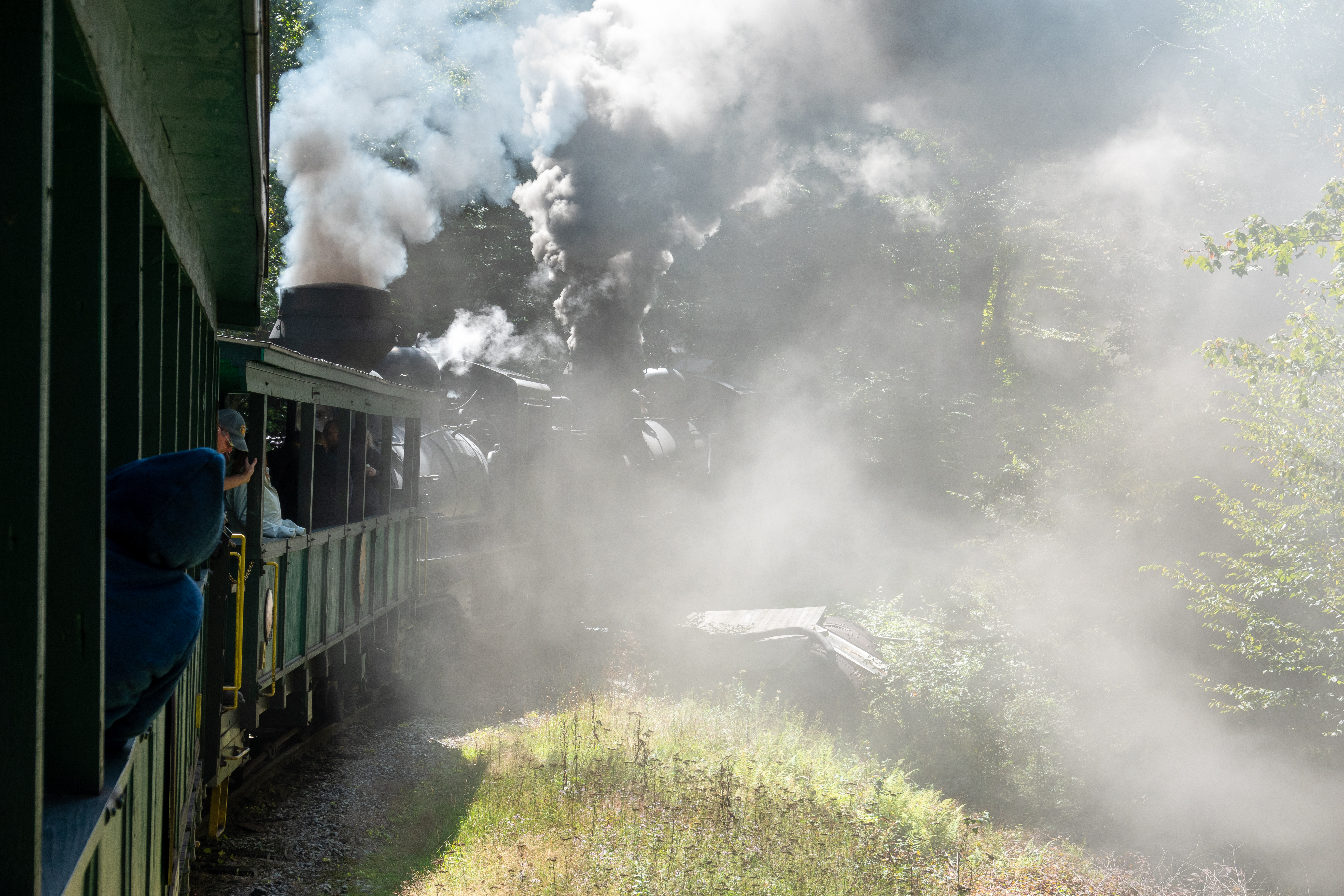
The train took a few hours to grind its way up the mountain via several swtichbacks.
Logging camp. The big red thing is a log skipper, which can carry logs from thousands of feet away, across valleys and up the slope.
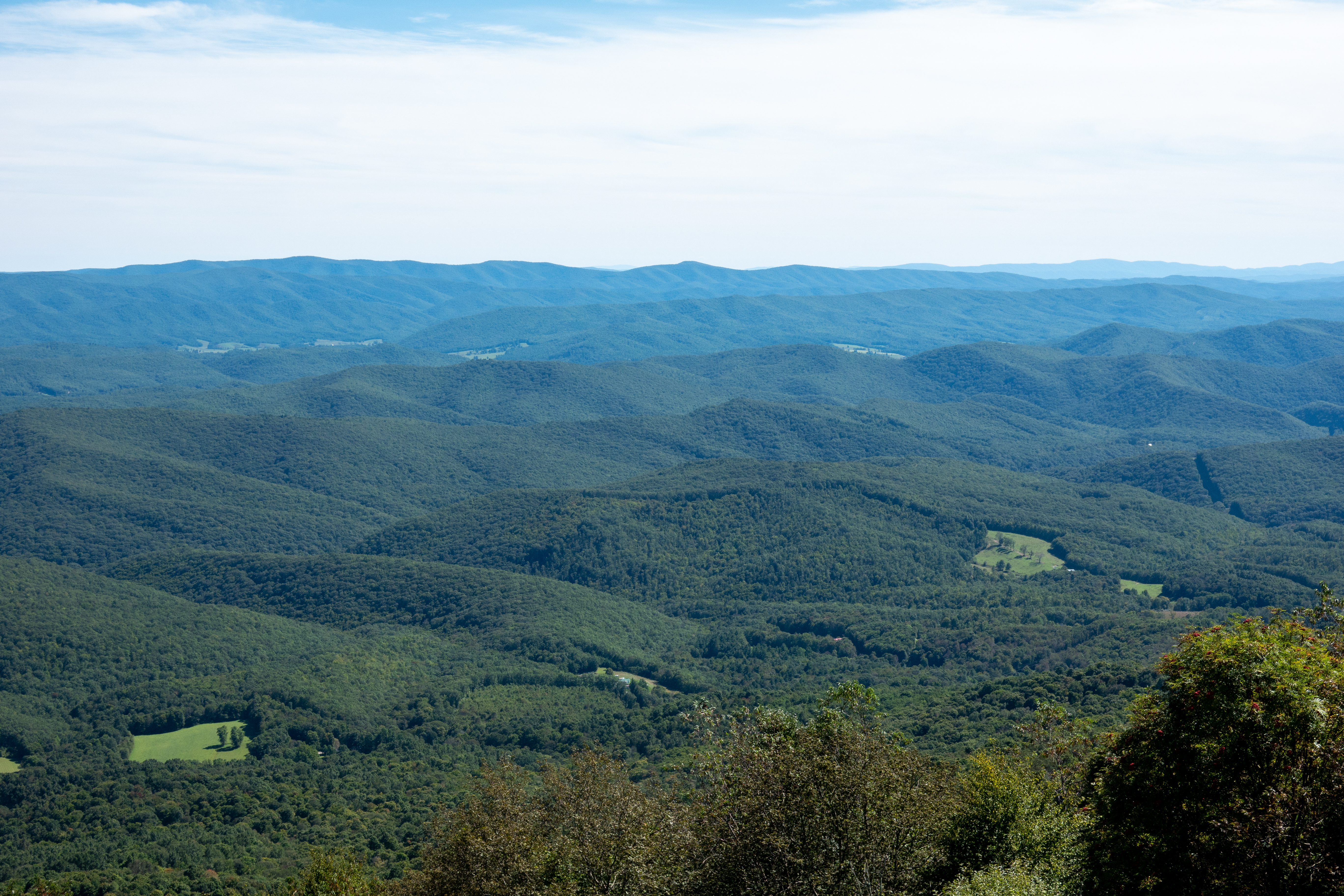
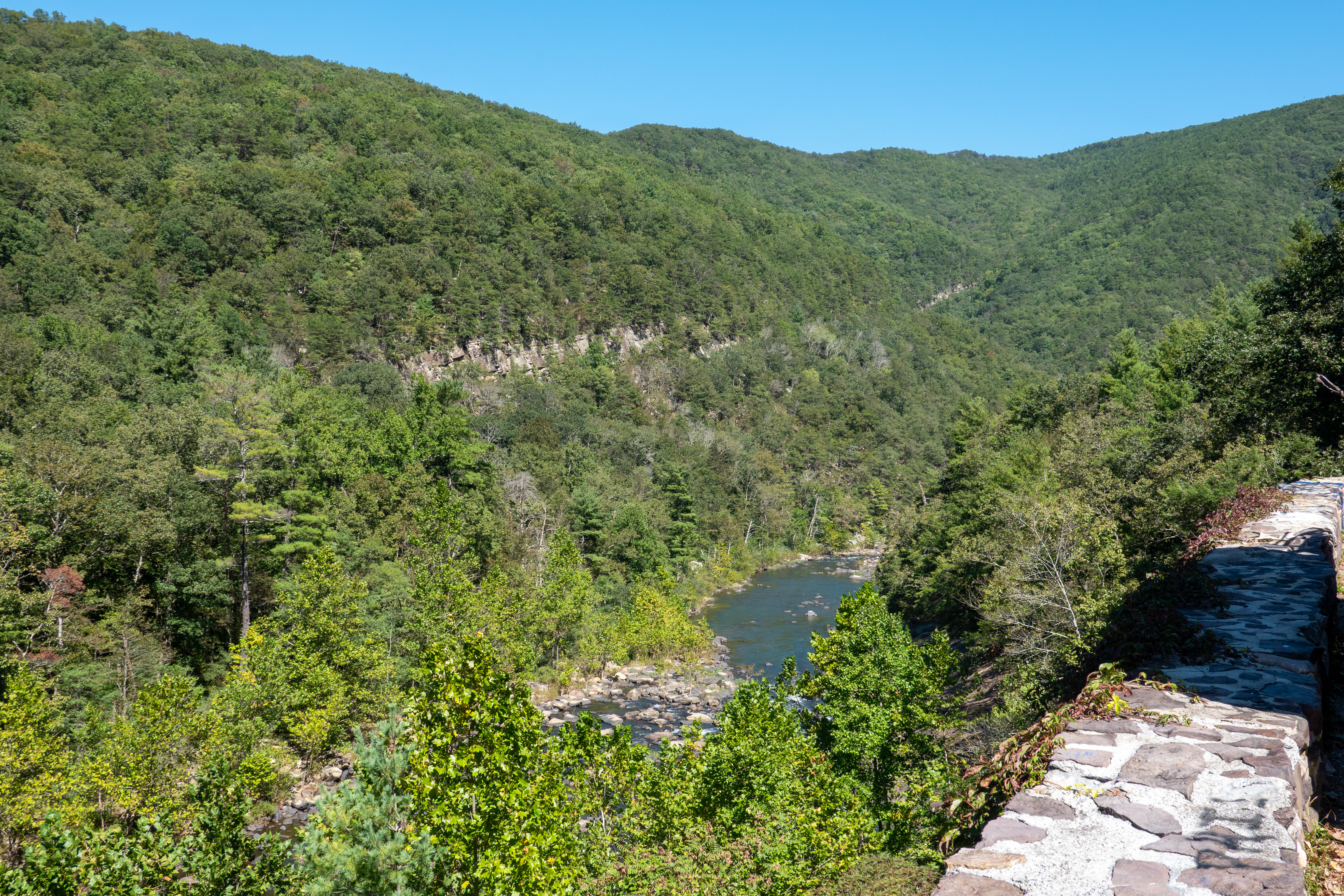
The views from Bald Knob were spectacular, as it was a cloudless clear day.
We acquired leaflets which gave us the history of the logging in that area, including the description of the reconstructed logging camp, Whittaker Camp #1. The train did not stop at the camp which is not open.
We shall return to West Virginia. This was our first foray and we enjoyed it.
And Back to Virginia
We then headed back to Virginia, heading towards Appomattox, which neither of us had visited. Fred commented that the road would be excellent practice for driving in the UK, as it was a narrow two (and sometimes only one!) lane road that wound through the mountains and had spectacular views.
Fortunately, traffic was light so the only challenge was the road itself!
Appomattox
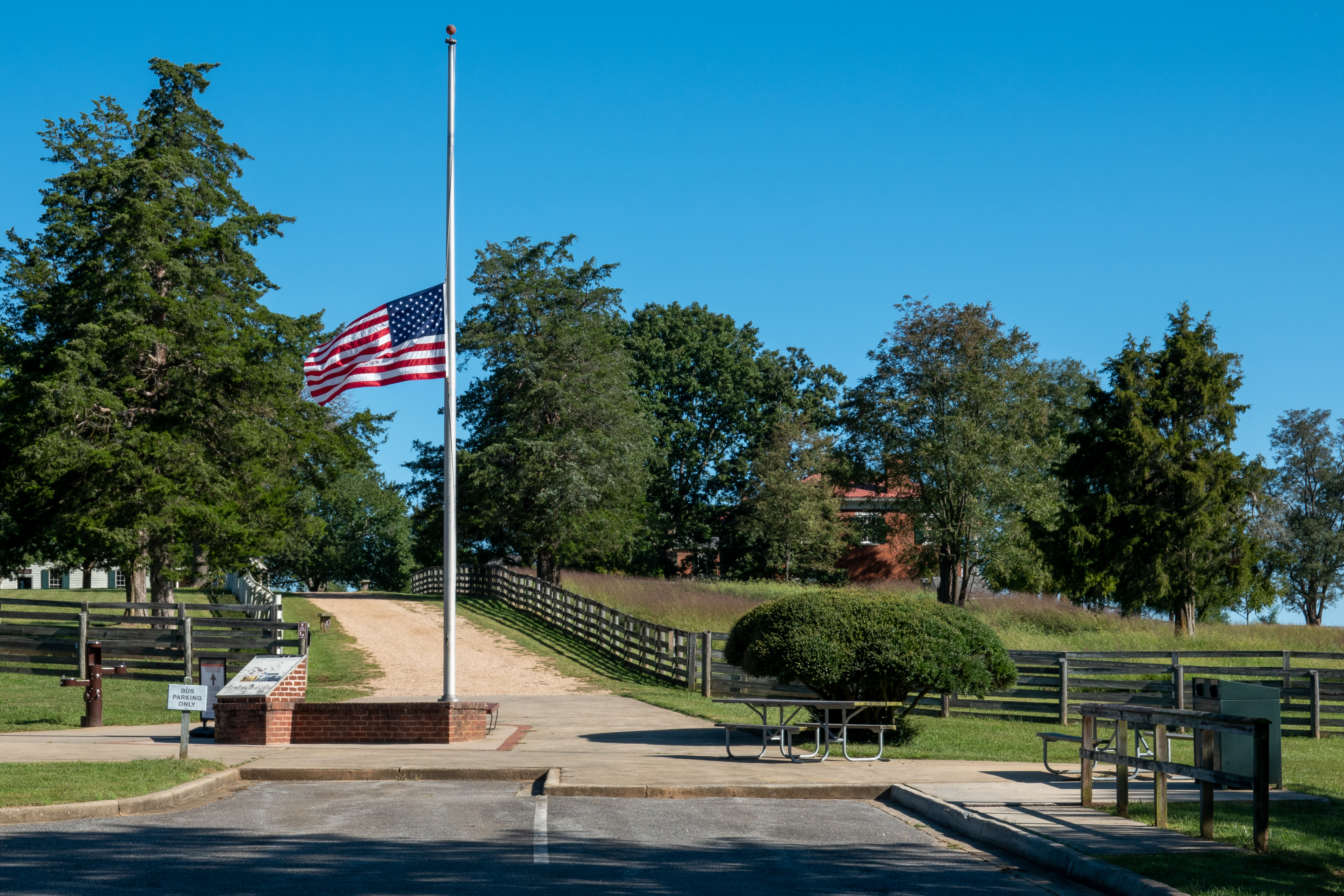
Park entrance.
The 917 enjoying the sun. Coffee break!
We stayed at the Holliday Lake State Park near Appomattox, in a delightful spot, with a lot of privacy. (General information (virginia.gov))The weather gods were still being kind and it was a brisk sunny day for our visit. The Visitor Center at Appomattox was closed but the McLean House was open with social distancing and mask requirements and Park Service employees were stationed to answer questions.
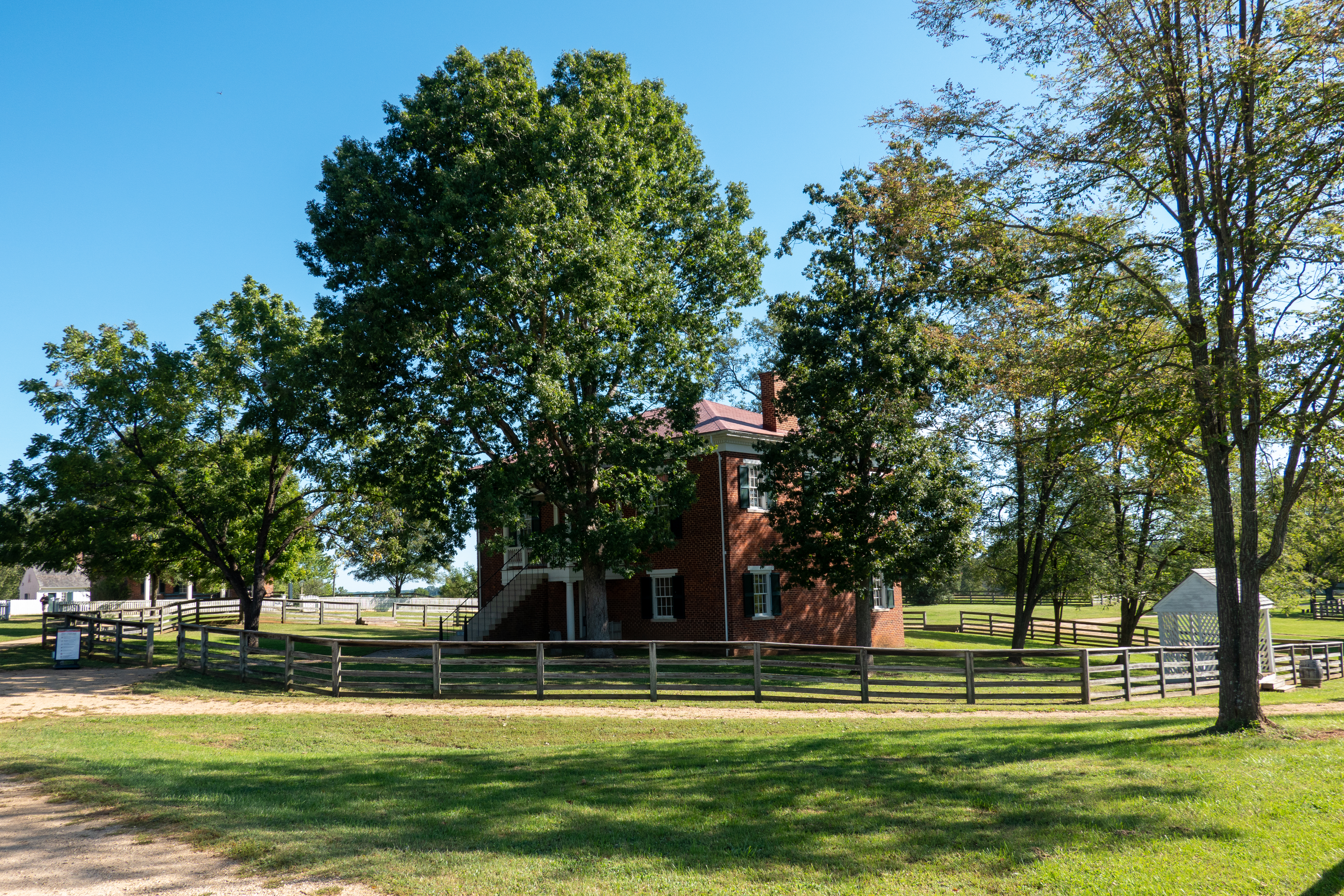
The McClean House – almost a complete reconstruction.
The original Appomattox court house.
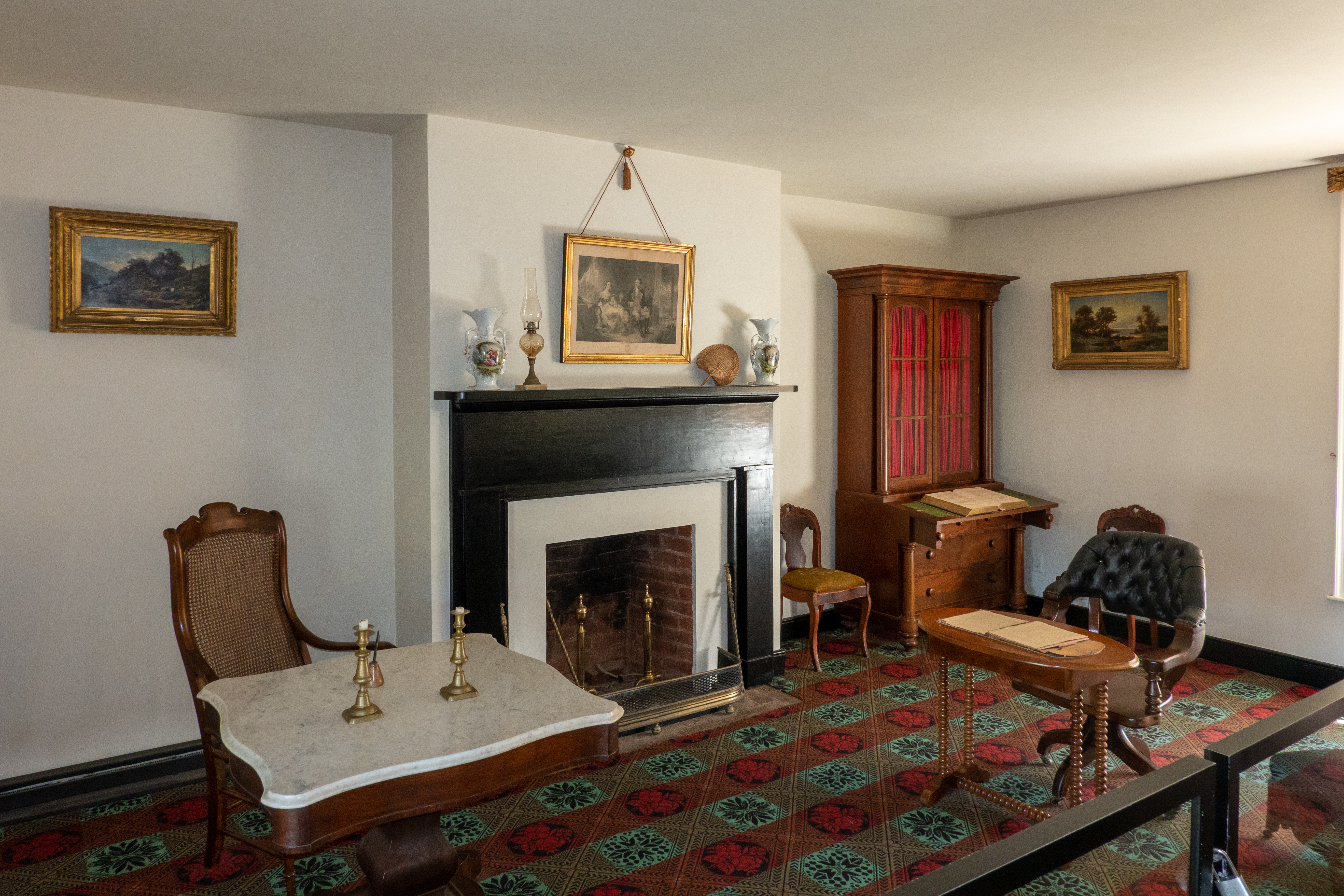
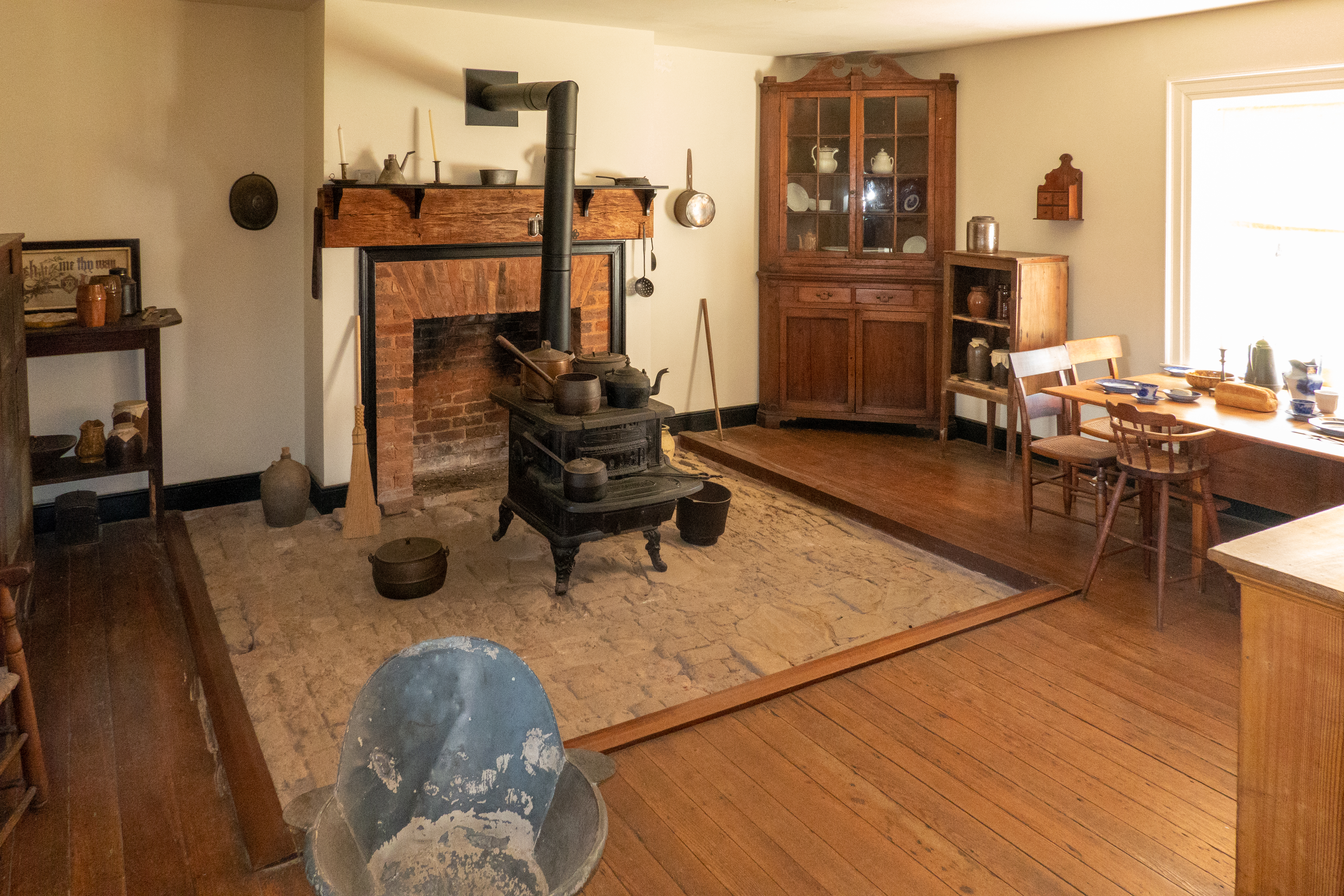
We saw the sitting room in which the final Agreement was signed and wandered through the “town” to visit other open building.
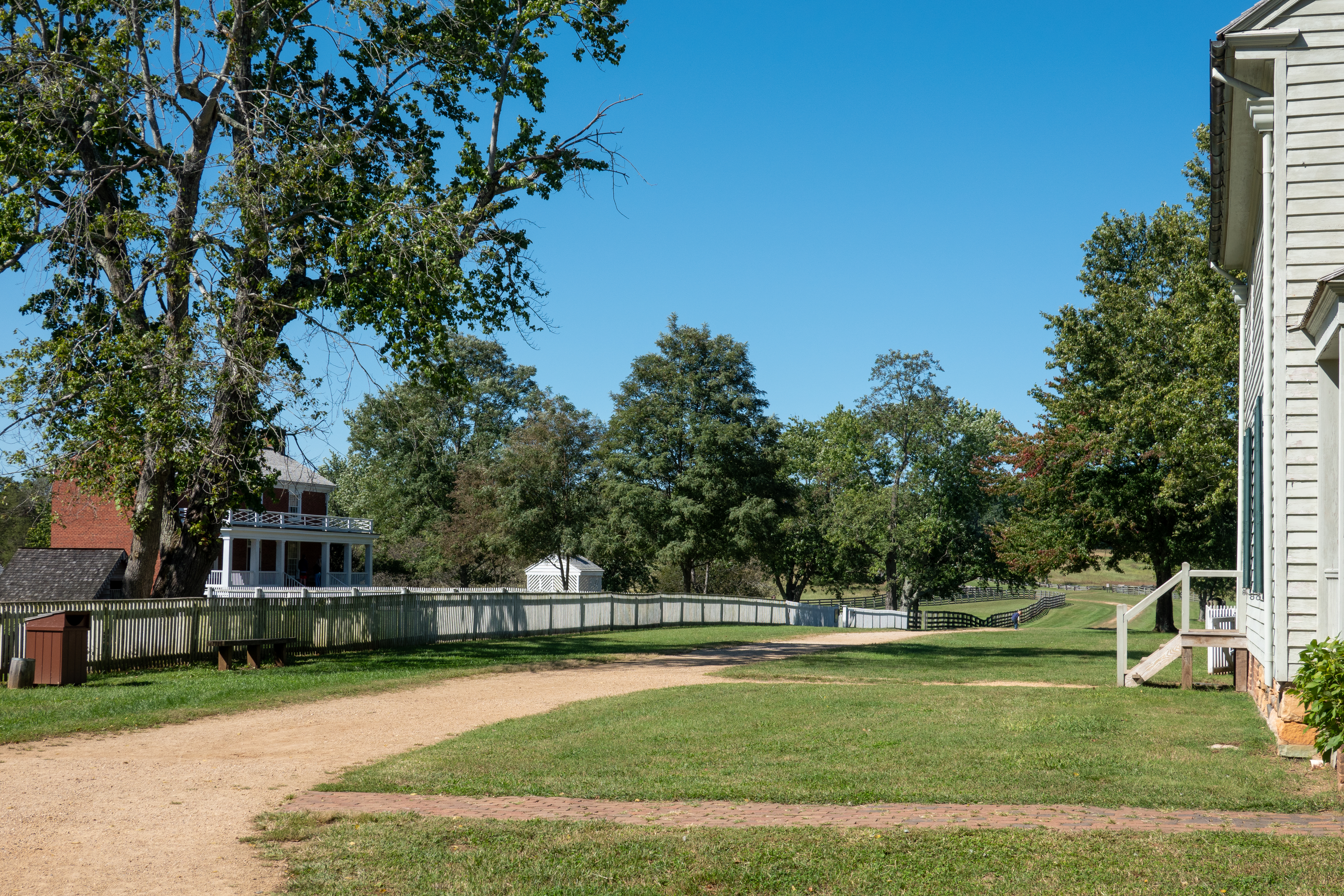
Street view, looking west. The Union troops were on the ridge in the background.
The sitting room where the surrender was actually signed.
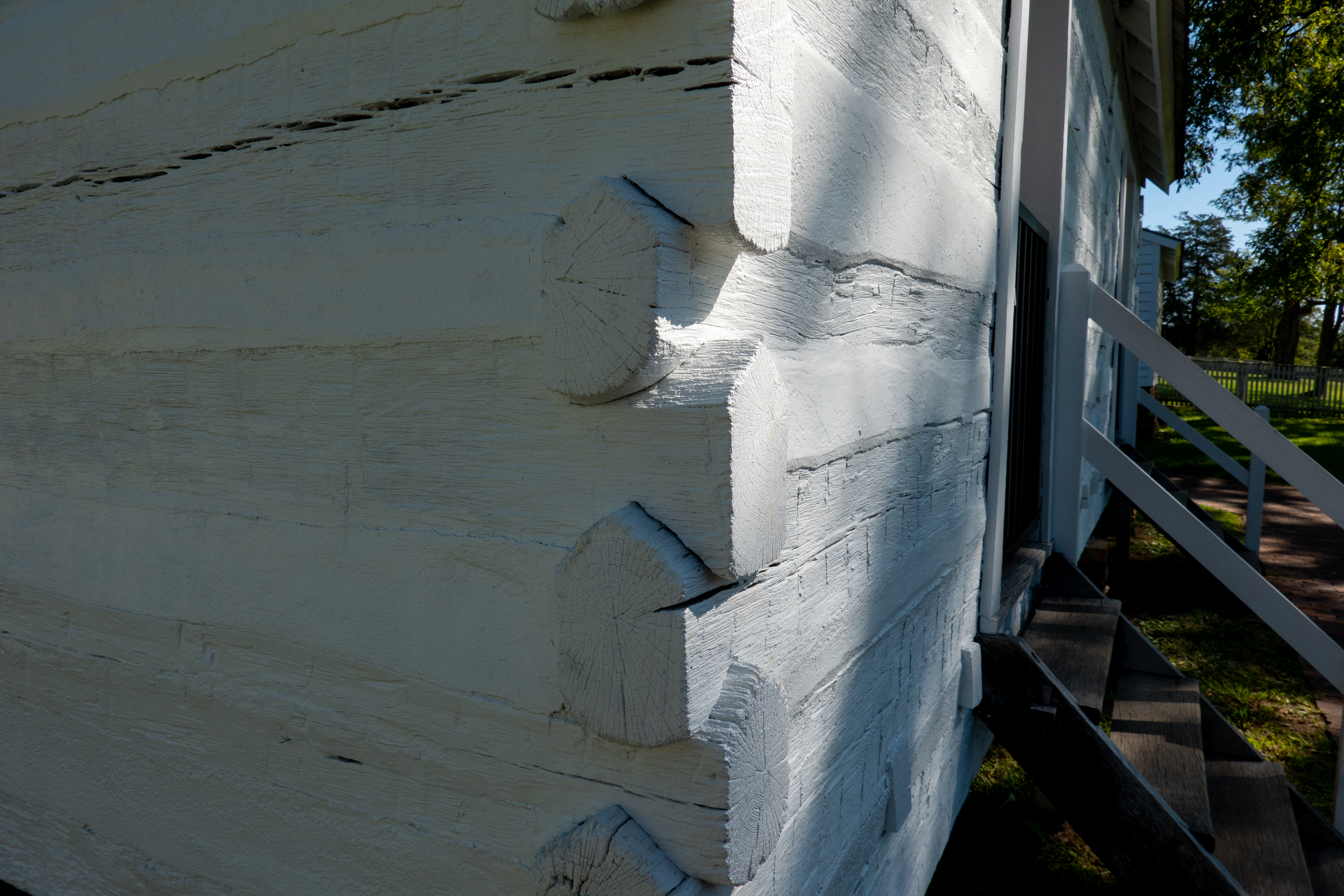
Log cabin construction of the outdoor kitchen.
The printing shop where the parole certificates were printed was open, as was a lawyer’s office. The paperwork never ends – some 30,000 defeated Confederate soldiers had to be issued with parole certificates so that they could go home. Somehow you never think about the administrative details of ending a war.
Presses.
After lunch we headed for the High Bridge State Park. This is a 31mile Rail Trail, a Virginia Historic Landmark on the National Historic Register of Places. (General information (virginia.gov)) We had an initial problem getting to the parking lot as a bridge on the road was too low for us, but, after a successful detour we made it. So, short wheelbase, tall camper! We cycled first to look at the High Bridge, which is simply amazing, and then backtracked into the little town of Farmville before returning to the camper and driving back to our campsite.
“There are longer bridges and there are taller bridges, but there is no longer, taller bridge.”
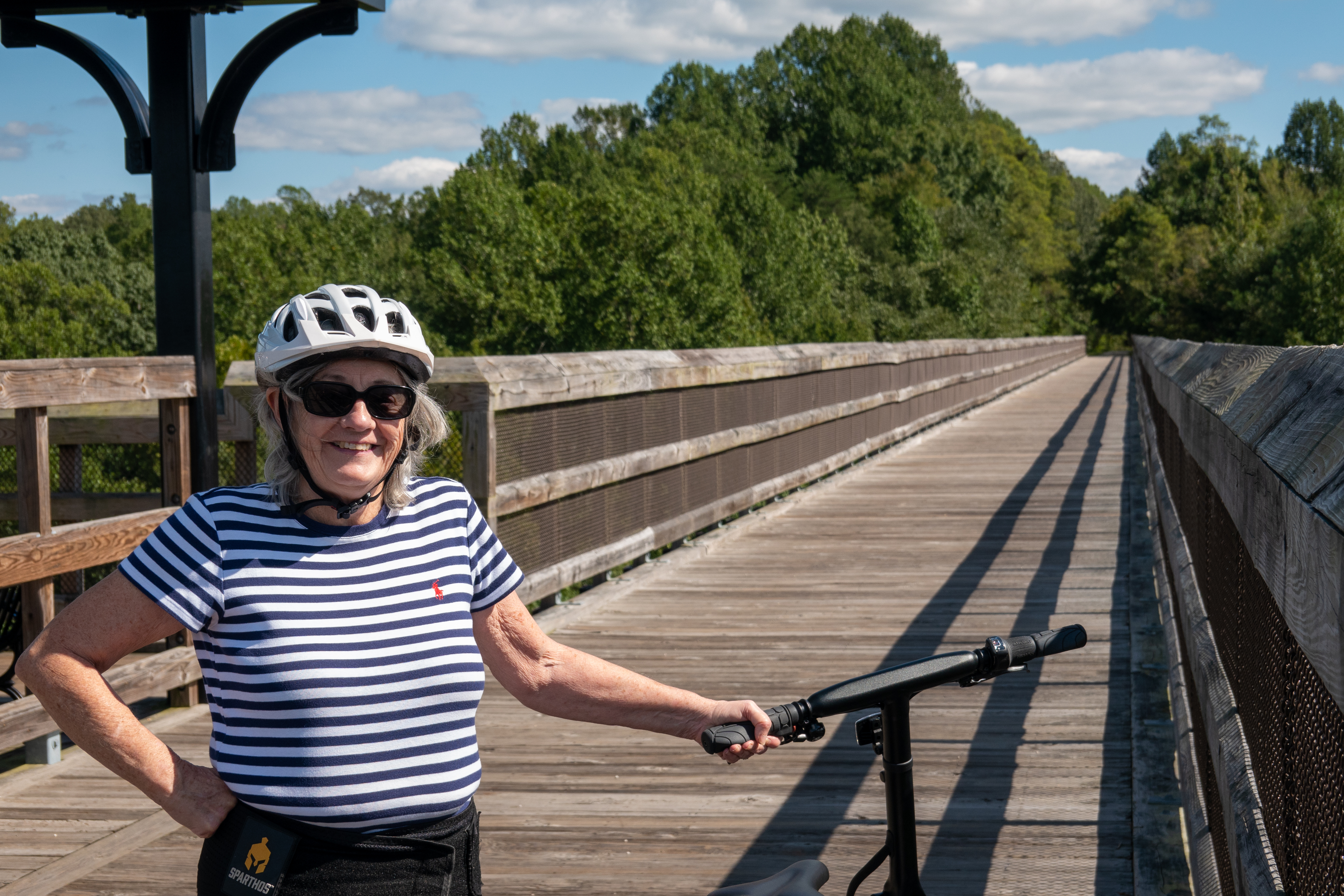
Denise at the bridge.
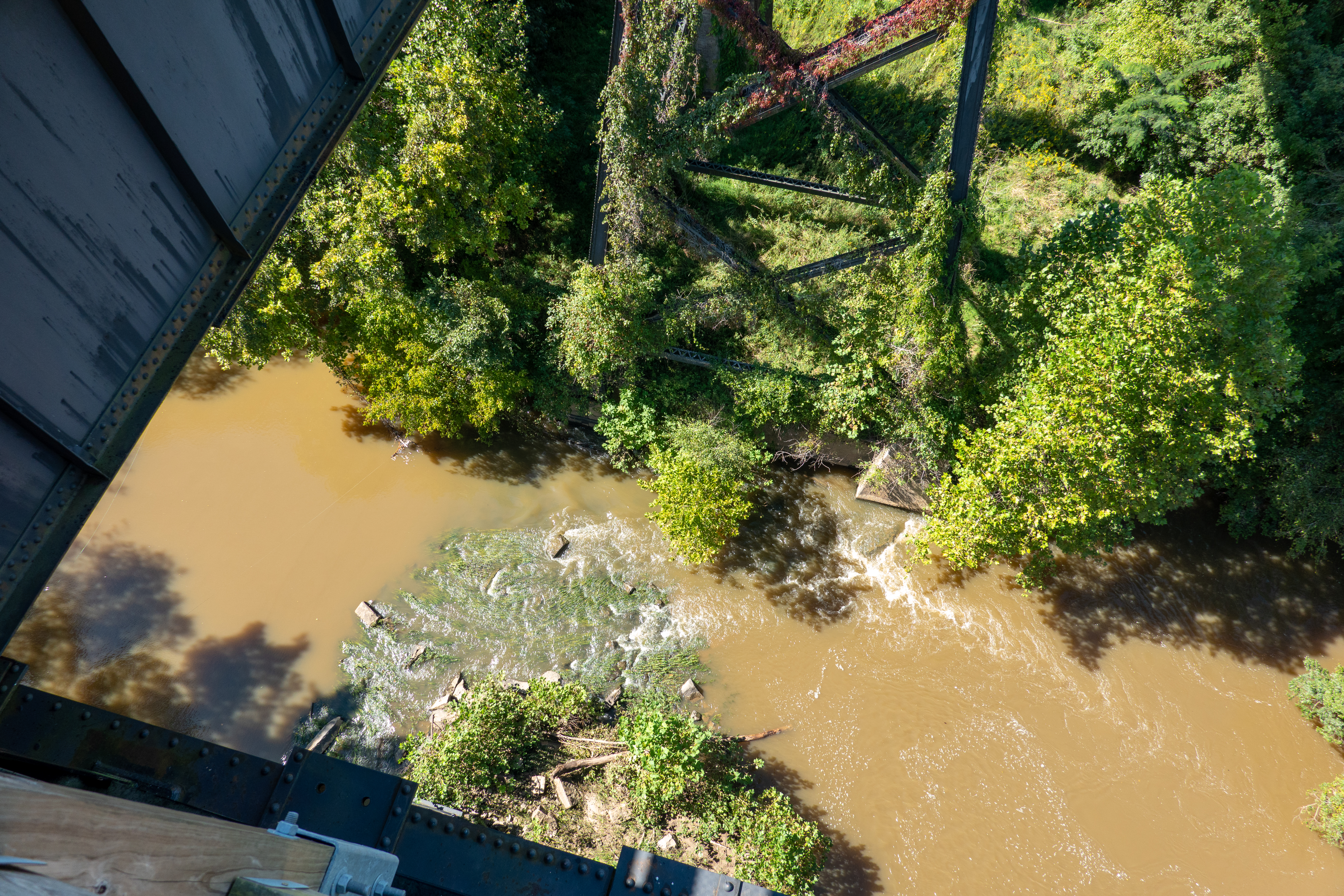
Long way down.
Civil War image.
The bridge was built before the Civil War. The Confederates attempted to burn it, but the Union troops put out the fire and used the bridge to cross the Appomattox river and attach the Confederates near the court house. Rebuilt several times after the Civil War, the high bridge was finally abandoned around 2005 and then made into a park.
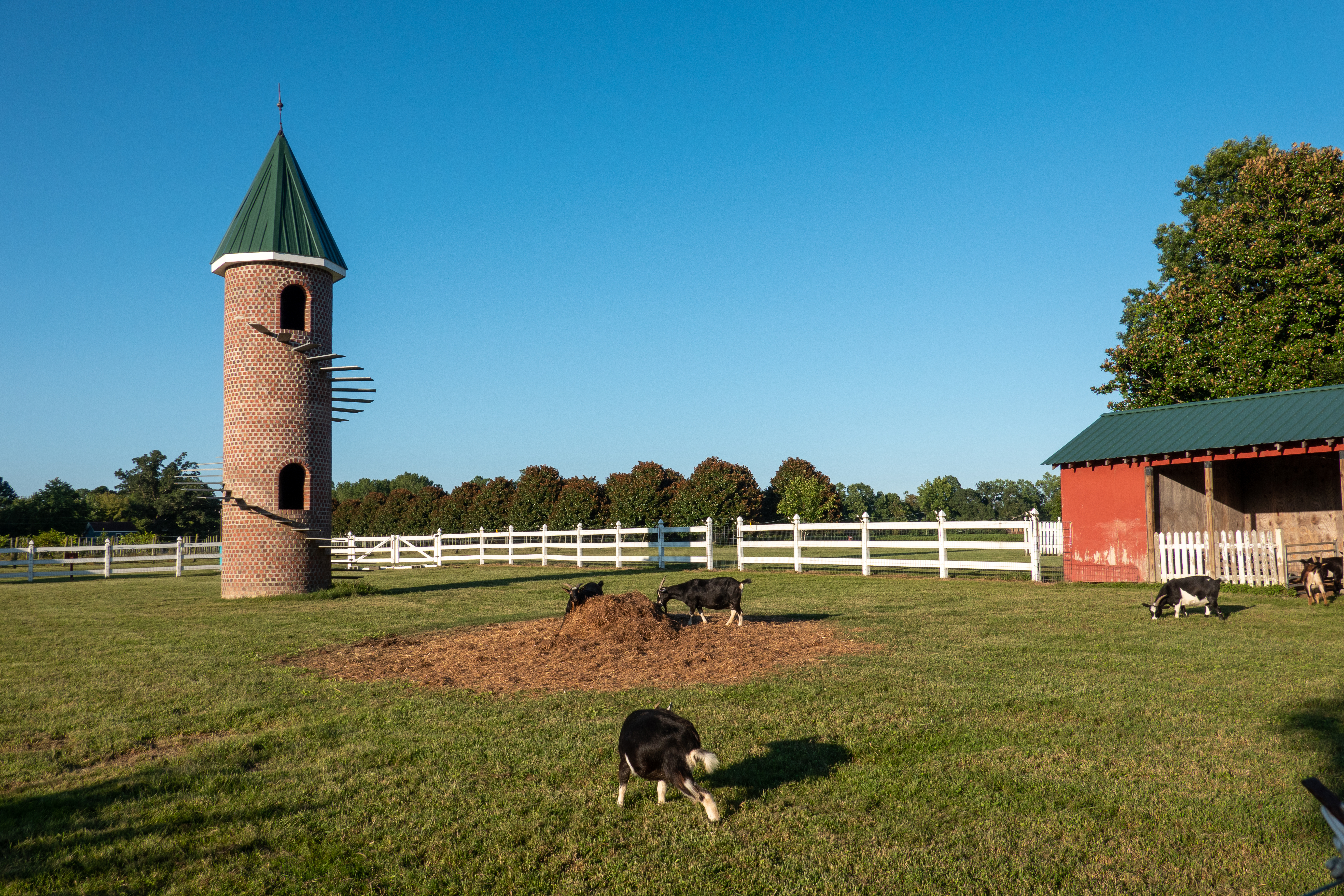
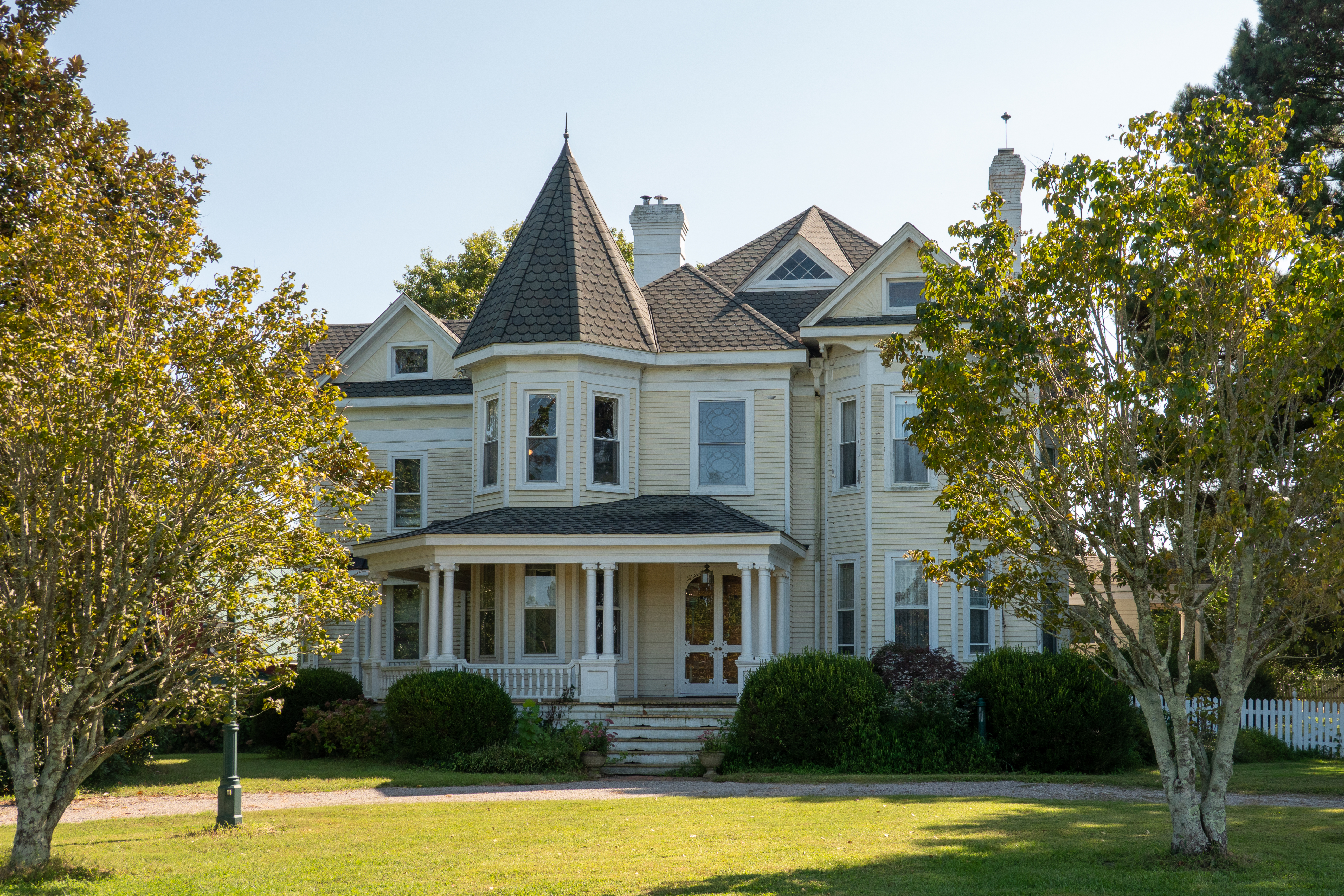
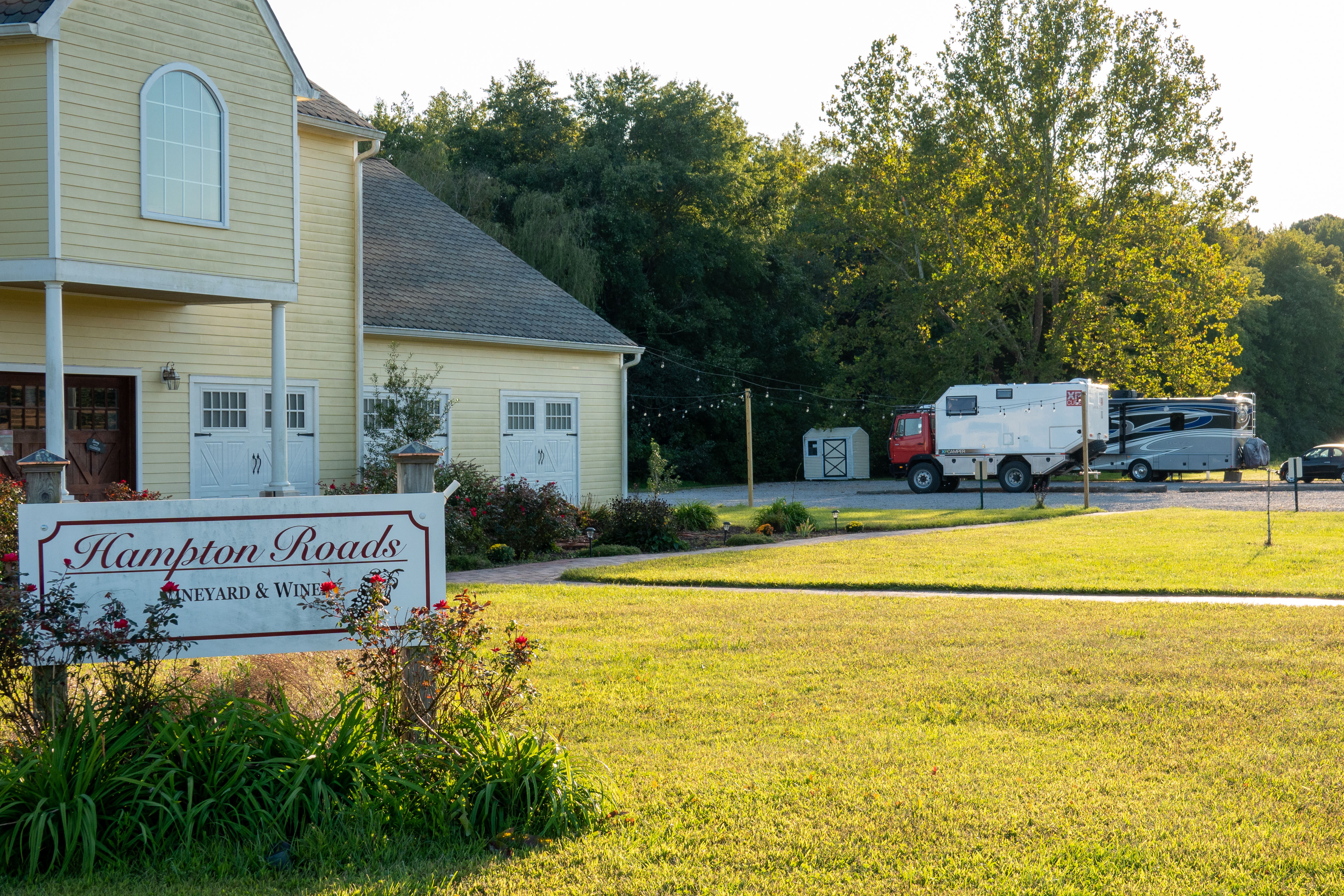
Our next stop was a visit to the Hampton Roads Winery at White Oak Farm. (Hampton Roads Winery) We enjoyed our tasting and chatting with the owners. We admired the goat tower (!!) and goats who used it.
It was hard to believe we were a few miles from a short ferry ride to the bustling Williamsburg area.
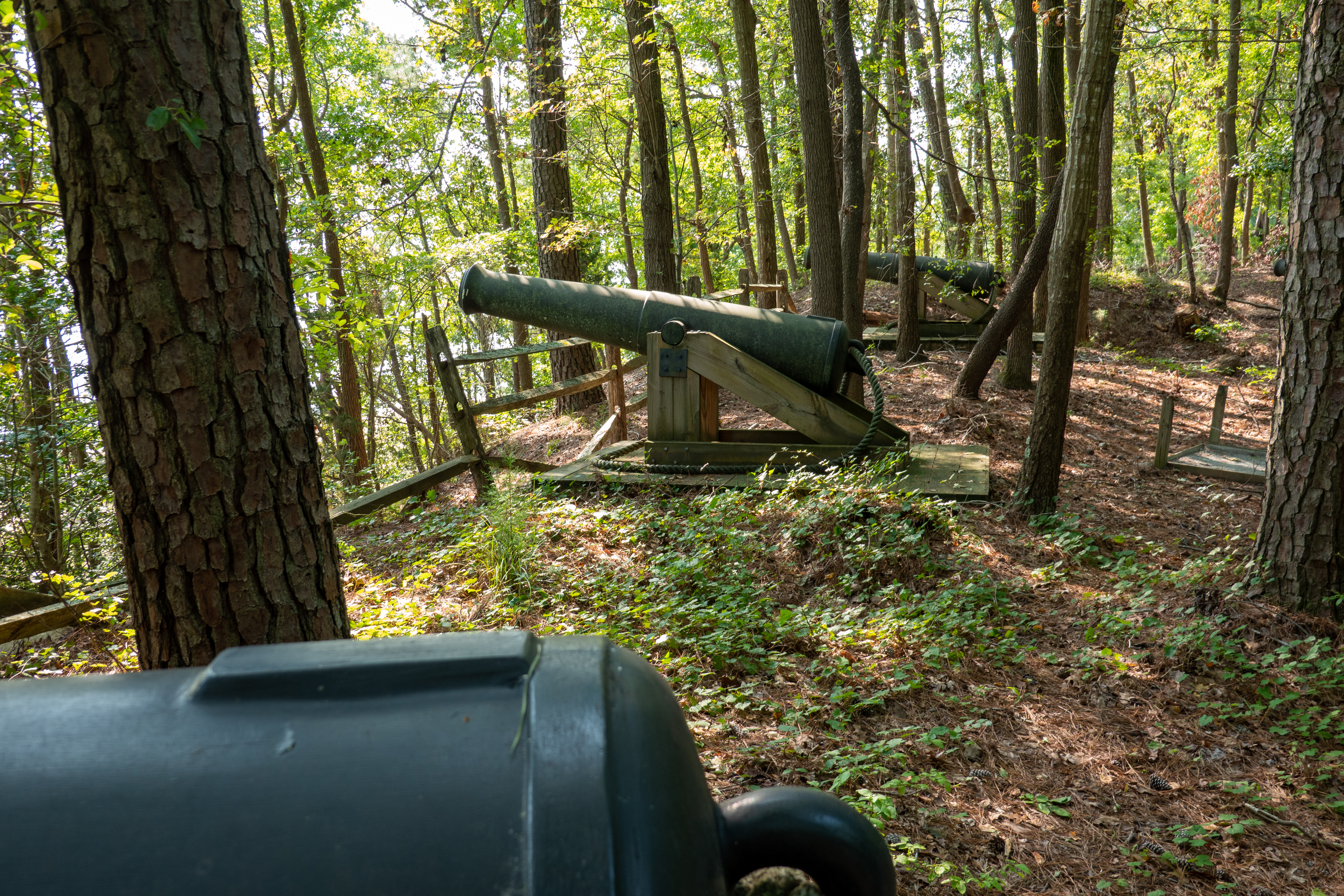
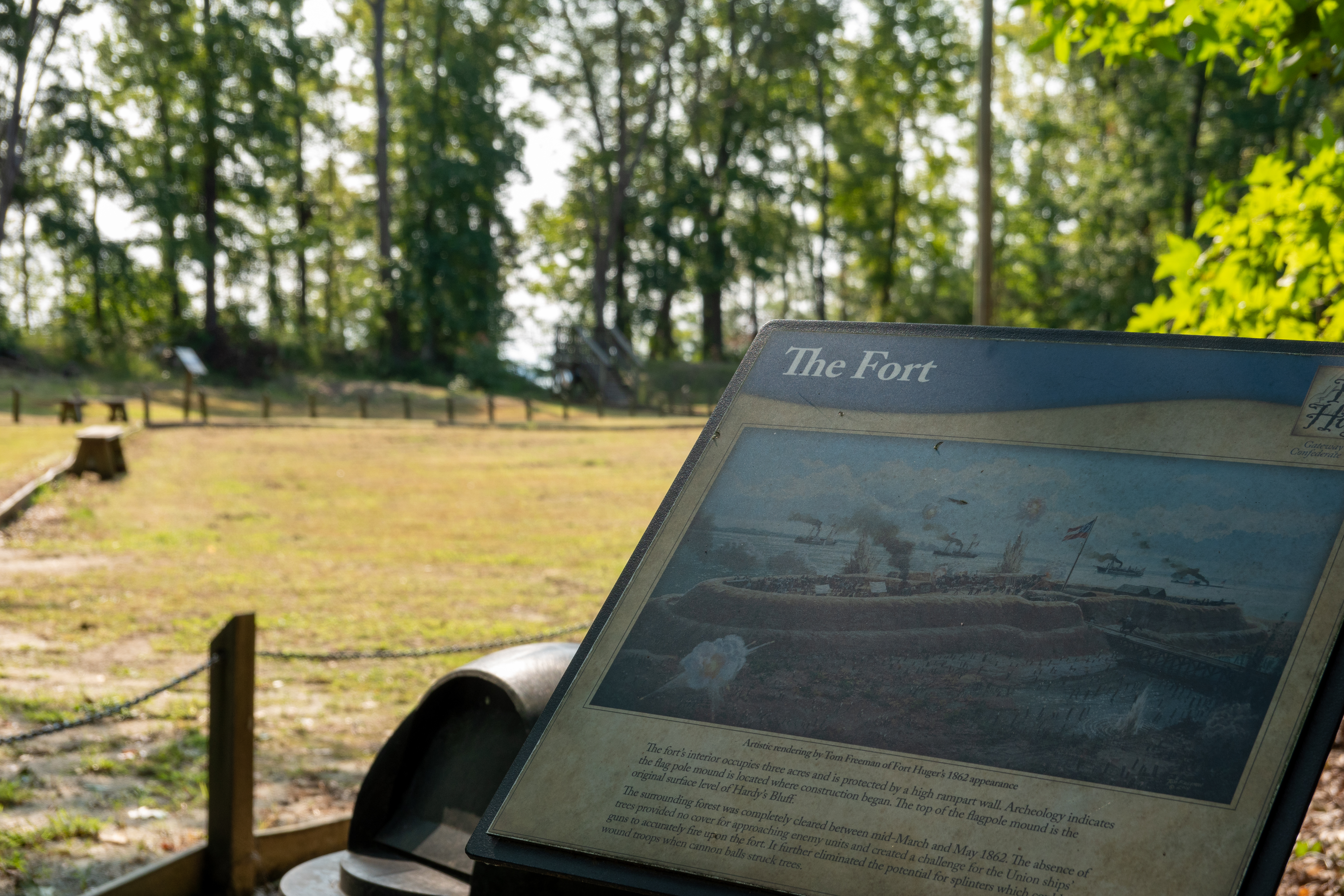
Working our way towards Norfolk, we visited Fort Huger, a tiny restored Confederate battery. Normally, you can see lots of ships anchored in the river, but the day we visited there were none.
Fiberglass cannon.
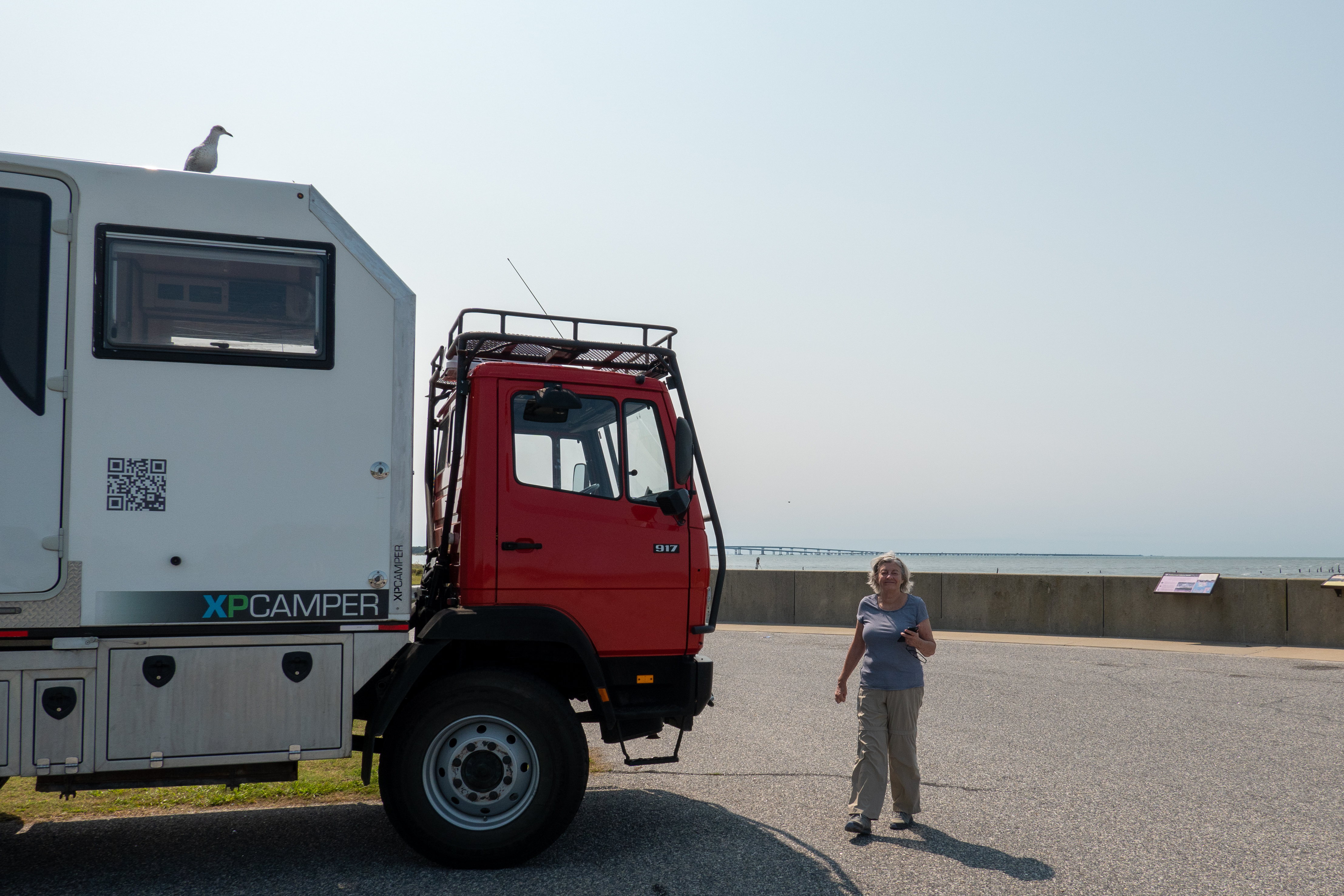
We were looking forward to taking the Chesapeake Bay Bridge Tunnel, but there were repairs underway and the overlook points were closed. We had to content ourselves with a look back.
The gull was unimpressed.
Chincoteague
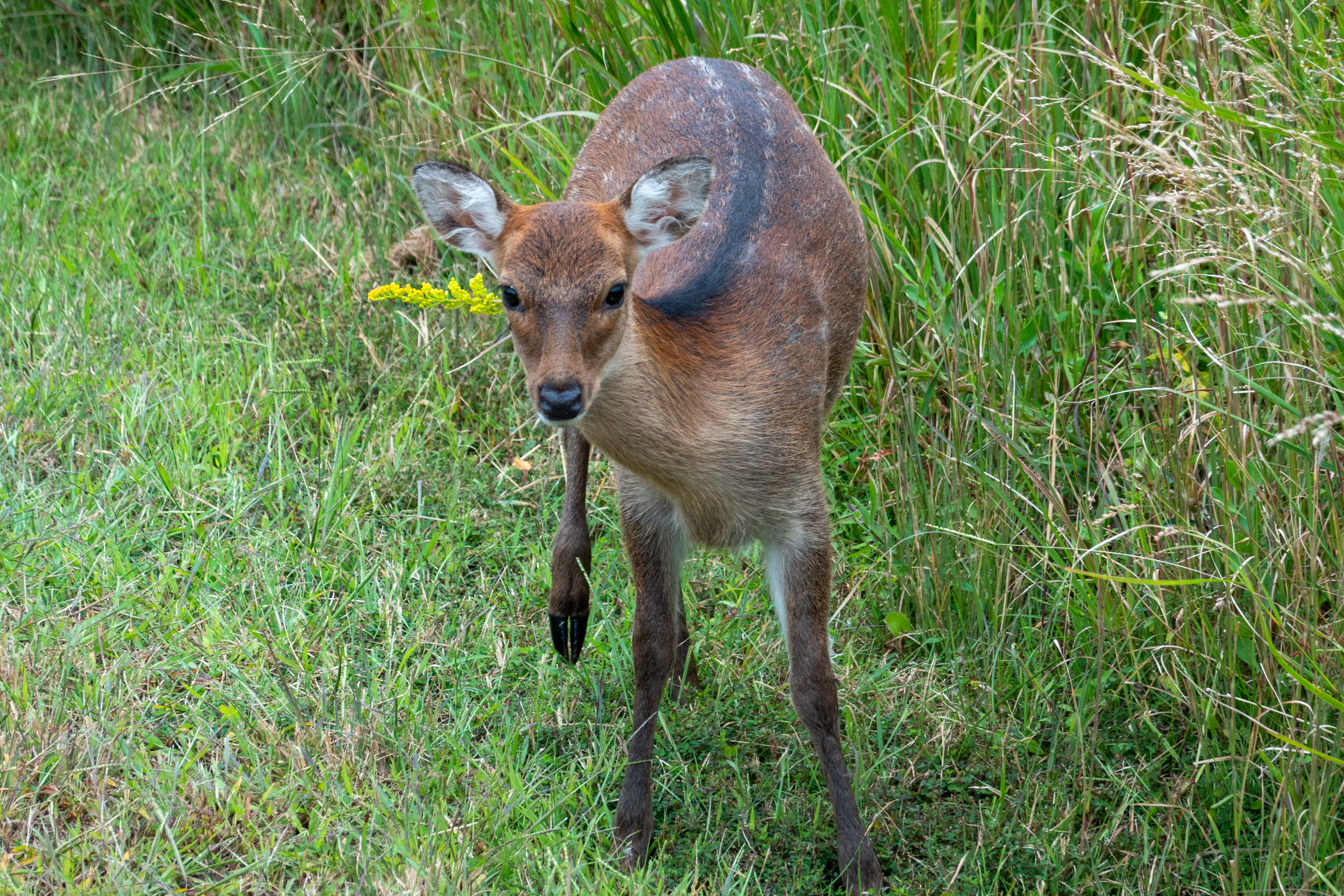
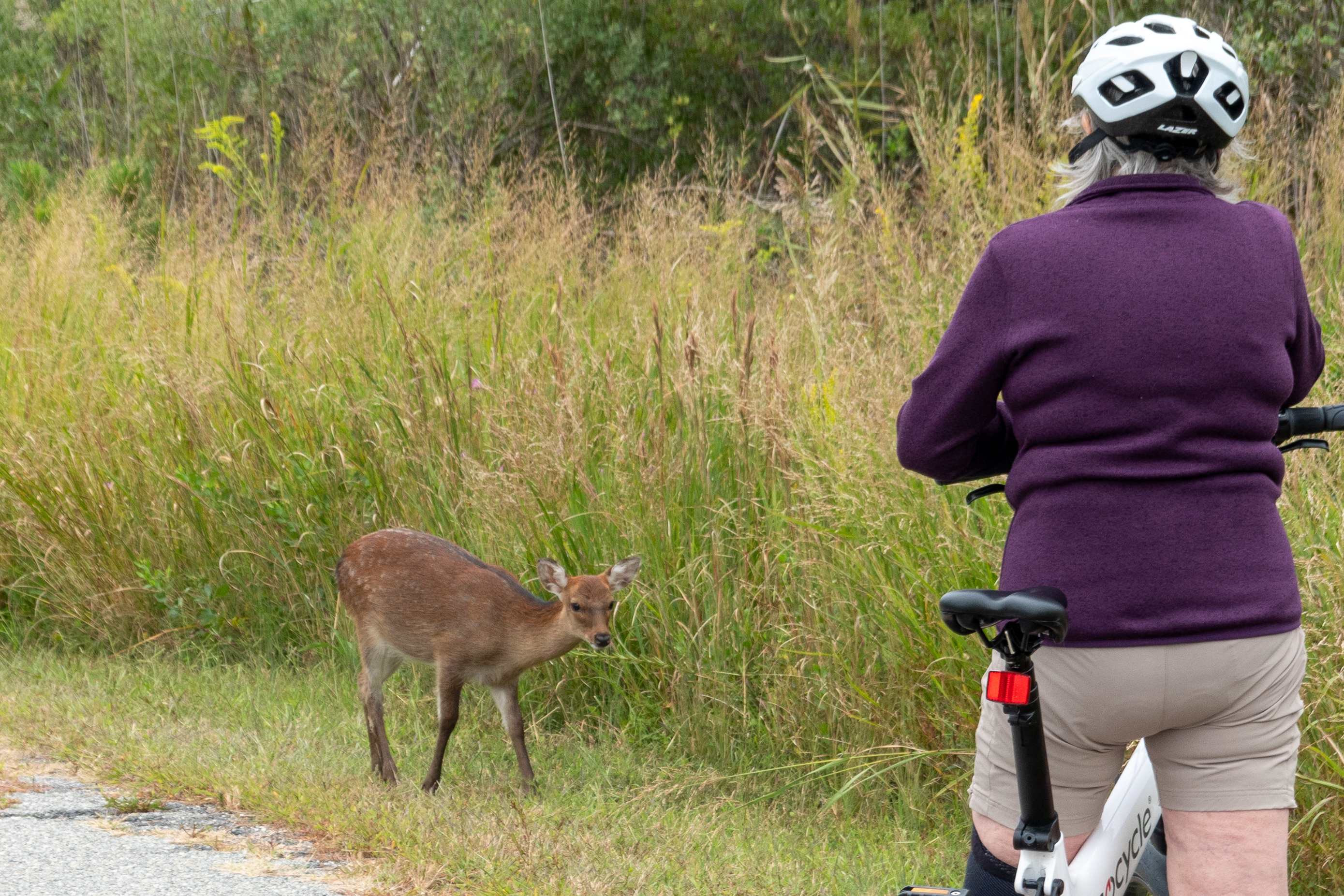
And on to Chincoteague. Our last visit was too many years ago to count but Denise had happy memories of lots of bike friendly paths and so we hoped to be able to visit Assateague Island by bike. We stayed at the KOA campsite as it was centrally located. Unfortunately, the weather gods decided we had seen enough glorious sunshine and a cloudy, cool day greeted us. We set off anyway and did enjoy biking the island. It was much too cool to dip our toes in the ocean. We did spot Chincoteague ponies from afar and a Sika deer, so we considered our ride a success.
Sitka deer. (Yes, from Japan.)
The ponies were not receiving socially.
Denise, discussing tourism with the deer.
After a rainstorm, we headed out for ice-cream, as you cannot go to the beach without having ice-cream! The following day we drove home, through some mixed could and rain. All in all, a great little trip.
Important new photo news. Through the magic of the new editor from WordPress, you can see the full size images simply by clicking on the image in the blog. Cool!
We had been notified that our new refrigerator was en route to the Turners in Nevada so we did rather shorten our planned time in southern Idaho. It was time to get our new refrigerator installed and we had an invitation to attend a steak fry at the local Volunteer Fire Department in Wellington, NV. How could we say “no”?
We had previously visited and admired the north of Idaho and its incredible scenery but as we entered Idaho from southwestern Montana we found the scenery totally different.
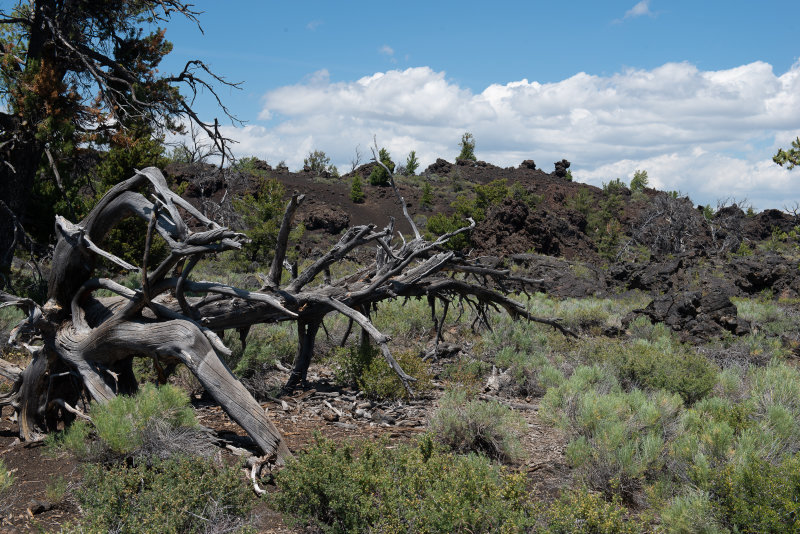
Our first stop was the Craters of the Moon National Monument and its totally lunar looking landscape. We had heard that the campground filled up each day despite its bleakness and we made a point of getting there in time to get a space, before we set out on foot for the visitor center to orient ourselves.
Not a lot of shade at noon.
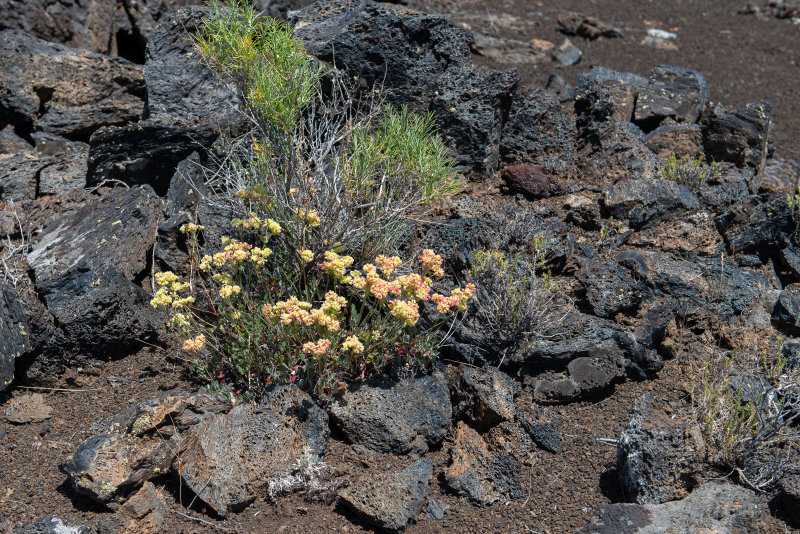
Bleak, but the flowers were sprouting through.
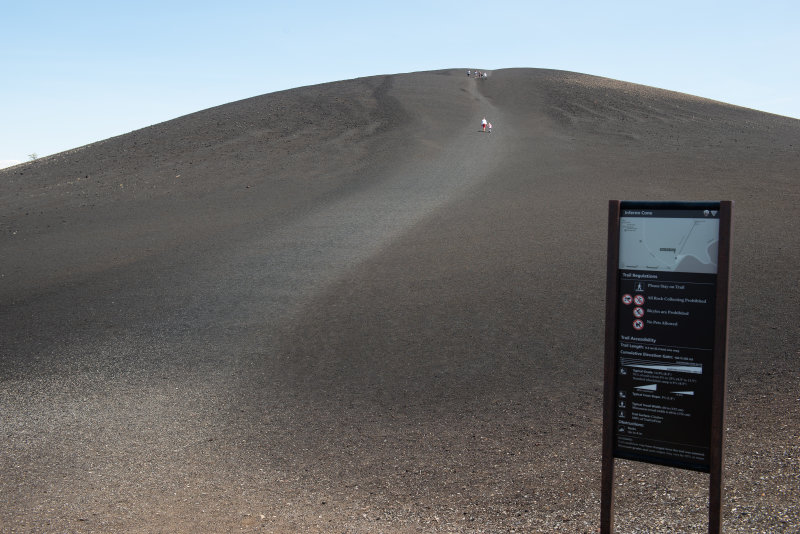
It was just as well that we walked from the campground as the parking was impossible for bigger vehicles. Regular cars had taken all the RV spots. (GRRRR!) After the usual movie, which we always enjoy, we set out to drive the loop with its various scenic view points. We climbed the Inferno Cone, a large cinder cone.
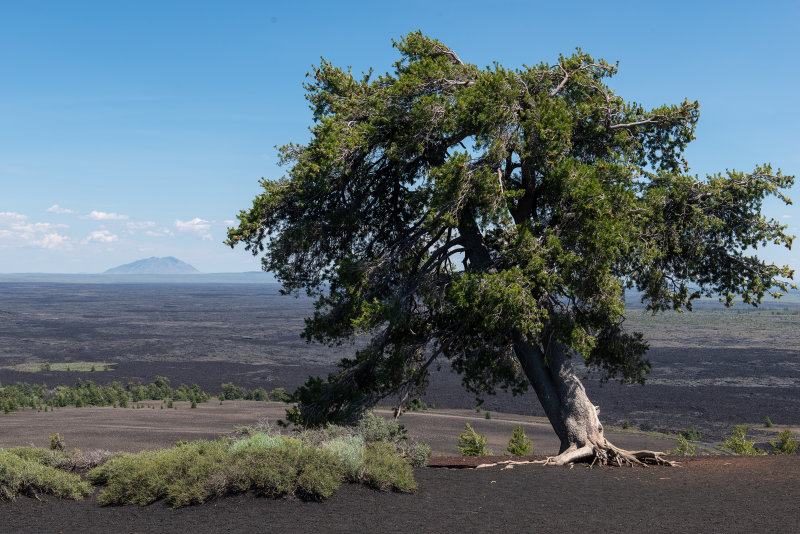
It was almost like being at sea or in the air – there was nothing to give any perspective.
Top of the Inferno.
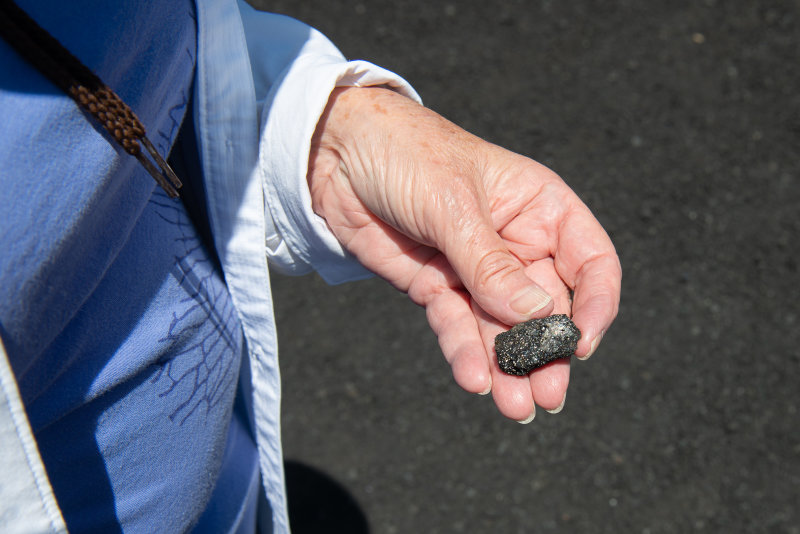
Beautiful, sparkling stone on the trail.
Looking down at the parking lot.
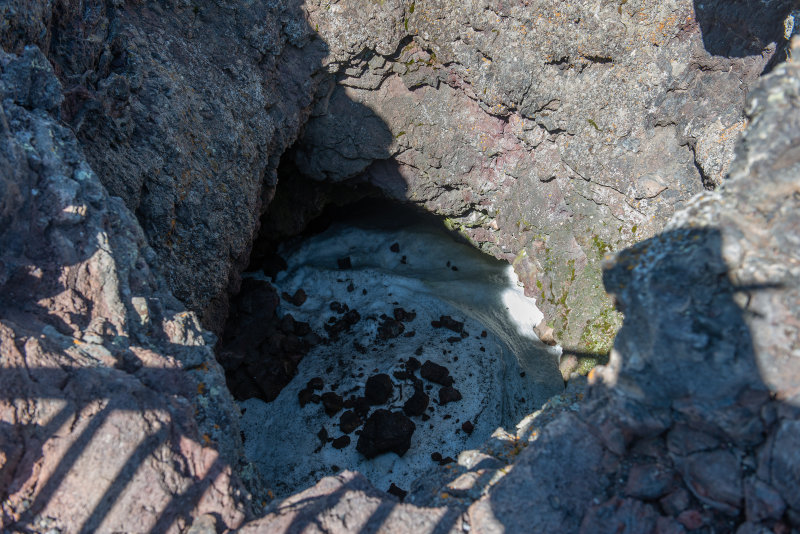
Ice! Down at the bottom of the vent. Amazing.
Panorama from the top of Inferno cone.
When you get to the top you keep expecting to find a crater – but there is none. The cinder cone was built up of cinders blown in from three little vents to the west. One of which now has ice in it. (See image, above.)
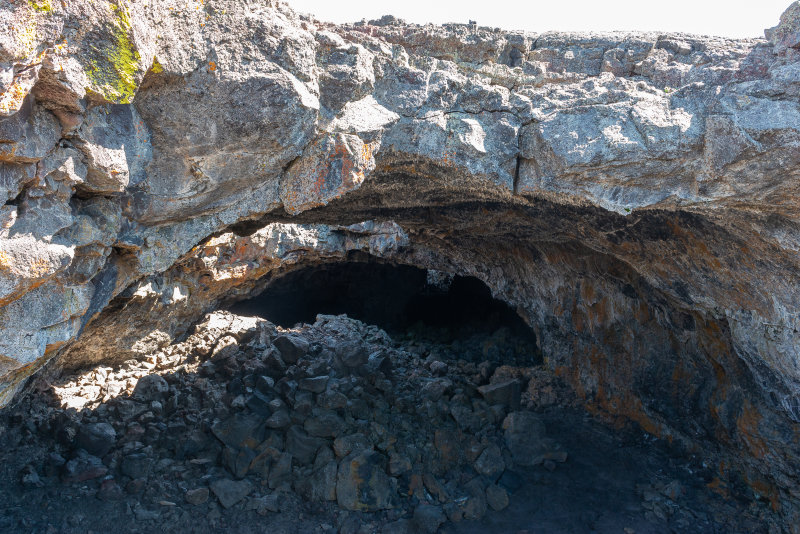
We hiked out to view the bigger lava tubes at Indian Tunnel, but did not enter any as we did not have a permit.
Hmmm. Child sacrifice?
Hard to capture the size.
We continued south and decided we needed to visit at least one real waterfall before leaving the mountains, so we set off for the Soshone Falls near Twin Falls, Idaho. On line research produced horror stories from drivers of long RV’s about the dangers of the narrow winding road to access the falls. We had no problems, especially after driving in the Andes, and really enjoyed our visit. The falls are controlled as needed for irrigation and other uses and can be quite dry, but they were flowing splendidly during our visit.
Falls View downriver.
One of the few European campers that we saw this trip.Denise at falls.
We then set off for Nevada as temperatures climbed. We began looking for campgrounds that advertised shade and bringing the Blue Cat up front into the air-conditioned cab during the afternoon as the camper was just too hot for him.
Safely back in Nevada, the fridge installation was an interesting experience, as yet again, the skylight had to be removed for access. We used a neighbor’s hoist to remove the old fridge and install the new one. The Blue Cat was distraught when his camper left to go next door without him! He ended up underneath Robinson Fuso, the Turners old camper, which he obviously felt was familiar territory! He came running when the 917 returned.
After another enjoyable stay, including the aforementioned steak dinner, we headed east on Route 50, again, this time on our way home. We planned a leisurely wander, not a mad dash, and began with a visit to the Berlin-Ichthyosaur State Historic Park. The wonderful book “Traveling America’s Loneliest Road” (https://www.amazon.com/Traveling-Americas-Loneliest-Road-Geologic/dp/1888035056) is full of intriguing side trips from Route 50 and this time we actually had the time to take some.
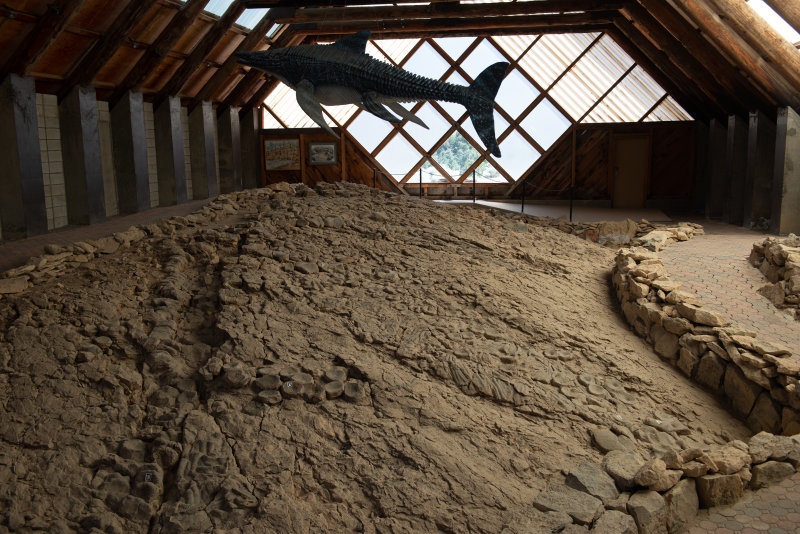
Denise really enjoyed seeing the ichthyosaur fossils on display. The shelter had been built over where the bones had been discovered and showed them in the ground, as found, and not rearranged to make a complete skeleton. Over 40 skeletons had been discovered there but many were not in good condition or were incomplete.
Denise and the one that got away. You really have to look to see the fossils.
Inside the shelter.Denise with fossils outside. A cover was planned, but never built. If you don’t know what to look for, you will never notice them.
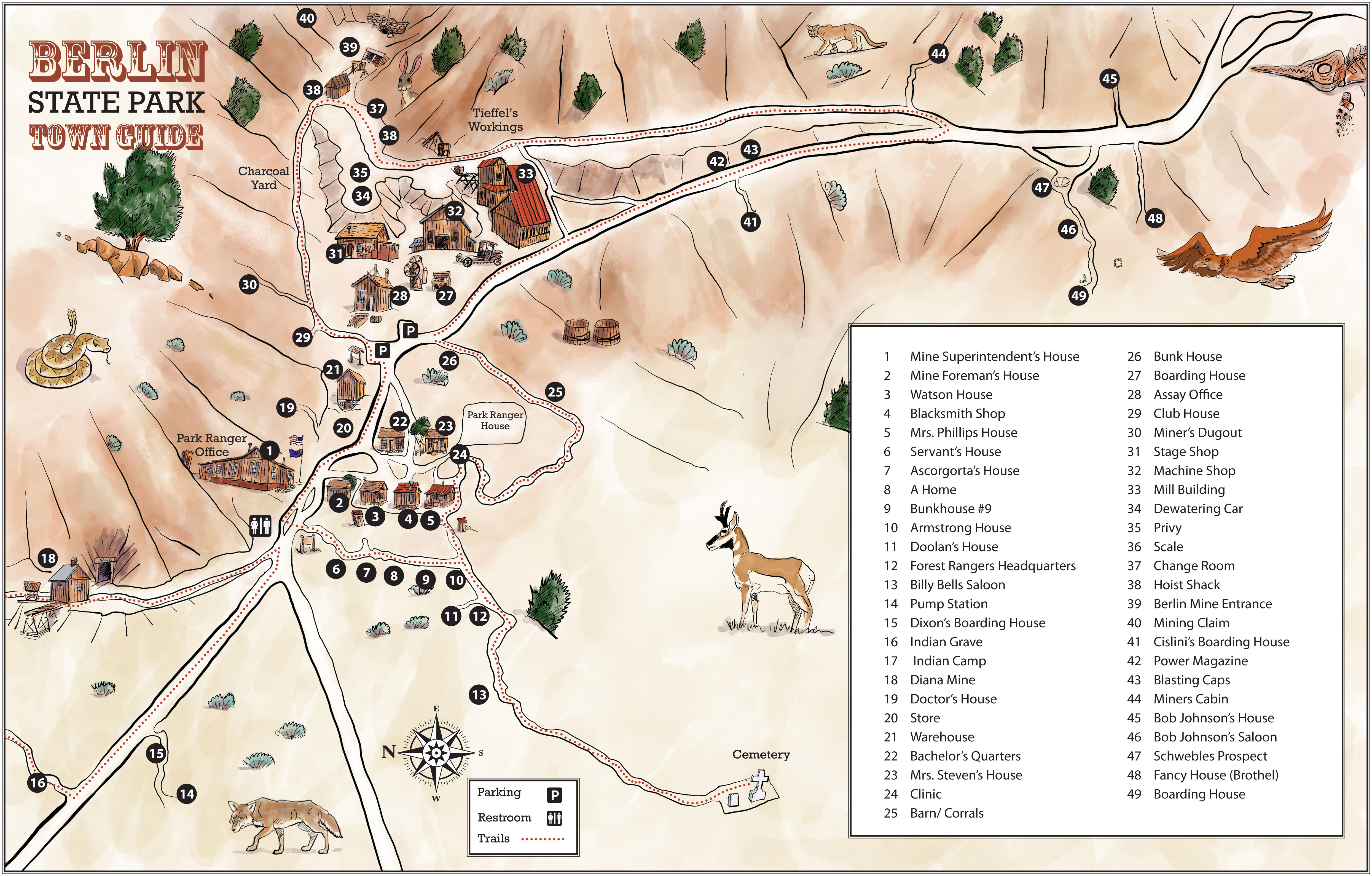
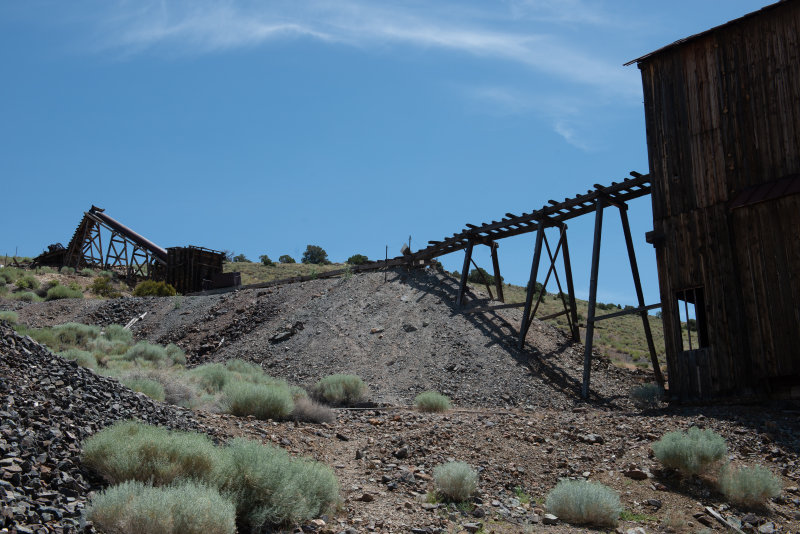
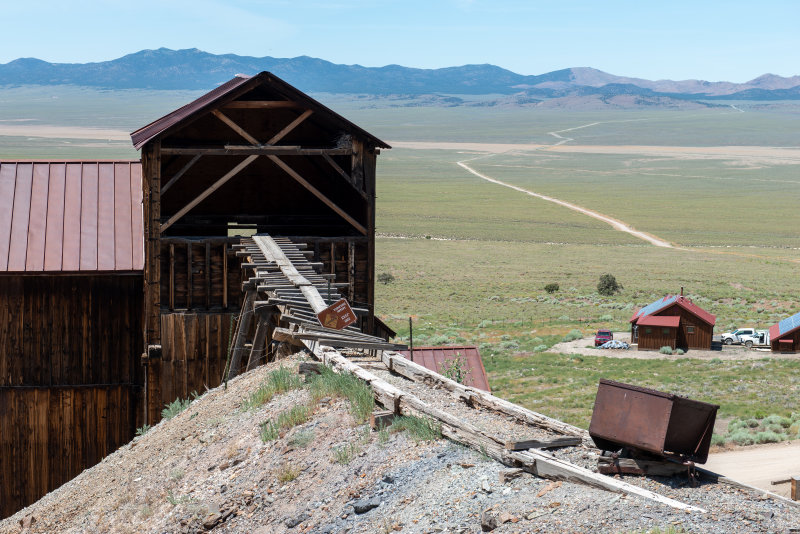
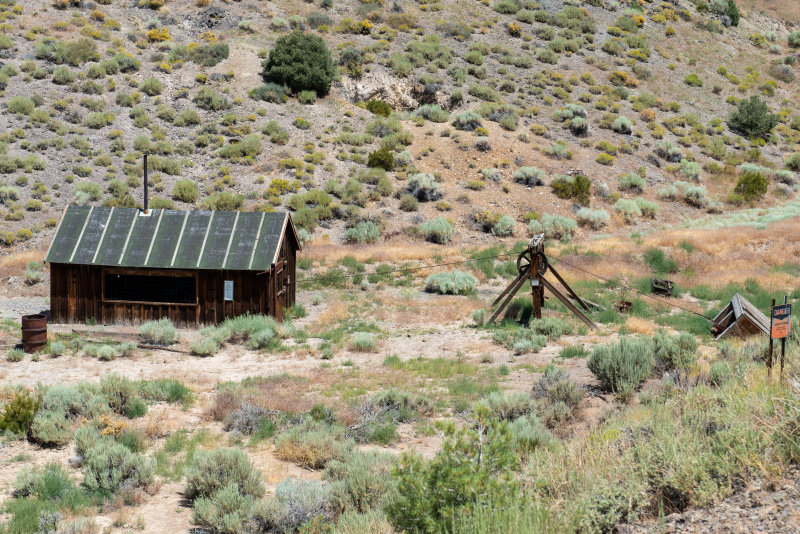
The site of the Berlin Mine ghost town is fascinating.
Lots of cool stuff to see.
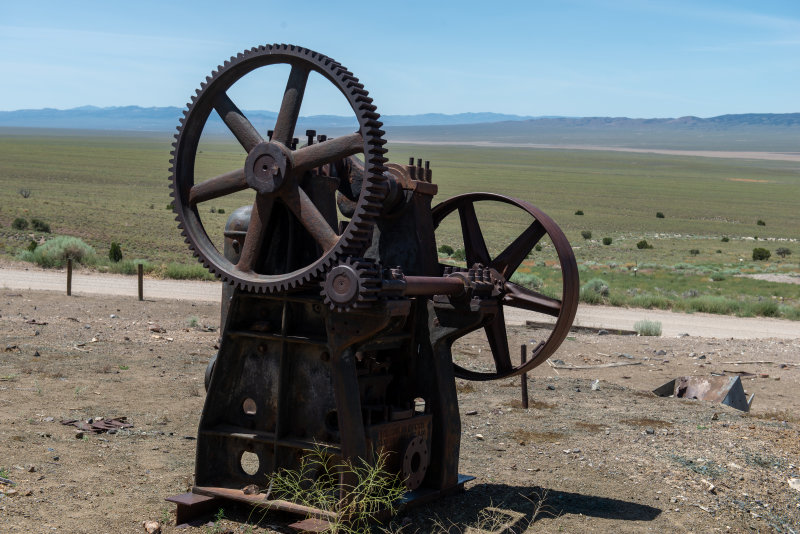
Ore crusher.Secondary ore chute leading to the main mill.Inside the Mill.
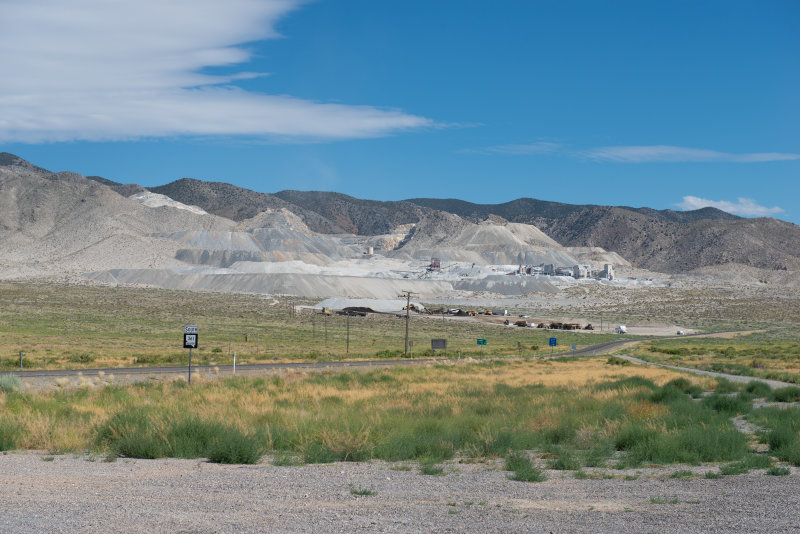
We came across the mountains in the background and the valley in the foreground to reach Berlin.The huge mill ore mill dominates the scene.The main entrance to the mine was not very impressive, just an angled shed.
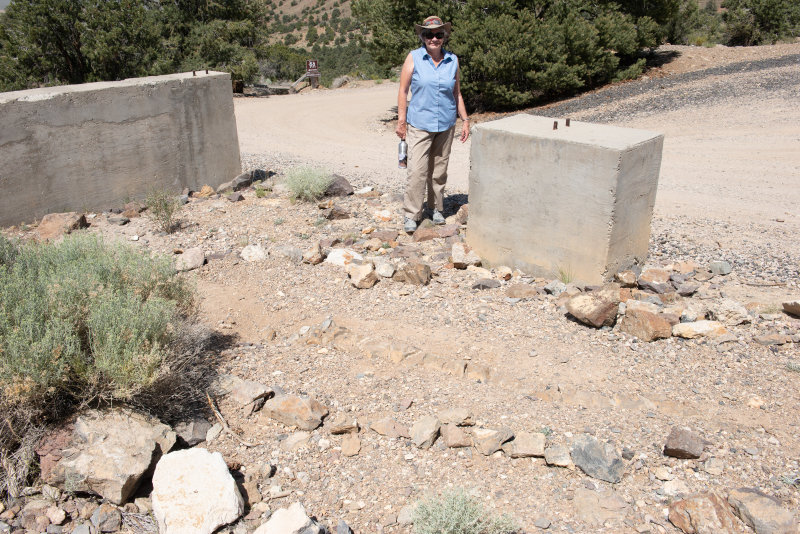
Tires are a bit flat.We were grateful for the facilities in the 917.Artistic massive beams.
We then headed to Ely for the required Chinese meal. May not meet purist standards, but we enjoyed it, as usual. We took on diesel and were starting to head out of town when we saw a sign for the Success Loop, a 30 mile off road loop which begins after the Cave Lake State Park near Ely and ends five miles north of the town of McGill on Route 93. Hmmmm. Sounds like our kind of road!
The views were spectacular, especially as we approached the Success Summit, with the Schell Creek Range in the background.
After passing a flock of sheep with their shepherd, we camped in the mountains, off of one of the side trails. The night was delightfully cool as we were at about 8,000 feet.
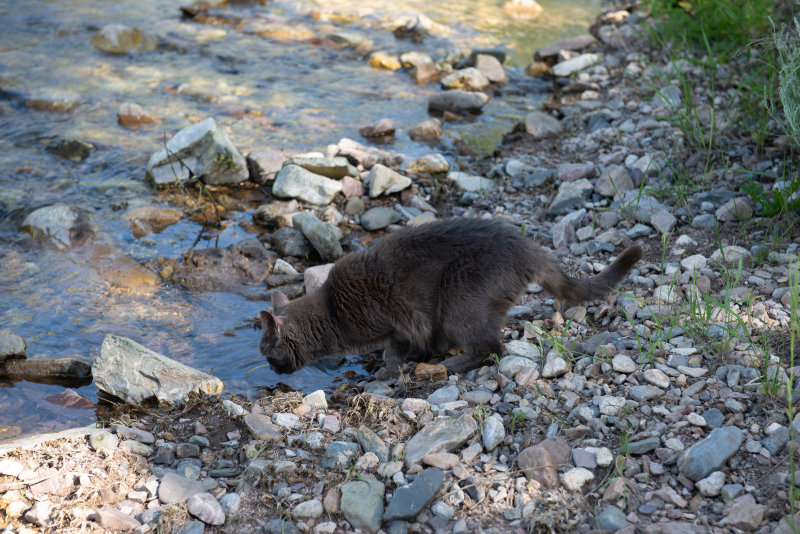
The Blue Cat getting back to his wild roots and sampling a mountain stream!
We had now spent two months at between five and ten thousand feet and really noticed the heat as we dropped below that to return home.
The next morning, we dropped back into Ely for a cappuccino at the combination coffee and flower shop, then got back on Route 50 to take the Osceola trail and enjoy lunch at the top of the pass. A future camping site!
Hard to show the steepness in a photo.
That is US 50 down on the valley floor.
Wonderful future campsite, just over the pass from the Great Basin National Park.
Spectacular mountain after the Great Basin National Park.
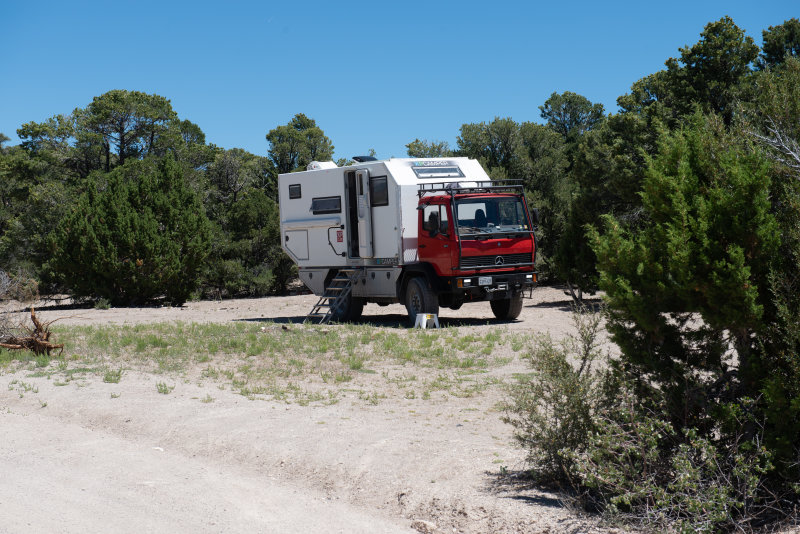
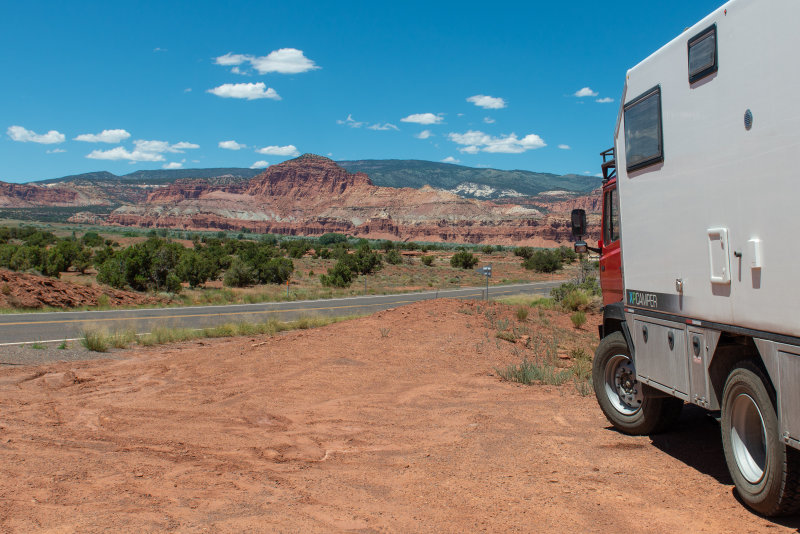
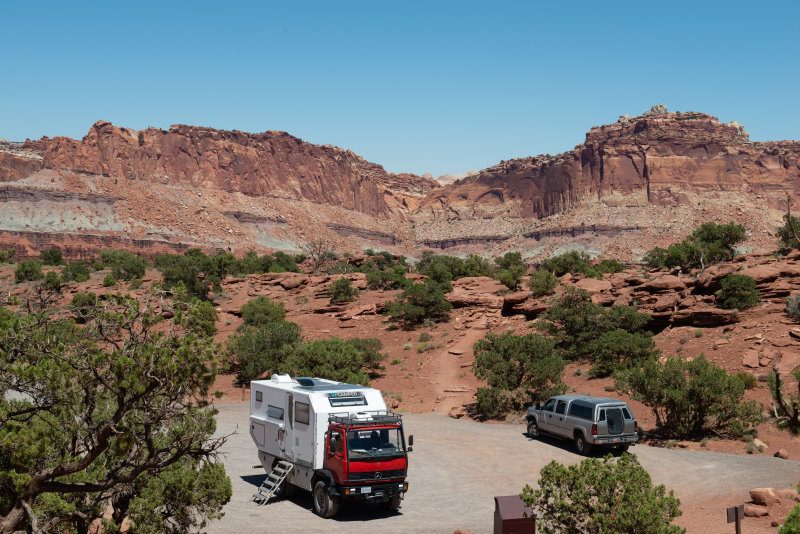
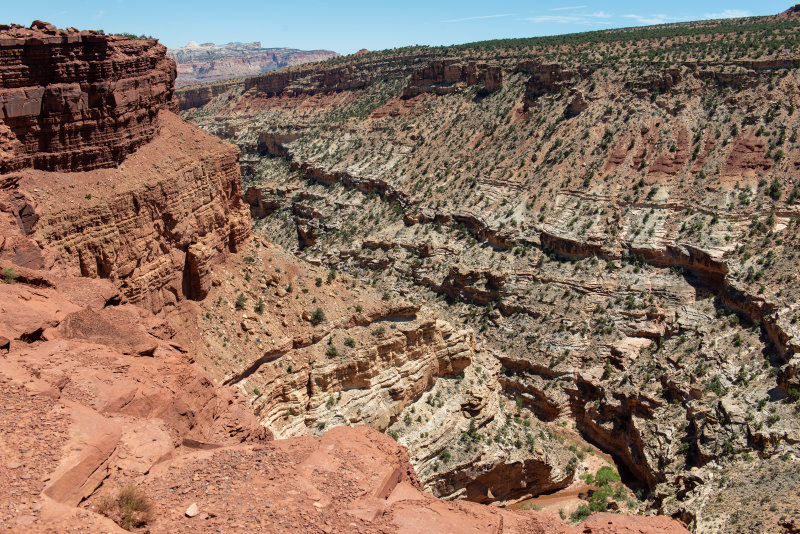
We flew past the Capitol Reef, but this time did not go up to the “Temples.”
Nearing the Capitol Reef. From the Goosenecks towards the hills.
The “Goosenecks” at Capitol Reef.
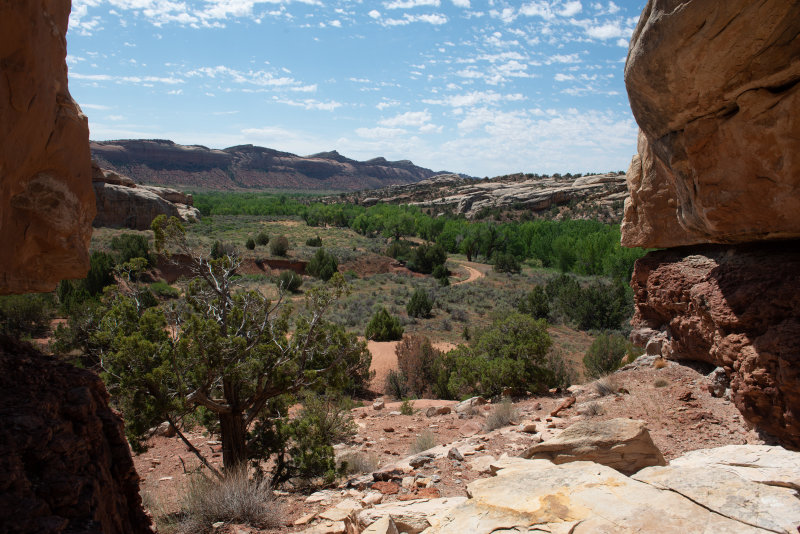
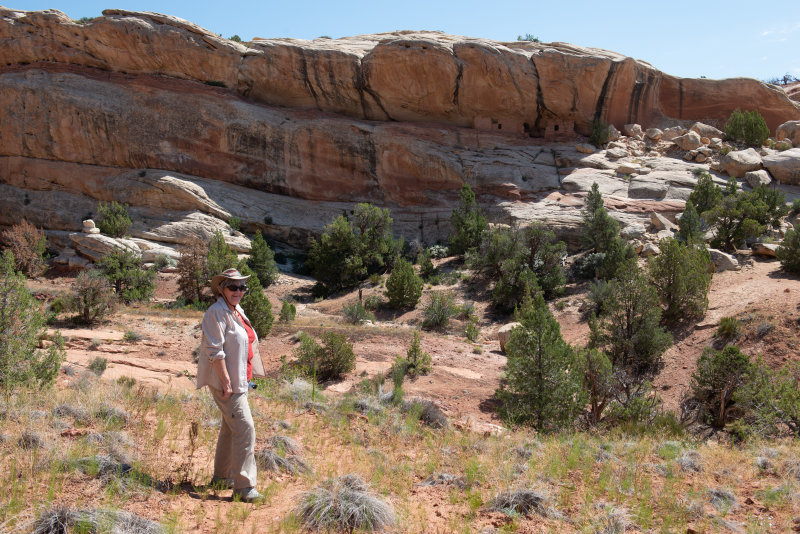
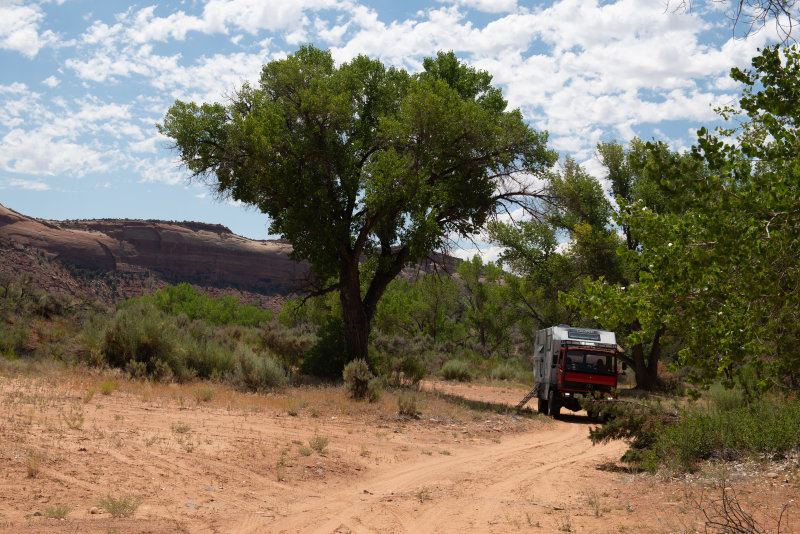
Denise wanted to see some ruins so we were planning to go to Cortez to the Hovenweep National Monument but after a night spent in the Natural Bridge National Park campsite, we got sidetracked by some ruins in Mule Canyon. We were looking for a ruin known as the “House on Fire.” In actual fact, despite extensive internet research, we were not able to find them. We finally followed one set of directions and hiked to find a couple of houses on a ledge with spectacular views but gave up on the rest!
Not on “fire” perhaps, but spectacular.We were getting quite good at finding water courses.
Denise admires the view.The trails were narrow, but it was the trees that kept the 917 out.
And another view. Can you find the tiny building on the ledge?Lunch in the shade.
With temperatures near 100F, we decided to leave Hovenweep for a future visit and continued east and stayed in Durango, at the campsite astride the Silverton railway line. Always fun to see the trains. (http://www.unitedcampgrounddurango.com/)
Fred was thrilled to drive the Wolf Creek Pass over the Rockies (he likes the song) and as usual the scenery was spectacular, though a lot less snowy than our previous crossing at the Monarch Pass.
Me an’ Earl was haulin’ chickens, on a flatbed out of Wiggins, and we’d spent all night on the uphill side of thirty-seven miles of hell called Wolf Creek Pass. Which is up on the Great Divide.
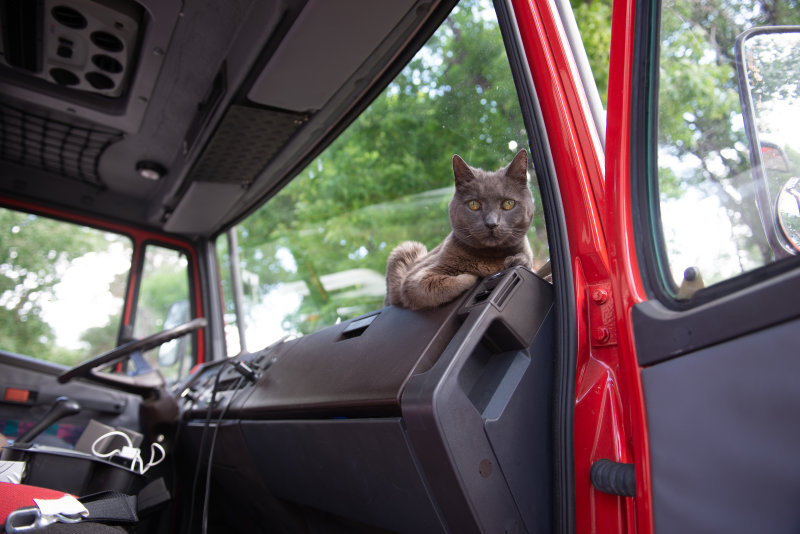
No chickens, just a cat.
We made a quick trip to Taos, New Mexico, hoping for Indian Fry Bread, but in vain. However we did a little shopping and enjoyed some New Mexican food for lunch. (http://taoseno.com/) Who knew that the gentleman running a jewelry store on the corner of the main tourist square would be a Palestinian from Jerusalem? Sadly, or fortunately, perhaps, we were not in the market for jewelry.
Sopaipillas may not be Navajo Fry Bread, but they are good.
We later discovered that friends from our days in Cuba are living in Santa Fe, and had we known, we would have kept going for a visit. Next trip!
We camped at Raton Pass which Fred found interesting, especially as they were having visits from bears and were refusing to accept tent campers. Blue was kept on his leash when outside!
The look you give when they tell you that you will have to stay on your leash.
The Appalachians were much less spectacular than the Rockies but we enjoyed our journey home through them. It is good to be home again!
Our first stop in Montana was at the site of the Battle of the Little Bighorn, where Custer was defeated by Indians from the Lakota Sioux, Cheyenne, and other tribes.We, of course, arrived at Saturday noon along with lots of other people but we were able to find a parking space tucked in with the other RV’s. So we had lunch and then set out to walk to the Memorial at the site of Custer’s final stand.
We also walked to the Indian Memorial, a modern and moving site with comments from all the different tribes and a spectacular sculpture. It is hard to imagine a more evocative image.
It was interesting to see the white remembrance stones dotted around the hillsides.These represented the Cavalry dead. Interesting information, more than half of the 7th Cavalry troops were foreign born, representing about thirty nations.
The Indian dead were represented by brown remembrance stones. There are not many of these as the victorious Sioux and others removed their dead and wounded from the field immediately. We drove from the site of the final stand to the Reno/Benteen defensive site and dutifully read all the signs along the road.
Note: From this point we are using a new image hosting system. If there is a link below an image you may click it to see the image in a range of different sizes.
The paintings, which matched the actual landscape, made it very easy to imagine the scene. The effect was all the more dramatic as we were there on June 29 and the battle took place on June 25, so even the yellow flowers are correct. https://pbase.com/diplostrat/image/169600293
Books have been written about the battle, but Fred would opine that Custer was not quite the vainglorious idiot as portrayed in modern movies. That said, he made a huge mistake and it cost him his life and half of his command. He was worried that the Sioux would try to escape – he didn’t realize that they had the strength to actually attack.
His deputies took casualties, but, after getting caught in the open against superior forces, they actually managed to do it by the book and retreated to high ground where they held off repeated attacks for over a day. In the zeal to portray Custer as a hero, back in the day, Reno had his career ended. Read the Wikipedia here: https://en.wikipedia.org/wiki/Battle_of_the_Little_Bighorn#Controversies
Our next stop was Great Falls where we discovered and stayed in an amazing KOA campsite. The incredible landscaping made this the Taj Mahal of KOA’s. We had a pleasant shady spot and enjoyed a campground fireworks display in honor of Canada Day! Adding in free pancakes for breakfast and a great ice-cream bar, we decided to stay a second night as the day’s adventures had lasted longer than expected! Though fireworks were lacking the second night! https://koa.com/campgrounds/great-falls/
Our first visit in Great Falls was to the Lewis and Clark Interpretive Center and we enjoyed it very much. The Interpretive Center is located on the Missouri River and there is a delightful river walk and some pioneer activities taking place there. We walked down along the River Walk to see the Giant Spring, one of the largest springs that Lewis and Clark documented on their trip. The whole complex is well worth a visit. (https://www.visitmt.com/listings/general/museum/lewis-and-clark-national-historic-trail-interpretive-center.html) Inside the center, the displays follow the rivers taken by the group and their timeline, so we progressed through their journey, learning of their successes and challenges. And, of course, there was a film, this time by Ken Burns, which was well worth watching. Because of waterfalls they actually had to portage their canoes 18 miles around five large waterfalls, so it was easy to look at the area and imagine their problems.
Our other visit in Great Falls was to the Malstrom Air Force Base to visit the Museum there. (https://www.malmstrom.af.mil/About-Us/Malmstrom-Museum/) Once we were cleared to visit by the Visitor Center, we made our way to the museum passing by a selection of planes on display. The museum itself was fascinating. It explained the mission of the base which was to maintain and keep in constant readiness a number of Minuteman missiles. Two excellent films explained how this was achieved. There were also examples of various pieces of missile and control consoles. The Museum Director was an enthusiastic source of lots of information. And we learned that we had actually seen the relocation of a missile on previous day’s drive towards Great Falls; we had thought it was simply the National Guard. Interesting aside, the museum had a map of the route that Lewis and Clarke took across what is now the air base. (Sorry, no pictures taken on base.)
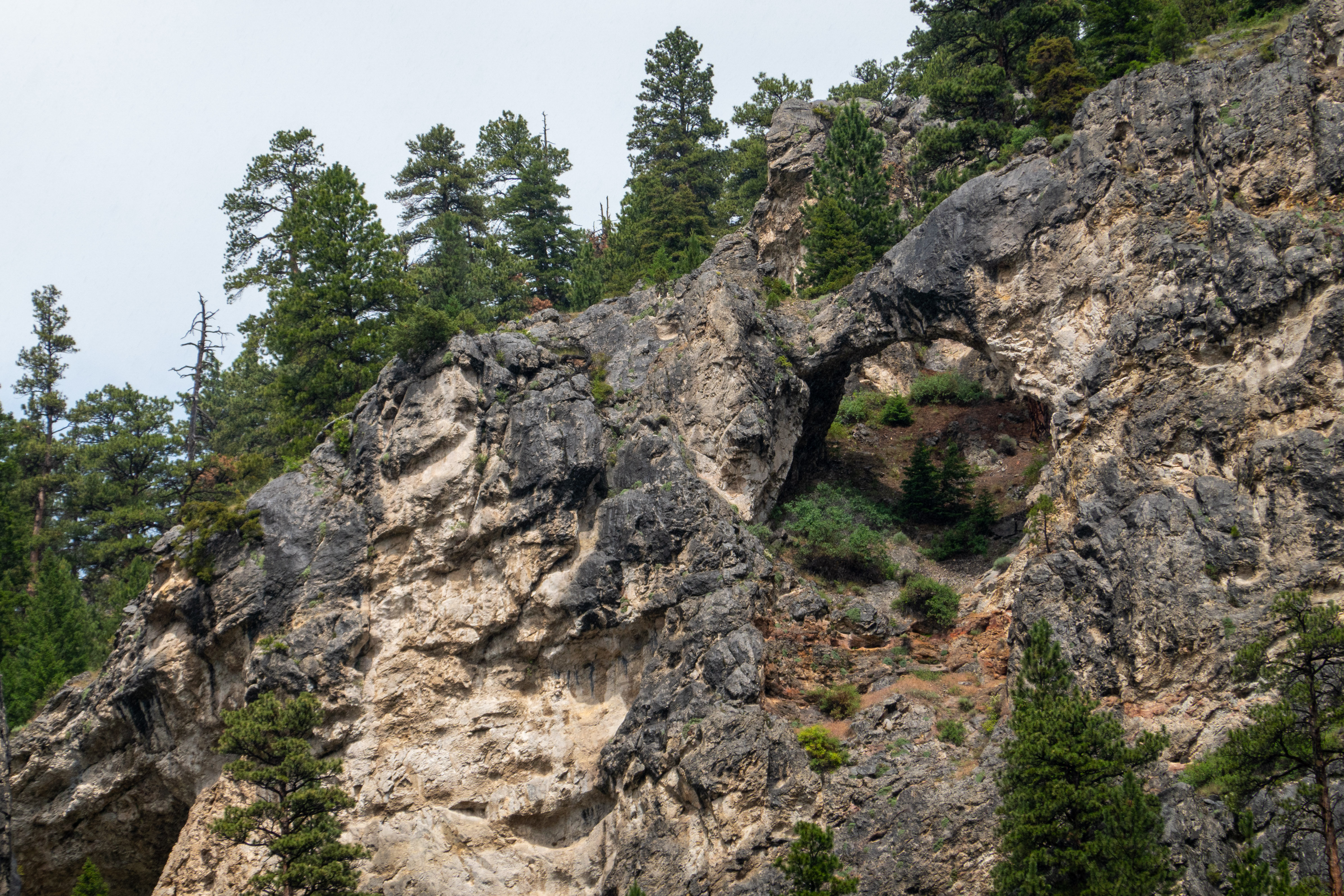
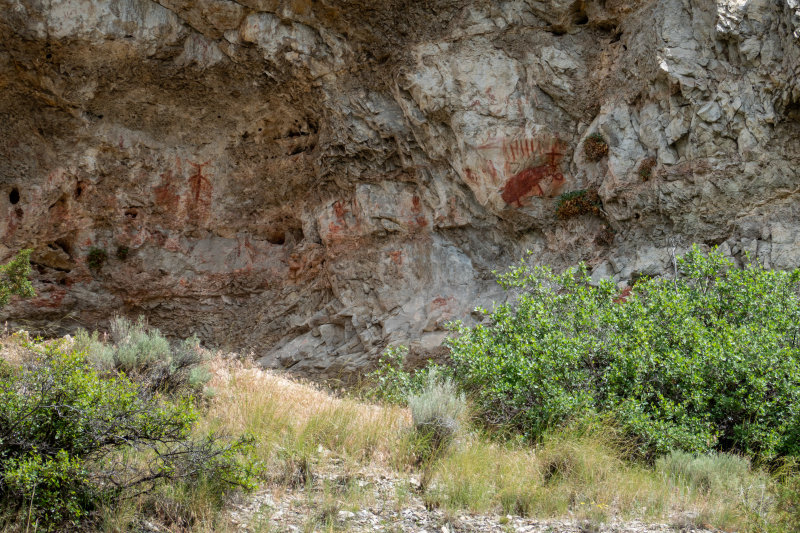
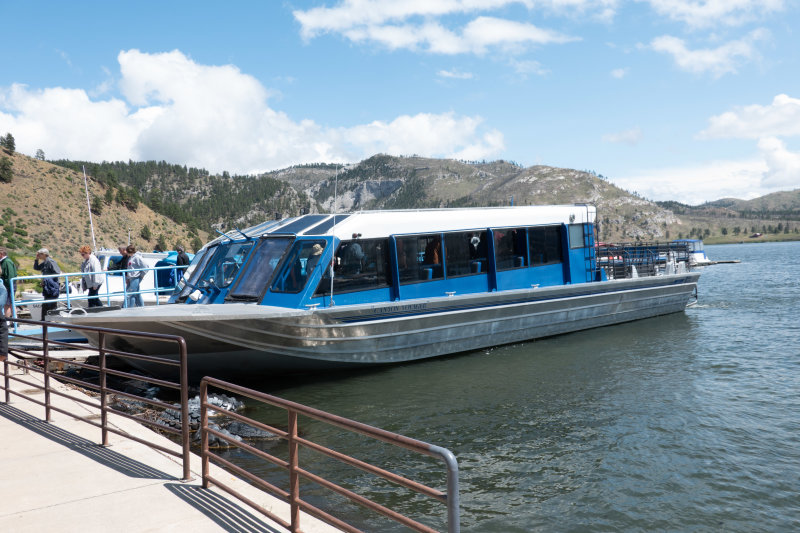
While everybody knows about the mighty Mississippi River and can probably even remember how to spell it, the Missouri is a bit overlooked. Pity, because it is a huge river, a major tributary of the Mississippi, and, of course, the focus of Jefferson’s dreams of a river route to the Pacific Ocean. As lamented previously, the Lewis and Clarke Expedition is too little taught in US schools. We have joyed retracing the routes in this and previous trips – freely admitting, that we started doing this after stumbling over Lewis and Clarke sites in our own, total ignorance. Upriver from Great Falls, the Missouri passes through an impressive valley, dubbed the “Gates of the Mountains” by Clarke. So naturally, we had to pay a visit. It was pouring rain when we arrived and boarded the boat, but over the course of the visit, the sun came out and, by the time we finished, the boat was in full sunlight.
The tour actually starts upriver, goes downriver, and then returns. But Clarke was coming from the portage at Great Falls, so his first view was of the “Gates” themselves.
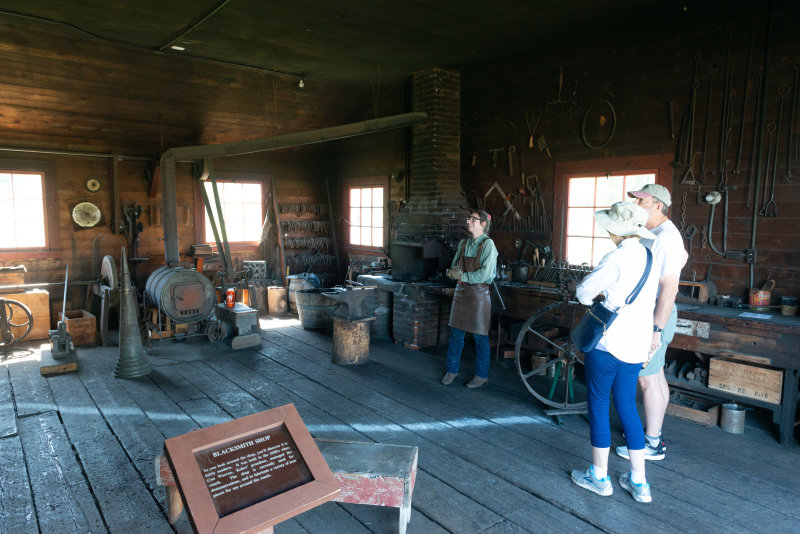
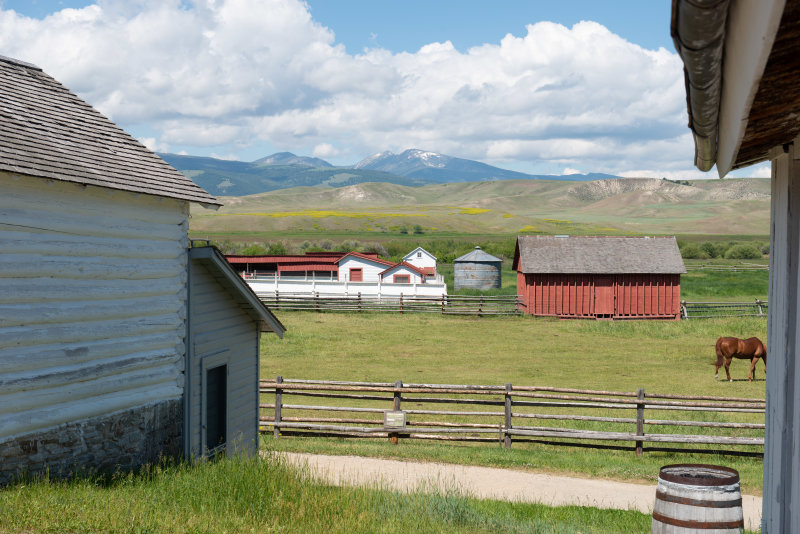
From Great Falls we moved on to Deer Lodge. July 4 was approaching and we decided we wanted to be in a small town to see a celebration. Denise also wanted to visit the National Park Service Grant-Kohrs Ranch Historical Site in Deer Lodge. (https://www.nps.gov/grko/index.htm) This site preserves the ranch, founded by Johnny Grant and then bought by Conrad Kohrs, one of the great cattle barons of the 1800’s. The ranch originally grew when Grant, who spoke only French and a number of Indian languages, had the brilliant idea of exchanging worn out, stressed cattle from the wagon trains for his well fed, thriving animals. He exchanged one of his for two of the others. Needless to say, his herds grew as he fattened up the new cattle and then traded them for even more cattle.
The first view of the house is a simple frame building.But walk around back and it is a huge edifice.
Conrad Kohrs was a German immigrant and we were fascinated by his very decorated Victorian house, not at all what we expected from a frontier home. It could have been a historical site in Boston or New York. Sadly, such is the fear of people not being able to shut off their flashes, that no photography is allowed inside the house.
The ranch is still functioning and gives wonderful insights into the history of and current methods of ranching, explaining how the bad winter of 1868 changed cattle ranching. The tremendous loss of animals after a summer drought and vicious winter, led to the realization that winter feed was needed to maintain the herds.
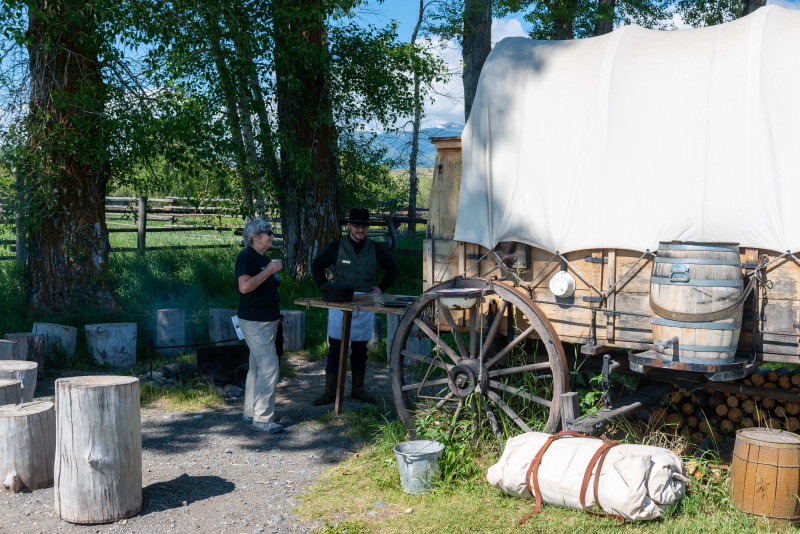
We enjoyed cowboy coffee from the chuck wagon and we chatted to a guitarist/luthier (!) from Pennsylvania who was singing original cowboy songs.
Coffee fix at the chuck wagon.Memories of how we used to cook when camping in Botswana.
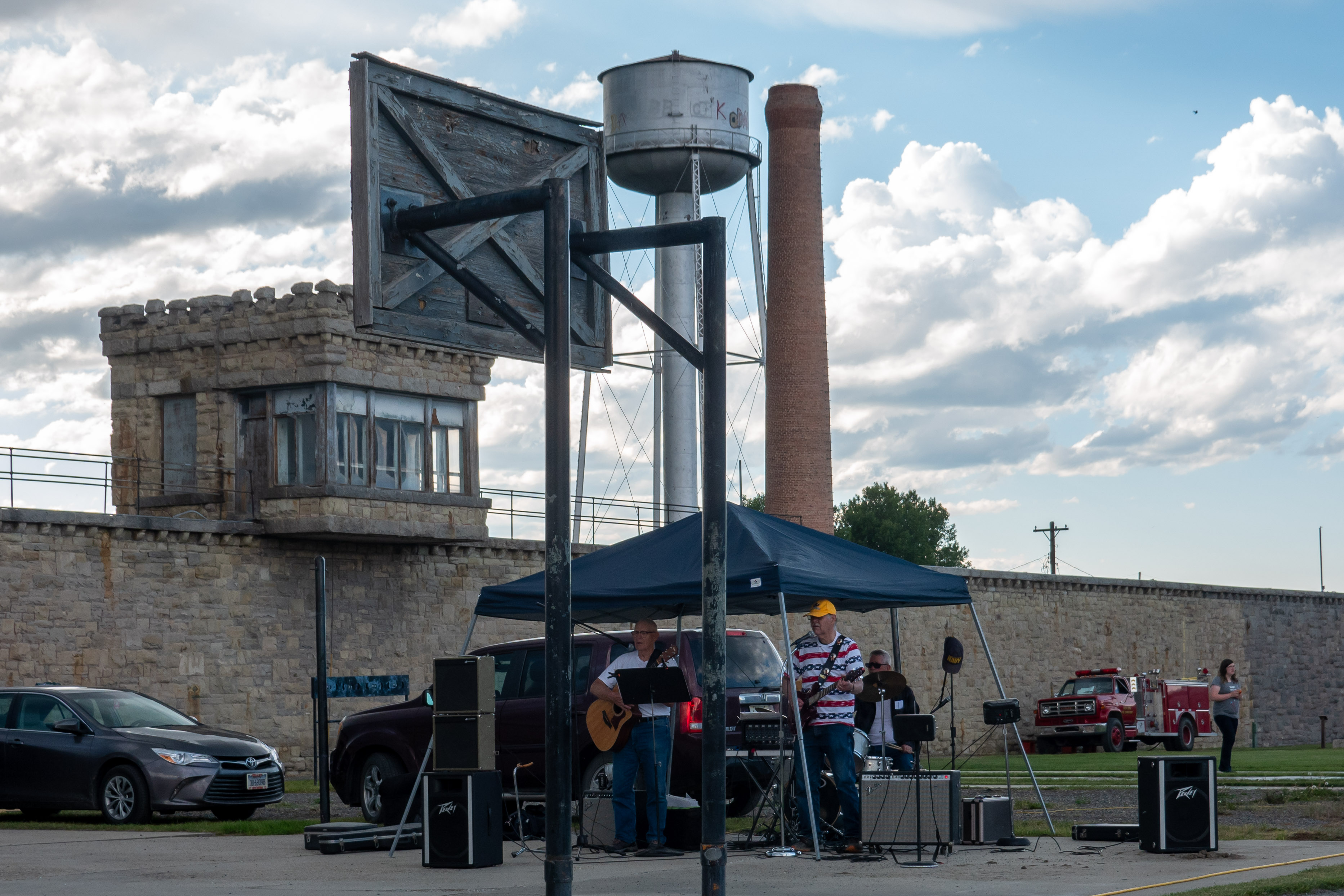
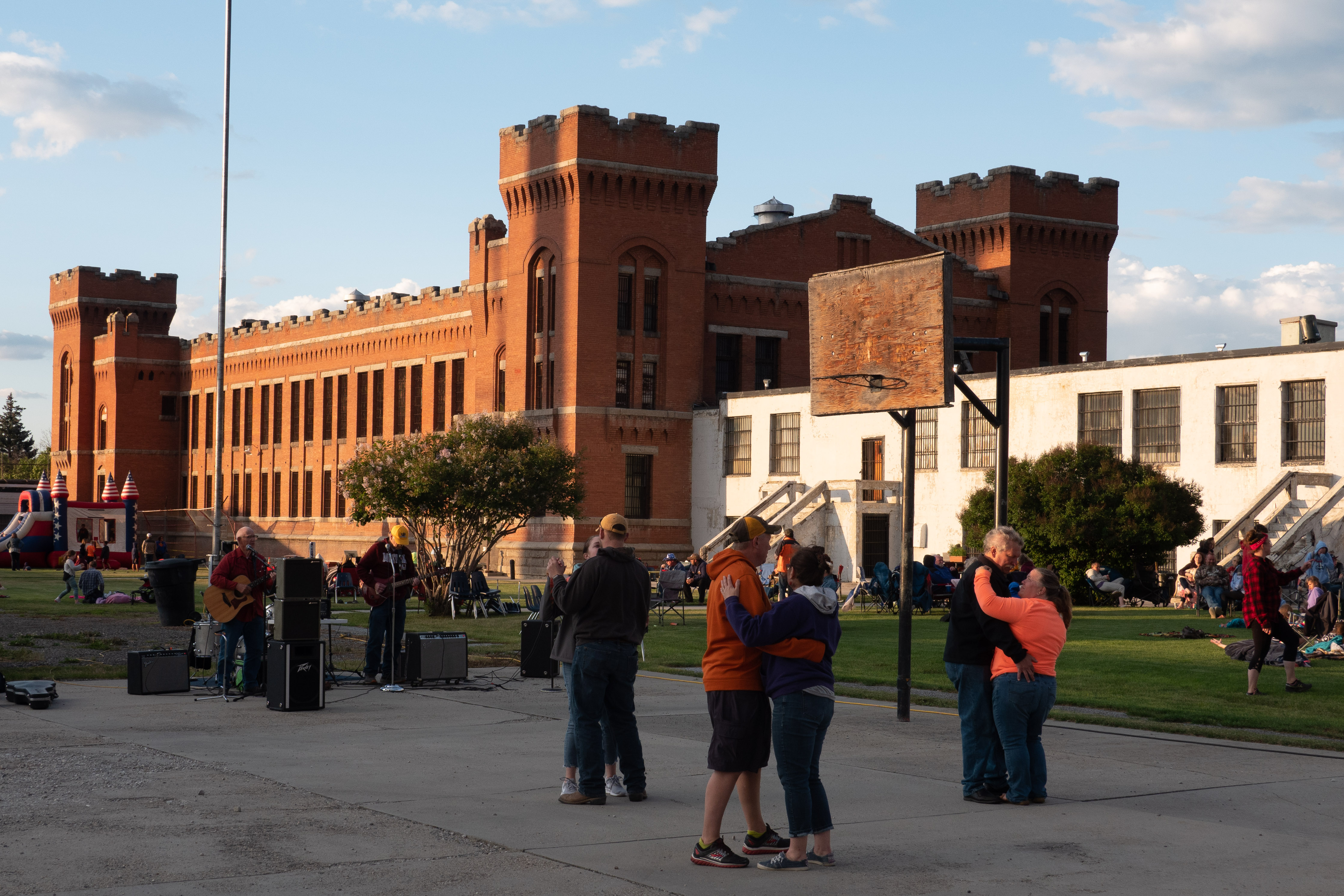
The July 4 celebration in town took place inside the Old Prison compound and took the form of a pig roast and pot luck. We were somewhat amazed that a town could be small enough to hold a pot luck that everyone could attend! We dutifully stopped at the supermarket in town and purchased makings for a pasta salad for our pot luck contribution. As we are still using the ARB electric cooler, we were unable to refrigerate anything large. Armed with the salad and insect repellent against the vicious mosquitoes, we set off for the celebration. It was fun, there was live music for the first part and then we ate dinner.
No, they didn’t play Folsom Prison Blues! With the second set, folks were dancing.Enough for the whole town. Literally.
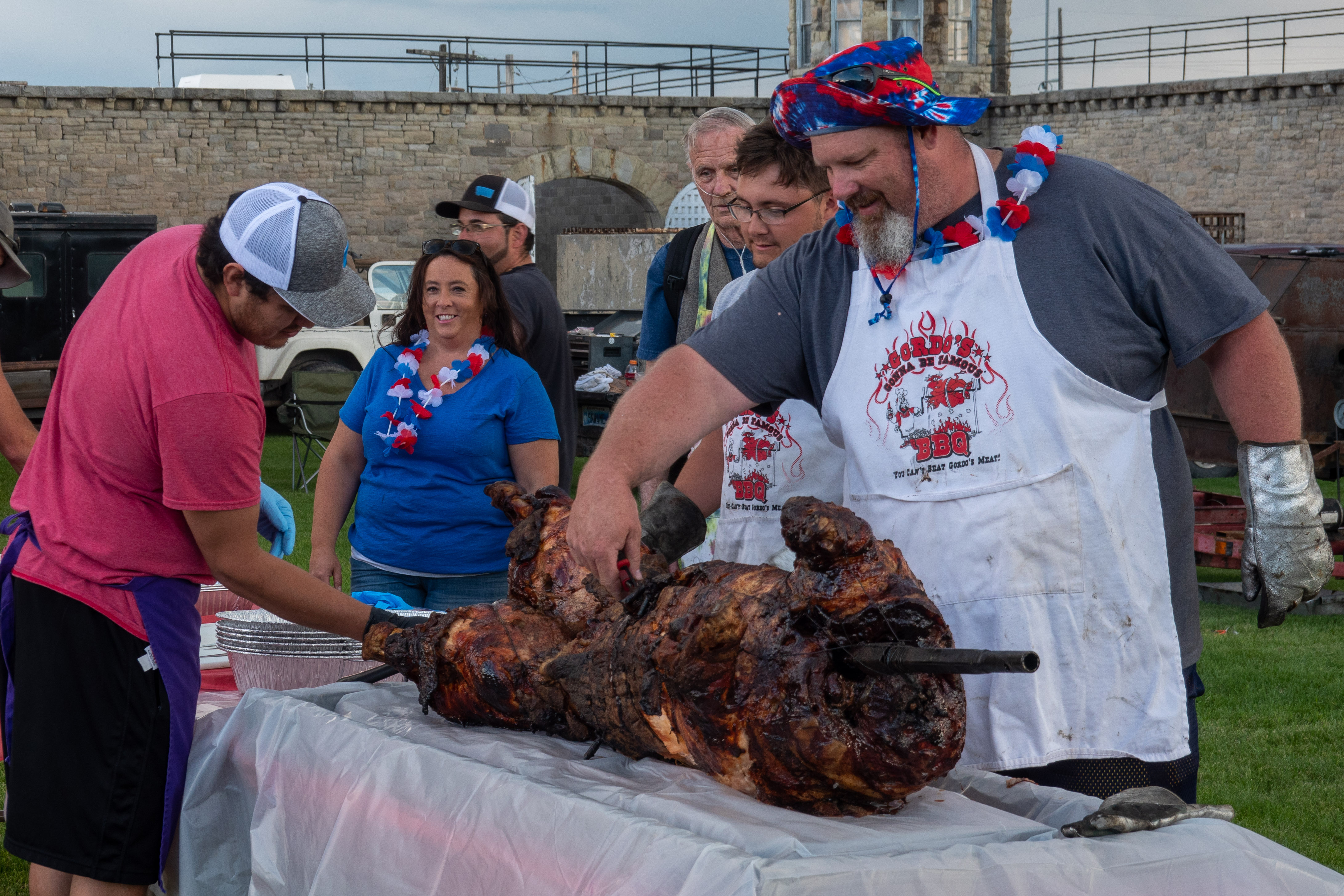
The pig was excellent! By this point we were cold, so we retired to the camper for a coffee and some warmth before returning for the fireworks. When it is still light at 10.15 PM, showing fireworks gets very late! But the firework display was fantastic. It lasted about 20 minutes and was even more amazing as it was one of at least four displays, all at the same time.
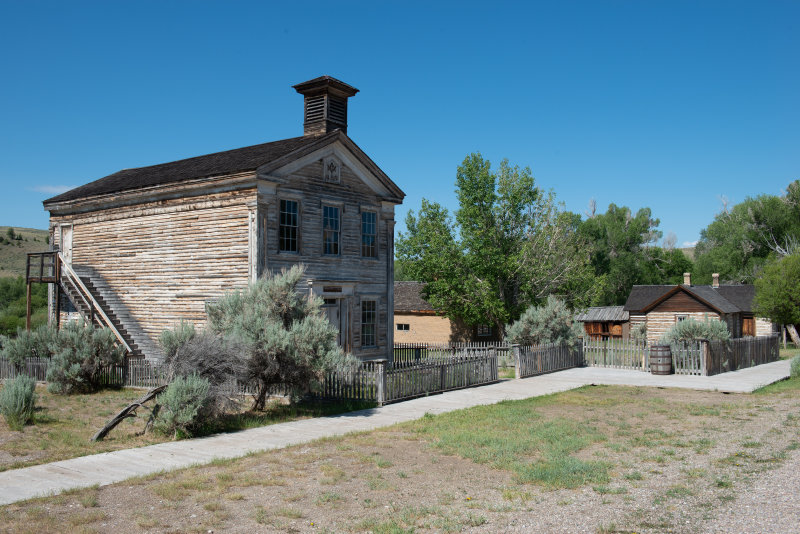
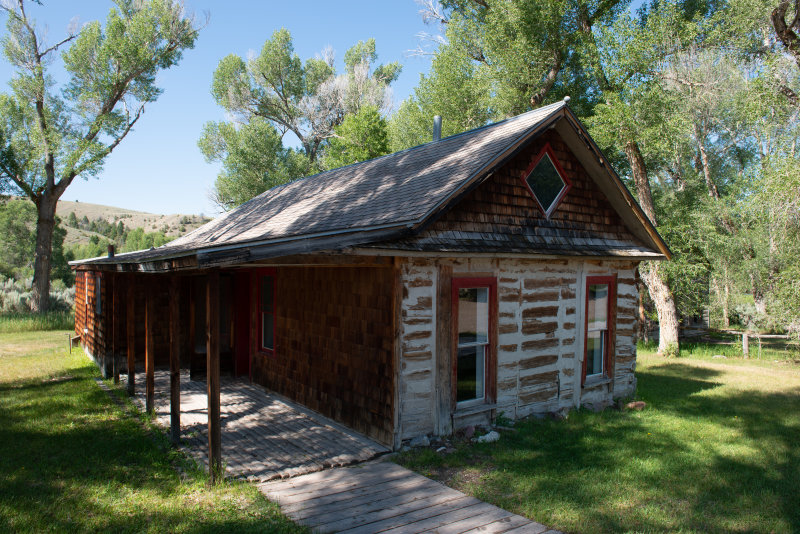
As we had received notification that our new fridge was being delivered, we began heading south back to Nevada. We did make a couple of stops en route. The first was to Bannack State Park. We had originally stopped at Nevada City, hoping to ride the Alder Gulch narrow gauge railway to Virginia City. We discovered it was not running on the day we arrived and Nevada City, a rebuilt town, looked rather like a tourist trap. So the authentic ghost town at Bannack State Park looked more like something we would enjoy, plus there was a campsite there. (http://bannack.org) So, off we went.
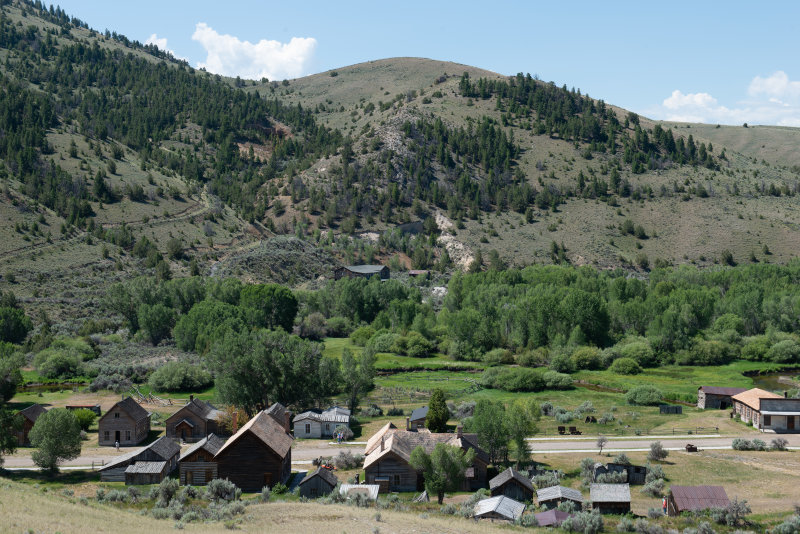
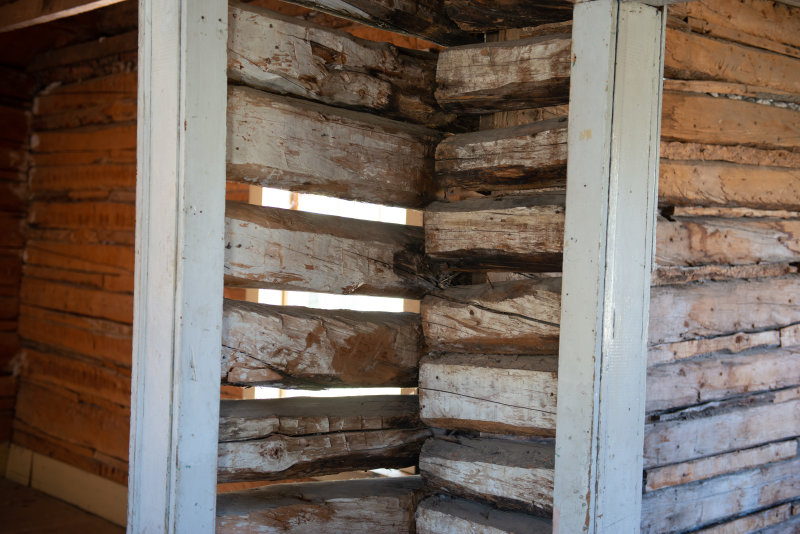
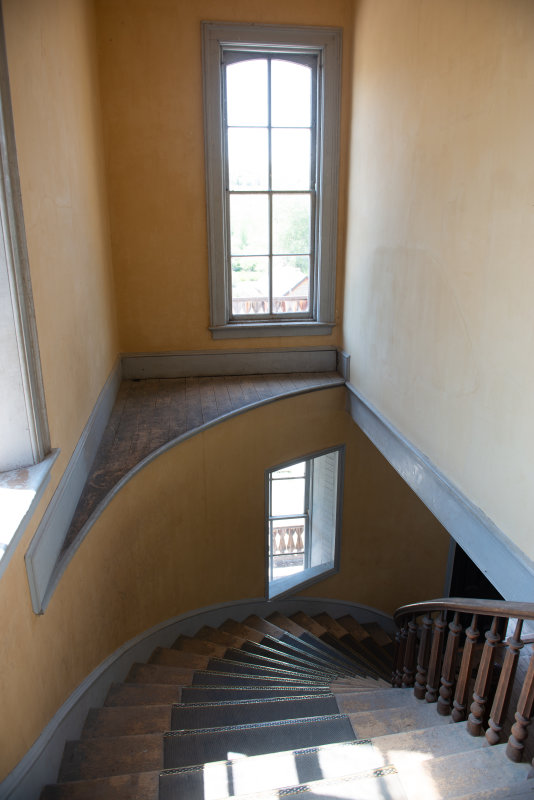
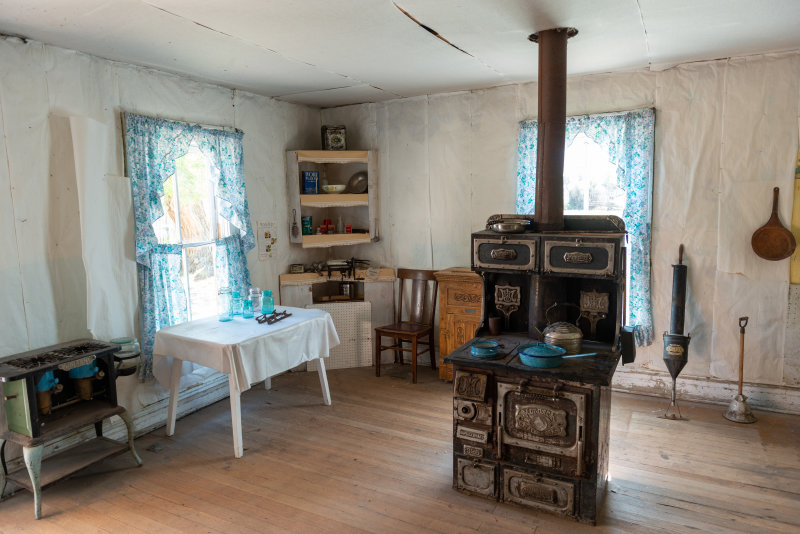
The campsite was lovely and we ended up staying two nights. We walked over to the “town” and had a most interesting and enjoyable visit. We purchased the information and self guided tour book for $2.00 which proved to be most worthwhile. It contained lots of information about life in the mining town and how hard it was.
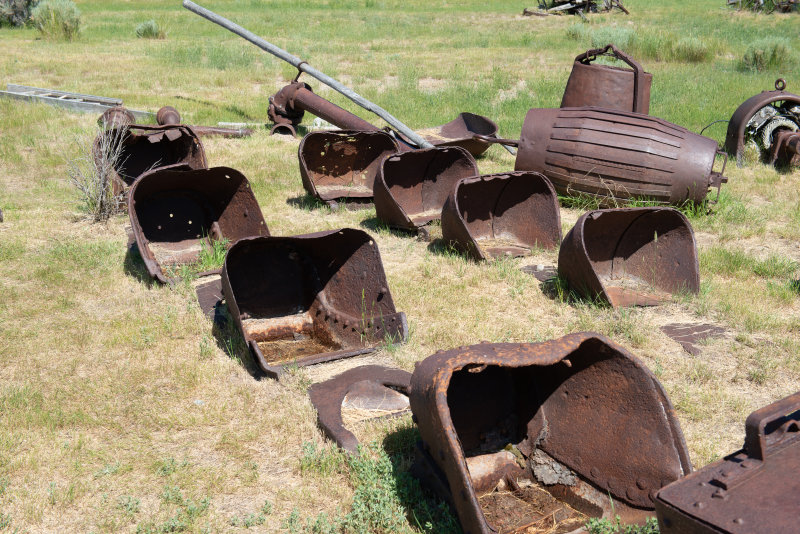
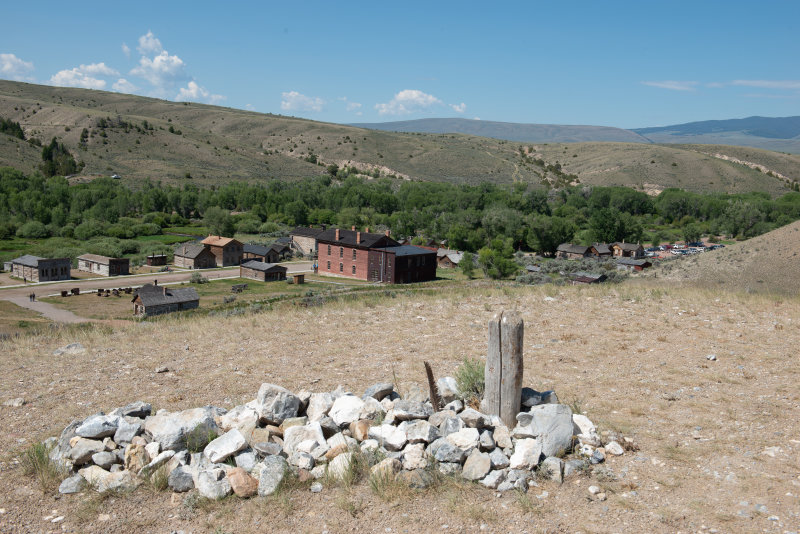
Looking over the town towards the river and the hillside where most of the gold was found. Most of the gold was placer gold, dredged out of the river.

















































































 DiploStrat