
Fred had not visited Pompeii for more years than he likes to remember (he was under 10 at the time!) and Denise had never visited so we were excited to be able to visit. Pompeii is, after all, one of the absolute “must visits” on the Roman history circuit.
This required a train ride, which we had read about and assumed would be a simple matter. Silly us! To begin with, the station manager was bored, to say the least and barely was able to tell us which platform to use, let alone when the train would leave. Even in Italian; we would not have dared ask in English. But, sure enough the train arrived and we got on. The windows had some kind of coating so we could not see out, which was an interesting experience, as we were checking the stations as we went by. We then arrived at a station where the train stopped and we had to get off. Fortunately one of the passengers told us which platform to wait on for the train to Pompeii.
We made it to Pompeii only to find a huge line of people waiting. In disgust, we went down to the square and found a lovely restaurant. We started with a coffee and a croissant, and finished with a shared pizza. A slightly odd one, with broccoli, but NO tomato sauce. Isn’t that illegal? Still, it was quite tasty and the waitress was most impressed as it seems to be a local speciality. Feeling thus prepared, we girded our loins and took our place at the end of the line.
Almost an hour and a half later, we made it into the ruins and headed to the back to see the amphitheater and thus do the circuit a bit backwards, so as to avoid the crowds. We stopped on our way in to see the Forum, with the temple of Zeus at one end with Vesuvius behind.

Most dramatic. It was super busy, despite being a Monday of the supposed low season. Tourists today, but, back in the day, this space would have been full of shoppers and people going about their business, just as in a contemporary city.


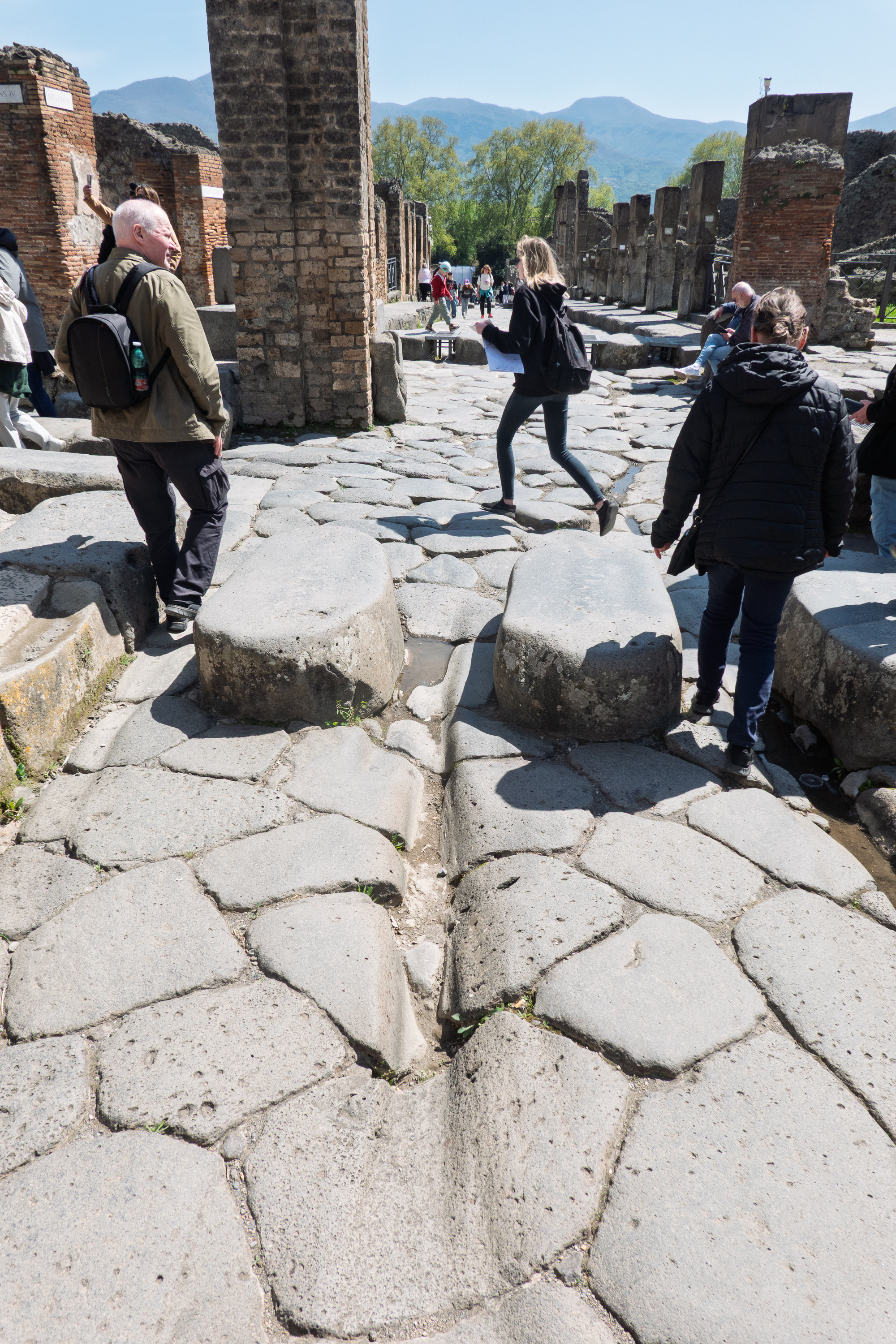
We enjoyed our visit but we were also somewhat disappointed that a lot of the major sites, including many or the named houses, were closed. That said, there were plenty of wonderful frescoes.


We are always thinking of food, so we loved the thermopolia. (https://en.wikipedia.org/wiki/Thermopolium)


View through the vestibule into the atrium with the impluvium to catch the rain.


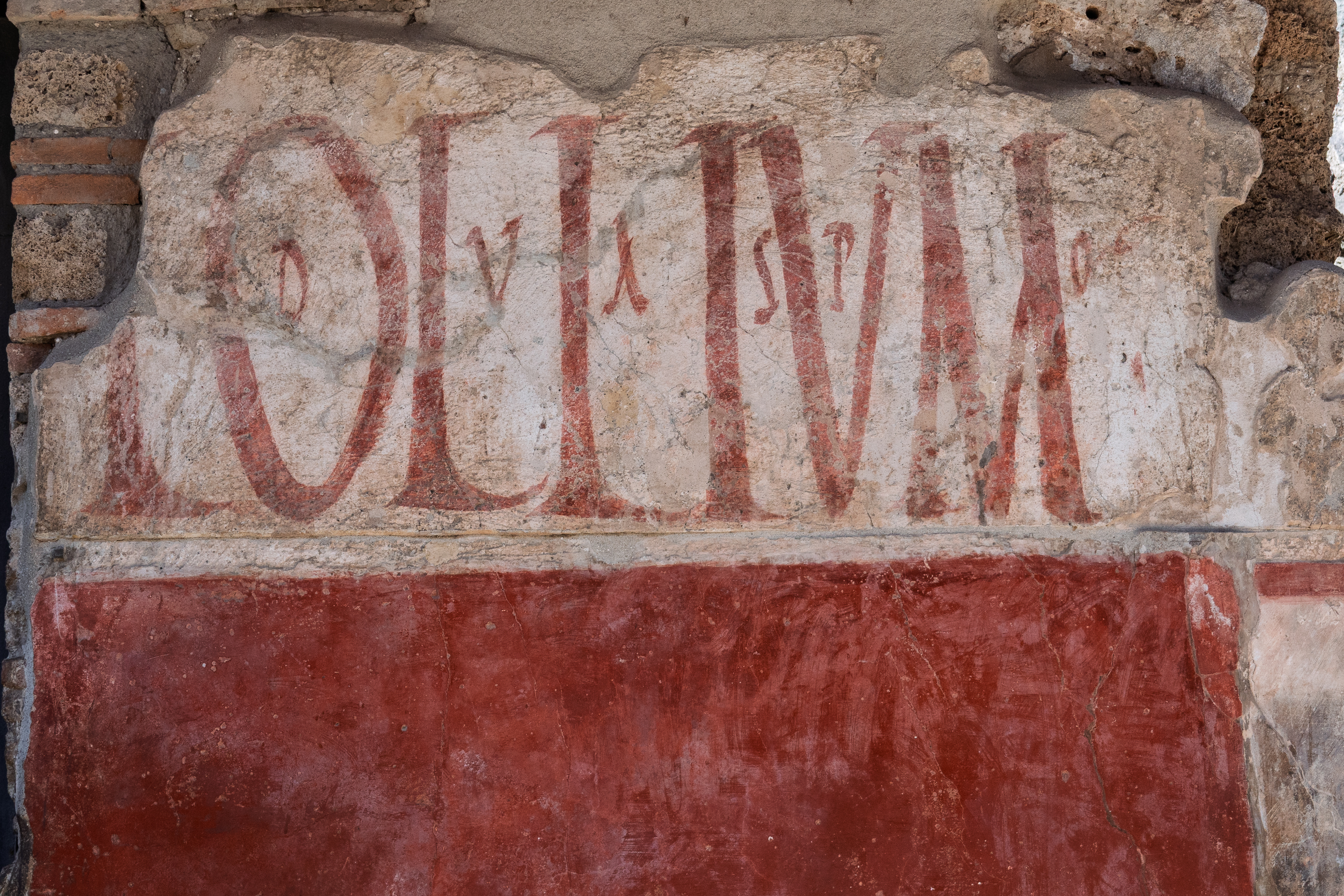
So many of the classic movies show Roman cities of gleaming white marble. Actually, the Romans built mostly with concrete, covered it with plaster, and then painted it red. They LOVED red, which they got from cinnabar. In Pompeii the cinnabar was ground more finely and thus the red is even redder than usual.
At the back of the ruins, we reached the amphitheater.
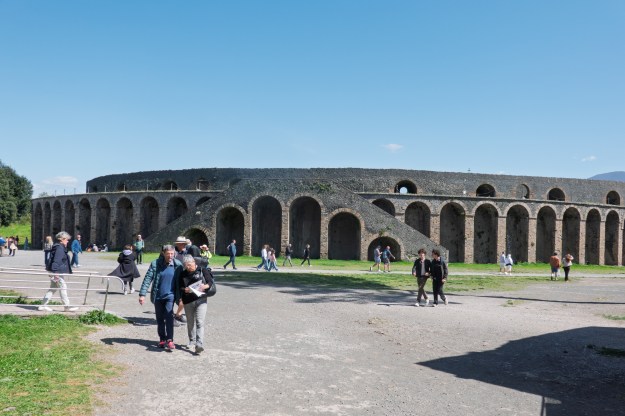
Dated at 70 BC, it may be the oldest known. Then, as now, sports fans can get unruly. In 59 AD, a riot that broke out between the people of Pompeii and the citizens of Nuceria . Like football games today, gladiatorial games and chariot races often enflamed town rivalries in Ancient Rome. In this case, the riot not only resulted in maiming, bloodshed, and death but a ban on holding games in Pompeii’s amphitheatre at all for a subsequent 10 years. Of course, the destruction of the city caused an even longer pause in performances.
What we know of the event comes from an account from Roman senator and historian Tacitus. In The Annals, he remarks, “About the same time a trifling beginning led to frightful bloodshed between the inhabitants of Nuceria and Pompeii, at a gladiatorial show exhibited by Livineius Regulus, who had been, as I have related, expelled from the Senate. With the unruly spirit of townsfolk, they began with abusive language of each other; then they took up stones and at last weapons, the advantage resting with the populace of Pompeii, where the show was being exhibited”.
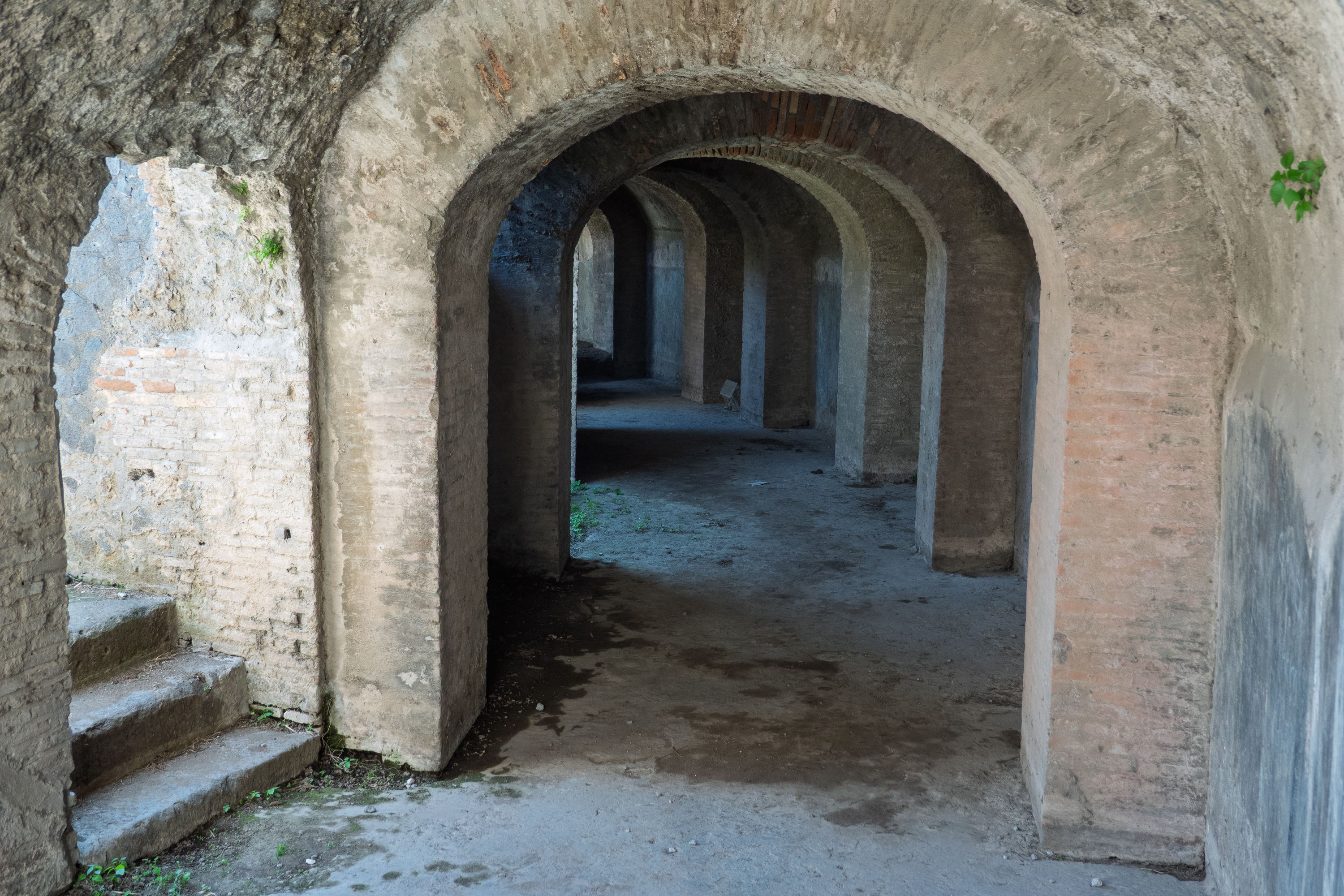
Fun inside and outside the arena.
After being forced to go three ways around the square because of closed roads, we did manage to see “the” brothel, the one with specific inscriptions. Pompeii had lots of them; at least 25, not counting inns and taverns. Fred found it a bit uninspiring, but, despite the crowds, managed two photos of the infamous frescos.

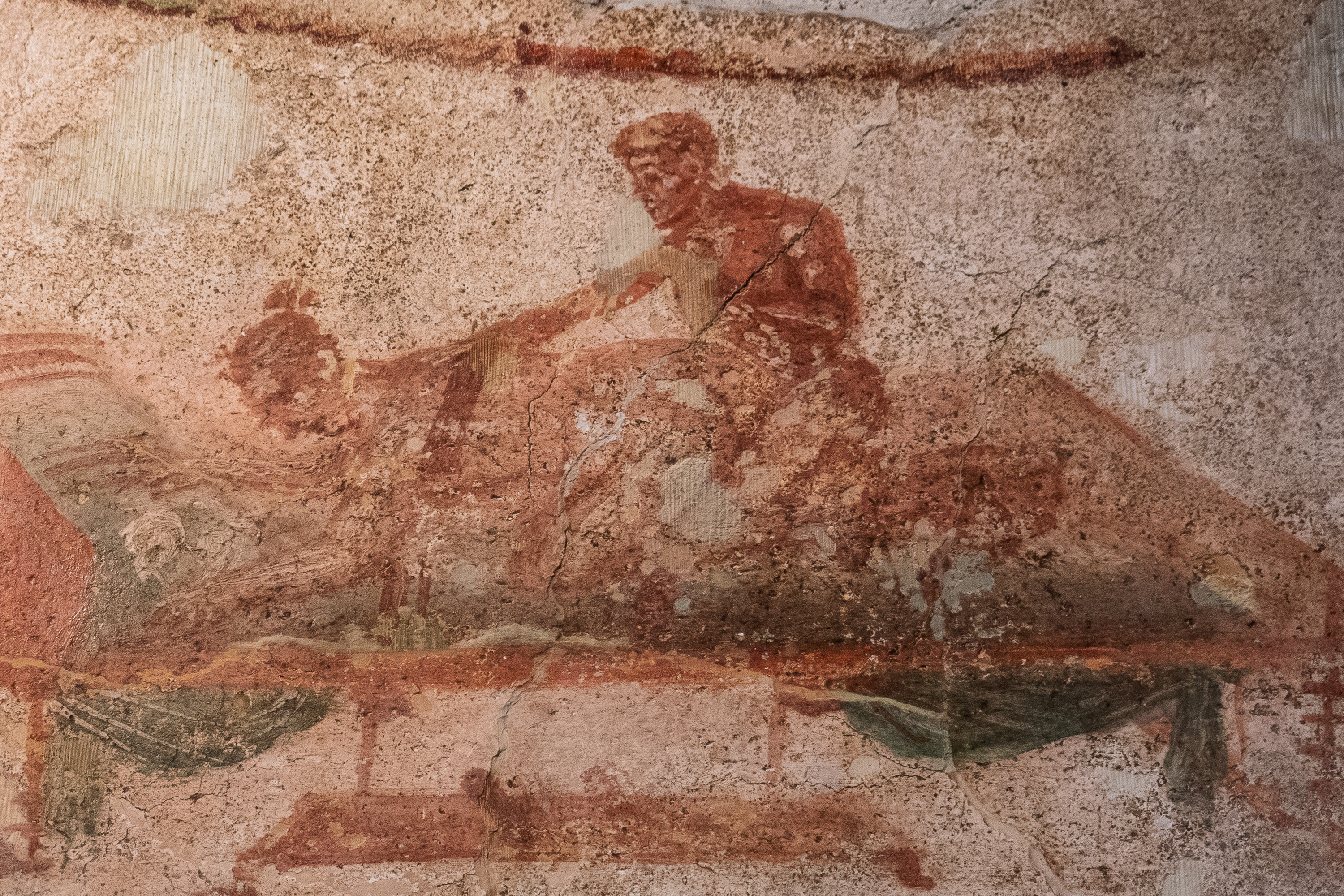
Just pick from the menu on the wall, you want it, we do it! Only the finest girls from the East! Two floors, lots of beds, no waiting! With that, we made our way to the exit.
After an ice-cream and a coffee back at the restaurant where we had our pizza., we were ready to tackle the trip home and headed back to the station to return to Herculanum.

There was actually an announcement this time; the Naples train was arriving. Great, we hopped on board, expecting that the train would stop at Herculanum, a major site. No, it proved to be an express and we ended up in Naples. We weren’t the only ones – there was a group of Spaniards who were having the same problem! We commiserated about the challenges of not speaking Italian! Fortunately, we were able to just catch the stopping train to return to Herculanum and our camper. The trudge up the hill was just as steep, but we made it back.
So, should you visit Pompeii? Yes, of course, it is one of the largest ruins of its type. Most others, for example Gadara or Jerash, in Jordan, (https://diplostrat.net/2016/07/27/heading-north-the-adventure-begins/) (https://diplostrat.net/2016/08/02/jerash-our-exploration-of-the-decapolis-continues/) have only a fraction of the city, usually the Forum, excavated. Herculaneum may be more instructive as most buildings are intact up to the second story and above, and this makes it much easier to understand things as you are literally stepping inside buildings from the past, not merely admiring foundations.
Worth noting that most Roman (and Greek) ruins simply “disappeared” as people never stopped living on the site and kept reusing the same structures. See, for example, the amphitheater in Arles, which became a medieval apartment block. It took a volcano or an earthquake or similar event to stop the clock and preserve a city, frozen in time.
So, if you only have one day, and you are only going to see one city, make it Pompeii. And, for the hard core, Pompeii could easily take up several days, to cover each district. But that said, Herculaneum is still special and should not be missed.
 DiploStrat