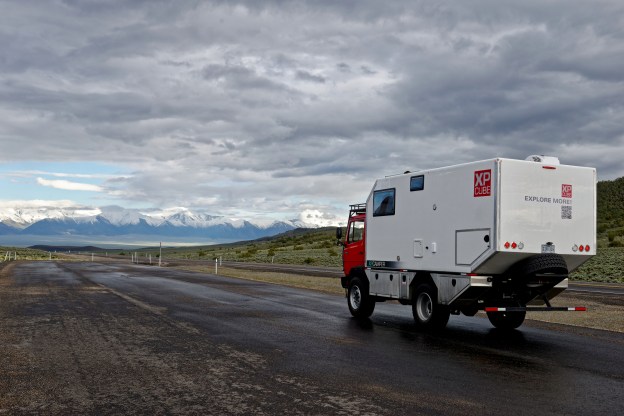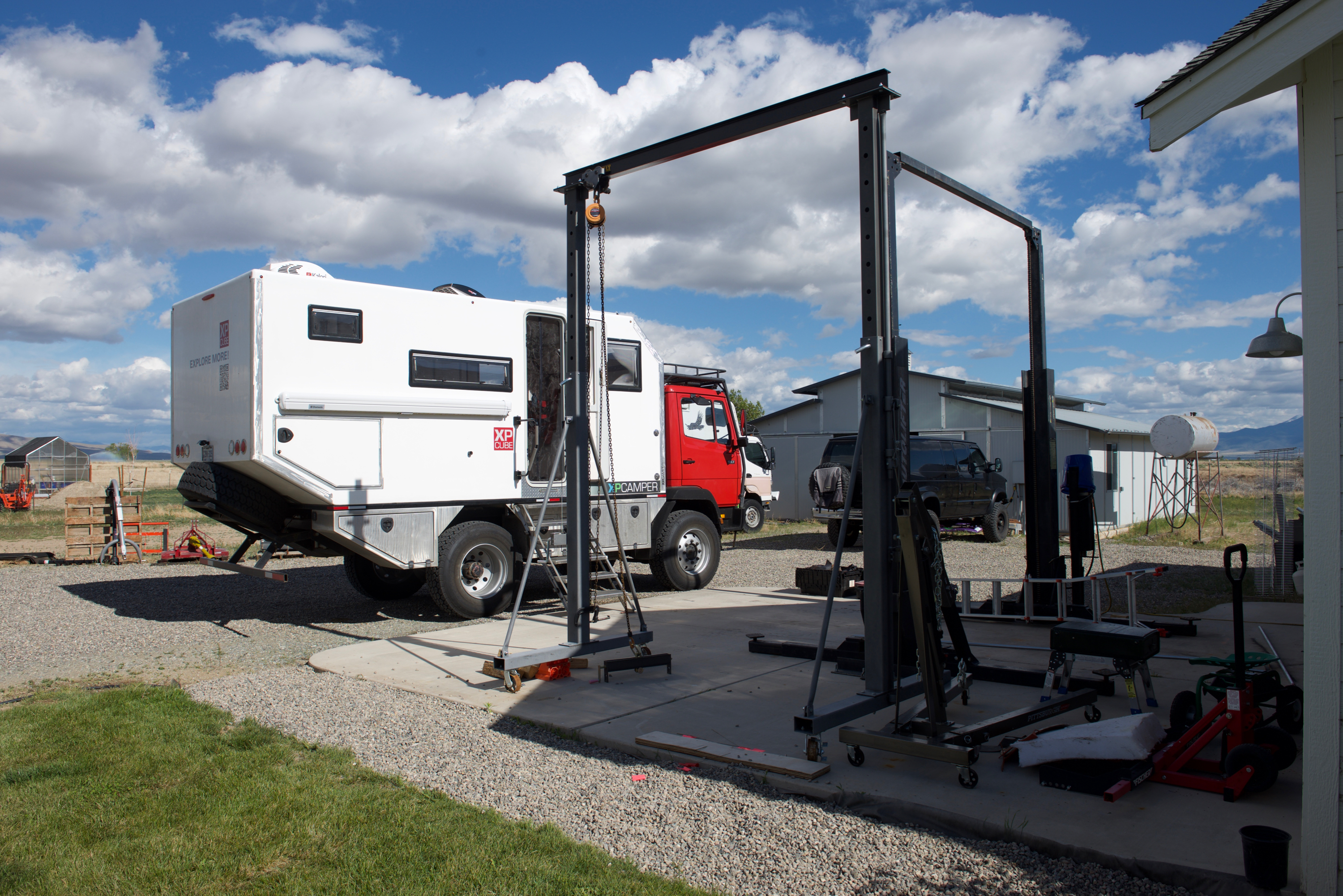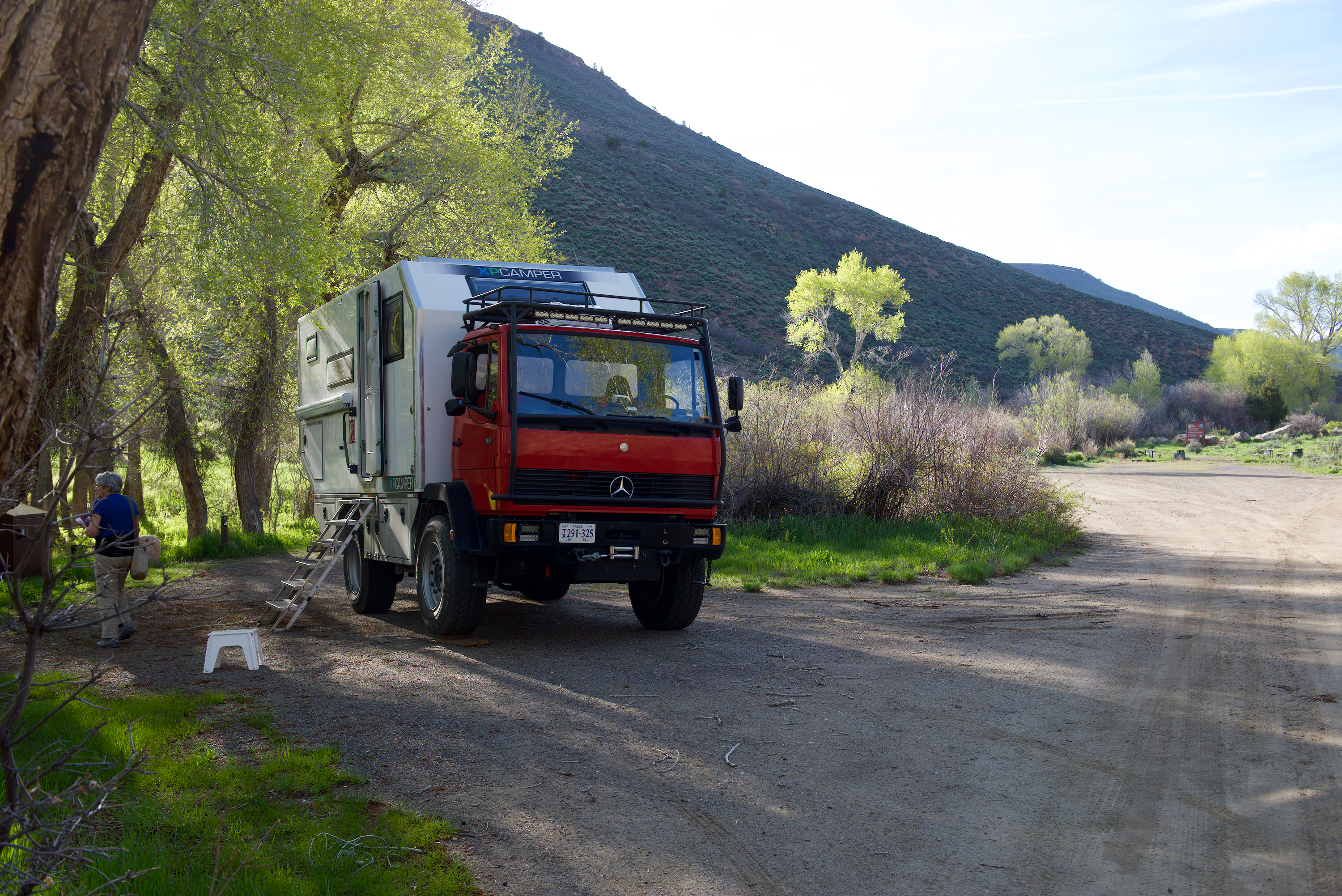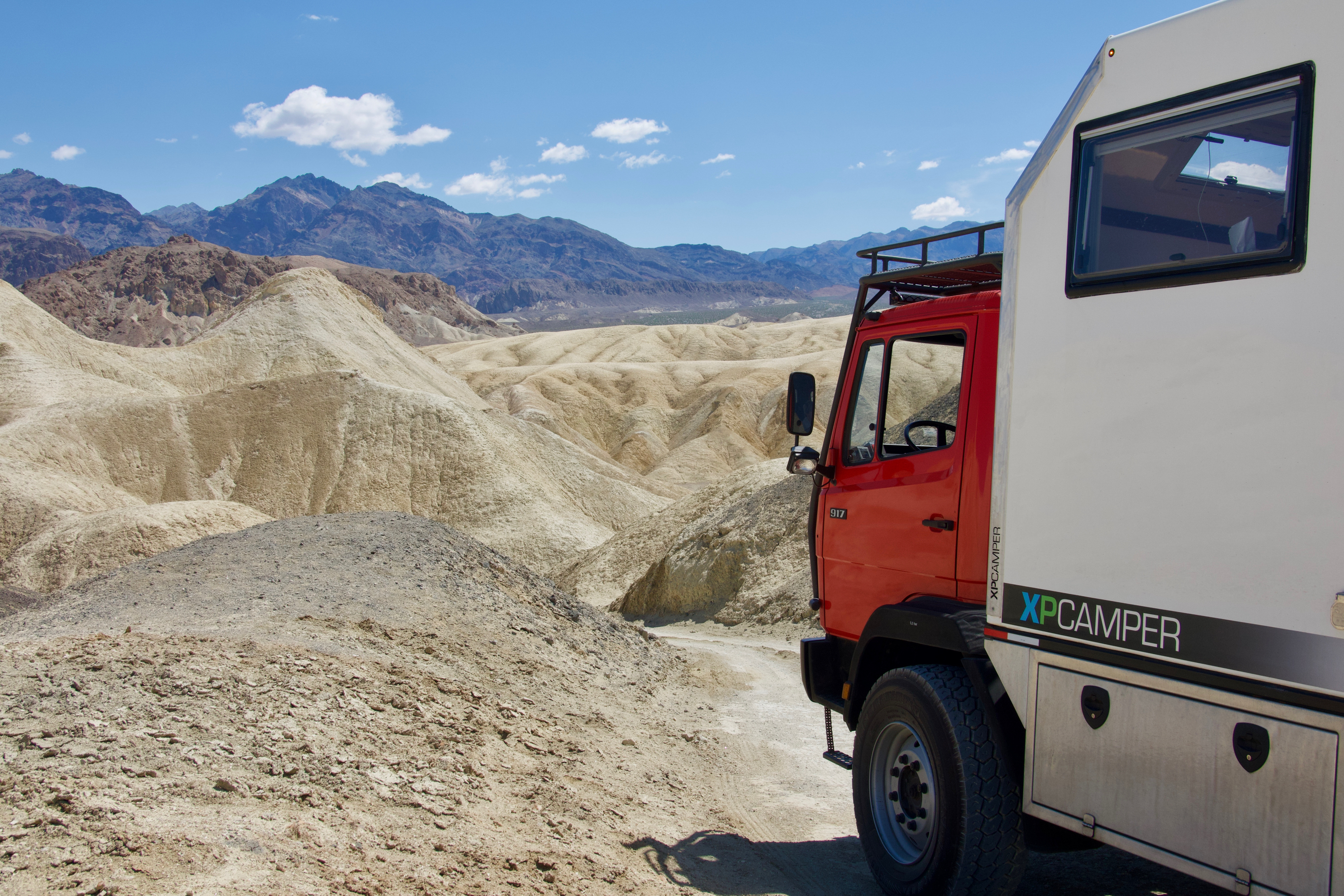
Still Searching for Moose!

We left Casper heading north-west en route to Thermopolis.  On the way, we stopped for lunch, quite by accident, at a pull off at Hell’s Half Acre!  It looks over a small, isolated, and deeply eroded valley full of painted desert colors and fanciful shapes. It used to have a restaurant, but now there are only slabs at the overlook. Hell’s Half Acre has been used in various movies, most famously “Starship Troopers” where it became Klendathau, the bug planet! 

As lunch spots go, it was quite spectacular! And we were not bothered by bugs, big or small. Movie fans take note. Like the Alabama Hills, Hell’s Half Acre is an interesting study in how a tiny space can appear huge when you carefully control the camera angles. Hell’s Half Acre was used for the scenes of the capture of the Brain Bug. Other scenes were shot in South Dakota and California.

Thermopolis sounds rather Greek but is actually a pleasant Wyoming town which is the site of multiple hot springs.  (http://thermopolis.com) We stopped at the Hot Springs State Park but decided not to soak there with hundreds of our nearest and dearest acquaintances. It was a Saturday afternoon and the places were all heaving.  So we headed for the Fountain of Youth campground which had its own pools for soaking. It turned out to be a rather ordinary commercial campground, but has three large hot spring pools.  (https://camphotsprings.com) Denise soaked a while in the coolest of the three, which was plenty warm enough for her!  Fred did get into the middle pool for a short while and he said it was hot!  The third pool was too hot to enter, but flowed into the second, which flowed into the first, which flowed out via a channel.  All quite ingenious.  We both enjoyed it all more than we expected to!  We should note that no photos of the soaking experience were taken!

Heading north again, we stopped in Cody, home of Buffalo Bill Cody.  To say that it is his town would not be an exaggeration!  We camped in a lovely campsite beside the Buffalo Bill Reservoir, in the Buffalo Bill State Park. 
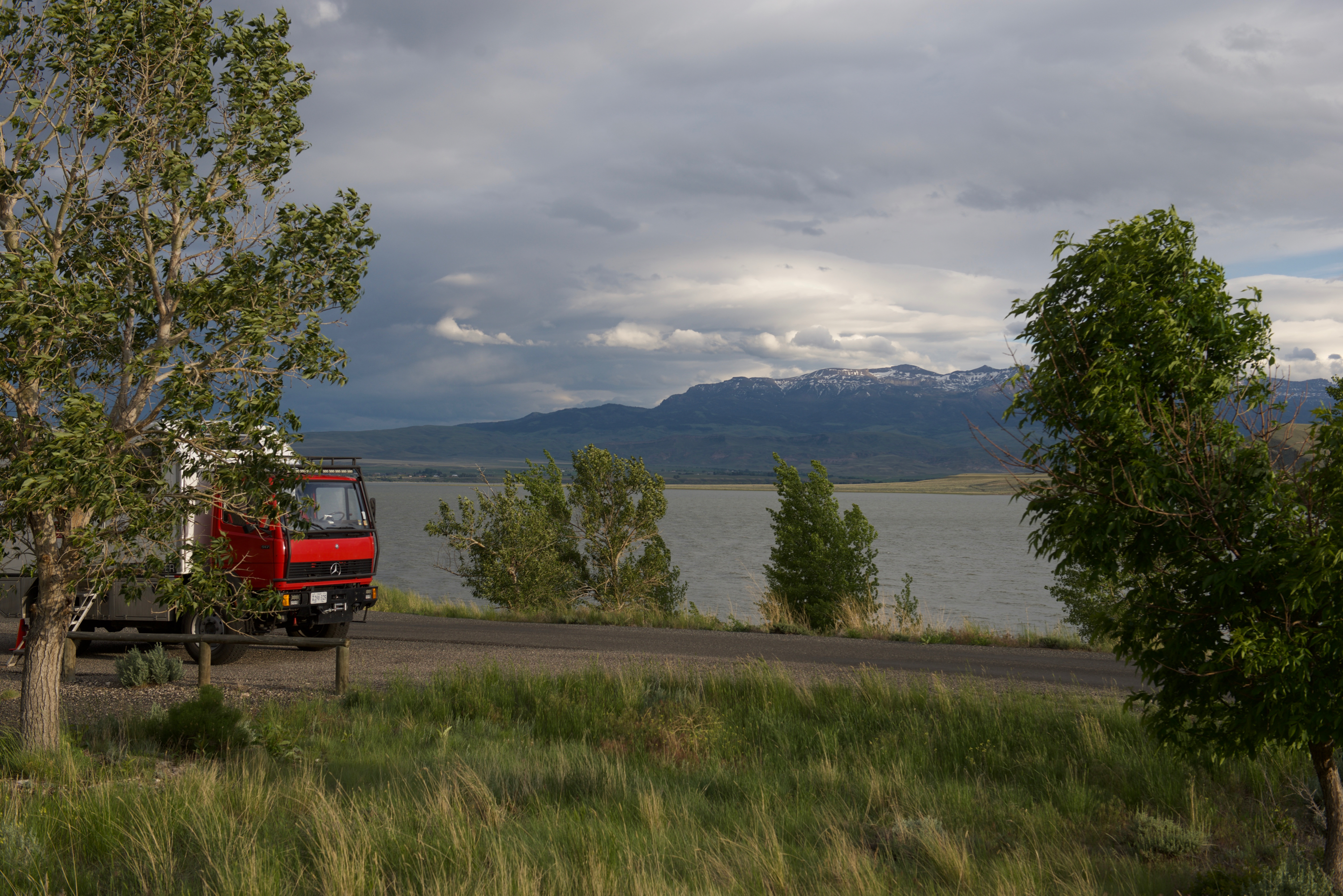
And while in Cody we spent a day at the Buffalo Bill Center of the West, which was a most interesting collection of museums, connected to the Smithsonian in DC.  (https://centerofthewest.org)  Sounds a bit like a tourist trap, but it is actually a very serious set of museums. All were excellently done, especially the Draper Museum of Natural History, which gave insights into local flora and fauna.  We also enjoyed the Museum of William Cody (Buffalo Bill) and the Plains Indian Gallery.  Denise enjoyed the Gallery of Western Art with paintings both historic and modern.  The Firearms Museum was under renovation.  They also have a selection of raptors and we enjoyed meeting a very well behaved screech owl! These are all birds that have been injured and cannot survive on their own in the wild.

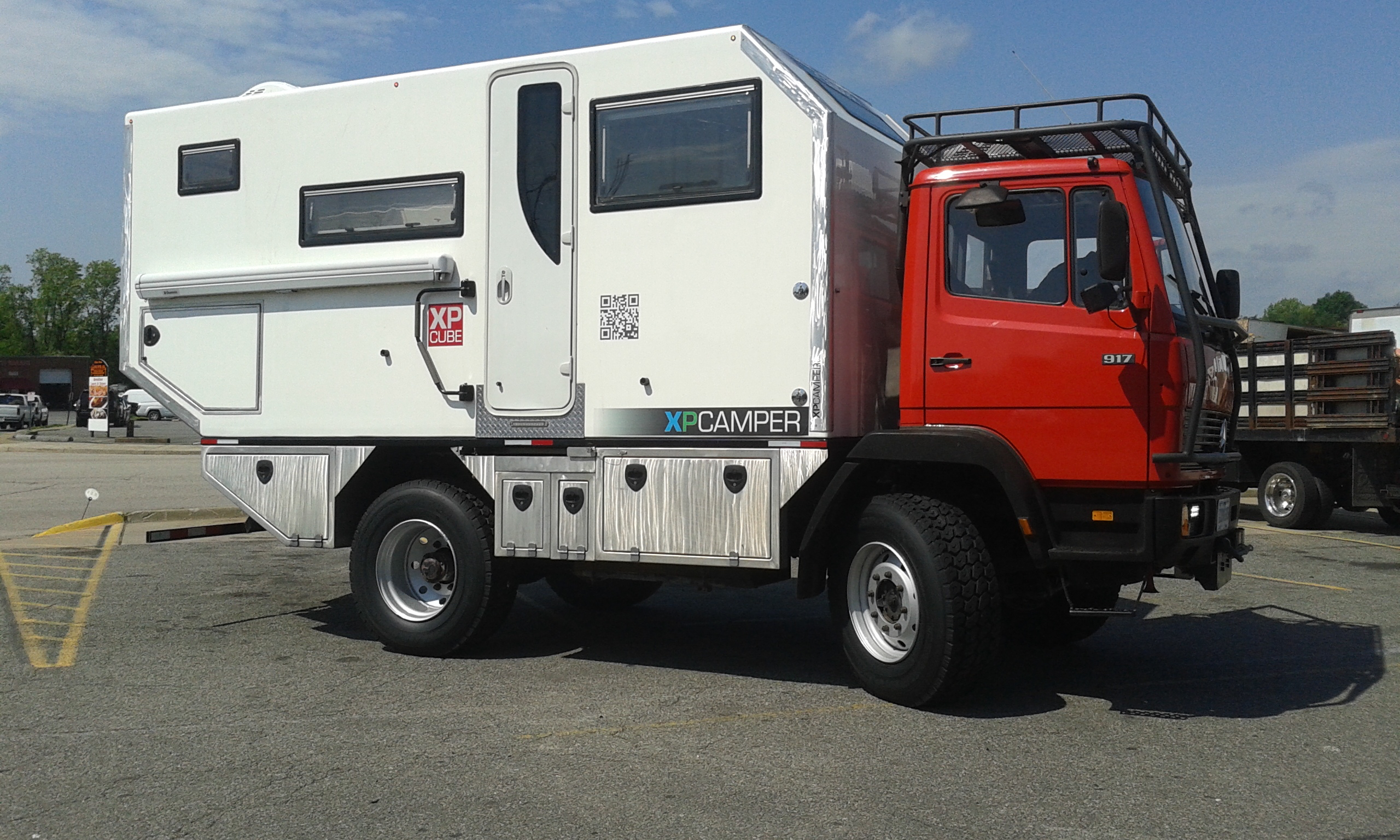
Our next adventure was a visit to the town of Kirwin, a ghost mining town in the mountains about 60 miles away.  (https://www.wyohistory.org/encyclopedia/kirwin-wyoming)  We were initially worried by all of the “we’re-all-going-to-die” posts on the Internet, especially as the 917 is a bit bigger than a Jeep, but after a lifetime in Africa and especially in the Andes, we decided to give it a try. The first part was paved to Meeteetse and a bit beyond.  Then the road was a well graded gravel one. 
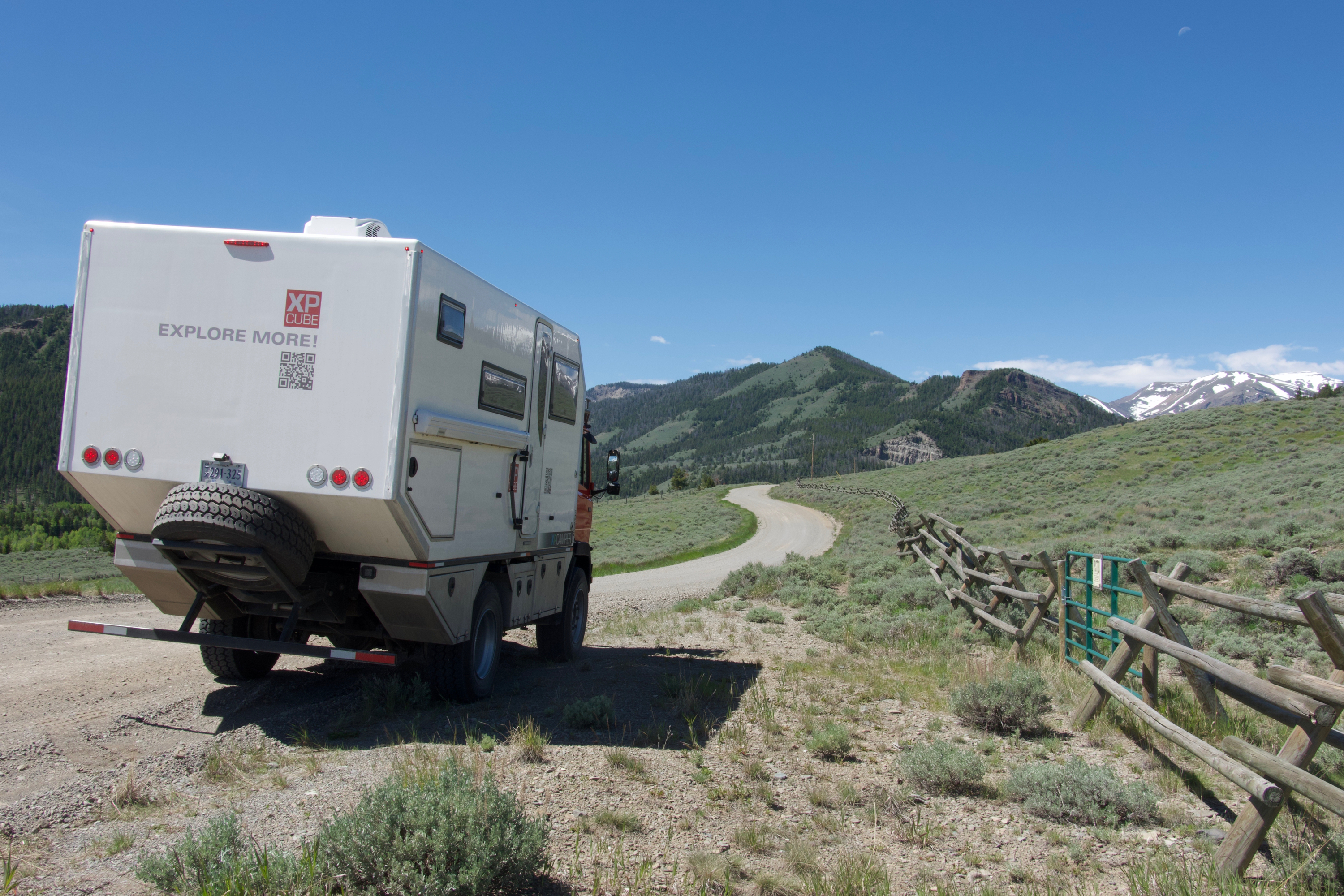
Finally, as we started to climb into the mountains through the Shoshone National Forest, the road was rockier and rougher.  It also included four river crossings, one of these involved driving down the river for 100 yards or so!  This reminded us of the times we hiked to view the forest elephants in Bangui which also involved much time walking through a river!  We were concerned about the water levels in the river as there had been so much rain this spring, but the the crossings were made without a problem. 
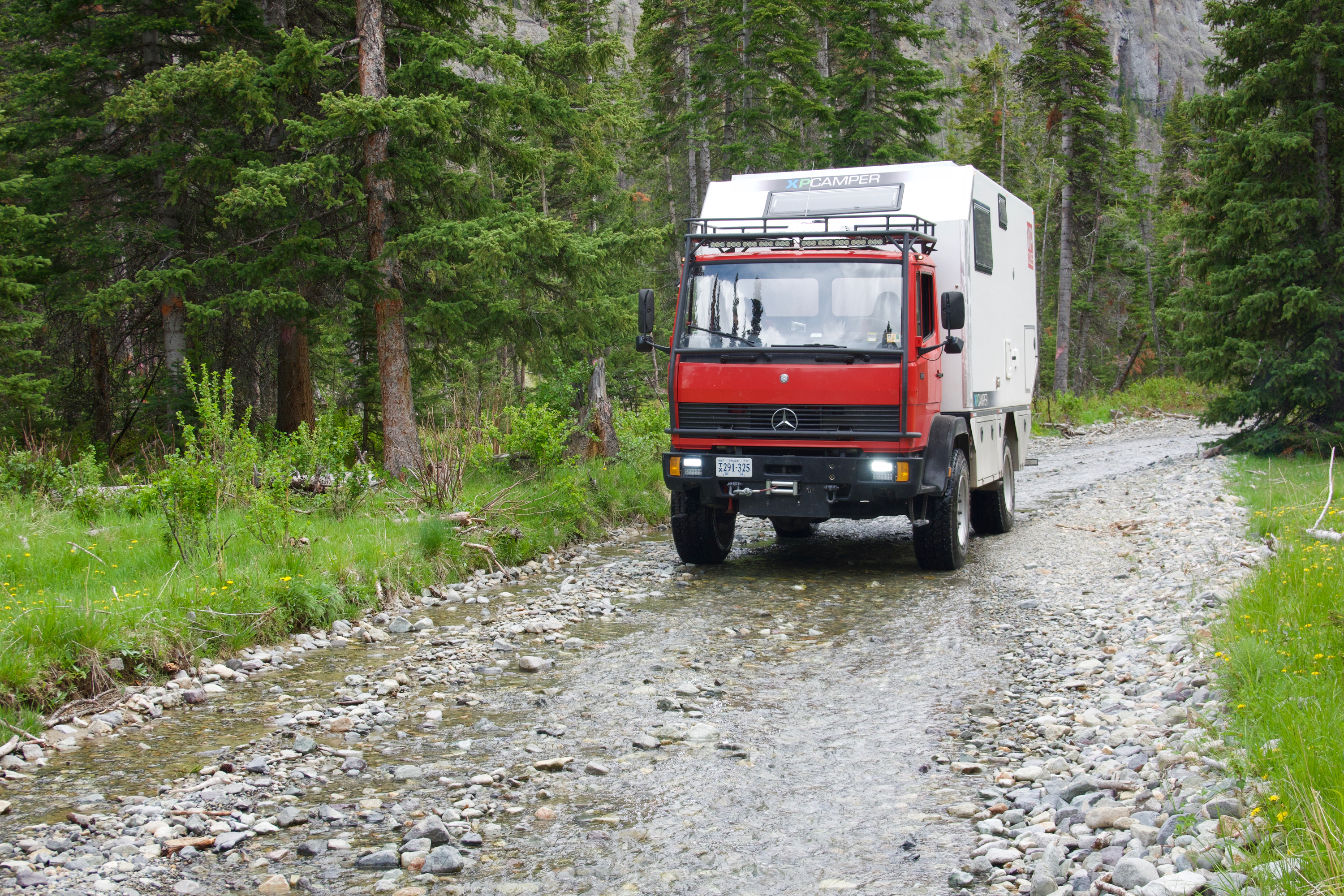
While it is clear that the road could get interesting in the rain or snow, it turned out to be very easy when dry.
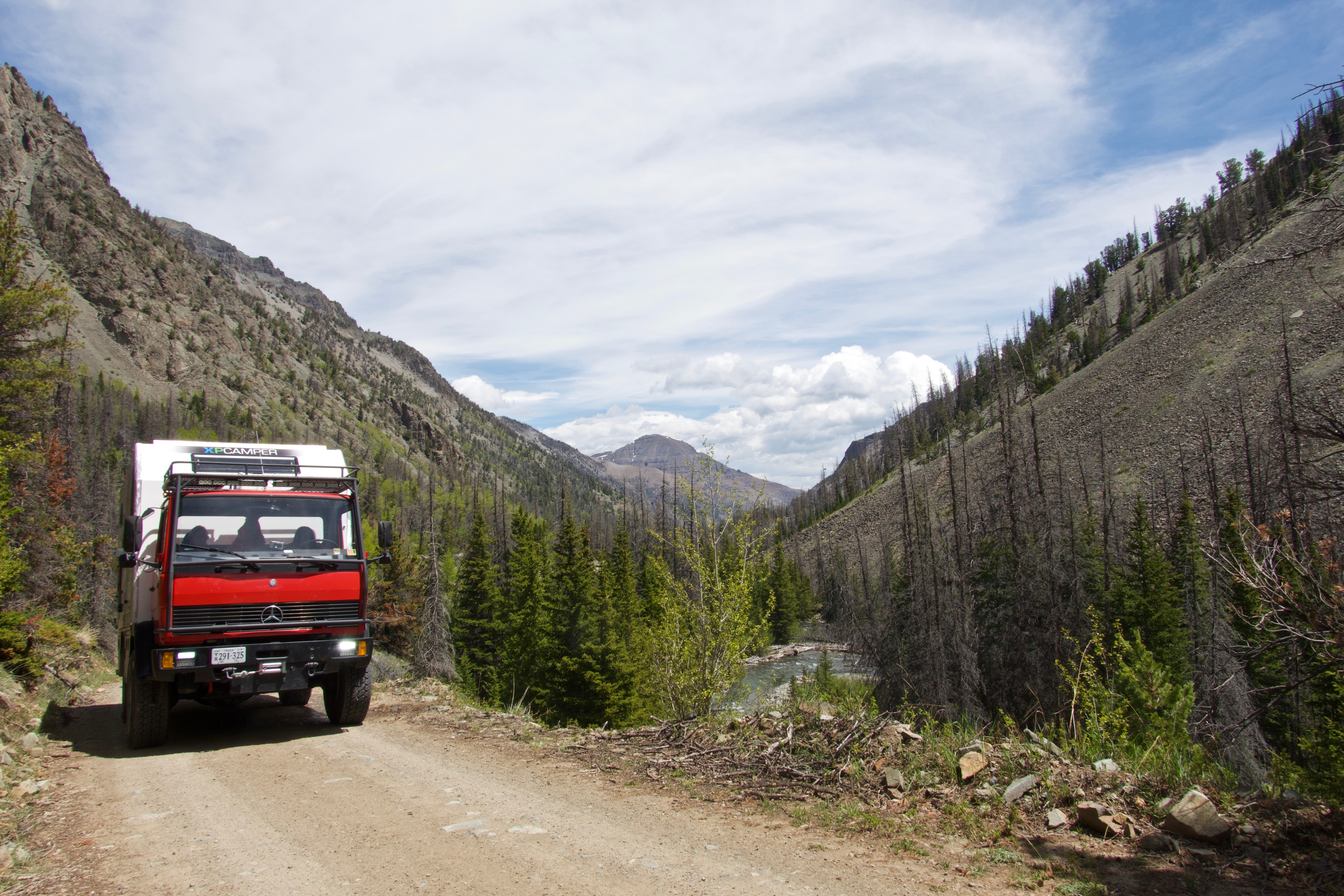
The trail was almost always at least one lane wide.

The ghost town was at 9,000 feet and a bit bleak on a cloudy day, with 12,000 foot peaks all around. 
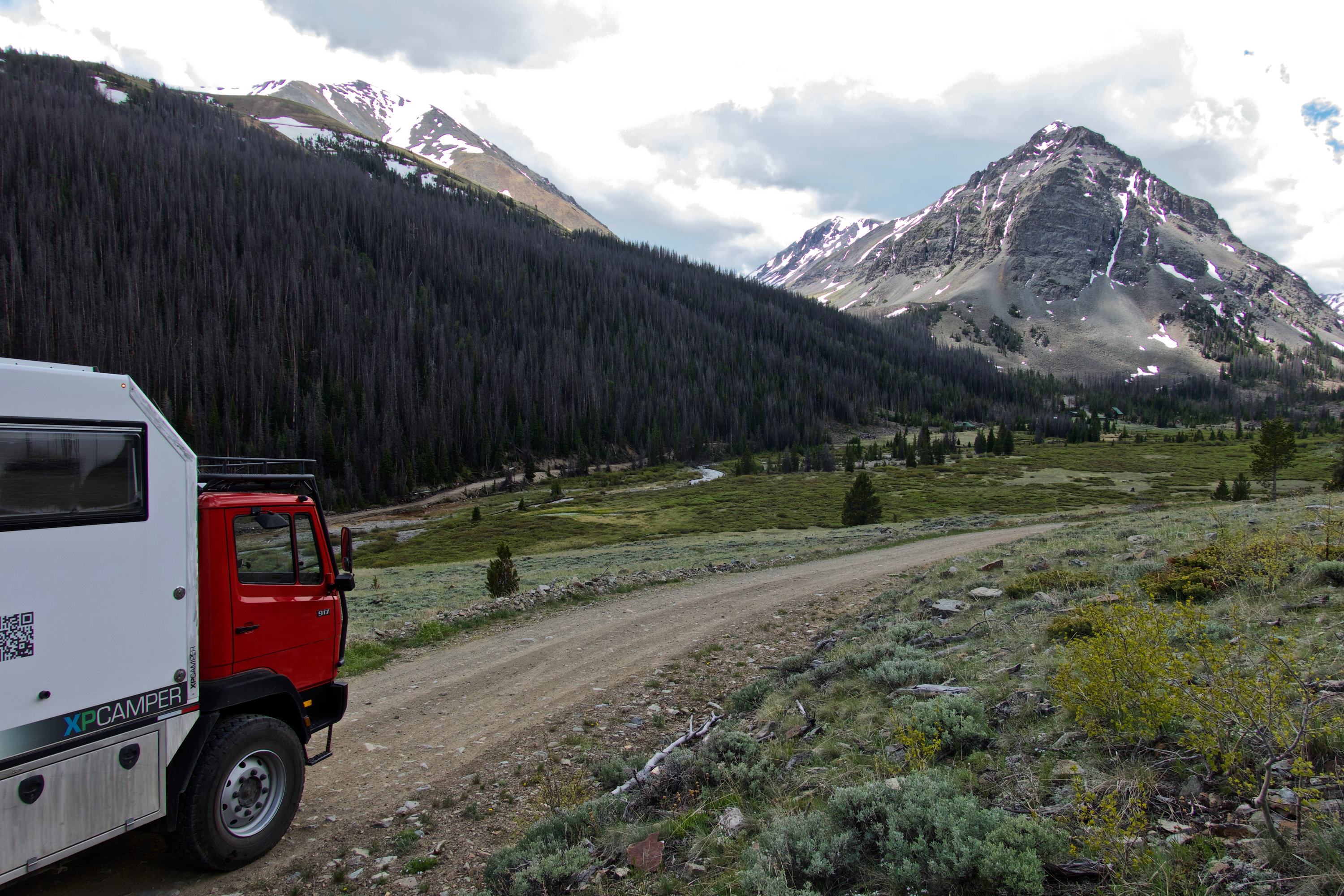
The mines were long abandoned but some of the buildings remained.

While we only met one vehicle on the way in, there was a constant stream of trucks and 4×4 off road buggies coming and going.  The flowers however, were beautiful in the slightly lower altitudes; miniature lupins, purple milk vetch, harebells and possibly Rocky Mountain iris. 


9,000 feet is high, so we descended a bit and camped at the Brown Mountain Campground run by the Forestry Service. It proved a delightful spot.  We were the only people there and enjoyed seeing a number of pronghorn and mule deer, passing by to feed and drink.  And, the next morning, we finally saw a moose! A young one, but a real, live, moose at last! 

Back in Cody, we treated ourselves to a lunch of wood fired pizza at the Trailhead restaurant (http://www.trailheadcodywy.com) and returned to the campground at Buffalo Bill State Park.

We wanted to see the Medicine Wheel, a sacred American Indian site in the Big Horn Mountains, but on our way, we stopped for lunch at the Visitor Center for the Bighorn Canyon National Recreation Area.  (https://www.nps.gov/bica/index.htm) A gentleman we met in the parking lot recommended that we visit the Canyon, chatting as he admired the camper!  So into the Visitor Center we went and saw the movie and then asked for information.  The Bighorn Canyon National Recreation Area stretches into Montana and in fact we ended up camping at the Barry’s Landing campground in Montana.  There are wild horses, bighorn sheep and various other deer wandering in certain areas, though in our particular case the bighorn sheep had gone to higher altitudes as it was hot.  We stopped at the Devil Canyon Overlook for spectacular views of the Bighorn Canyon and Lake before camping. 
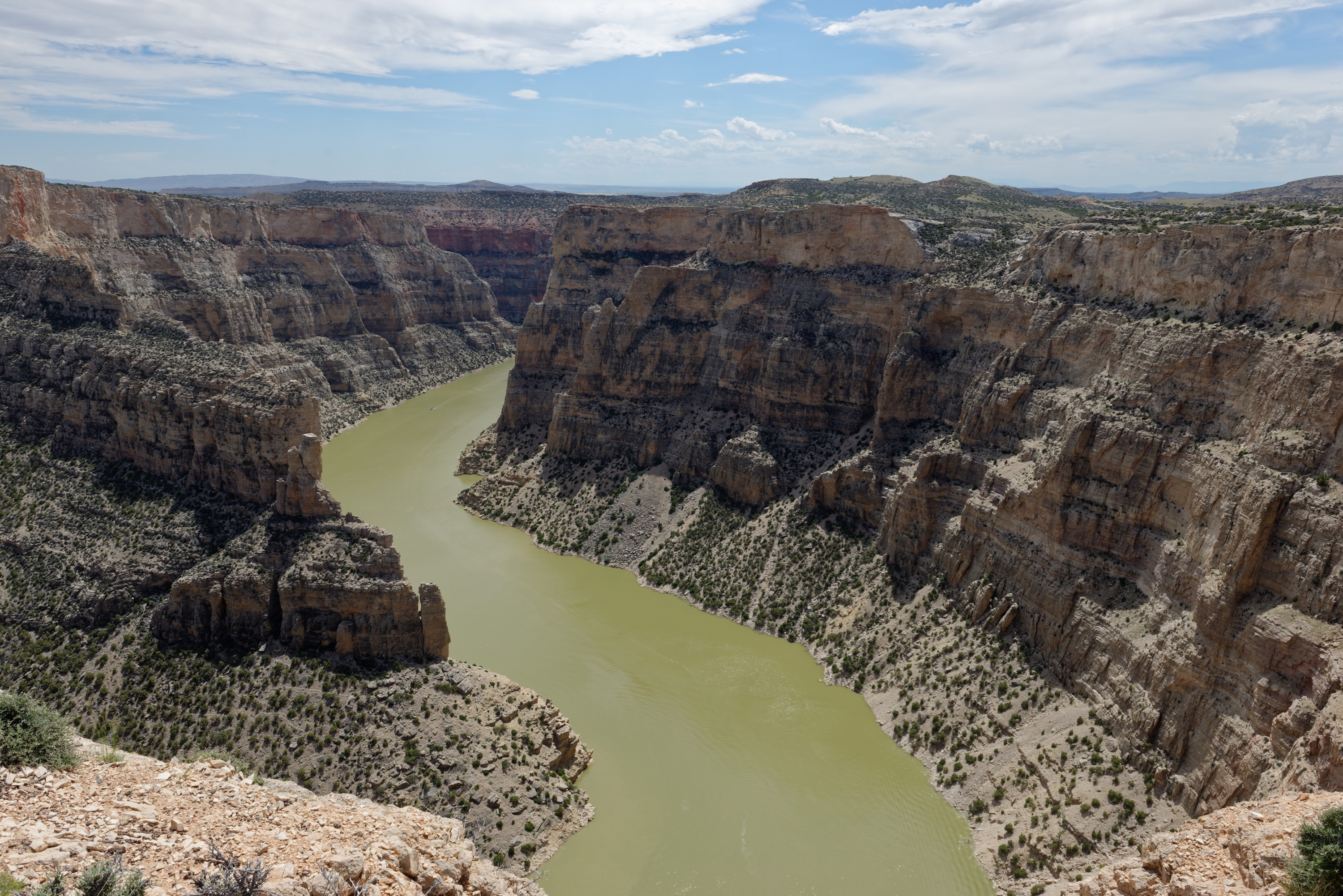
While we admired the view, the deer admired us.

We also visited a ghost ranch  owned by the “cattle queens”, Caroline Lockhart, also an author and journalist.  The site was green and lovely but one could only imagine how cold it is in the winter!

Descending the road we stopped to admire the tipi circles and mustangs.

The valley has hundreds of these stone circles. The stones were used to anchor the bases of tipis.

Back on route to the Medicine Wheel, we tackled one of the most spectacular roads we have ever driven, Wyoming 14 Alt.  The road closes in the winter and we can certainly see why.  (http://www.whp.dot.state.wy.us/home/ports/mountain_road_information.html) It climbs about 4,000 feet in about 5 miles at a 10 percent grade and would be just as bad going down as going up. 

We did rather crawl at times, but we made it and enjoyed the spectacular views some of which are over 200 miles. Much has been written about the Moki Dugway, but we think that 14A matches it.

The Medicine Wheel was well worth the visit.  (https://en.wikipedia.org/wiki/Medicine_Wheel/Medicine_Mountain_National_Historic_Landmark) The Forest Service had only just opened it for the season and there were still some snow banks covering the trail but the views were spectacular.  The Medicine Wheel is sacred to several American Indian tribes and we saw various offerings and prayer bundles at different spots.  Interestingly, since no one really knows who built the circle or when, it is considered a universal site and thus, unlike Devil’s Tower, there are no restrictions on photography of offerings, etc. The roundtrip path is only about three miles but at 10,000 feet of altitude and clambering through the snowbanks, we felt it. 
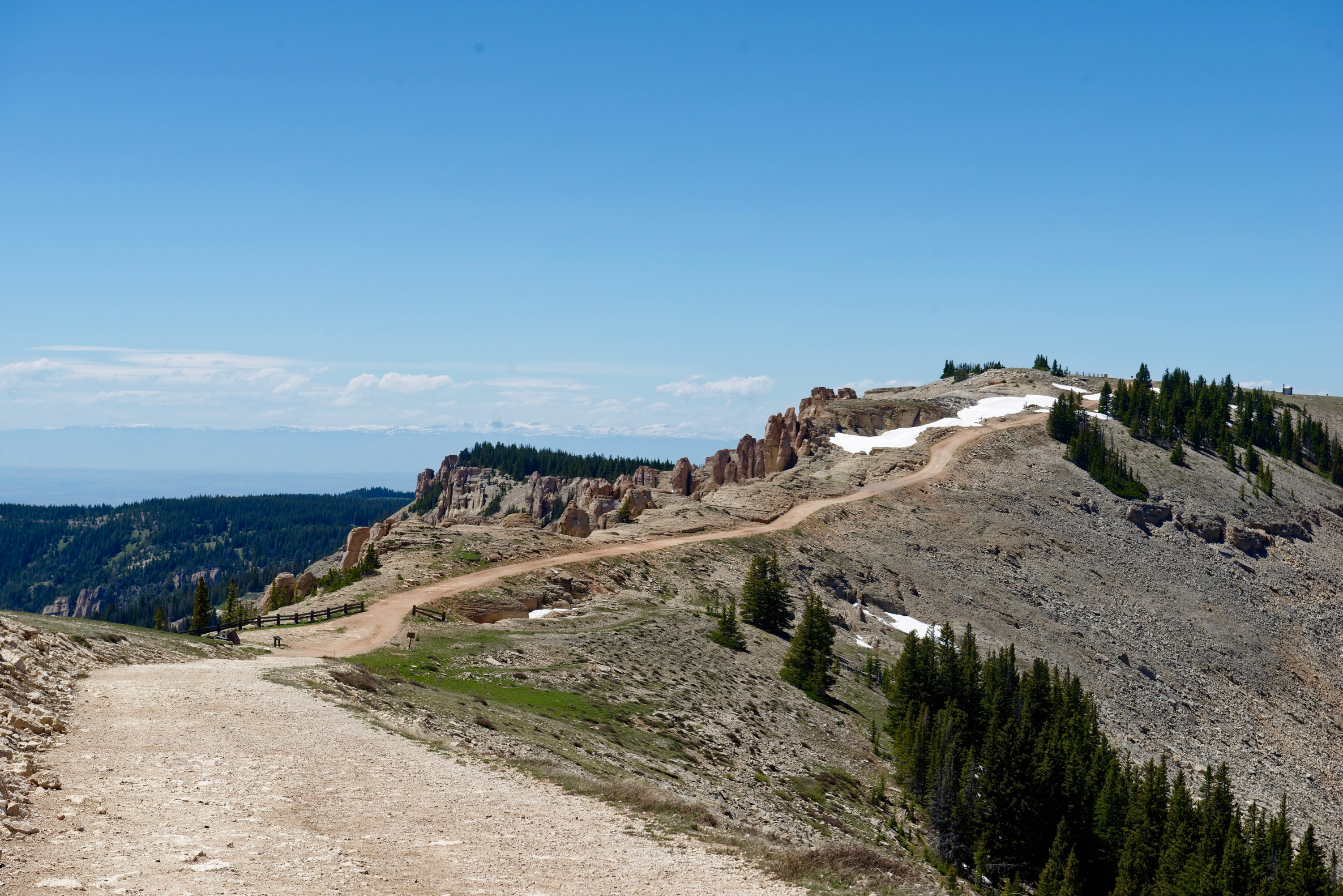
The trail rises up to the wheel.

How long have these rocks been arranged like this? Why? And by whom?

We then headed for a Forest Service campground back on Rte 14A where we found a lovely site and settled in for the night.

The next morning we headed out heading for Montana and to Denise’s delight there was a moose on duty, browsing at the entrance to the campground.  Denise was happy!
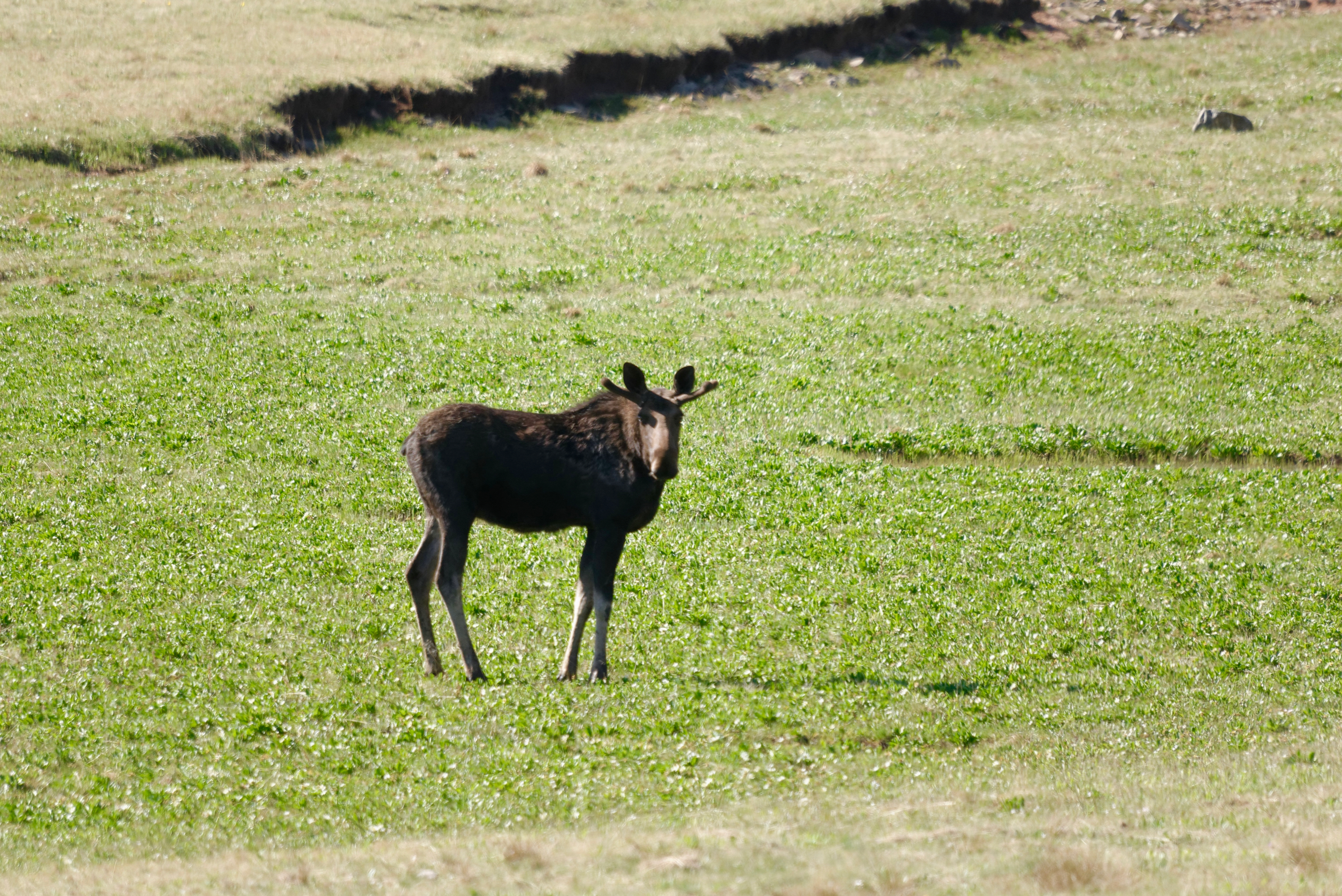
A moose at last!

Going to the Devil 

We set off to Devils Tower through a rainstorm or two and arrived at the National Park Service campsite just before the next downpour! 

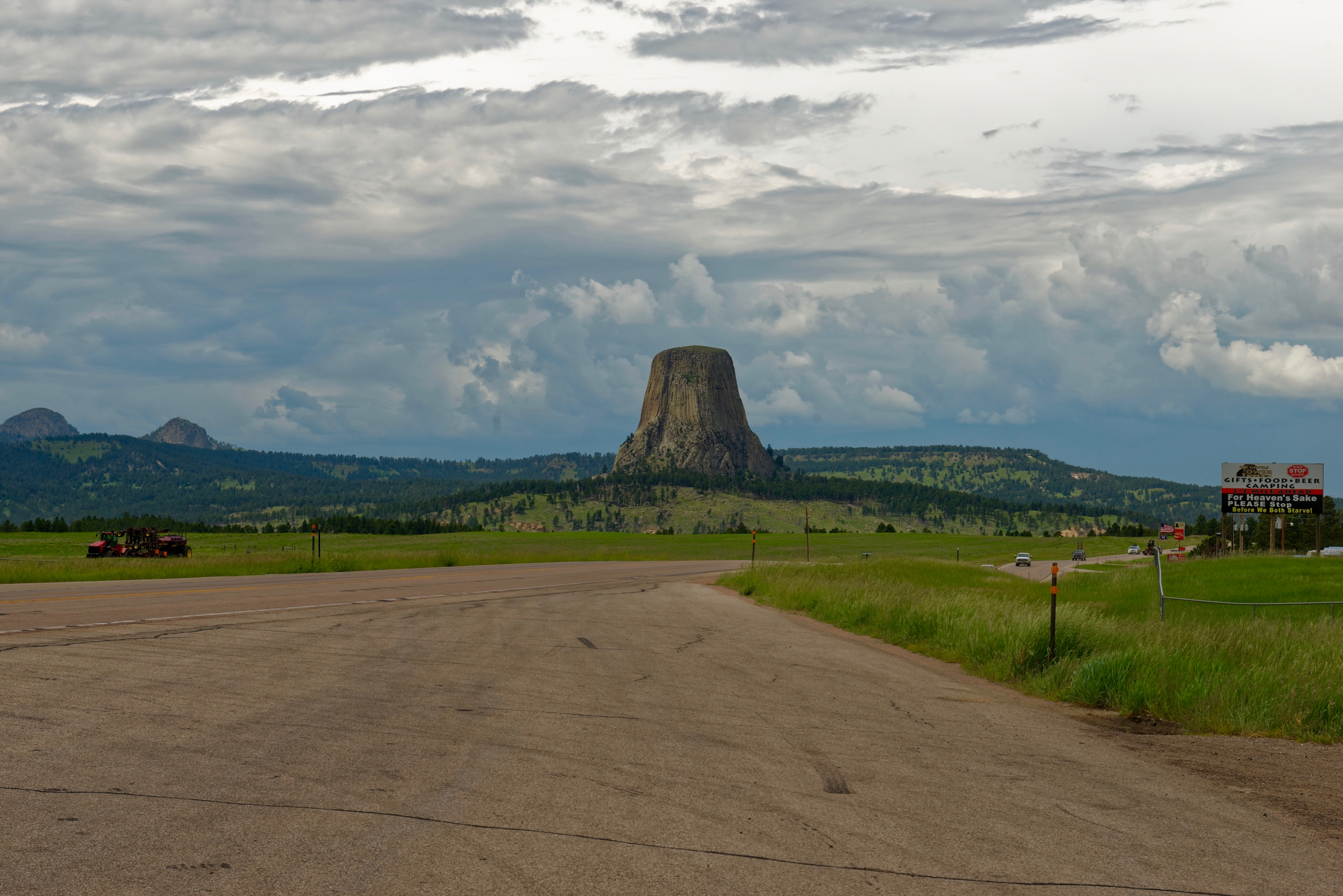
Devils Tower from the road in. And yes, the mountains on the left are new towers in the making.

From the campsite, we were able to walk up to visit with the prairie dogs in a huge prairie dog town. They are so cute, popping in and out of their holes and chittering warnings to the rest of the pack.  Cutest were the little ones who liked to play as well as eat!

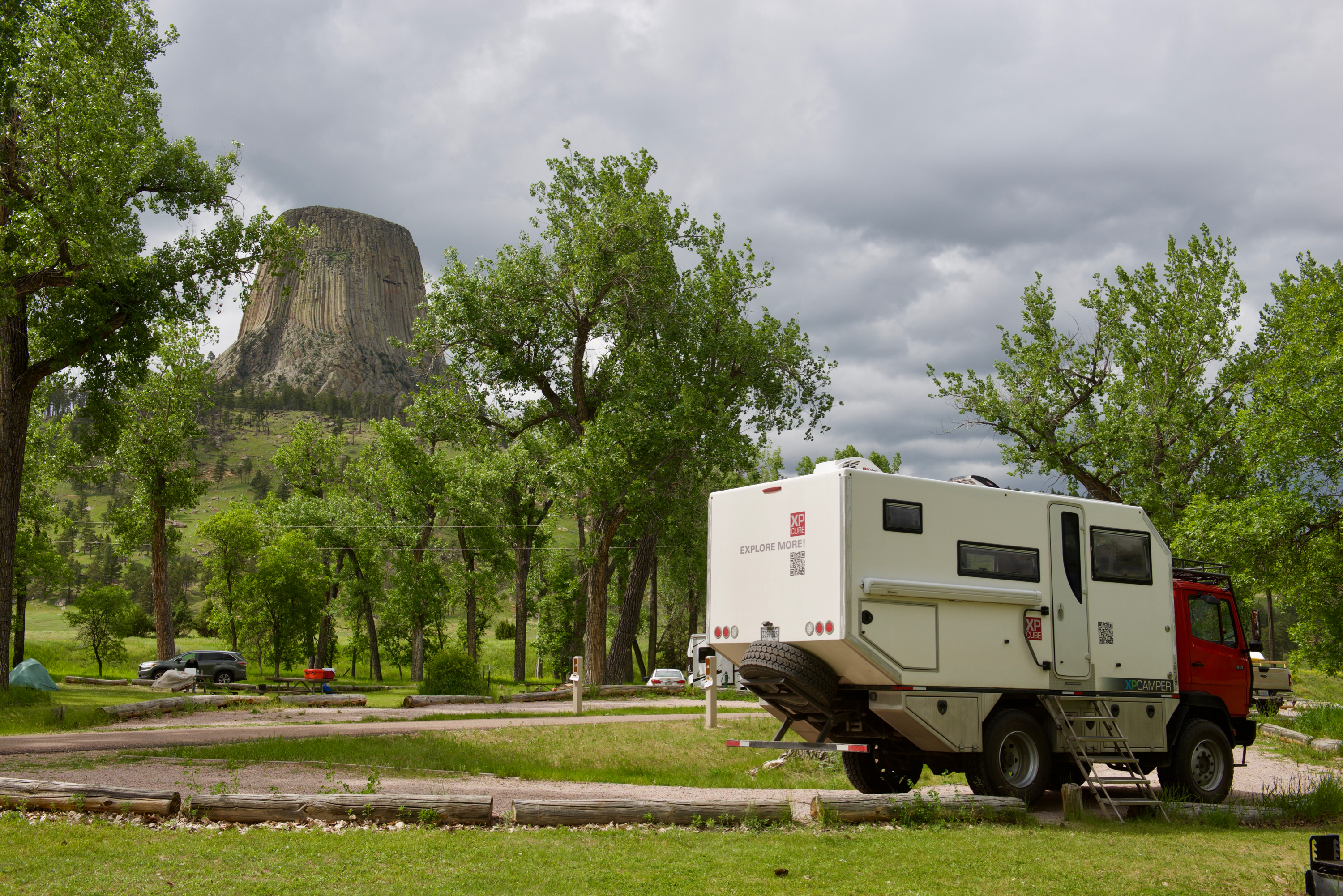
Back at our campsite we took in the Ranger presentation and simply marveled at that the Tower was RIGHT THERE, completely dominating our view. Never have we seen a campsite with an equal view.

That night the heavens opened. No flying saucers, but lots of rain.

The next morning it was obvious that we were going to have to stay a second night in order to fully enjoy the park, so after getting change from a nearby camper, we paid our fee!  

We then set off to hike up to the Visitor Center and walk the Tower Trail around the base of the Tower.  The 1.3 miles to the Visitor Center felt a lot further as most of it was seriously uphill but we made it and joined a Ranger tour of the Tower Trail.  He was a source of great information including where the ladder up the tower was located and various dates connected to its history.  Sadly, we learned that the flying saucers actually landed in a building in Mobile, Alabama. (Curse you, Steven Spielberg!) After a quick visit to the Visitor Center, we hiked back to the campground and to our lunch! (And vowed to bring granola bars or trail mix the next time!)

Along the way we met a lady who shared this truism: You climb on your heart and descend on your knees. Ain’t it the truth! Total distance was about four miles, which gave us a great appetite!

The next day we set off for Deadwood, a historical site and former mining town in South Dakota that has kept a lot of its old buildings and charm.  We wandered the Main Street, admired some of the architecture and even managed to find a latte in former gasoline station. And, if that were not odd enough, they also did glass blowing. 

It turns out that we were seen by some friends with a Tiger who live nearby. They were not in their Tiger, so we did not recognize them and, by the time we got their phone messages, it was too late to visit. But this gives us all the more incentive to return.

Courtesy of the Reader’s Digest book, “Off the Beaten Path,” we knew that there is the Chapel in the Hills, a copy of a Norwegian “Stavekirk” or wooden stave church, in Rapid City. This we had to see! It turned out the be a simply lovely site, on the side of a mountain, right in a residential area. The church resembles the wooden construction of a Viking Long Ship and is simply beautiful. And yes, it is in daily use. (http://www.chapel-in-the-hills.org)

We wanted to drive the Wildlife Viewing Loop at Custer State Park because they have about 1500 bison and Denise wanted to see the bison (and other animals).  Camping space is at a premium, so we had booked one of the last three sites available. By sheer dumb luck, it turned out to be just lovely. Animal viewing is often best at the end of the day, and so, with our fingers crossed, we set out on the wildlife viewing loop. It was a disappointing tour.  We saw both mule and pronghorn deer, wild donkeys, and some wild turkeys. Finally, we saw one lone bison, trying to shelter from the pouring rain.  So back to the campsite for supper we went, vowing to try again in the morning.

And after breakfast, we set off again.  This time our loop was much more successful.  We had a bison traffic jam and found bison all around us, behind us, next to us and in front of us.  Most had calves with them and they were so darling.  A bit playful and a bit scared at the same time. 

When we finally ran out of bison, we left the park to head back to Casper and drove through the Wind Cave Park, where we saw even more bison and some more prairie dogs.  So feeling well and truly fortunate, we headed for our campsite in Casper.  

We did make one stop at the Ayres Natural Bridge, an absolutely gorgeous and green oasis in the middle of the generally dry desert. The Bridge was noted by some heading west in the wagon trains.  We even saw domestic bison in a field as we drove to it! (https://www.wyohistory.org/encyclopedia/ayres-natural-bridge)

But then it was time to sort out fridges and coolers at our campsite, do laundry and other chores before heading out north the next day.

The Oregon Trail Revisited

The BNSF railroad runs massive coal trains from Wyoming to electrical plants in the south. We were used to big trains, but this empty train heading north was one of the longest we have ever seen.

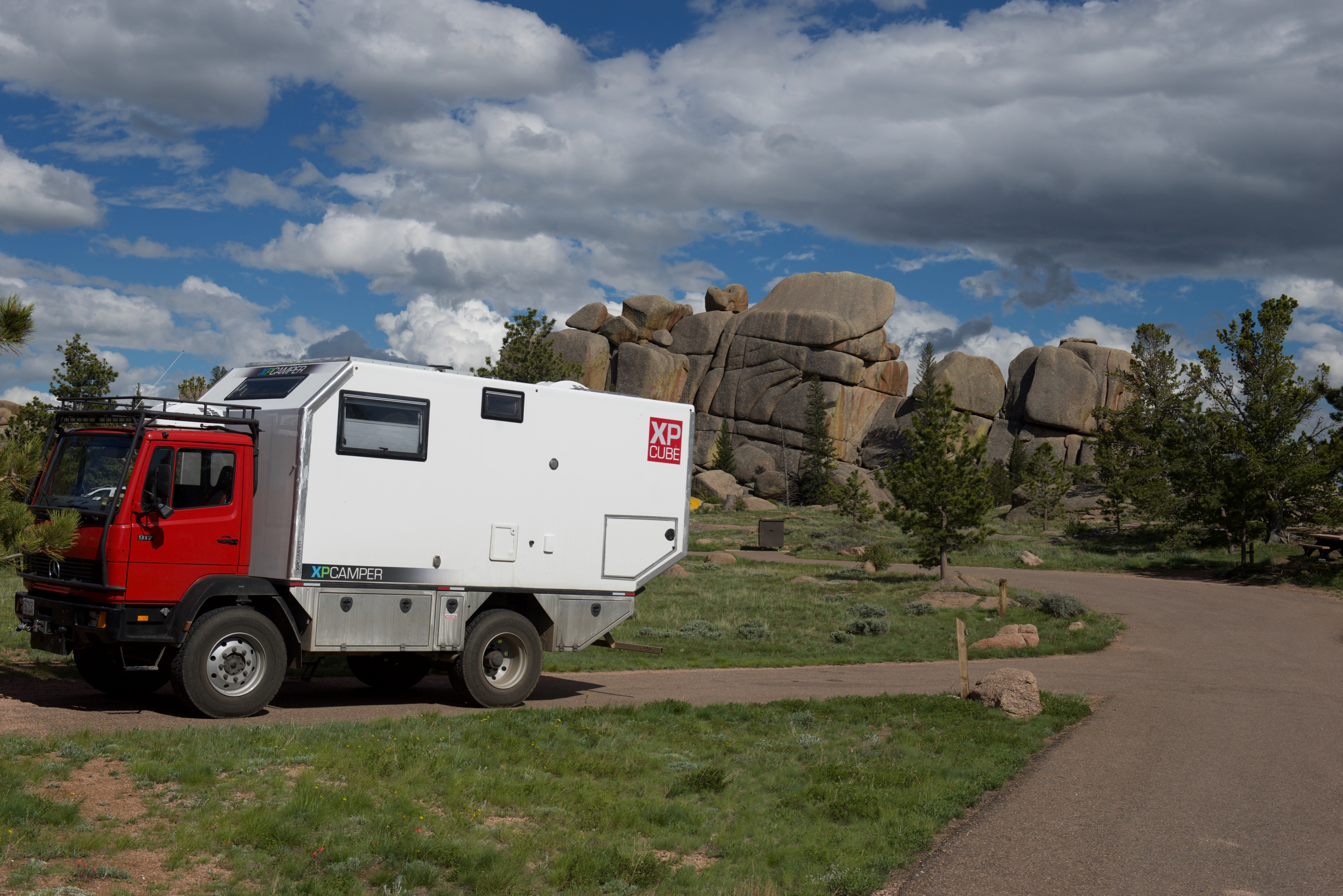
Entering Wyoming we spent our first night at an amazing campground at the Vedauwoo Recreation Area.  It is an area full of huge boulders and cliffs and is a very popular climbing site.  It reminded us of an area south of Jos in Nigeria, that we had camped in during our trip across the Sahara. (https://www.fs.fed.us/wildflowers/regions/Rocky_Mountain/VedauwooRecAreaPoleMtn/index.shtml)

We then headed north to Casper through some lovely green country (obviously lots of rain here also!) where we saw lots of pronghorn deer grazing in the meadows with the cattle.  And there were lots of cattle!  Courtesy of the Harvest Hosts website  we found Historic Trails West, who offered free camping for the night if we joined one of their covered Conestoga wagon expeditions along the Oregon Trail.  (https://www.historictrailswest.com)

This sounded like tons of fun, and is just the sort of silly thing we enjoy, so we signed up for a wagon ride/pioneer dinner.  And it WAS tons of fun!  The driver included explanations of the Trail and background into the lives of those heading west.  Most fascinating was how to get the two Percheron horses (not authentic from the time but practical) and the wagonload of people safely down a steep part of the trail.  Not to mention getting them up it again on the return.  Our meal was excellent, especially the cherry cobbler!

We spent a pleasant night up on the bluff surrounded by pronghorn deer and stayed warm and dry while the wind howled and the rain fell!  We have been experiencing lots of afternoon storms in Colorado and in Wyoming and some of them are quite violent.

The driver of our Conestoga wagon told us about the annual National Collegiate Rodeo Championship taking place in Casper at that time, so we decided to delay a day to attend the semi finals.  We had no idea that Western universities had rodeo teams and competed against each other for money and prizes.  We thoroughly enjoyed our first rodeo and watched with awe the bronco riding, the steer riding, and all the other events.  The skill of the riders and their horses is incredible. Fred, on the other hand, was most impressed that the majority of the broncos, steers, and even goats, made an immediate bee line for the exit chute as soon as their event was over. There were, of course, “shaggers” to catch and direct the animals, but in most cases it simply wasn’t  necessary, the animals knew when their event was over and left of their own accord. It may have been our first rodeo, but it was clearly not theirs.

We also visited the Fort Caspar fort and museum.  The site had long been used by traders, emigrants, and settlers. Over the years various trading posts, military installations, fords, ferries, and a bridge were built there.  (https://en.wikipedia.org/wiki/Fort_Caspar)

Still in Oregon Trail mode, we headed south to visit Independence Rock.  This rock was a gathering point and market for those heading west. Lots of names were carved on it by the settlers and it was known as the goal to be reached by July 4, so as to avoid the greater likelihood of winter snows in the mountains as they progressed to Oregon.  We did not find many clear inscriptions probably as we did not climb the rock itself. (https://en.wikipedia.org/wiki/Independence_Rock_(Wyoming)) We also went to look at Devil’s Gate, a cleft in the mountain that the settlers had noted and visited on their route west. (https://en.wikipedia.org/wiki/Devil%27s_Gate_(Wyoming)) We were not able to get closer than the overlook. From Independence Rock, the emigrants began an easy, one hundred mile climb to South Pass, a remarkably low and wide pass in the Rocky Mountains. (https://en.wikipedia.org/wiki/South_Pass_(Wyoming)) Looking back at Lewis and Clark, and others, the South Pass was a kind of Shangri-La for European Americans trying to travel west. And by making it easy to cross the Rocky Mountains, the South Pass helped spell the death knell for the Plains Indian nations.

New and improved panorama! Now even wider!

While on this jaunt, we realized that our refrigerator was not working well, again! So we turned it off, restarted it and prayed it would get its act together. We camped for the night beside the North Platte River in one of the BLM fishing camps, Chalk Bluffs.

The next morning our refrigerator (the one that was replaced last year in Maine) was really dead. So we returned to our campground in Casper with the aim of getting it looked at. The campground, the Casper East RV park (http://caspereastrvpark.com), welcomed us back and recommended a local RV repair shop. The shop, however However, told us to go away until August so we decided on Plan B. We ordered an ARB 50 quart plug in unit from Amazon and a new refrigerator,  a Nova Kool this time, the same as we had in the Tiger. We no longer trust the Thetford Norcold.  Meanwhile Denise borrowed a cooler from the camp owner which she will return when we return on Thursday to pick up our ARB. We did mention that the RV park was wonderful?

Why We Love the Loneliest Road or back on Route 50 again.

Our next stop was in Nevada to visit friends. They are long time travelers who recently moved to Nevada following a disastrous house fire. (http://robinsonfuso.com) Now established in Nevada, Jon has let his tool and equipment fancy take flight and has, I think, one each of everything from 3D printer to tractor.

The perfect place to pull out the cassette toilet and replace it with a composting toilet. We loved our Nature’s Head on the Tiger, but this time went with a C-Head as it is a better fit for the tiny bath on the 917. Jon was in fine form, machining a foot for the front of the toilet, reworking the teak shower floor, 3D printing a shower plug, and even repurposing the fan and vent from the SOG so that the C-Head has a power vent. Did I mention Jon’s superb craftsmanship?

And if you were wondering, the C-Head is wonderful. Sadly, they are now out of business.

Time to head east for our appointment at Terry Lee Enterprises in La Junta so we set off east along Route 50.  What more could we ask?  The pavement is good, the traffic light, and the scenery spectacular. Plus we know where the camping places are.  We ran in and out of rainstorms as we drove, which helped to explain how green everything was this year (much greener than the last time we drove Route 50 two years ago).

And we stopped, as always, in our favorite town of Ely.  Ely always provides what we need, when we need it and whatever it may be.  Previously we needed a car wash, a new fuse for electric steps, and espresso.  Ely provided.  On that trip we discovered the Happy Valley Chinese restaurant and thoroughly enjoyed lunch there.  Another time, all we needed  was dinner at the Happy Valley restaurant and a state park for an overnight. Again, Ely provided. This time we needed peat moss in a reasonably sized package for our new composting toilet, a supermarket, and of course lunch.  Ely provided, so we bought a perfectly sized pack of peat moss and our Chinese lunch was wonderful.  (And the portions so large that we got three more dinners out of it!) Unfortunately we have never managed to be there at the weekend to ride the steam train, but we live in hopes that we may manage that one of these days. Any excuse to return.

We continued east towards the Great Basin.

After a nostalgic night’s camping in the Great Basin National Park, we entered Utah near the town of Delta where Route 50 wanders rather and finally becomes 1-70. 

But we were back on 50 as we left Grand Junction, heading through Colorado. Another night of nostalgia as we found the Dry Gulch campground in the Curecanti National Recreation Area for the third time.

Our first tourist stop was Fort Uncompaghre in Delta, Colorado.  (http://fortuncompahgre.org) It took us a while to find it and we enjoyed our driving tour of the town!  The fort, like Bents Old Fort near La Junta, which we had previously visited, was a trading post in the 1800’s. This is a reconstructed site and extremely well done.  We have visited a couple of these forts and we learn something new each time. 

The whole history of the Santa Fe trail and the “Old Spanish Trail” to Mexico City and Los Angeles (La Ciudad de Nuestra Señora de los Angles) is fascinating and relatively little known. This time we learned how valuable were the furs which the trappers caught and the reason for the preference for beaver hats in Europe – the fur is naturally waterproof. Georgette Heyer and Jane Austin fans take note! Now you know why Mr. Darcy, and others, favored curly beaver hats.

The various trails, Oregon, Santa Fe, “Old Spanish”,  and the rest, are interesting studies in geography as destiny. Some of them went hundreds of miles out of the way to find a lower pass through the mountains, or more assured water and grazing for animals. We you consider that they were all traversed mostly on foot, this could mean weeks of extra travel. On the other hand, it could be the difference between arriving alive and perishing in the desert. In contrast, European trade routes were known and in habited for thousands of years. The only thing similar may be the Silk Road. Even the trans Sahara routes had been used for millennia.

We spent the night at the Winery of the Holy Cross Abbey, in Cañon City, Colorado, courtesy of the Harvest Hosts group.  (Of course we purchased a couple of bottles of wine, which we shall enjoy!)  It was a pleasant spot with nice views of the abbey.

On a whim, we decided to ride the the Royal Gorge Railroad through Colorado’s Royal Gorge.  This proved to be great trip on a beautiful sunny morning.  We booked breakfast on the 9.15 a.m. train and enjoyed our 2 hour ride, through the Gorge, with eyes open for animals, while enjoying our breakfast burritos and coffee.  We saw various deer, both mule and pronghorn, and missed the supposed sightings of the bighorn sheep, though some saw them!  The camouflage is so good it is hard to see the animals unless they move.  

We then headed up the road to La Junta. We checked into the little motel and took the 917 to Terry Lee Enterprises bright and early on Monday morning. We didn’t need much, and indeed, the spare tire carrier probably could have been modified by any welding shop, but it felt good to let Billy modify his own creation. We changed every fluid and replaced several pinion seals. The bottom of the truck is much cleaner now.

The truck done, we headed back to Cañon City to buy more wine. (Well, it was excellent and they let us stay a second night!) The next morning we took a four mile walk along the old railroad path overlooking the Arkansas River. We went through three tunnels which had been cut by hand by prisoners from the penitentiary in Cañon City. Cut by hand as no one was going to give prisoners dynamite! We took photos of the train as it went and returned and then we met a herd of big horn sheep. None of this viewing through the train window – we were up close and personal. To be fair, I think the sheep were much less impressed than we were.

We then headed off for Leadville with an afternoon coffee stop at the Brown Dog in Buena Vista, another find from a previous trip. (https://browndogcoffee.com) We found a wonderful, huge dispersed camping area just outside of town and settled in for the night.

The great AT&T coverage let us make our first blog post of this trip.

Discovering Route 395

After Overland EXPO, we wanted to go somewhere to shoot pictures of the 917 in action. Bad weather put paid to plans to return to the Valley of the Gods, so we headed west, across Death Valley to California.

Along the way we stopped for the obligatory photo on old Route 66,

We did not spend any time in Death Valley; we merely popped through the 20 Mule Team Canyon, but that said, it is spectacular.

The grades into the valley test your exhaust brake to the maximum! Oh, and the views are amazing. But with an 18,000 lb. vehicle, the road commands a lot of attention.

A grade of almost 10%. Note the road continuing across the valley.

In May the temperature in the valley is not bad, but you can imagine what it is in high summer!

Climbing out the the valley, we camped at an abandoned work site, known as “The Slabs.” (The old foundation slabs make nice level campstites!)

Once into California, we turned north on US 395. We had never heard of Route 395 which runs along the Sierra Nevada, but we very much enjoyed driving it.  We are not alone – it even has a Facebook group.

Our first stop was the Alabama Hills. The Hills have been Hollywood’s secret weapon since the 1930’s. You want the Hindu Kush (“Gunga Din”), the Lone Ranger’s massacre site, Afghanistan (“Iron Man”), a burned villa (“Gladiator”), or simply spectacular scenery for westerns, great and not so great? The Alabama Hills provide it all in an area about two by five miles. We drove around the rocks a bit (proving that the swing away rear bumper would swing!) and then settled in for the night.

No, we are not in the Hindu Kush.

The next day dawned grey and dismal, but we still drove under Gunga Din’s bridge, almost by accident. (Sadly, Annie, the elephant, was no longer there.) This is a great video: https://vimeo.com/8561946

The bridge spanned from the concrete in the foreground to the rock on the other side of the truck. The “yawning chasm” was a matte shot. You are standing where Annie the elephant stood when she shook the bridge.

We left the Alabama Hills and headed into Lone Pine to visit the Film History Museum.  This was most interesting with everything from cars used in the era to memorabilia and posters from different movies.  Fred especially liked the old movie camera car, used to film racing cowboys and crashing wagons.

The town of Lone Pine has what may be the most beautiful McDonald’s in the world. (We went to the espresso bar, not as scenic, but better coffee.)

All of the scenery on Route 395 was incredible, though we could have wished for better weather – rain, clouds and even snow were our constant companions. 

Then it was time for a visit to a most moving and sad location, Manzanar, National Historic Site. One of the Japanese Internment Camps, established after the bombing of Pearl Harbor, it housed about 120,000 ethnic Japanese of which 60% were US citizens. They, for the most part, lost everything; homes, businesses, and even pets were abandoned at short notice. Allowed to carry, only a suitcase, they were forced into the windy, dusty high desert environment.  Parts of the camp have been reconstructed and interviews with former residents tell their stories. A very sad and shameful part of our history.

As we continued our drive north, we stopped at the Laws Train Museum and Historical Site, a collection of old houses and memorabilia from the late 1800’s and one of the last narrow gauge engines and cars from west of the Rockies.  The Laws Depot from 1883 is there.  Other than the falling rain, it was pleasant.

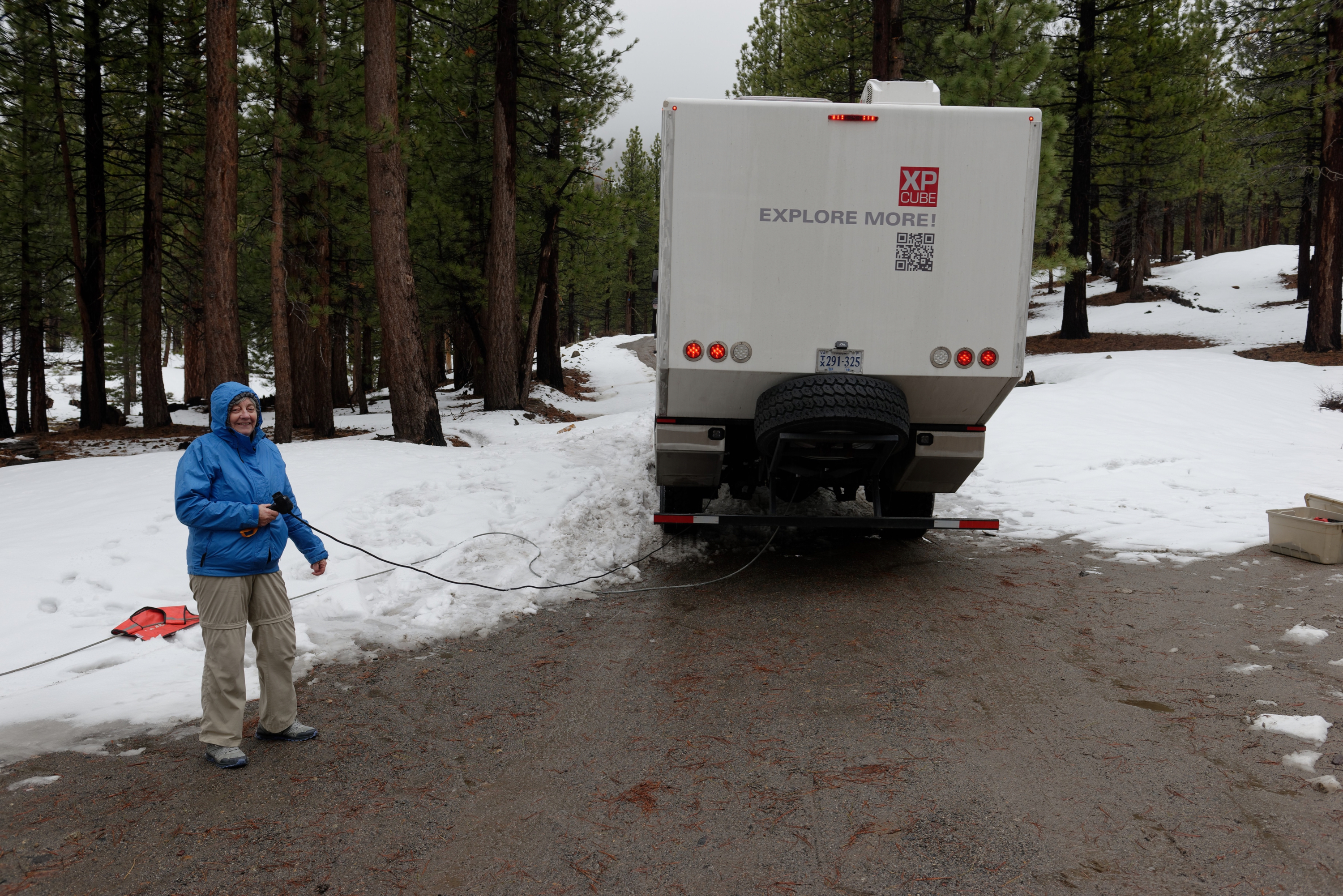
Heading north still, we decided to see the Obsidian Dome, a volcanic feature amongst a number of volcanic calderas, cones and lava flows.  As the road climbed, the rain turned to snow and we found ourselves in deep drifts.  Of course we managed to get stuck as we were not expecting this and were not even in 4×4.  (Yes, we should have been).  This posed a bit of a problem – we had sand ladders and “Go Treds” but no shovel. (Don’t even say it!) We successfully extricated ourselves using the rear winch. For the first time in our lives, Mr. “I-don’t-need-no-stinkin-winch” was saved by a winch. (Yes, we did have a nice new tree strap.) Actually, the truth is that Denise ran the winch while Fred drove.

Denise, a beautiful wench, or is it winch?

Once out, the snow was falling, so we decided to stay put and camped beside the drift!!  Next morning we had a dusting of snow on us but the sun was shining!  We had not seen it in so long!

Our final stop on 395 before heading into Nevada was at the Mono Lake, known for its tufas.  Mono Lake is a salt lake, which forms tufas, strange spires and knobs, when fresh water springs containing calcium bubble up through the lake water and combine with the carbonate-rich waters of the lake. 

We started at the Visitor Center and then retraced our steps to the South Tufa area where a footpath led down to the lake and close encounters with both dry and wet tufa.  There are no fish in the lake only briny shrimp, which are a favored source of food for several migrating birds.  There are also alkali flies which are a food source.  There were a few birds around but we did not visit in the main migration season.

The Mono Basin is very volcanic with the youngest mountain range in the US.  For example, Panum Crater only erupted 650 years ago.

As we left, we went to the Panum Crater, and climbed up the side to view the lake and the crater, before heading into Lee Vining to enjoy an ice-cream on the first sunny day in a week!  And on to Nevada where we planned to visit friends, for the Memorial Day weekend.

On the Road, Again

This time our departure was rather rushed as we could not leave until the new wheels arrived from Germany.  (http://www.expeditions-lkw.de/felge-11-75×22-5-8-loch-et-110-kronprinz.html  Thank you, Fabian!) They made it by the skin of their teeth and we drove to Baltimore on the Wednesday to pick them up and then dropped them at the tire shop.  Fred had them installed with the new tires on the Friday and then it was all systems go for departure on the following Wednesday. Thank you all of the wonderful folk at Alban Tire, Springfield. (https://www.albantire.com

New, round wheels and tires!

It always takes far longer to get ready than one thinks it should but we made it out about 11 AM with most of what we planned to take with us!  And in the U.S. one can always buy what one forgets!  In other parts of the world that is not always the case!

We were heading for Overland Expo West, (https://www.overlandexpo.com/west) so had a limited amount of time to make it to Flagstaff, Arizona which made for long driving days. We could see considerable flooding as we approached the Mississippi River and as the river was cresting further north at that moment, we were glad to get through without problems. Perhaps as result of all of the rain, the spring flowers beside the interstate were lovely, even into the desert.

We took the shortest possible route, Interstate 40, but were frankly shocked by the state of the road surface in several of the states and by the general lack of open rest areas. Oklahoma had not one rest area available, so no wonder all the truck stops advertised “clean toilets”.  Even a camper needs a rest area for a lunch stop.  Eating lunch in a truck stop parking area is no fun. 

That said, there were some pleasant surprises en route. The KOA in Grants, New Mexico is not impressive from the road, but it turns out to be lovely and right in the middle of “El Malpais” (badland). (https://koa.com/campgrounds/grants/) They even have a short, annotated lava/nature walk which gives you a sense of the unique geology of the region.

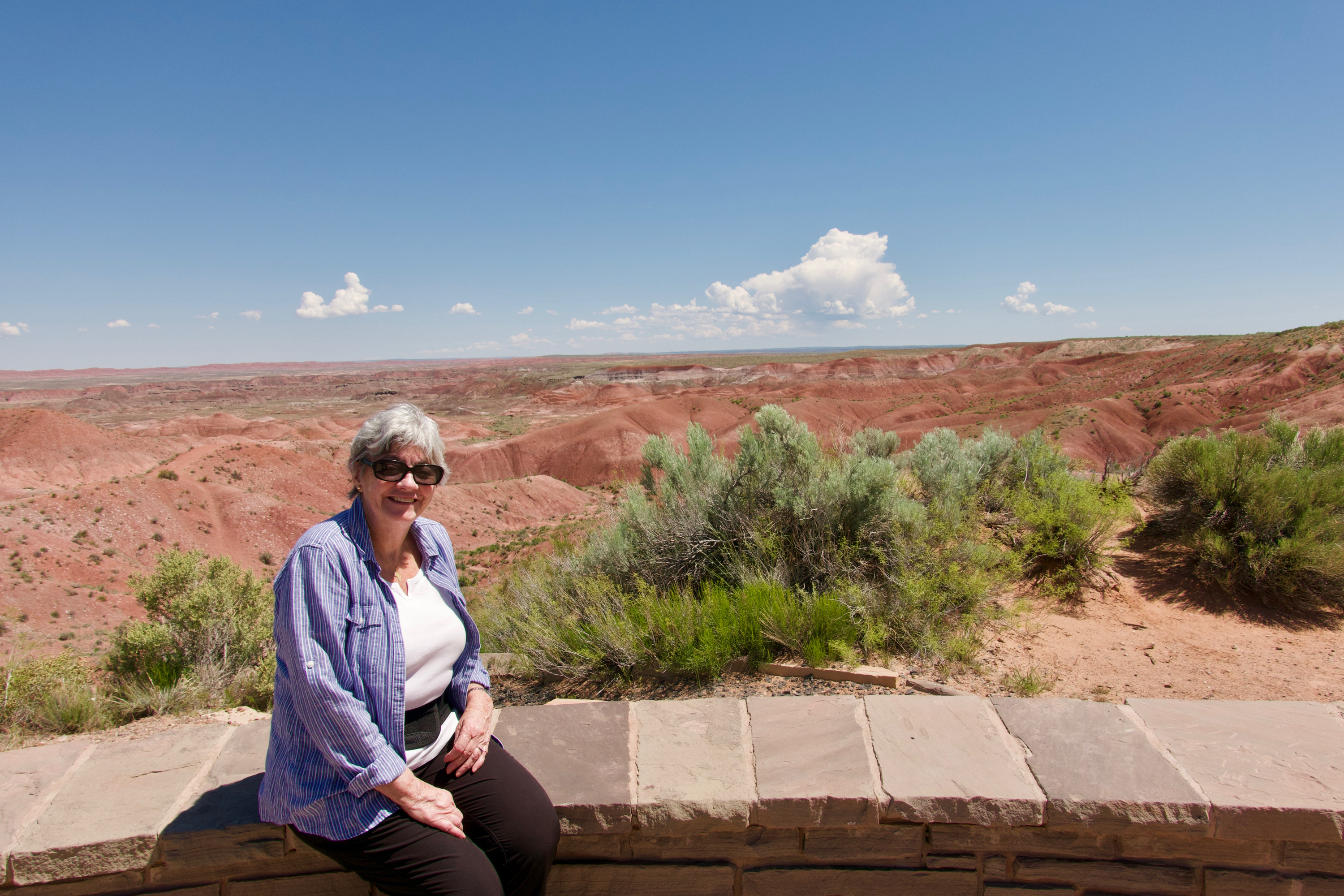
As it was warm and the sun was shining, we made a flying return to the Painted Desert and stopped at the same overlooks we had visited on our first trip west in 2014. That time it was cold enough to chill the proverbial monkeys! This time it was lovely and the sunlight made the colors so much richer.

But we made it to Flagstaff in time, met up with friends at the KOA and headed to Overland Expo. And the new wheels and tires? Round and wonderful! We could make as much as 60 MPH!

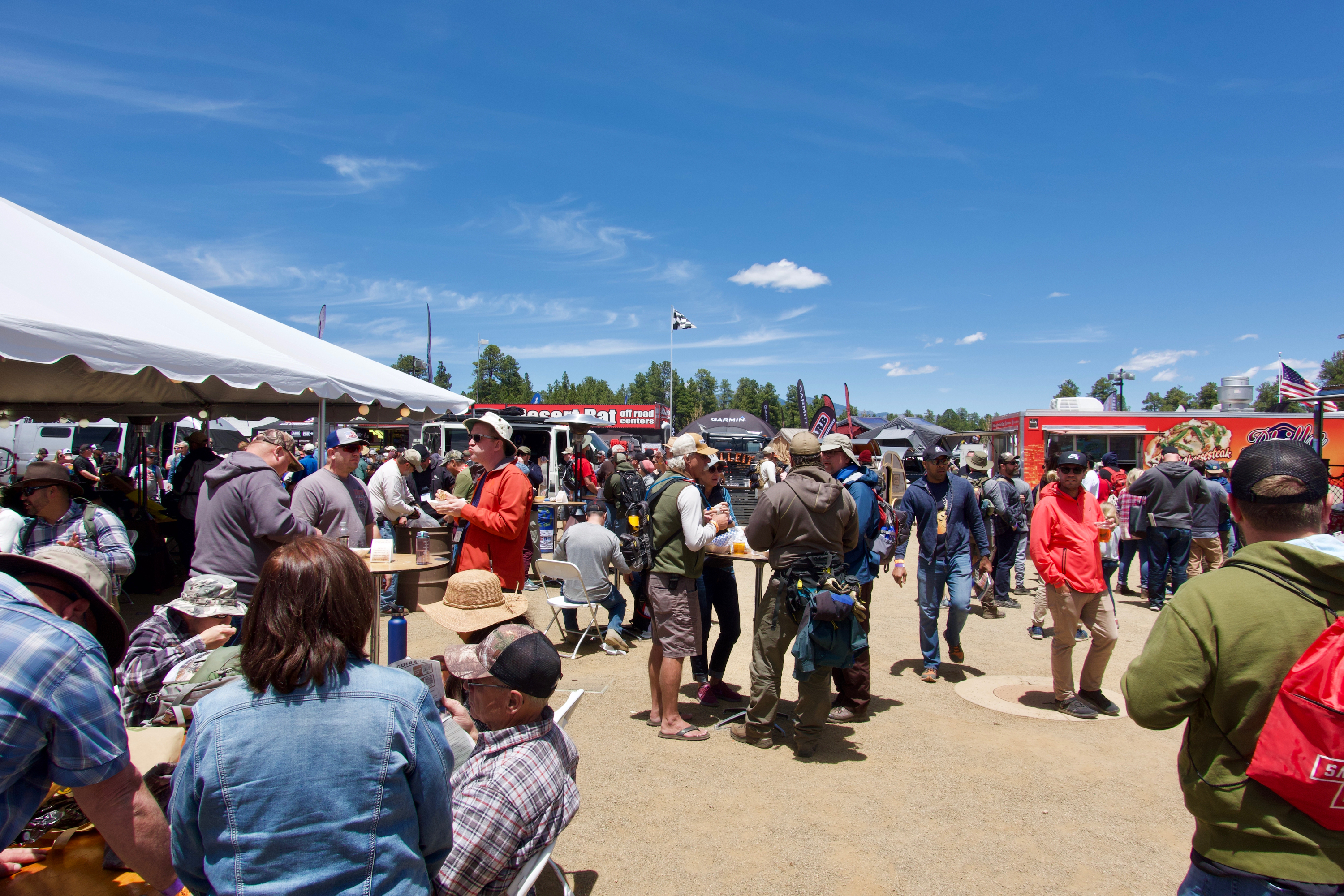
Overland Expo is in a new venue, Fort Tuthill Park, which is right in Flagstaff, a boon for day trippers and those who stay overnight in hotels. The event is now up to 22,000 people, and, as Denise’s brother would say, it was “heaving.”

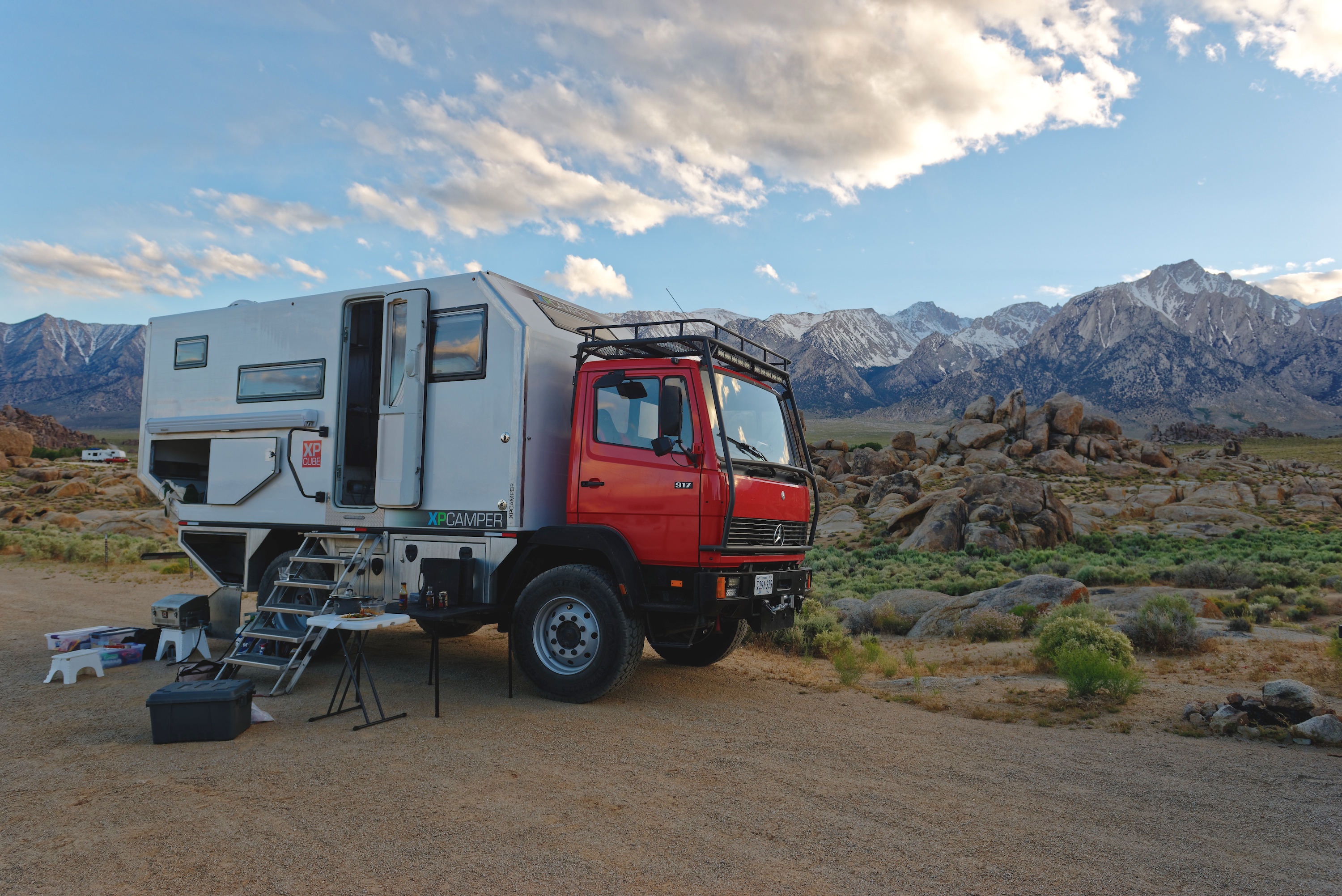
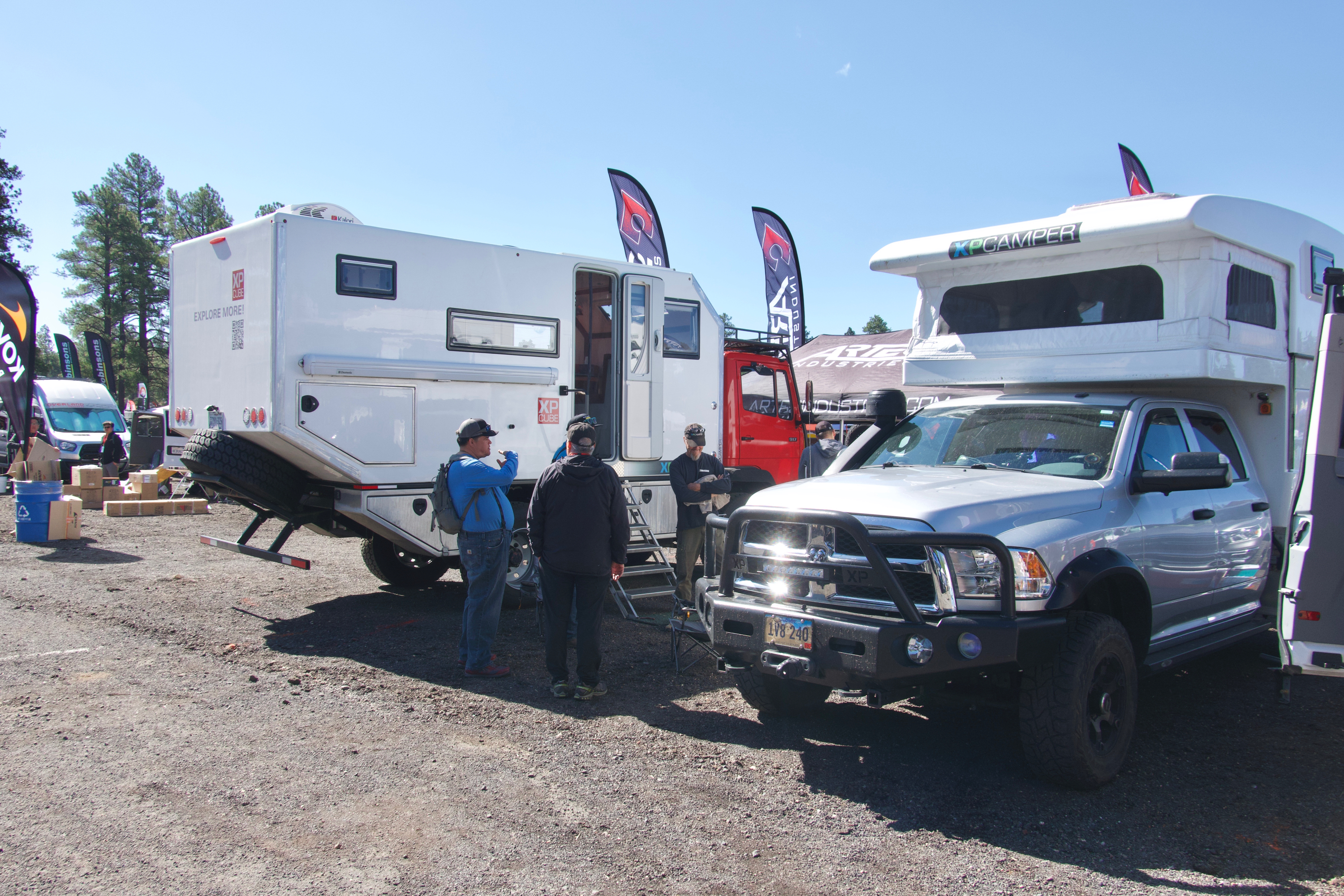
We showed the 917 at the XPCamper display and were busy dawn to dusk.

We were able to slip away and catch Dan Grec’s wonderful presentation on West Africa. (http://theroadchoseme.com)

Fred was also able to catch a presentation on driving to the Eye of Africa: https://en.wikipedia.org/wiki/Richat_Structure a cool looking hole that can only be appreciated from space. Go figure! Still, we may put it on our agenda for the coming years. This link gives a good impressionistic view of the event: https://americanadventurist.com/overland-expo-west-2019/

True to the history of Overland EXPO in Flagstaff, it snowed on Monday morning!

We even saw Rob and Nina Blackwell’s old truck in the camping area. The new owner is said to be delighted with it. (http://whiteacorn.com)

An old friend from EXPO’s past. (This is the truck they drove across Asia to Europe.)


On to Paris, the final lap.

Heading down the Rhine, we enjoyed the many castles perched on crags and of course, the Lorelei Rock. 

Interesting trivia. During WWII the Allies generally tried to avoid bombing churches or old castles. So, suddenly, lots of railroad tunnel mouths and other points got converted into “churches.” And so they remain to this day, with trains running through them every day.

The “church” of Our Lady of the Tracks!Great RV campsite!


A Viking sistership.


… and an older style Rhine boat.


_ND87209

The Captain, piloting the boat from one of two outside conning stations.


_ND87222

For those of us old enough to have stood a bridge watch with a wheel and lee helm, the high tech controls of the Viking river boat are amazing!


_ND87216

Yes, people are THAT close!

Passing on to the Moselle River, we stopped at Cochem, where the highlight of our visit was the eleventh century Reichsburg Castle high on a hill, overlooking the town. https://www.reichsburg-cochem.de/index.php?id=4&L=1

_ND87276

The final highlight of our tour and one that was totally unexpected was our visit to the city of Luxembourg.  We began at the American Military Cemetery just outside town and were much moved by the simplicity and yet emotion inspired by the rows of white crosses.  More than 5,000 US Servicemen are buried there including General Patton. (https://www.abmc.gov/cemeteries-memorials/europe/luxembourg-american-cemetery#.W6KwTS-ZOEI

_ND87363

Patton reviews the troops.

After this visit, we headed into town, where we explored on a walking tour the Chemin de la Corniche with its spectacular view of the 17thcentury wall and city, the main market area and the Notre Dame Cathedral.  


We returned to the Cathedral for a wonderful, thirty-minute organ recital. You can see and hear a bit here. (Hint: Crank up the volume!)    


And having left our boat, we headed to Paris by bus.  Once there, we visited a Moroccan restaurant near our hotel which we knew from previous visits had a long lunch the following day with a friend from Bangui. Then back to the US after a great trip.

_ND87389

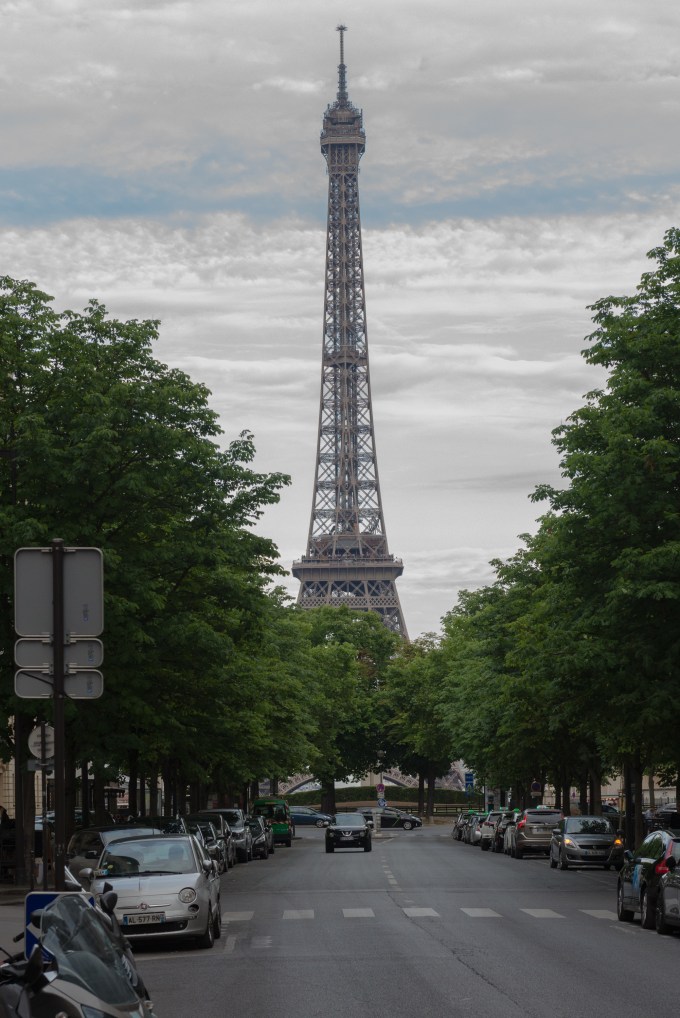
Some views of Paris are eternal.

Rollen auf dem Fluss (With apologies to Creedence.)

We unfortunately left the sunshine behind as we entered Germany. The transit from the Czech Republic to Germany was by bus and our first stop was Nuremberg. This turned out to be a bit of a loss as a rock concert prevented us from visiting the (in)famous “Triumph of the Will” stadium (https://en.wikipedia.org/wiki/Triumph_of_the_Will) and the trial museum was not open either. We had to content ourselves with a visit to the market and a sample of the famous local sausages.

_ND86966

Nuremberg market square with the 14th century Schooner Brunnen fountain in the front and the Frauenkirche (Church of Our Lady) in the background.

It was difficult to imagine this square as the site of Hitler’s final speech in “The Triumph of the Will.” May it always be remembered today for sausages and Lebkuchen, gingerbread cookies.


_ND86971

The Männleinlaufen, an animated clock on the Frauenkirche


_ND86975

We finished our visit to Nuremberg with a view of the town from the Castle.

After Nuremberg we arrived at the boat in Bamberg and spent our first night on board. The next morning we set off in the pouring rain to see Bamberg.  As it was a Sunday, a lot of museums were closed and we were unable to enter the Cathedral due to Sunday services, but we had a pleasant, if damp, view of our first German town and would certainly return.

_ND86980.jpg

The Fuersten gate to the Bamberg cathedral has two interesting statues; “Ecclesia” and “Synagoga.”

_ND86995

Ecclesia is crowed with heaven. She used to carry a staff with a Crucifix, symbolizing the power of the church on earth. (Original statues were removed in 1937.)

_ND86994

Synagoga is, however, blindfolded and carries a broken rod. (A not too subtle message!)


_ND86983.jpg

According to legend, the bishop of Bamberg would not grant the citizens any land for the construction of a town hall. This prompted the townsfolk to ram stakes into the river Regnitz to create an artificial island, on which they built the town hall they so badly wanted.

_ND87000

The bridge over the river runs right through the town hall. (On the inner wall is a plaque dedicated to Claus von Stauffenberg. From the Bamberg area, he was one of the leaders of “Operation Valkyrie”; the plot to assassinate Hitler.)

_ND86987

Beautiful statue on the bridge

We ended with coffee and cake (yes, there is a theme here!) in a Konditorei and returned to the ship, feeling warmer!  We left around midday heading for Wurzburg down the Rhine-Main-Danube Canal.

We traveled several rivers during this cruise and enjoyed them all! We are total lock and canal fanatics, having transited the Panamá Canal, the Suez Canal, and parts of the Kennet and Avon Canal. If the Rhine-Main-Danube Canal is less well known than Suez or Panamá, it is an amazing engineering accomplishment with a long history. Read more here: https://en.wikipedia.org/wiki/Rhine–Main–Danube_Canal

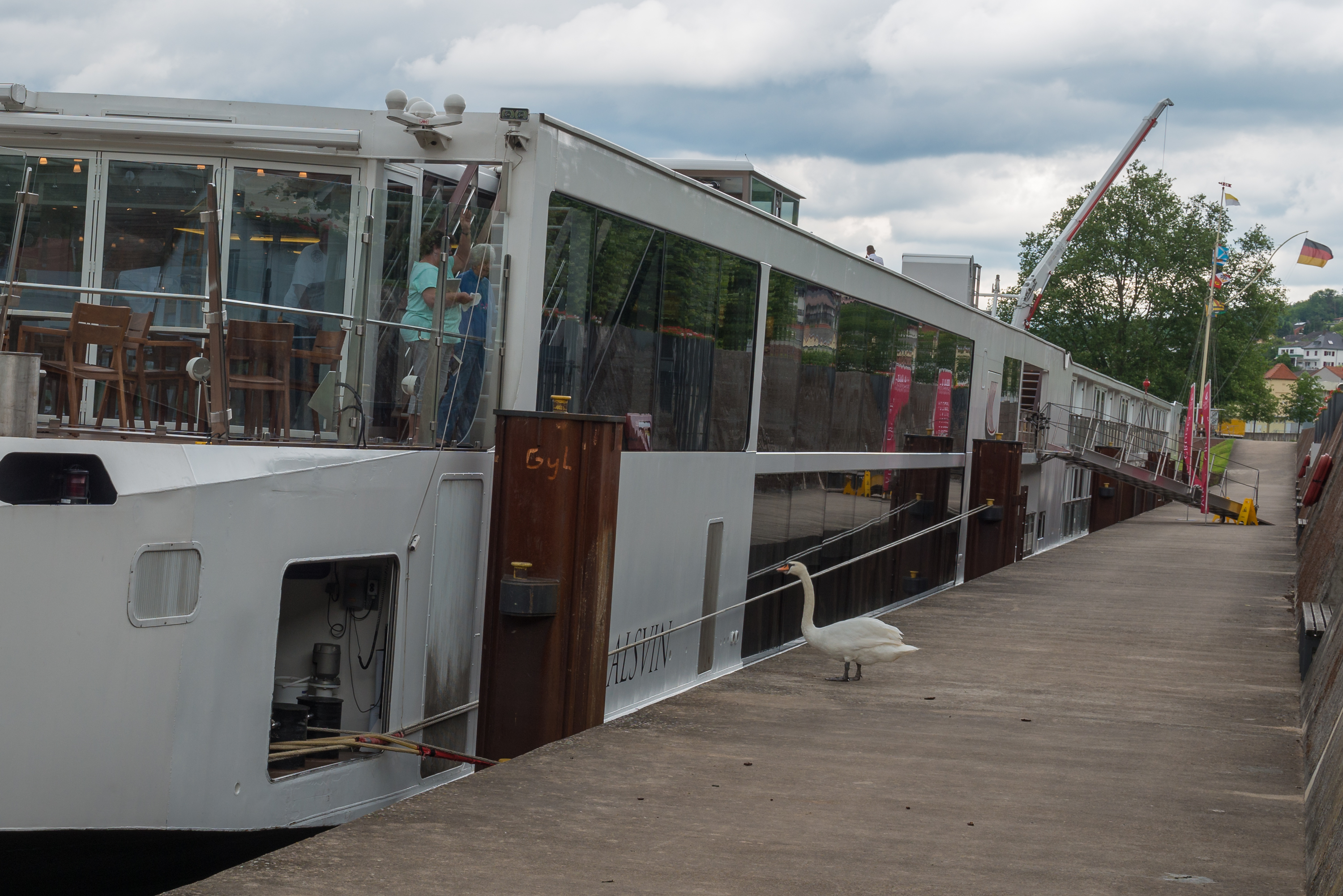
For those who are wondering, the Viking river cruise boats are very much like miniature ocean liners. They are carefully sized to fit the locks but despite being very long and narrow, they do not feel cramped at all. Indeed, the general feeling is one of extreme spaciousness. Because of low clearance, the bridge, and indeed everything on the top deck, can be lowered.

The clearances on the canal are so low that the top deck was closed for most of the first part of our trip.  The cabins are lovely the bathrooms are a textbook layout for a semi-dry bath. Great ideas for our next camper! Our boat was the https://www.vikingrivercruises.com/ships/longships/viking-alsvin.htmlTake a tour here: https://www.vikingrivercruises.com/content/360/start.html?secure=true

The next day, we took a full day excursion to Rothenburg ob der Tauber.  The rain was not constant and we enjoyed an extended walking tour of the town, which is one of the best preserved of the old towns, many of which suffered extensive bomb damage during World War II.

_ND87026

The medieval feel is quite strong and included a costumed minstrel band singing, drumming and asking for beer up and down the high street.  Great fun.

We spotted a stork’s nest and walked the town walls and visited the Hauptkirche of Saint Jakob (high or main church).

The church contains the Altar of the Holy Blood, a reliquary said to contain the blood of the Christ.


On our return to Wurzburg we visited the Bishops’ Residenz, a UNESCO listed site built between 1720 and 1744 by the prince bishops.  A very opulent palace created for some very powerful men of their time, with extensive marble, gold stucco and frescoes.

Nothing modest about this palace

The ceiling frescos were later featured in the PBS series “Civilizations.” Beyond the theme of the superiority of Europe, they feature amazing trompe d’oeil elements like people who begin as paintings on the ceiling and end as statues and figures painted so that they appear to be standing outside of the fame of the ceiling; an amazing 3-D effect. Religious scholars could use this palace as the setting for a discussion of the doctrine of the poverty of the Christ. (Yes, that is sarcasm.)

venetian-room.jpg

Grand Stairway (Photo from the Web.)

We declined the all day tour to Heidelberg as the sun was peeking through and we preferred to sail on the river and enjoy the view.

We weren’t the only ones enjoying a quiet day on the river.

Lumpia, pancit, ribs!

The cuisine on board was excellent European food, so we were surprised to learn that the chef is actually a Filipino. When he learned the Fred had lived in the Philippines, a Filipino feast was prepared for lunch.

We stopped briefly in the small town of Collenberg. At one time it had an interesting motte and bailey castle. The motte was a hill overlooking the Main River and the bailey extended down to the river’s edge, allowing it to control traffic.

Local official checking out the river boat. He collected a toll in cookies.

The following day we were due in Mainz in the mid morning but were delayed because of heavy lock traffic on the Main River.

Tied up at Mainz. You can see how long these river boats are.

This messed up the guides that Viking had booked so we headed out alone for the Gutenberg Museum, which was the highlight of the day for us.  We viewed the Gutenberg Bibles on display in the museum, which are amazing and still so colorful after all this time. We watched a printing demonstration in German, which was fun for both of us and showed the color techniques. (Denise speaks German, but Fred does not. He had the greater challenge!)

_ND87118

Been a long evolution from this to an inkjet on your desk

If they can fit, so can we!

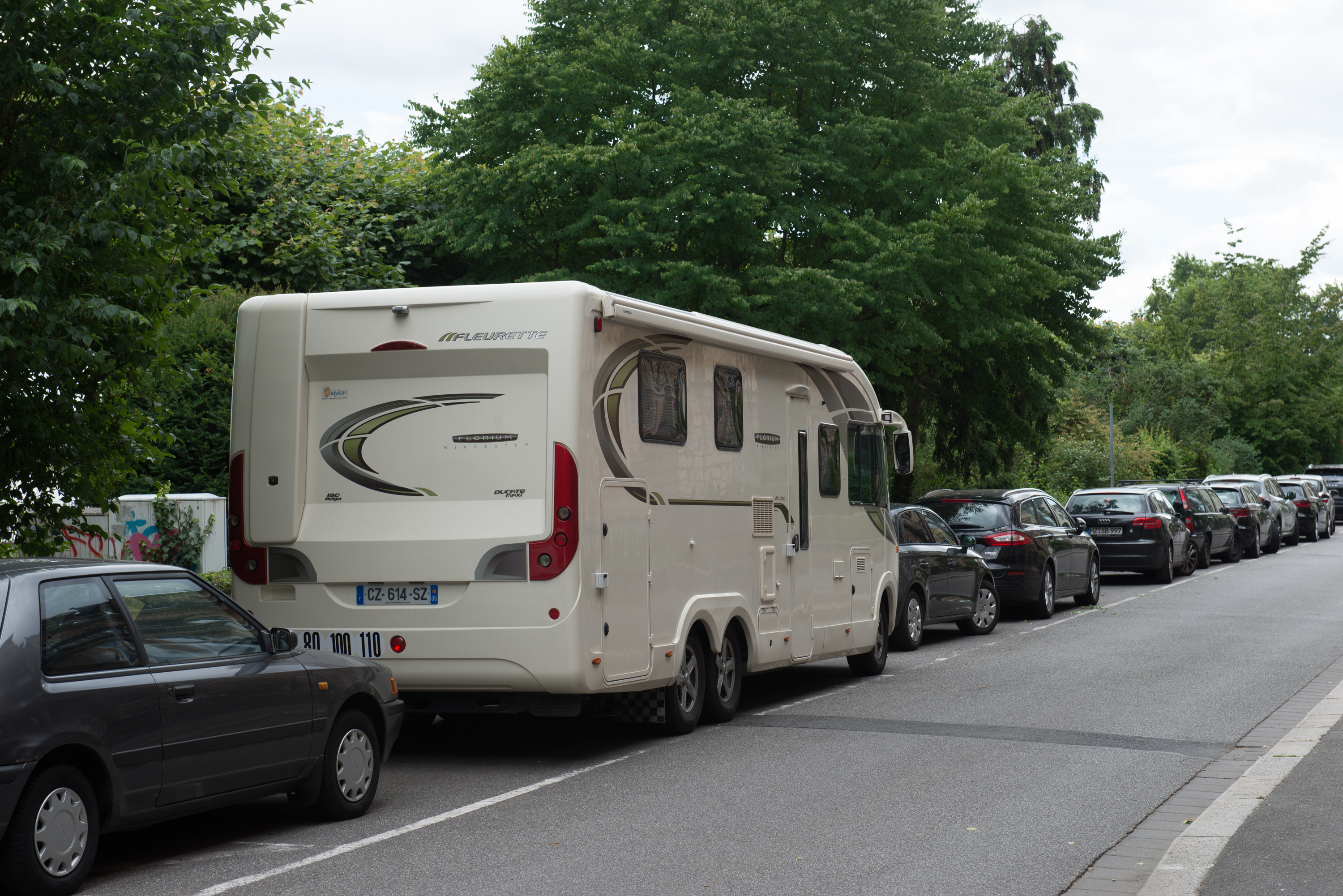
With our plans to ship our camper to Europe, we were always alert for signs of campgrounds and campers. It was interesting to see this beast parked on the street in Mainz.

Memorial to the cruiser “Mainz” sunk at the Battle of the Heligoland Bight. Note the graffito of a peace symbol. (https://en.wikipedia.org/wiki/Battle_of_Heligoland_Bight_(1914))

Mainz is known for beautiful architecture

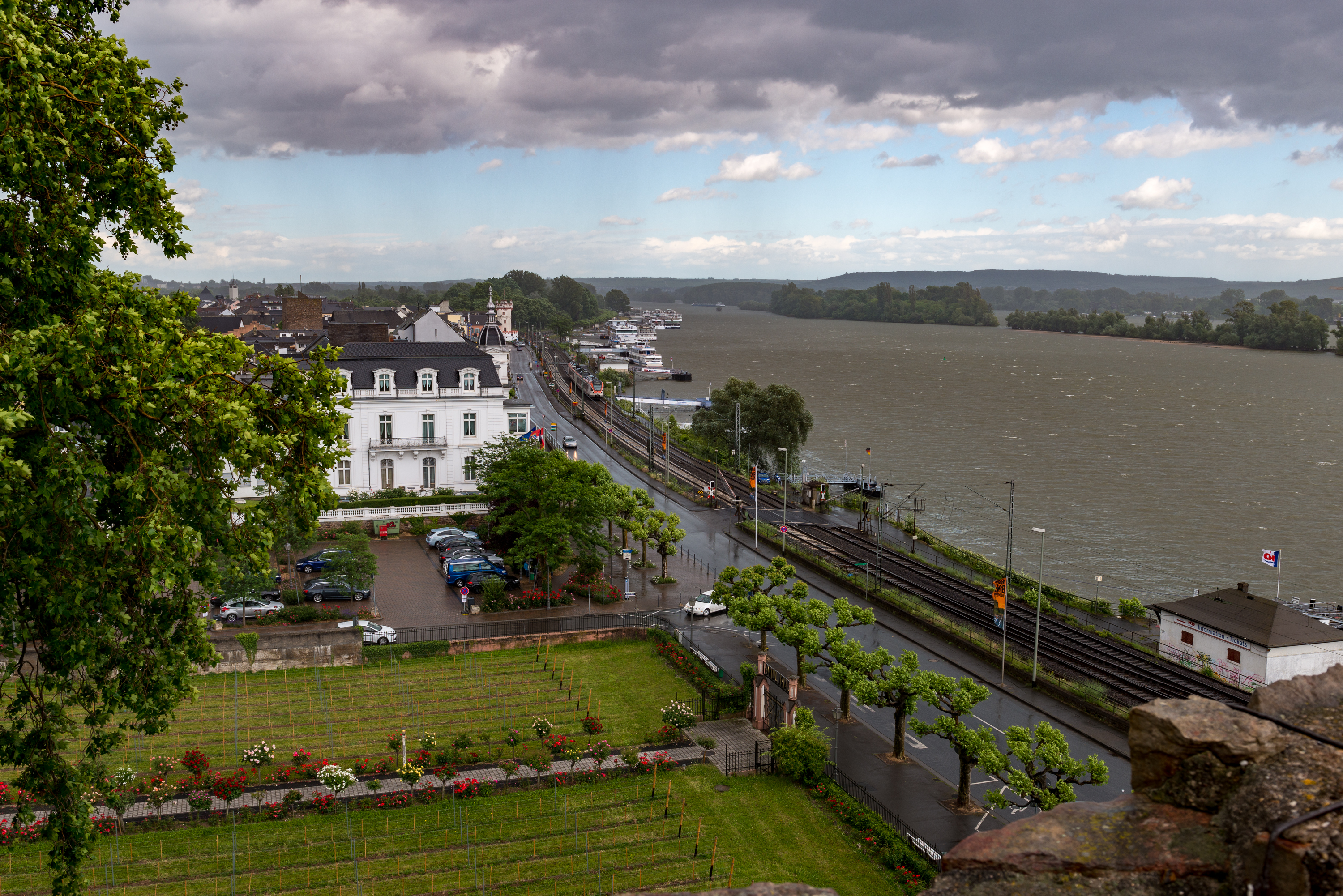
That afternoon we visited Rudesheim am Rhein.  We wandered the town and headed for the Rheingau Wine Museum at Brömser Castle. https://www.ruedesheim.de/en/wine-culinary-art/wine-culture/The museum, located in the 1,000-year-old castle, was itself interesting and dealt with the history of wine making but the fabulous part was the castle tower itself.  This was accessible to those wishing to climb it, which we of course did, and enjoyed spectacular views of the river and town from the top.

Threatening skies

We love prowling the winding stairways of medieval castles, cathedrals, and other buildings. This little tower was one of the best textbook cases of how these passages were laid out to favor both communication and defense. For those of you who are not medieval fortification nuts, the stairs were built as a clockwise spiral so that an attacker climbing the stairs would have his sword arm blocked by the central support. A defender, on the other hand, would have his right hand free. The steps were also often uneven, so as to cause someone not familiar with the stair way to stumble. And, of course, they were only one person wide so that attackers could never take advantage of numbers.

We missed the two museums devoted to torture and crime, although the toy and railway museum might be a better bet. A good reason to go back? Of course! Where else can you find an inn with a medieval tower flying the Harley-Davidon flag?

Prague to Paris, Starting in Prague

In May of 2017, we were temporarily without a camper, and Denise decided that she needed a trip somewhere! So, as we are loyal PBS viewers and as several friends had enjoyed a Viking River cruise in Europe, we made a last minute decision to cruise with Viking on their Prague to Paris jaunt. We gave Viking only about three weeks notice, but we were pleasantly surprised that they managed to fit us in with a minimum of fuss and bother, both on the cruise, and on our various flights. We first flew, via Amsterdam, to Prague, a city that Denise had always wanted to visit. We were greeted with lovely sunny weather and thoroughly enjoyed our ramble around the city on the afternoon of our arrival. It was such a lovely day, we just had to have cake and espresso! It was at this point that we discovered that, despite being in the EU, the Czech Republic is not a Euro country. Worse, most ATM’s in Prague only accept local cards! Finally we were able to exchange US$ cash for sufficient local currency and the coffee and goodies were ours. The moral of the story is that it is always a good idea to have some local currency on hand! Not all of Prague was dignified and classic, we enjoyed several oddball sights as well: Being quite tired, we had dinner in a restaurant in our hotel, which served local specialties. The “queen” of Czech cooking is said to be roast beef with cream sauce, Svíčková. Certainly the dish we had was out of this world. When we looked it up in our European cookbook, we realized that the book dated from the Cold War and noted that this dish, along with the famous Prague Ham, was unavailable locally. Reminded us of Cuba – Cubans would look at a Cuban cookbook from Miami and comment, “Yeah, my mother would talk about those dishes.” How times change!  We found a recipe in a cookbook on our riverboat and photographed it!  You can also find various recipes on the Internet: https://www.eatingeurope.com/svickova-braised-beef-recipe/ A tour the next morning showed us some of the city’s highlights, including the Prague Castle with its spectacular views and interesting history. (See photo at top of post.)  (https://en.wikipedia.org/wiki/Prague_Castle)
_ND86840

St. Vitus Cathedral. (This church was used as a background in the movie “A Knight’s Tale.”)

Parts of the Prague Castle as still used as government offices. (We had flashbacks was we watched a motorcade arrive!)

Ah, memories! And this time we don’t have to do anything!

Then we simply joined the crowds to enjoy the spectacle of the ceremonial changing of the guard.

Love the old goose step, Soviet style

Prague, like many medieval cities sits astride a river. _ND86822 One way to cross the river is the Charles Bridge, famous for its many statues. Two are especially interesting. It is a crucifixion scene, labeled in Hebrew – an incentive for Jews to convert. (We were to see more of this theme.)
_ND86879

The caption on this crucifix is in Hebrew and exhorts Jews to convert to Christianity.

And if you weren’t ready to convert, there is a statue on the spot where John of Nepomuk is said to have been martyred by being thrown off the bridge. Notice that the image of the saint and the cross are shiny – you touch them for luck. (https://en.wikipedia.org/wiki/John_of_Nepomuk) _ND86877 Both were reminders that history has its rough side.
_ND86883

Charles iV, King of Bohemia and Holy Roman Emperor. Note the incredible detail of his clothing.

The bridge is named for Charles IV: https://en.wikipedia.org/wiki/Charles_IV,_Holy_Roman_Emperor Once back in the city center, we chose to leave the tour and enjoy a quiet lunch a little off the beaten track. We duly admired the famous clock striking the hour off the Market Square. In addition to telling the time and various astronomical data, it features saints and apostles appearing at the windows. Of course, you need a degree to understand all of the data presented – and this thing was built in the 1400’s! Read more here: https://en.wikipedia.org/wiki/Prague_astronomical_clock
_ND86890

Click on the image to enlarge and see St. Peter, with his key to Heaven, in the window

And we tried the local delicacy of Tredelnik, a charcoal roasted pastry. (https://en.wikipedia.org/wiki/Trdeln%C3%ADk) Keeping up with the times, it is now available filled with soft ice cream. A divine mess!

Baking over charcoal on spinning wooden rods.

And another famous street food, Prague Ham.

Prague Ham

The pastry/Ice cream fix accomplished, we had to find a horse carriage for the obligatory tour. That night, we went to a tourist dinner with local dishes and traditional dancing.  The music was great, the dancing was fun, and the costumes lovely, but the food at our hotel was better! _ND86962_ND86961 The next morning we headed off by bus to Germany to board the Viking Alsvin. We spent the first night tied up to an industrial dock at Bamberg.

Turning Towards Home

Now it was time to head south and we decided to make another stop in the Hudson Valley of New York State to help our daughter celebrate her birthday.  But before leaving Canada there was a monastery that Denise wanted to visit.  First, because she had never gone to a monastery before and second, they were known for cheese making and Gregorian chant in a modern style, both of which appealed.

So we headed for the Abbaye St Benoit du Lac (https://abbaye.ca/index.php/fr/) tucked away in the southern edge of Quebec south of Magog.  (Gog and Magog? What could go wrong?)  The  Abbaye was founded in the early 20thcentury by French monks of the Benedictine Order, after being banished from France (who knew that monasteries had ever been banned in France?) and had been built in stages, mostly quite modern.  The church was built on more traditional lines.  We took part in an interesting tour and attended part of the daily Mass, which included chants. We then headed to the store for a selection of cheeses and of course, a CD or two.  We completed our visit to the area by buying some fresh crusty bread and proceeded to eat lunch by opening one of our new cheeses.

We then headed for the US skirting Montreal and crossing over the border near the St. Lawrence Seaway at Cornwall.  The crossing was uneventful, but it occurred later that this was such a small post that an expedition vehicle might well have raised eyebrows.

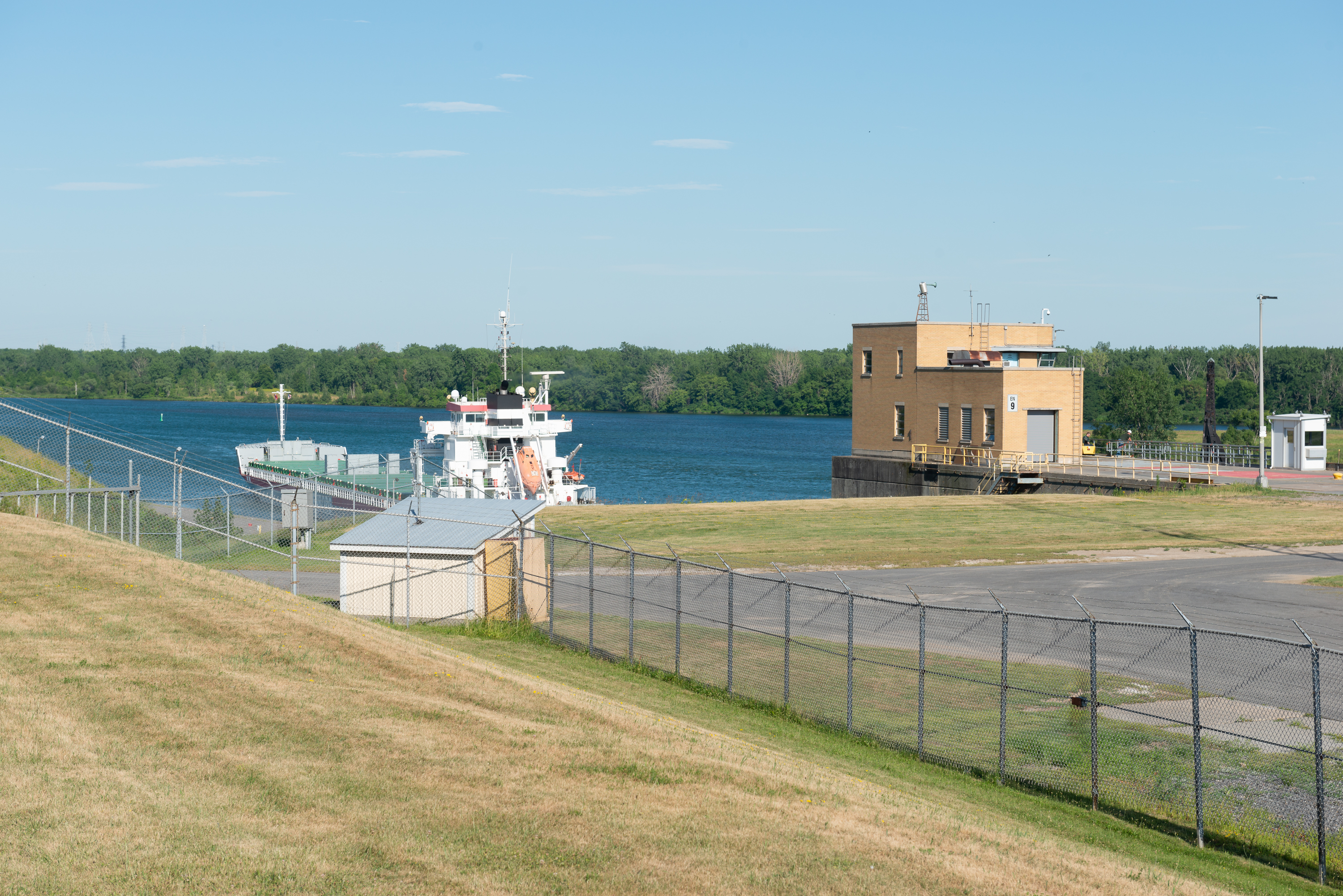
Fred had long wanted to visit the Seaway, having seen the old Walter Cronkite film as a child. (https://www.seaway.dot.gov/explore/video-about-the-seaway) And, of course, having lived in Panamá, transited Suez, and spent time on an English canal boat, we are ALL about canals! But neither of us realized that most of the viewing points for locks are on the Canadian side.  We did however discover that the Eisenhower Locks were next door to the Robert Moses State Park (https://parks.ny.gov/parks/51/details.aspx) and that the park has a campground, right on the Seaway. So we headed there.  As it was close to 5 pm, we headed first to the Park office to see if there was a space available.  Indeed there was and we acquired an electric only space (all that was available) in one of the two campgrounds.  From one of the lookout areas we then watched a ship go through the lock before heading to our campground.

Only the ship’s bridge is still showing over the top edge of the lock.

Leaving the lock and heading towards the Atlantic. The next lock is about a mile downstream, across a small lake.

This was a lovely site, nicely wooded with a path leading to the water’s edge.  Blue approved and went to explore the beach.  Fred looked up the time of the next ship passing the locks and walked out to the water to watch its passage and take a photo or two.

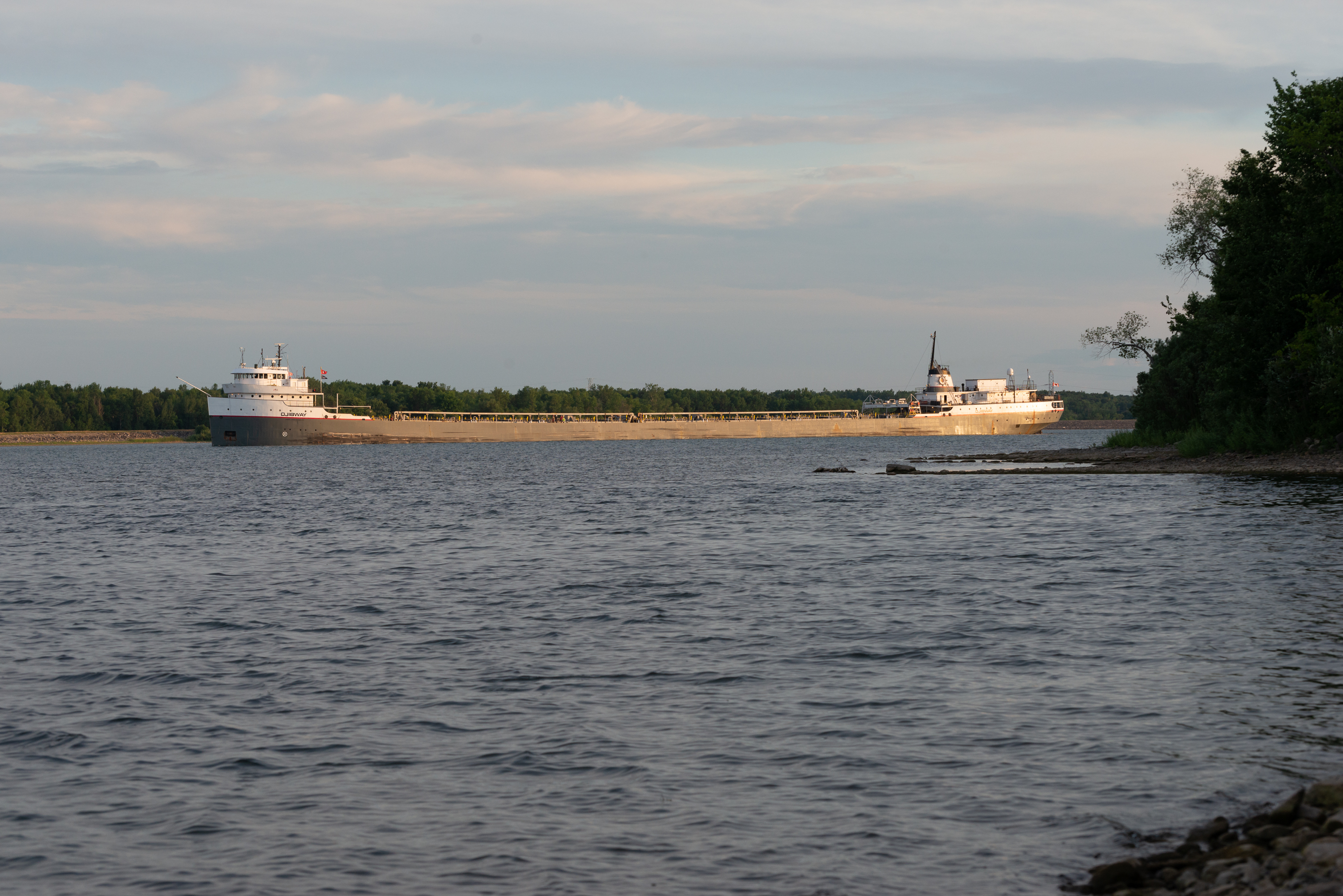
A classic Great Lakes ore carrier came into view.

And lined itself up with the lock chamber.

We knew that the weather was supposed to worsen overnight. And indeed it did.  We awoke to pouring rain and set off to visit the Visitor Center in cloudy, cool weather.  There were no ships due to pass but we enjoyed the film of the creation of the Seaway (the same film that Fred had seen at the cinema once in the 50’s). (https://www.seaway.dot.gov/explore/visitors-center)

We spent the day heading east and then south through New York before stopping for the night in Lake George.  We took a site at the Lake George Battleground State Park campsite, which is right in the center of town.  This made it easy to decide to go out for dinner.  The weather had improved during the day and the sun was shining so we Googled restaurants in walking distance and decided to try what looked like a reasonable Indian restaurant (http://www.tandoorigrilllakegeorge.com/menu.php) just up the road.  We left the skylight in the camper wide open to cool it and with not even an umbrella between us, headed out.  Well, just after we placed our order, the heavens opened and it poured.  Fred raced back to the campground to close the skylight to prevent us having a totally wet bed and drove the truck back to the restaurant, as there was parking available.  Soggy Fred arrived back in time for his dinner and we had a lovely meal before driving back to our site in shining sun again!  The food was so good that we ordered more and packed the fridge so as to offer an Indian meal to my daughter and her family the next night!