Category Archives: Expedition Vehicle Travel

An expedition vehicle is basically a four season capable RV that does not depend on hookups and has 4×4.

Sailing Home

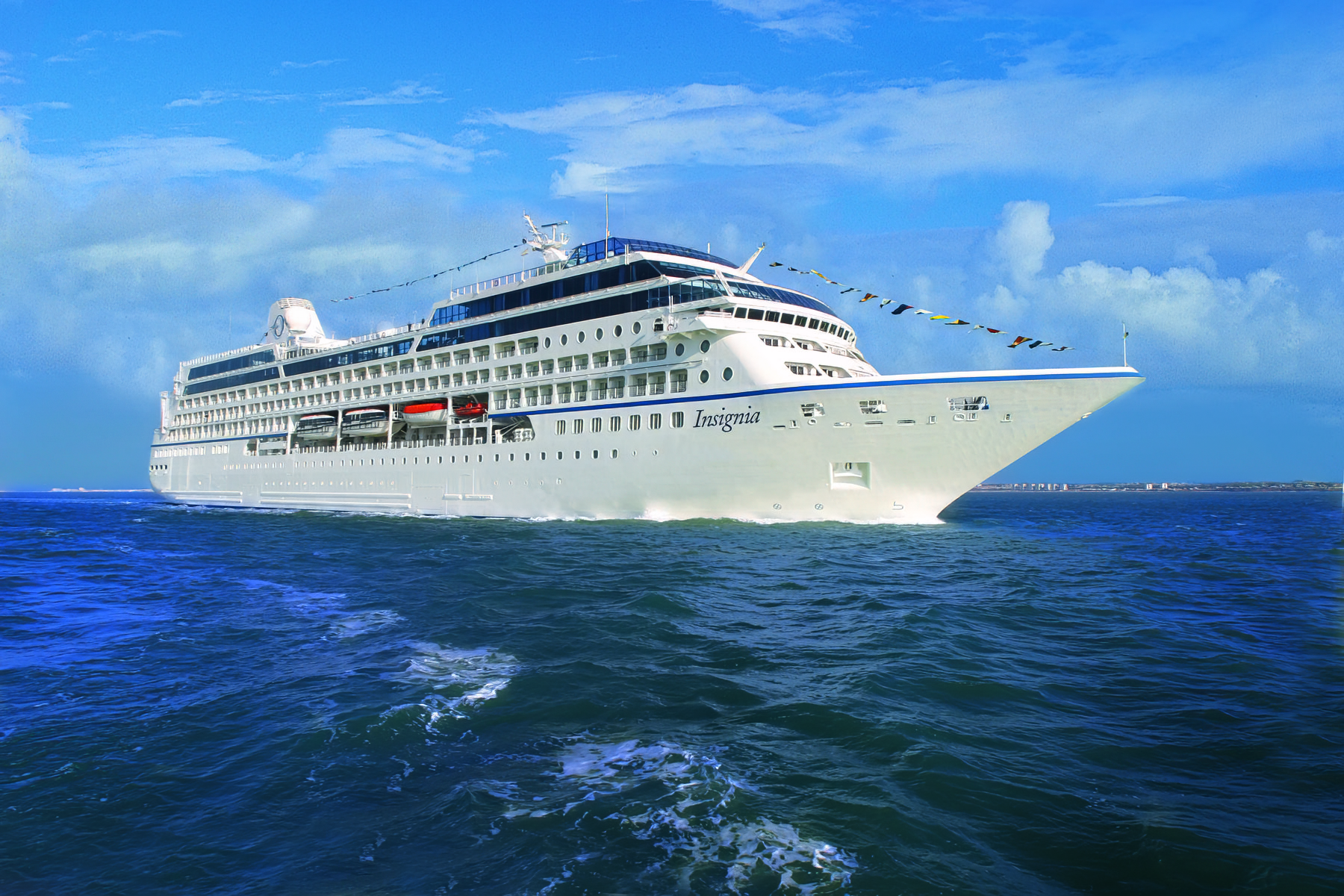
We started the Euro saga by sea and, thereafter, returned to the US on round trip tickets from UK. But these tickets limit the time in the US, so we needed to break the cycle and have more time in the US. We cast around for options. A one way ticket cost almost as much as a round trip, so we decided to try to go by sea. The obvious choice is the Queen Mary, but having been on her twice, she is not our favorite ship. Then Denise had a breakthrough; she discovered an Oceania ship from London to New York, with stops in Ireland and, of all places, Sainte Pierre and Miquelon. (More on this later.) (https://www.oceaniacruises.com) We had never taken a trip with Oceania, but friends of ours love it. The dates worked and so we signed up.

The ship was leaving from Tilbury Docks on the eastern side of London. With the 917 safely parked, and our bags packed, we took the train from Yatton, to Paddington Station in London.  We then managed to meet (always a challenge) the taxi service, which we had prebooked.  Traffic was absolutely horrendous and the 45 miles took about two and a half hours.  We had a rather uninspiring stay at a hotel near the port, before finding another taxi to take us to the port, the next day.

The Tilbury terminal turned out to be an old port, newly refinished, and perhaps most famous as the landing port for the Windrush immigrants. (https://www.bbc.com/news/uk-43782241) And we would never had heard of these folks were it not for an episode of Call the Midwife.

Boarding was easy and we sailed that evening, following a car/truck ferry down the Thames.

Click on the photo; it was dark and these things are amazing to look at.

After dark we sailed past a mysterious set of towers in the river. The Maunsell Forts were built to keep the Germans from laying mines and to provide a platform for anti-aircraft guns. It appears that we passed the Red Sands fort. (https://en.wikipedia.org/wiki/Maunsell_Forts)

After the war, they fell into disuse and some were used for “pirate” radio stations back when the UK did not permit private radio stations. I remember listening to “wonderful, Radio London” back in the summer of 1967.

The next morning, we were in Bruges. (OK, Zeebrugge, to be exact.) We chose not to go ashore, as we had visited Bruges a couple of weeks previously and frankly wanted a day to recover from putting the camper in storage, multiple train and taxi trips, and the rest. (https://diplostrat.net/2024/07/24/more-horses/) We caught up with the Yasmine, the ferry we had seen leaving London and watched a nifty dredge busy deepening the channel and, in the process, delighting all of the hungry sea birds.

Dinner is served!

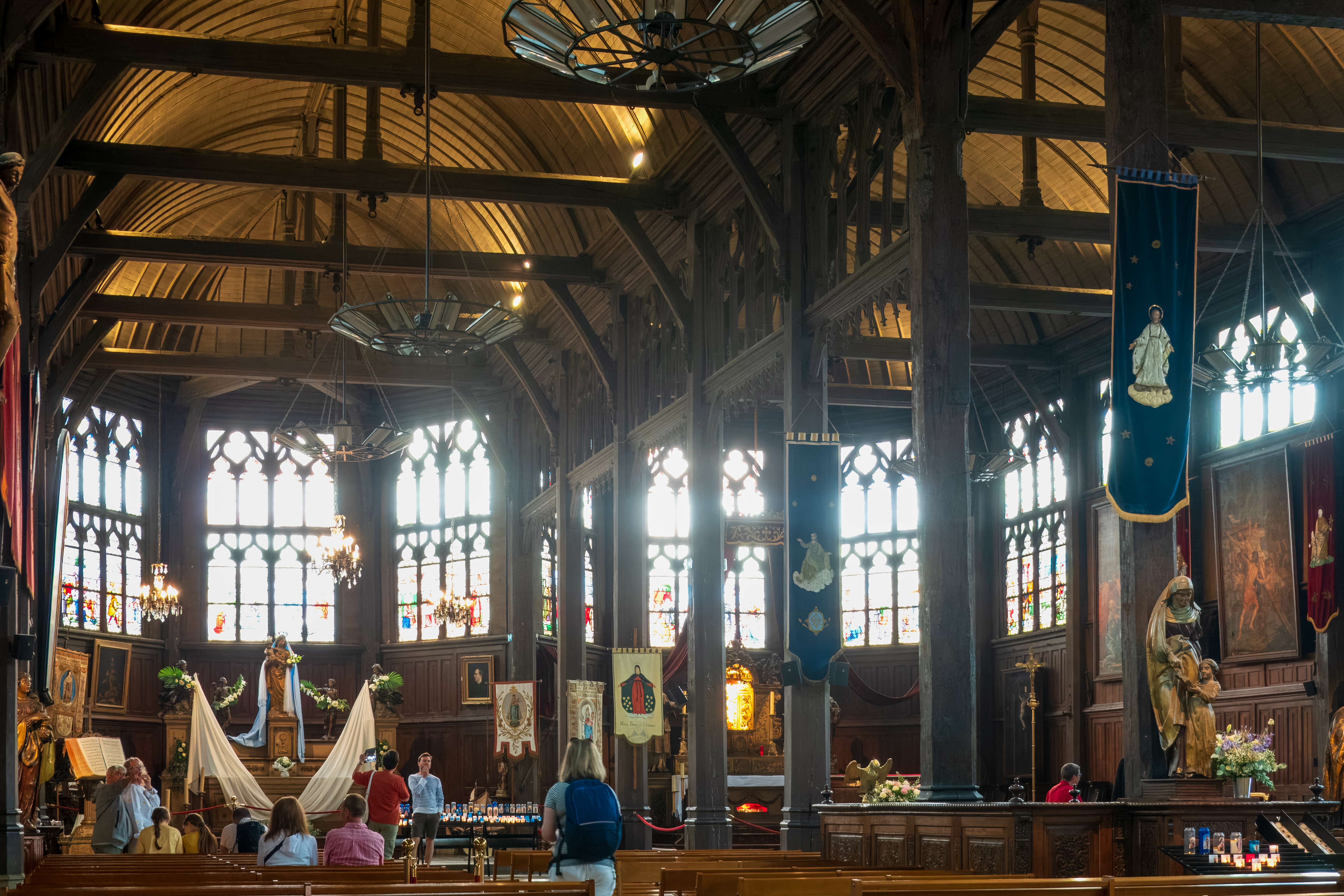
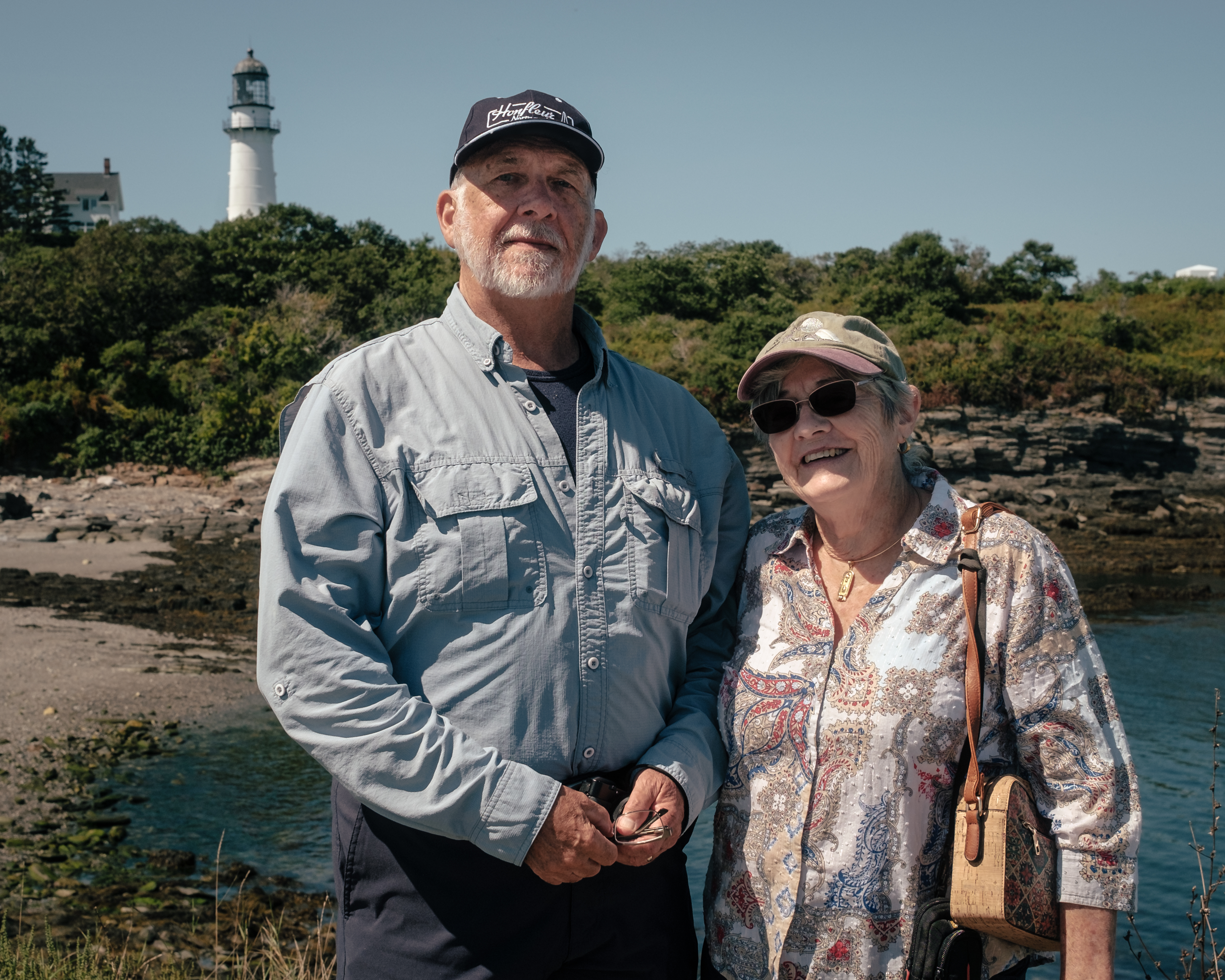
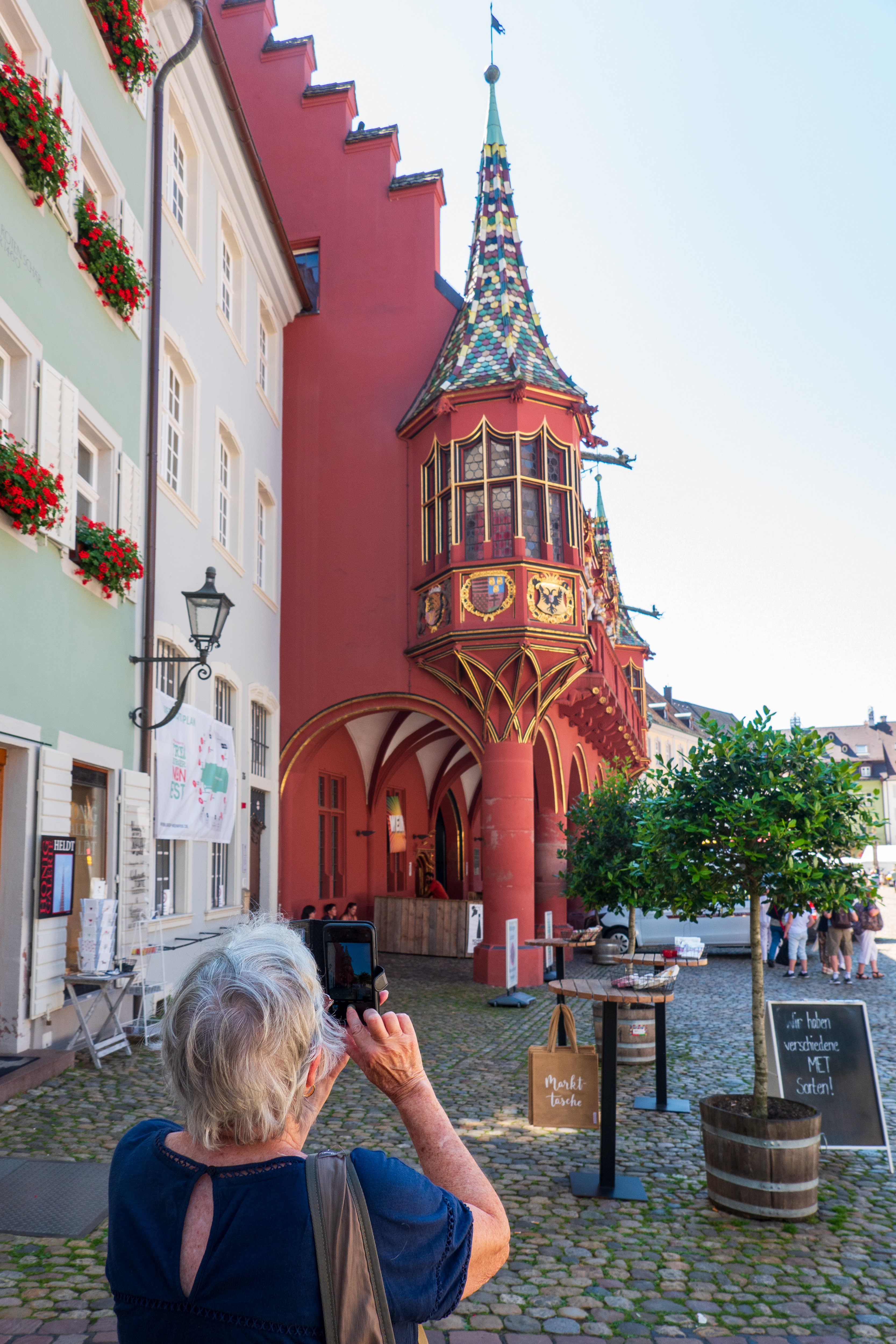
The next stop, Honfleur, in France, turned out to be an unexpected gem. Honfleur is a charming historic town with a lovely old port, right across the river from the much bigger port of Le Havre. (https://en.wikipedia.org/wiki/Honfleur) It was an easy shuttle ride to town where the bus stopped in the middle of a HUGE aire – campers as far as the eye could see. We, of course, set off in search of coffee and a croissant, which we enjoyed overlooking the little harbor basin.

We had managed to pack one electric toothbrush motor, but no brushes. After a quick visit to a pharmacy to acquire the last brush in the store, we raided a chocolate factory for gifts and set out to visit the very old church.

The bell tower is actually across the street from the church.
St. Catherine’s Church, in the form of a market hall or two ship’s hulls.
Largest wooden church in France, all timbers cut by Norman axemen. No two the same length.
One of my favorites; I love the view of the music and the performance notes.
Cow piss. Be sure to sample local treats!
The basin was very scenic.
And the kids were there sketching and painting.

The ship then headed for Ireland where the weather proved to be very Irish, at least in Dublin.  The expression is, I believe, “a soft day”.  It was a bit misty and moist but we had a super afternoon at the University of Dublin.  We had prebooked a visit to the University to visit the Book of Kells.  First we had an excellent tour of the university campus.

The Campanile under repair. Legend has it that bad things happen to students who walk under it.

Then we entered the exhibition of the Book of Kells. (https://en.wikipedia.org/wiki/Book_of_Kells) The exhibit included history and explanations of the creation of the book, why it is in Dublin, and culminated in seeing the book itself.  (https://www.visittrinity.ie/book-of-kells-experience/) It is quite beautiful. 
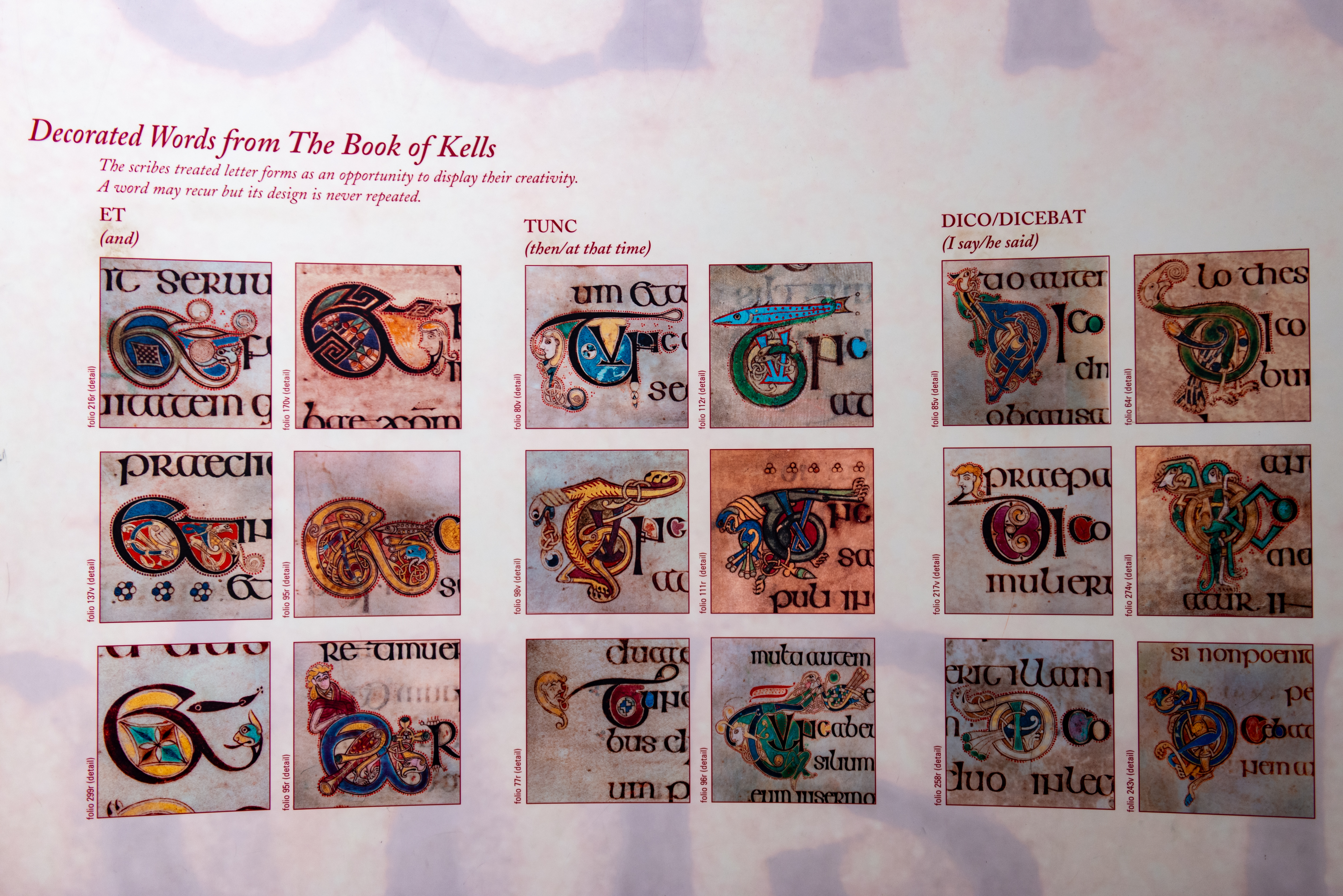
Does your word processor have this font?


This video exhibit was very pretty. Not sure we understand the point of the decorations floating away, but it is spectacular.

The Library was itself spectacular, even though a lot of the books had been removed so that the library could be renovated. How long would it take to read all of those books? And most are ancient originals. (The dust alone might be fatal!)

But enough books remained in the stacks to give you a good idea of the tremendous scope. The library also contained the harp of Brian Boru. (https://en.wikipedia.org/wiki/Brian_Boru)

We wished we could have had a second day in Dublin to visit some of the other museums, specifically the emigration museum.  We may have to return!

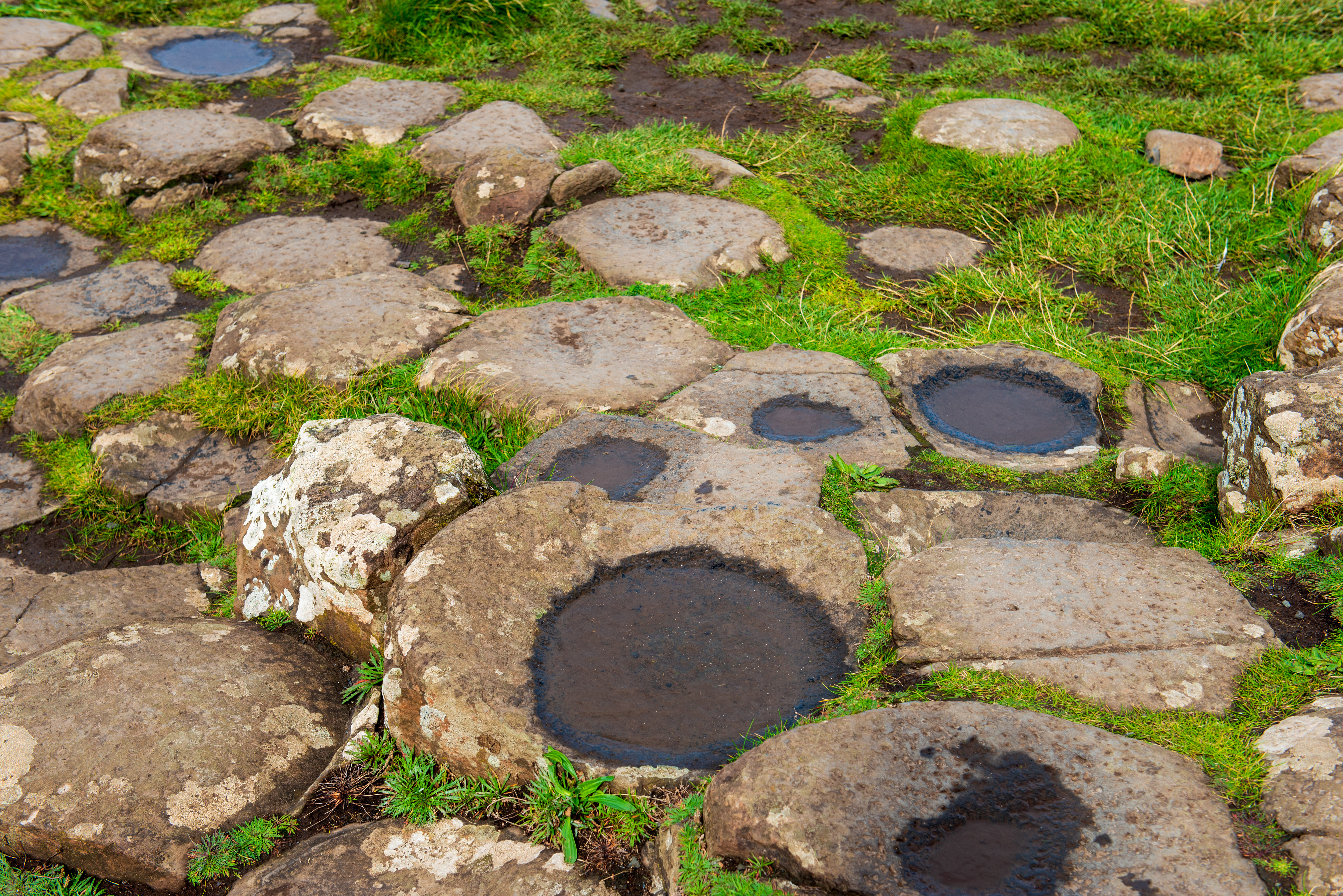
And on to Belfast where we had booked a trip to the Giants Causeway. (https://en.wikipedia.org/wiki/Giant%27s_Causeway) Denise had long wanted to see the “causeway” and we were delighted to get the chance. We passed on the Titanic displays.
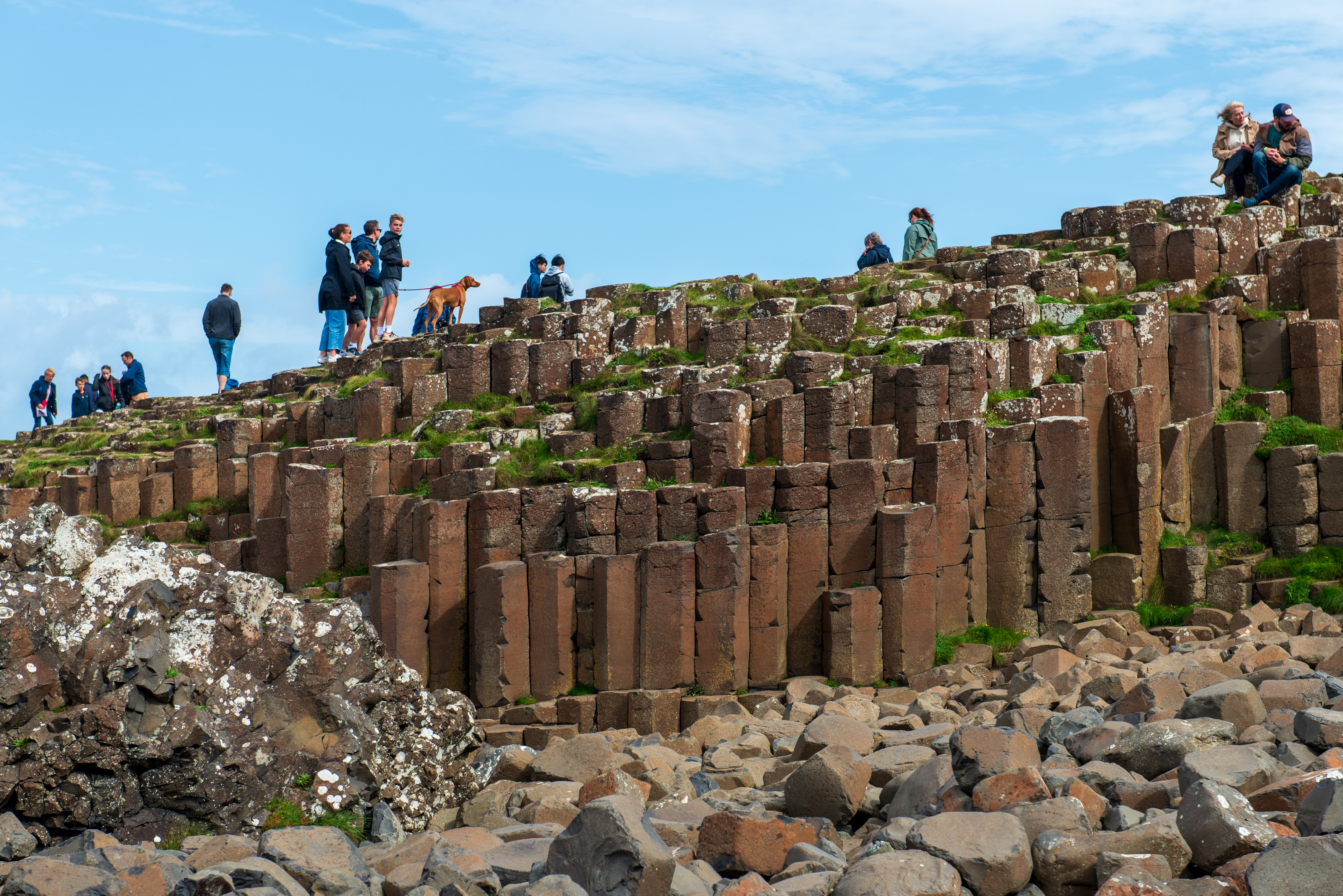
Where the basalt had not yet eroded, the columns looked like stepping stones.

The views from the bus were spectacular and walking down to the Causeway and back to the visitor center was interesting (and good exercise).  And it did not rain!

Sailing out of Belfast, we passed a familiar sight, a Viking ship, a twin of the ship that we took to Europe back in 2023.
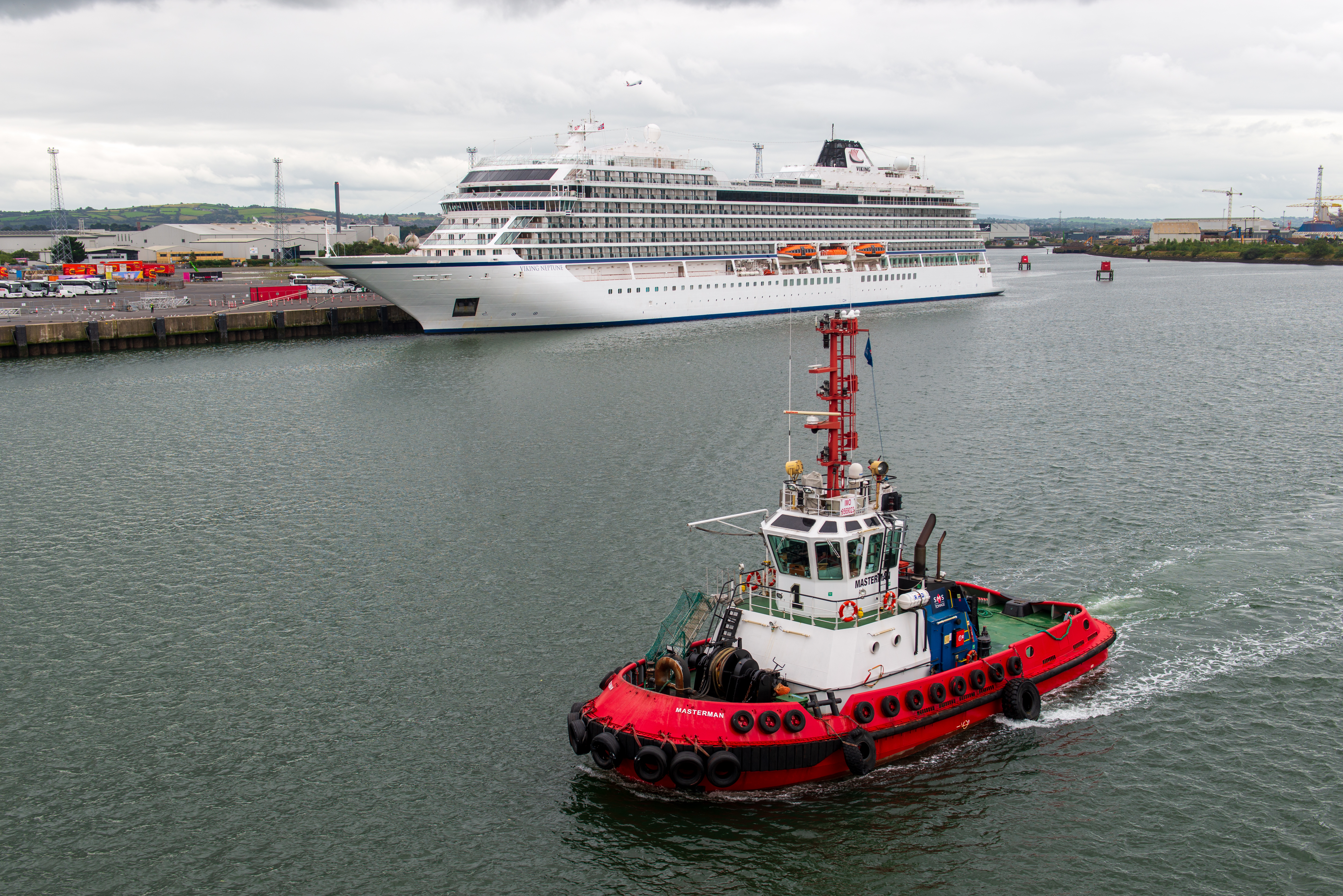
We first saw these pivoting tugs back in the Panama Canal in the 1970’s. They have a central dive system that allows them to push or pull in any direction. Something like this: https://en.wikipedia.org/wiki/Voith_Schneider_Propeller

The final stop in Ireland was in Killeybegs, which no one on board had ever heard of.  We certainly had not.  We went ashore and found a coffee shop, and enjoyed a walk around the very small fishing town. Small as it was, it made one person very happy; we helped him find a cell phone store which actually had a cable that he had not been able to find!
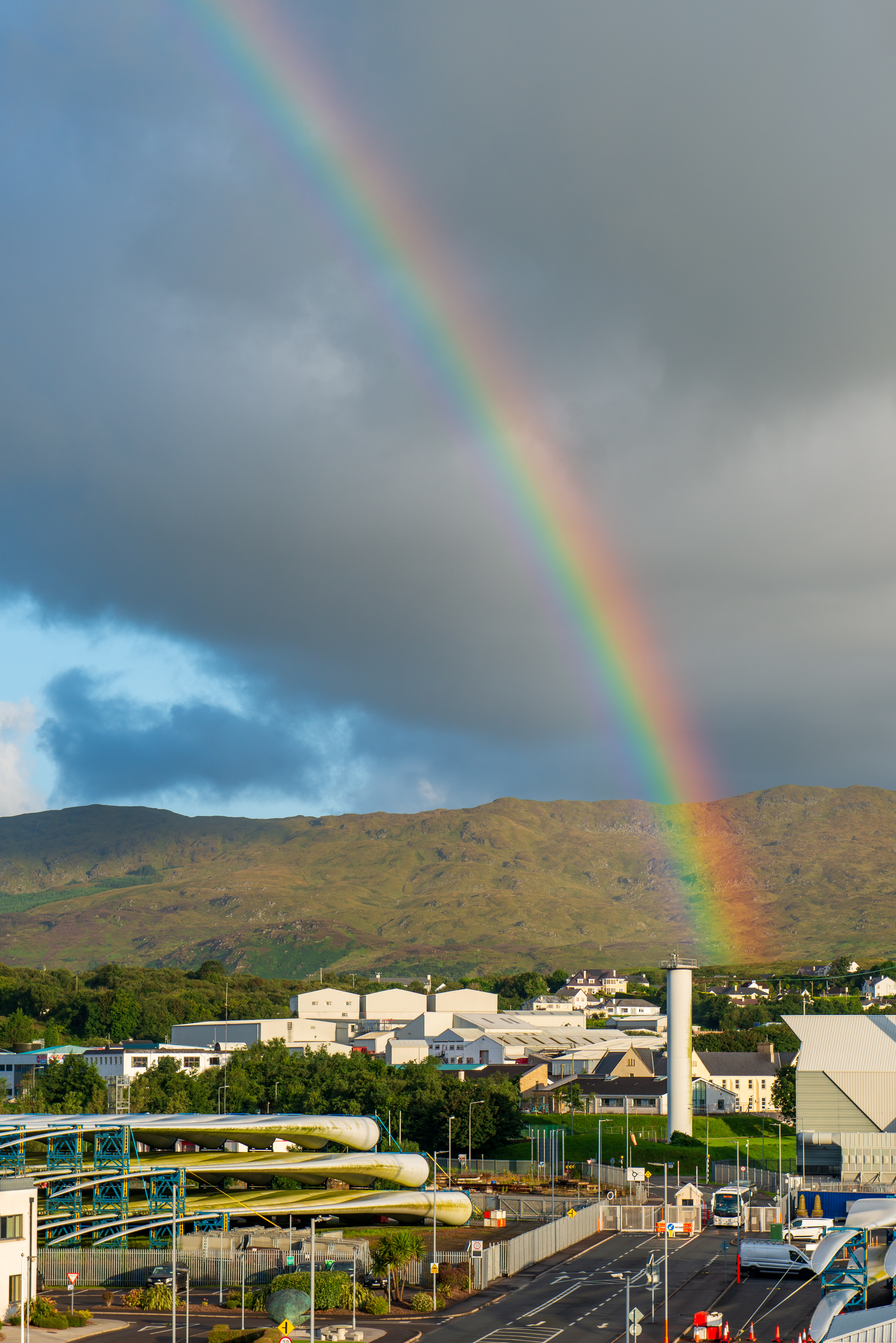
The Chamber of Commerce went all out, welcoming us with a beautiful rainbow.
The waterfront and the harbor were bustling with activity.

We then set off across the Northern Atlantic.  It was a lot rougher than we expected (it was August) and the Insignia, originally designed to sail the Caribbean, did not do well in rough seas.  In fact, we were obliged to miss our next stop in St. John’s, Newfoundland because our speed had to be reduced to keep passengers safe.  We all regretted this. (We learned that several other ports had been cancelled on the way over to UK.) So we held on tight and enjoyed our days at sea, pleased that we did not need the ubiquitous seasickness bags, scattered everywhere about the ship.

Atlantic Dolphin, pretty but distant.
Obligatory sunset photo.

There is a small archipelago of some eight islands off the coast of Canada and these islands are actually a part of France; a self governing territory that sends a representative to the National Assembly. And the story of how this came to be is even more fascinating and convoluted, turning on wars, Cod fish, Al Capone, and involving one of the largest and strangest submarines ever built. You can’t make this up: https://en.wikipedia.org/wiki/Saint_Pierre_and_Miquelon) We skipped the shuttle and walked into town, admiring the views of the harbor.
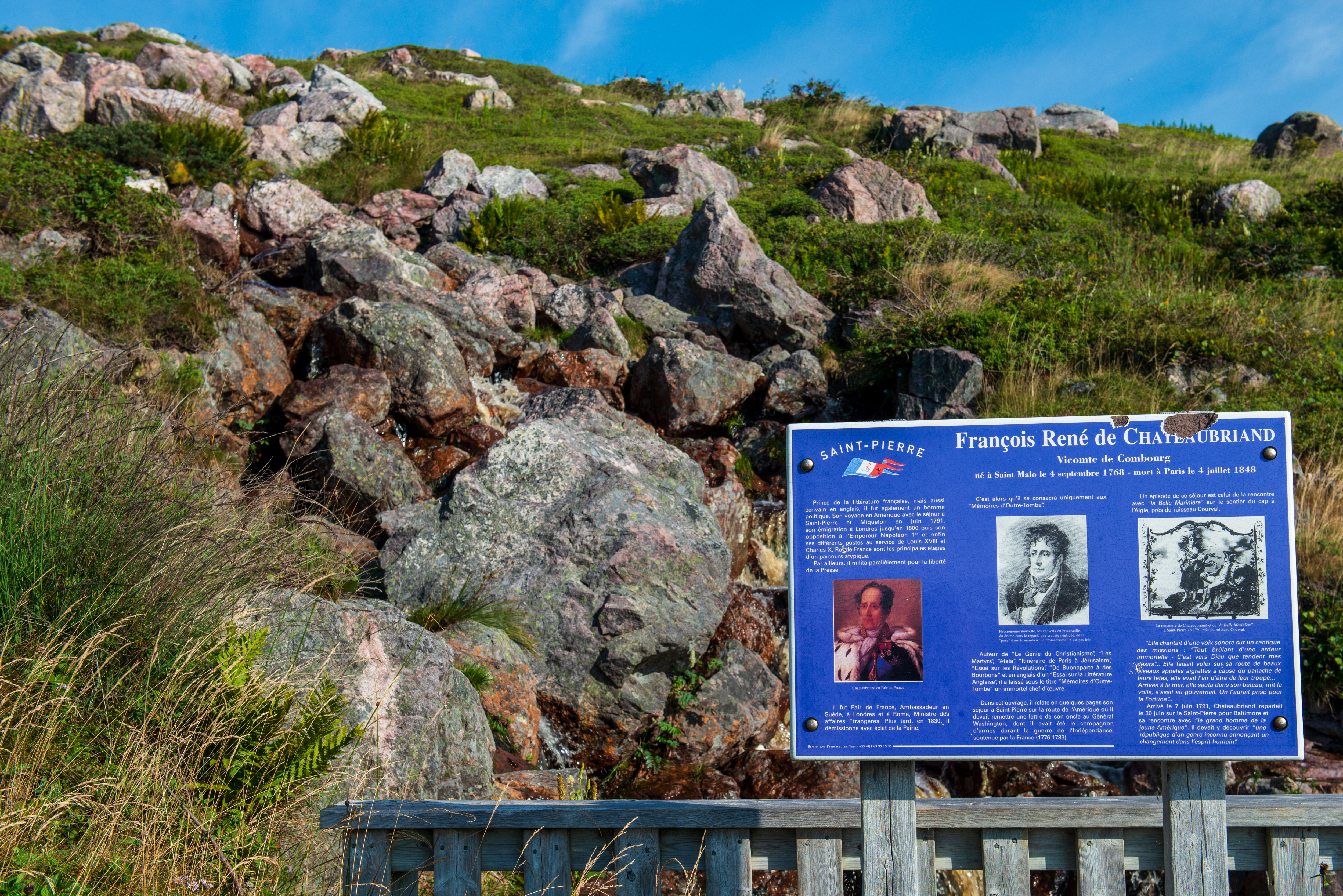
We were not the first tourists to pass this way.
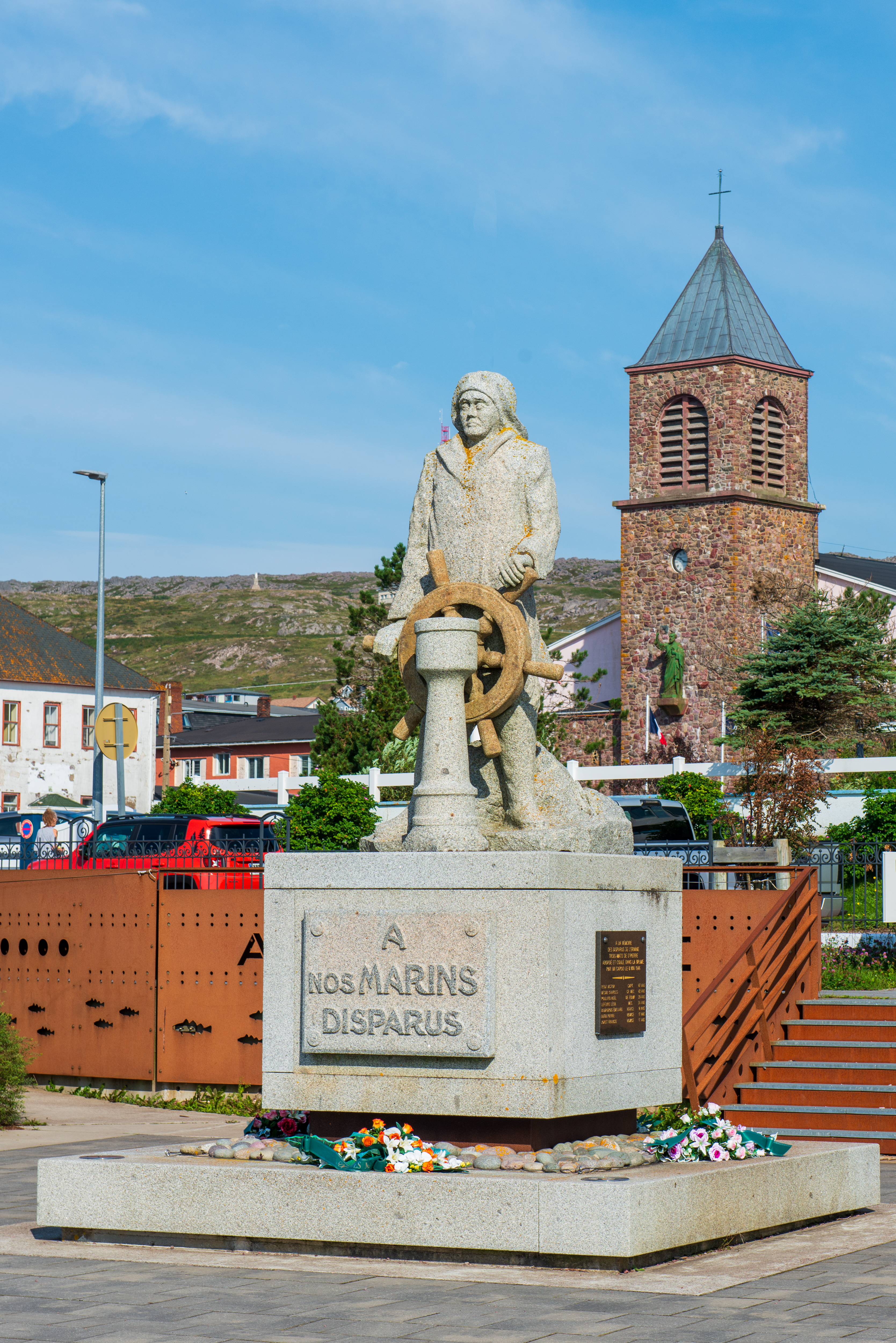
Memorial to lost sailors.
Cannon on the waterfront.

We wandered the scenic town and had a last galette lunch from a food truck. We also visited the little museum with neat prohibition exhibits. Fortunately, the weather was glorious. And then it was off to the Isle-aux-Marins, a mostly uninhabited island in the harbor. (https://en.wikipedia.org/wiki/Île-aux-Marins)
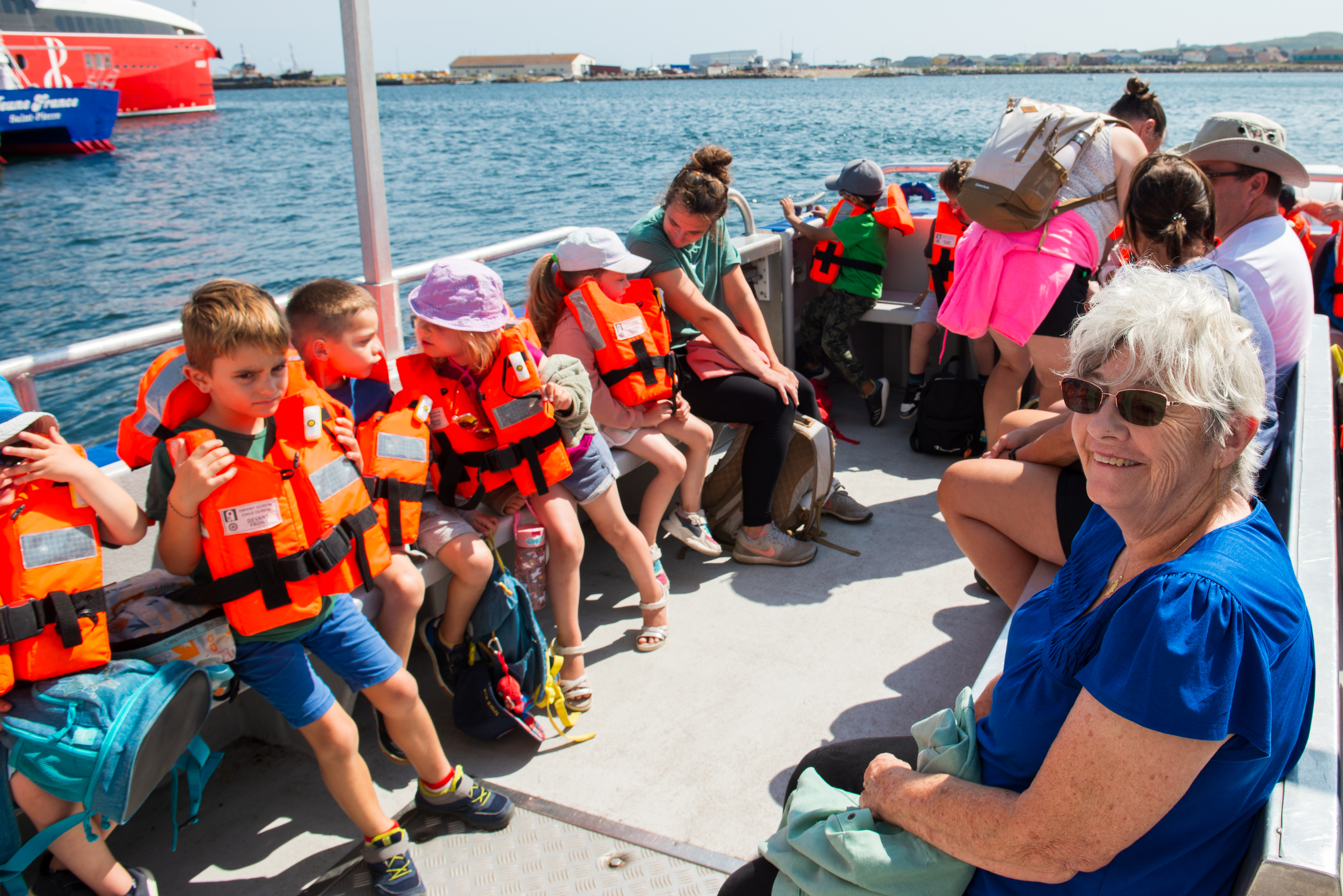
Denise herding school children on the ferry to the Île-aux-Marins.
The Insignia seen from the Île-aux-Marins.

We visited the museum on the island, which included relics from the wreck of the German cargo liner, the Transpacific. (https://thehoworths.com/2015/08/wreck-of-the-transpacific/)
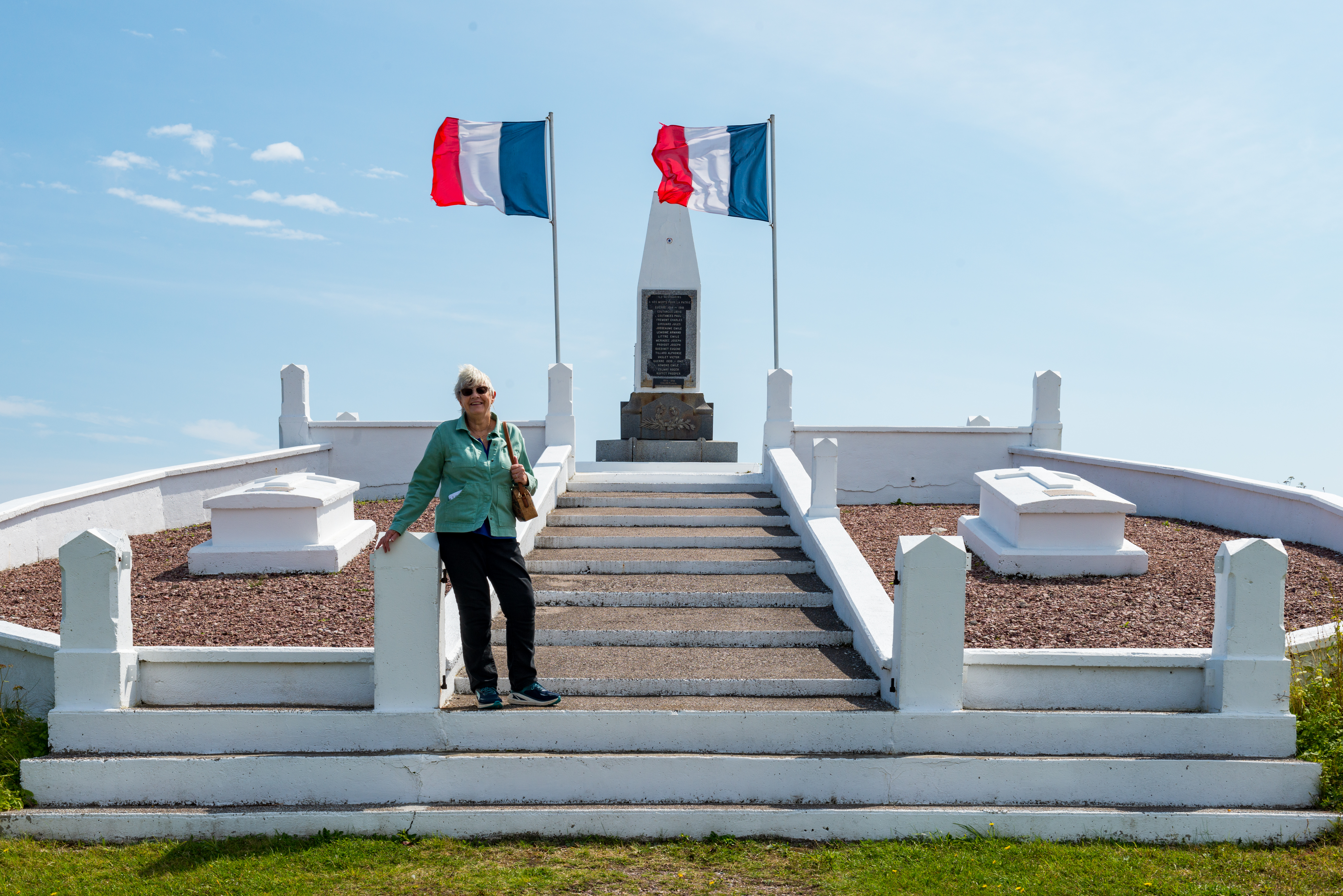
War memorial on the island.
Ship’s bell china, and a jukebox!

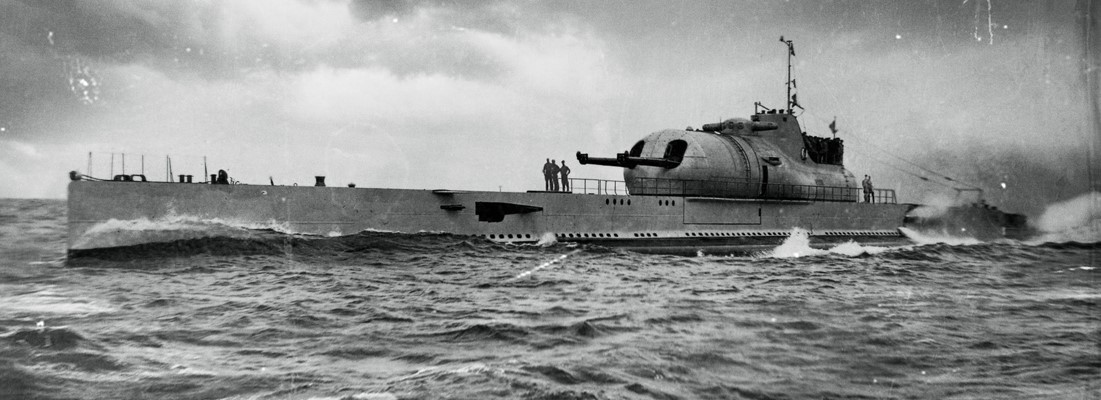
And that submarine? Meet the Surcouf! Yes, those are eight inch guns – the same size as a US heavy cruiser. She even carried a spotter aircraft. She sat so low in the water that her range finder was only good to about 10,000 yards. Insane! Read more here: https://www.silverhawkauthor.com/post/french-cruiser-submarine-fs-surcouf-nn-3-lost-18-feb-1942
And back to the ship to sail for Portland, Maine.

We were met by old friends, Tiger camper owners, and photographers. They swept us up and entertained us all day – lunch, views, history, we did it all! (https://www.stonecoastphotography.com)

Fred’s father had been the officer in charge of the US Navy “armed guards” on a Liberty ship during World War II. They manned the guns. (https://en.wikipedia.org/wiki/Liberty_ship) Like many veterans, he rarely talked about his experiences, so there is a huge gap in family lore. It was fascinating to visit the site where so many Liberty ships, the ships that won the war, were build and launched.

Replica of a bow, with the forward gun tub.
The display is located right on the site of some of the original slipways where the ships were built.

Maine sea food. Everyone else had the same idea on a pretty day.
My horn’s louder than yours. A lot louder! A reminder that the weather can be dangerous in Maine.
Looks so much cooler when a pro does it!
Nifty rocks that look just like petrified wood.
We had last camped with Knapp and Ella (and hound) in 2016 at the Tiger Rally outside of Leadville, Colorado.
Fred’s take of the classic Portland light.

We stayed on board in Newport and the next day, arrived in New York. We sailed up the river at daybreak to dock at almost the same pier where Fred first left the United States back in 1955. Been a long, strange trip to come full circle.
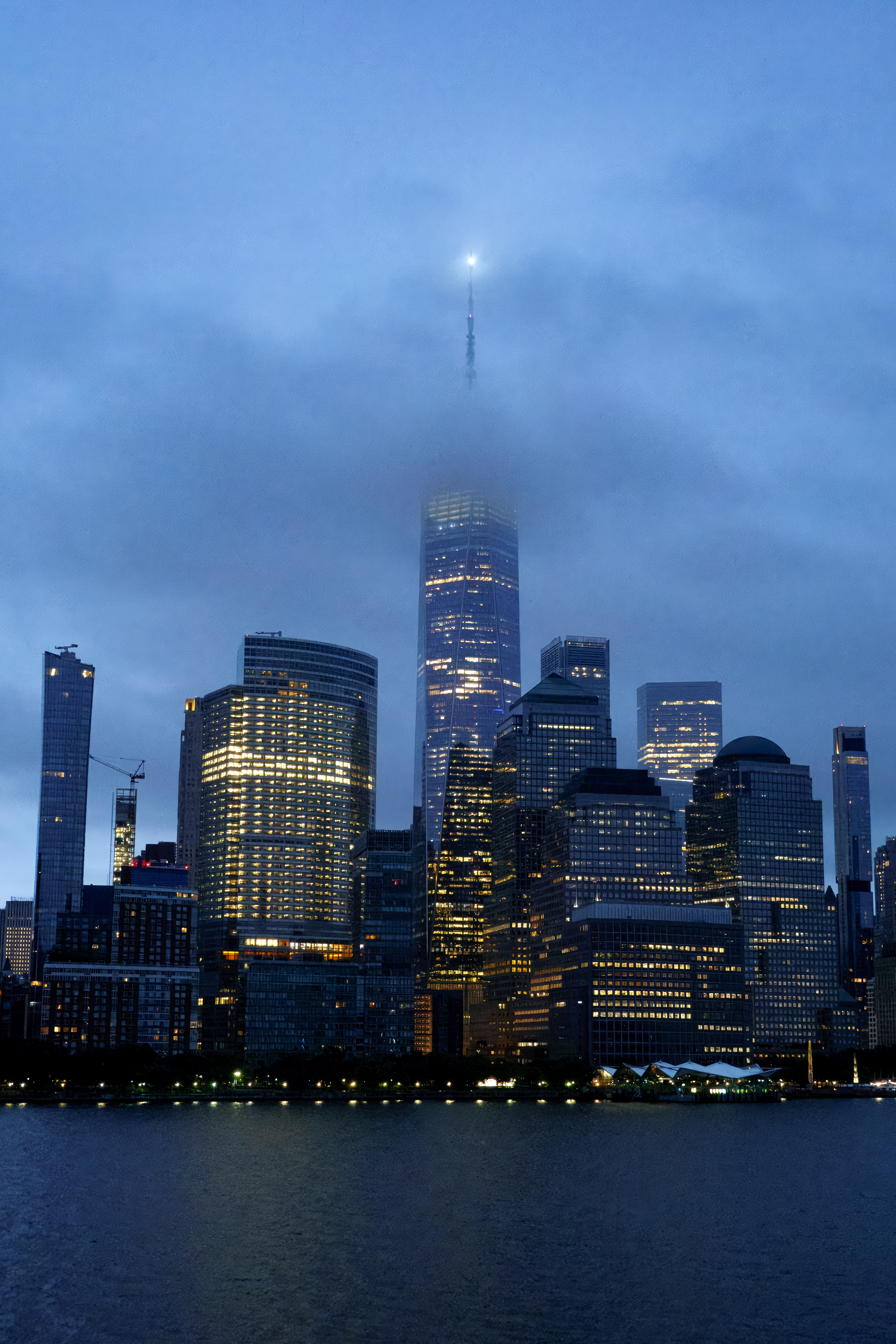
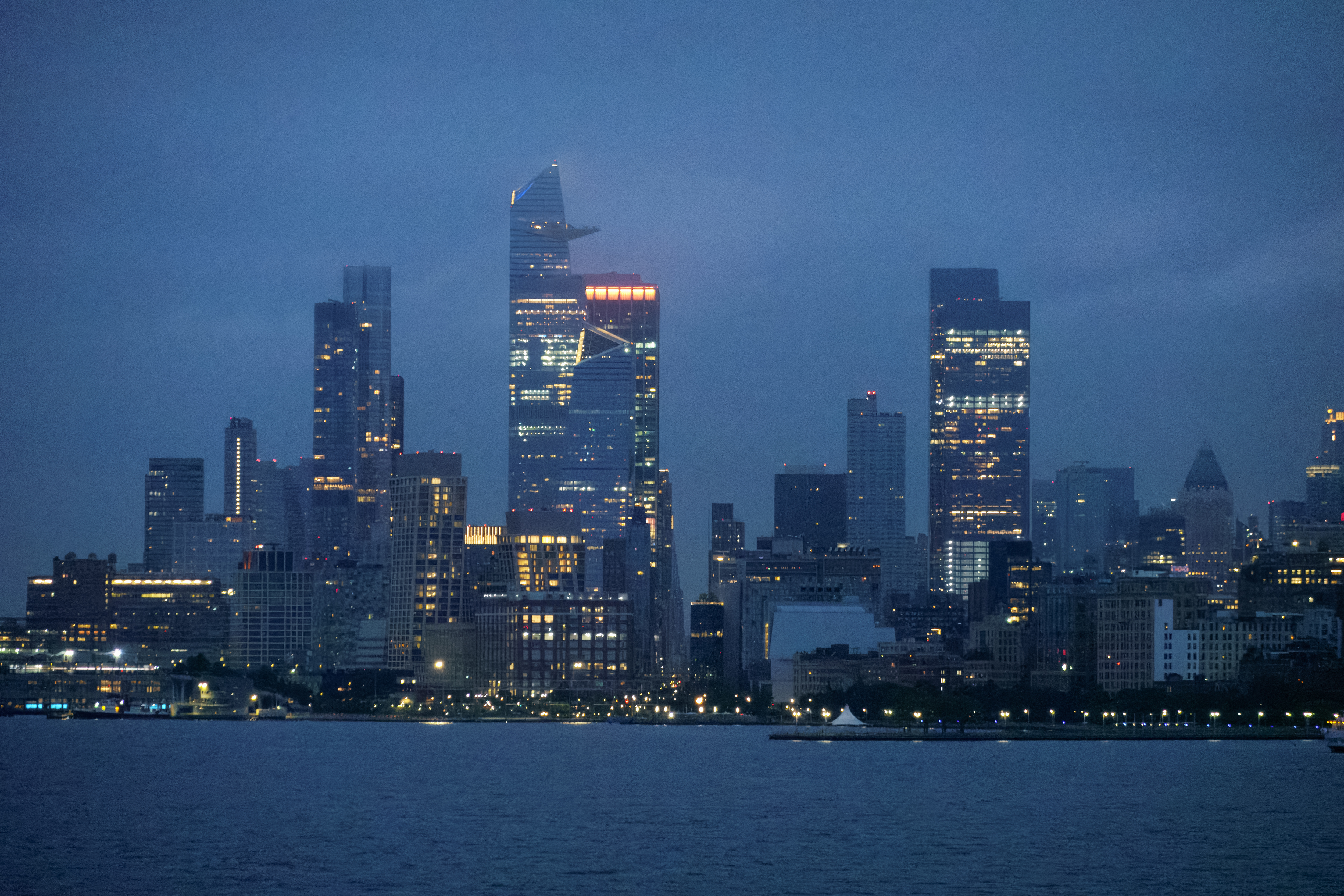
Manhattan from the Hudson.

Fred first left the US, bound for New Delhi, via Beirut, on one of the Four Aces, the S.S. Exeter. The ship with the yellow stacks in the picture below, is either the S.S. Constitution or the S.S. Independence, American Export Lines ships, tied up at the same pier. The Cook family later used these ships for home leave travel from Naples to New York.
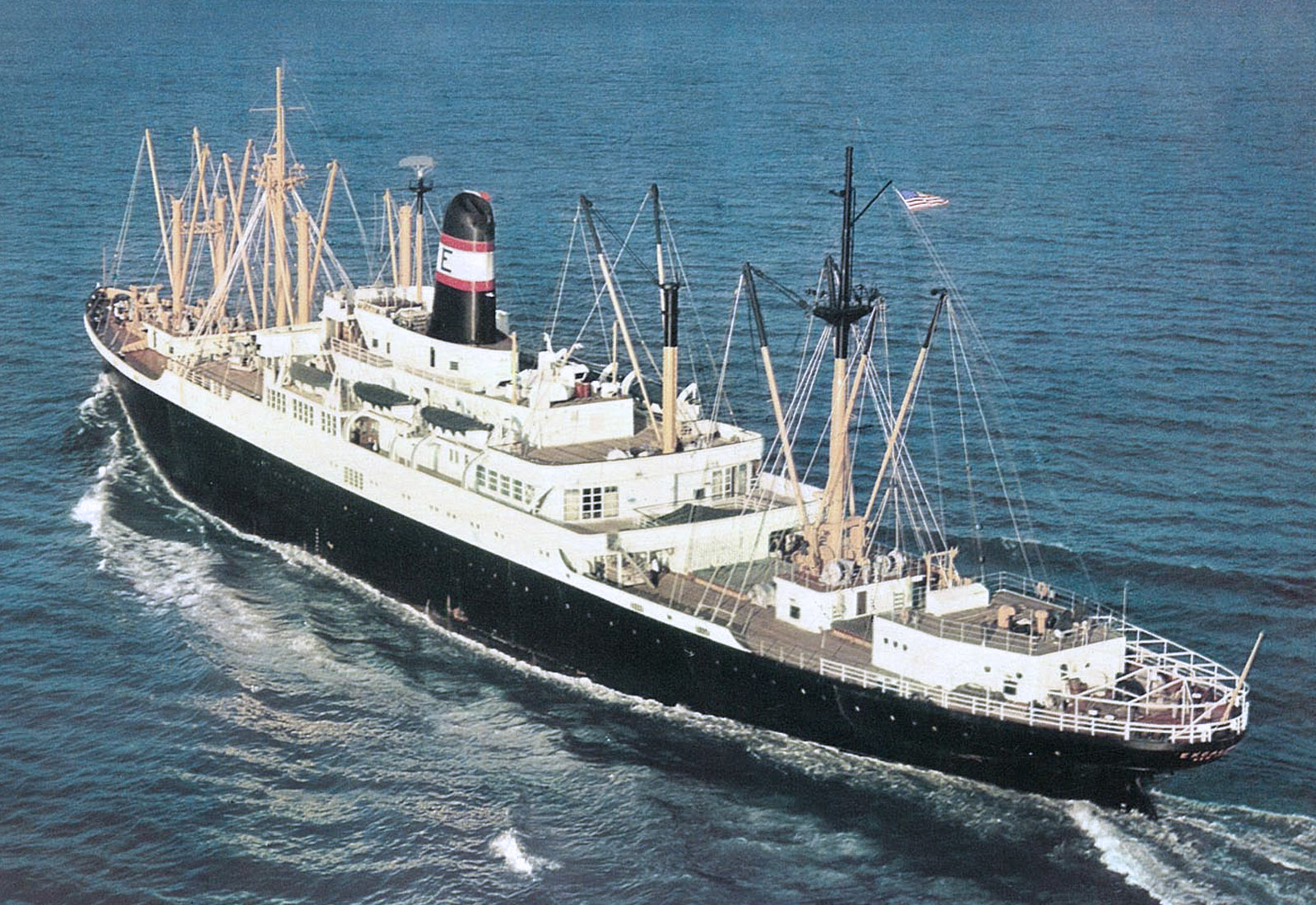
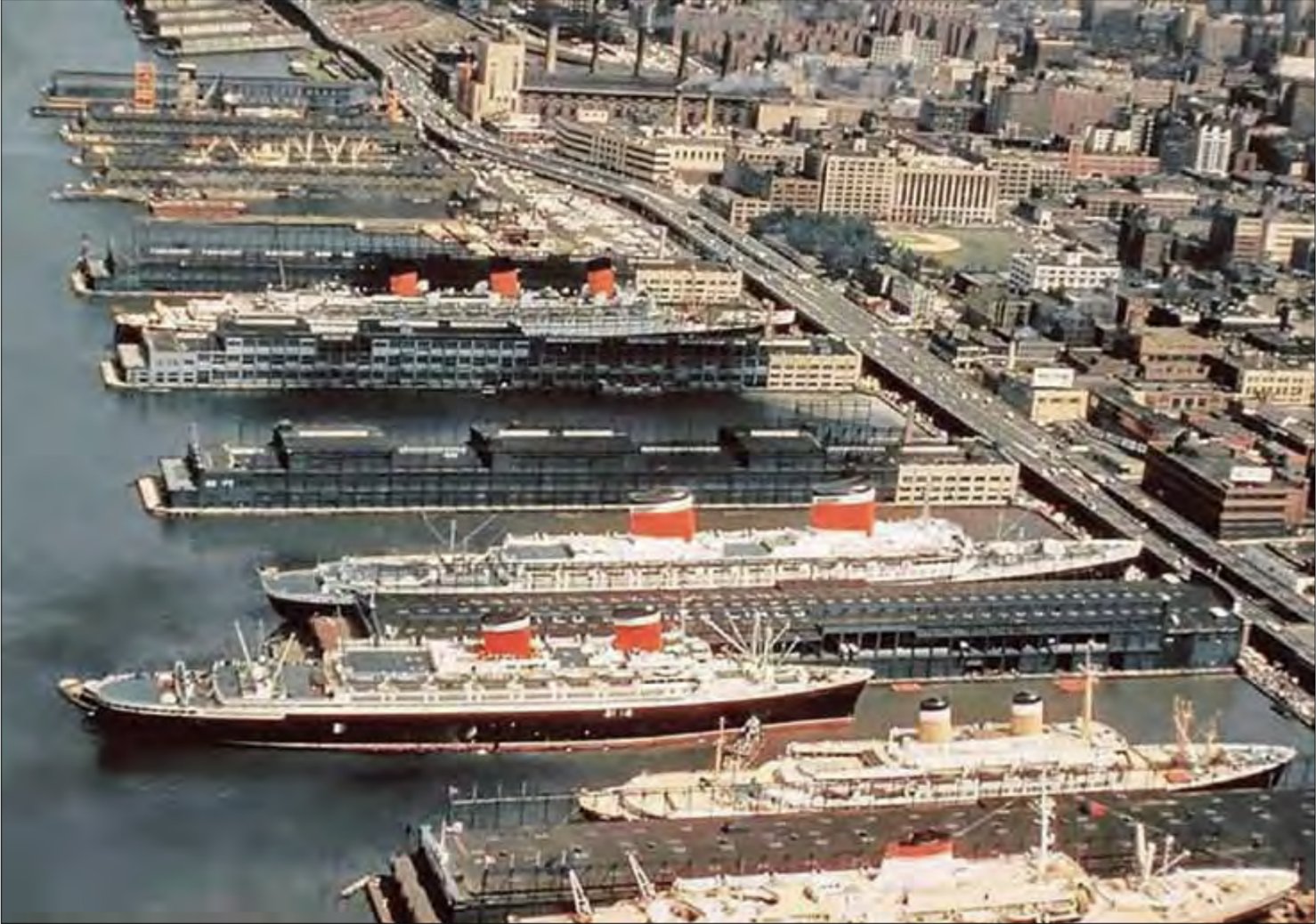
S.S. Exeter
Busy day on the Hudson. Everyone is in town. How many of these classic ships can YOU name>

We hopped on the Acela for Washington and, in a few hours, collapsed at home.

Wipers

Ypres can be pronounced at least three ways, and spelled at least four ways, in Flemish, French, and Cockney. After the horrific losses in the Great War, the British and the Commonwealth own the town, and so we went with the Cockney pronunciation – “Wipers.” Back in the day, it was probably preceded by at least one unprintable epithet. We went to Ypres to visit the historic sites.

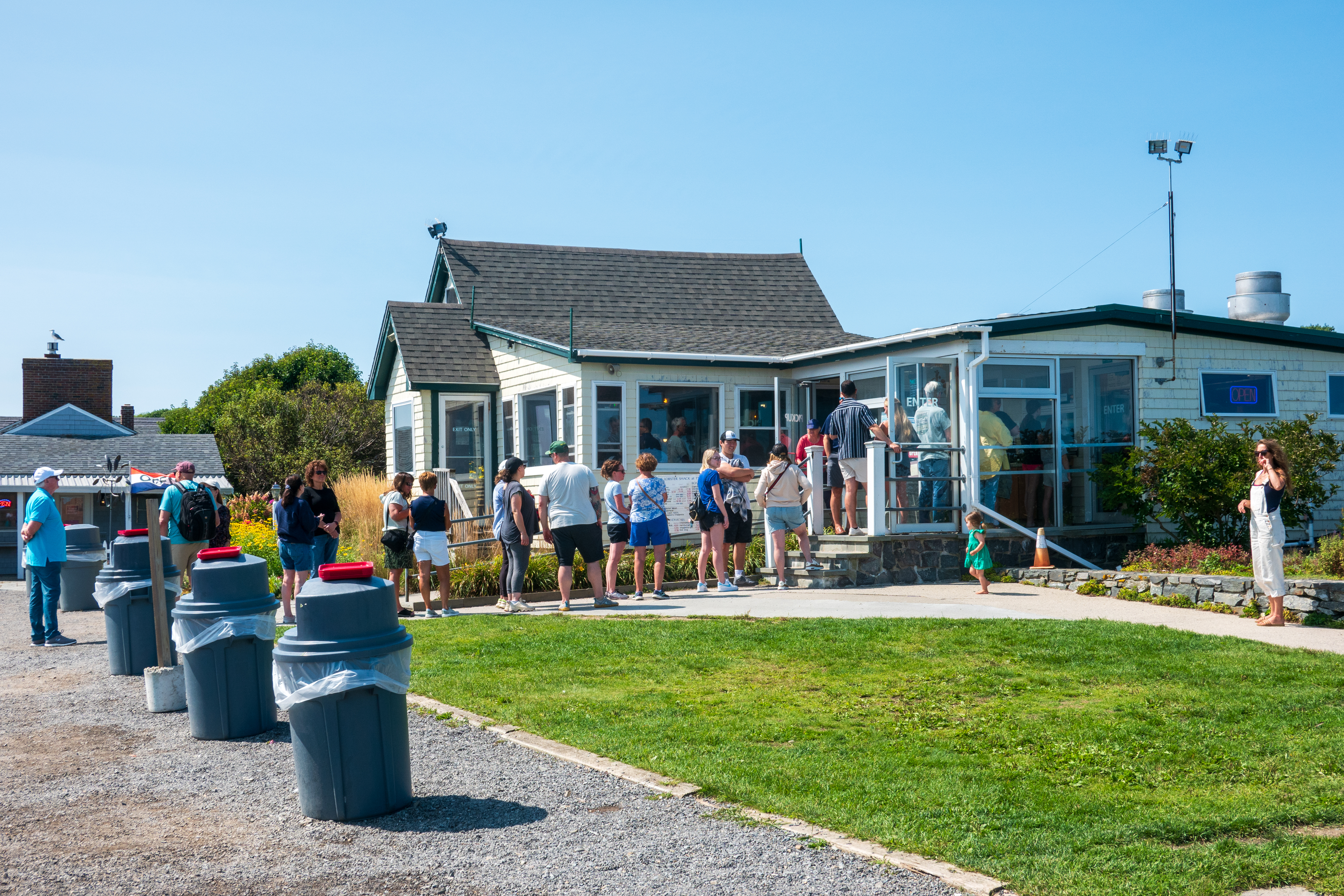
En route to Ypres from Bruges, we stopped at a most interesting Aire in the parking lot of an ice-cream factory/restaurant. Ice cream AND a restaurant AND free camping ? A triple threat! (https://smart-ijs.be) Shows up as a “farm” stay on Park4Night! We enjoyed an ice cream on the day we arrived.

Basic gravel lot, but each site had electricity and the dump station was better than most campgrounds.

The next day, we cycled into the nearby towns of Wingene and Egem.

See food truck to the left.

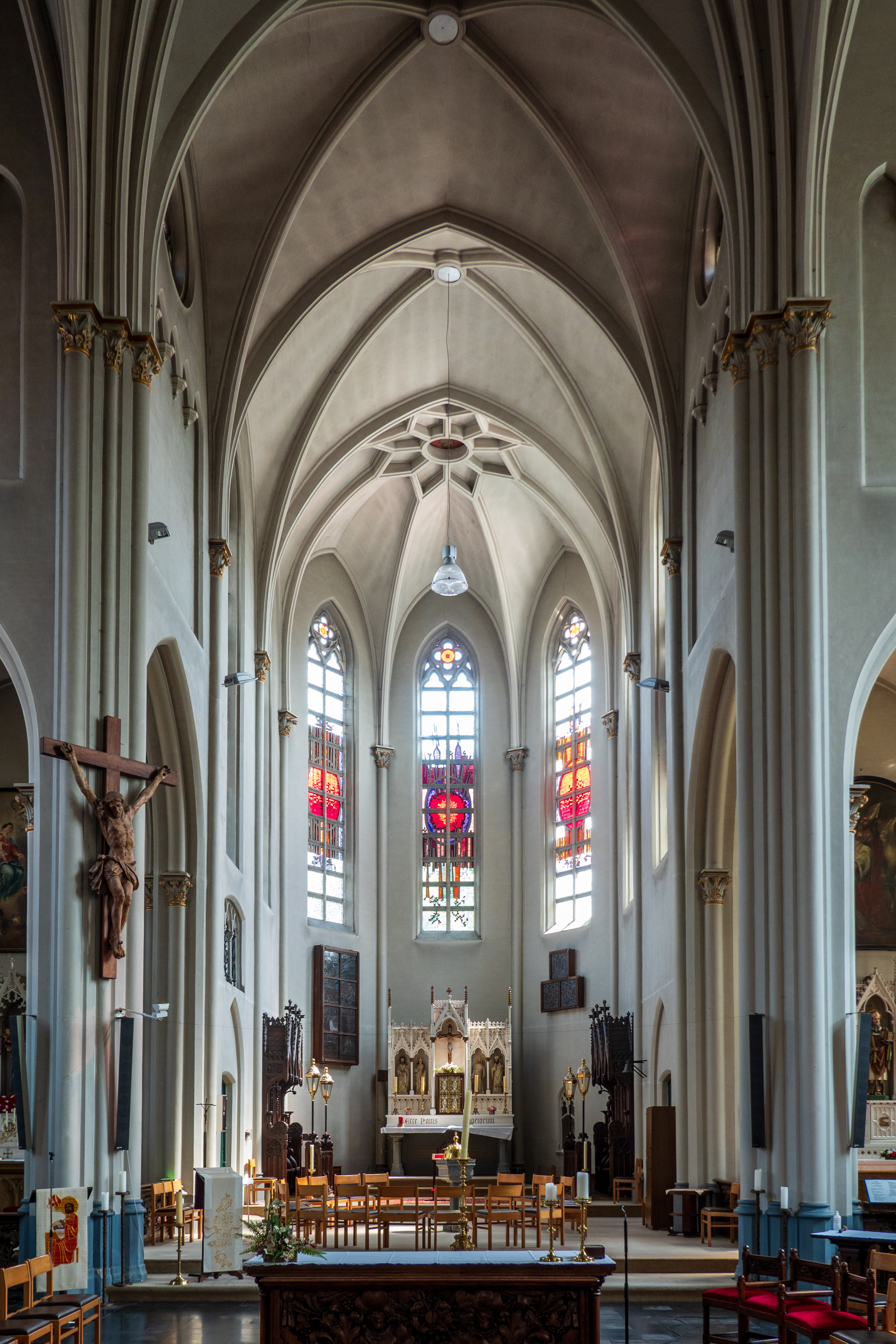
The Egem church is not on any tourist route, but it is, in fact, very pretty. After visiting the church, we decided to skip the sandwiches we had bought for lunch and wandered over to a food truck. The local butcher was having work done on his shop, and was selling from his truck. We found bitterballen (https://en.wikipedia.org/wiki/Bitterballen), a favorite, and then Fred decided to have a hamburger and of course a few Belgian fries. Great fun! (The sandwich did get eaten the next day – nothing goes to waste!)

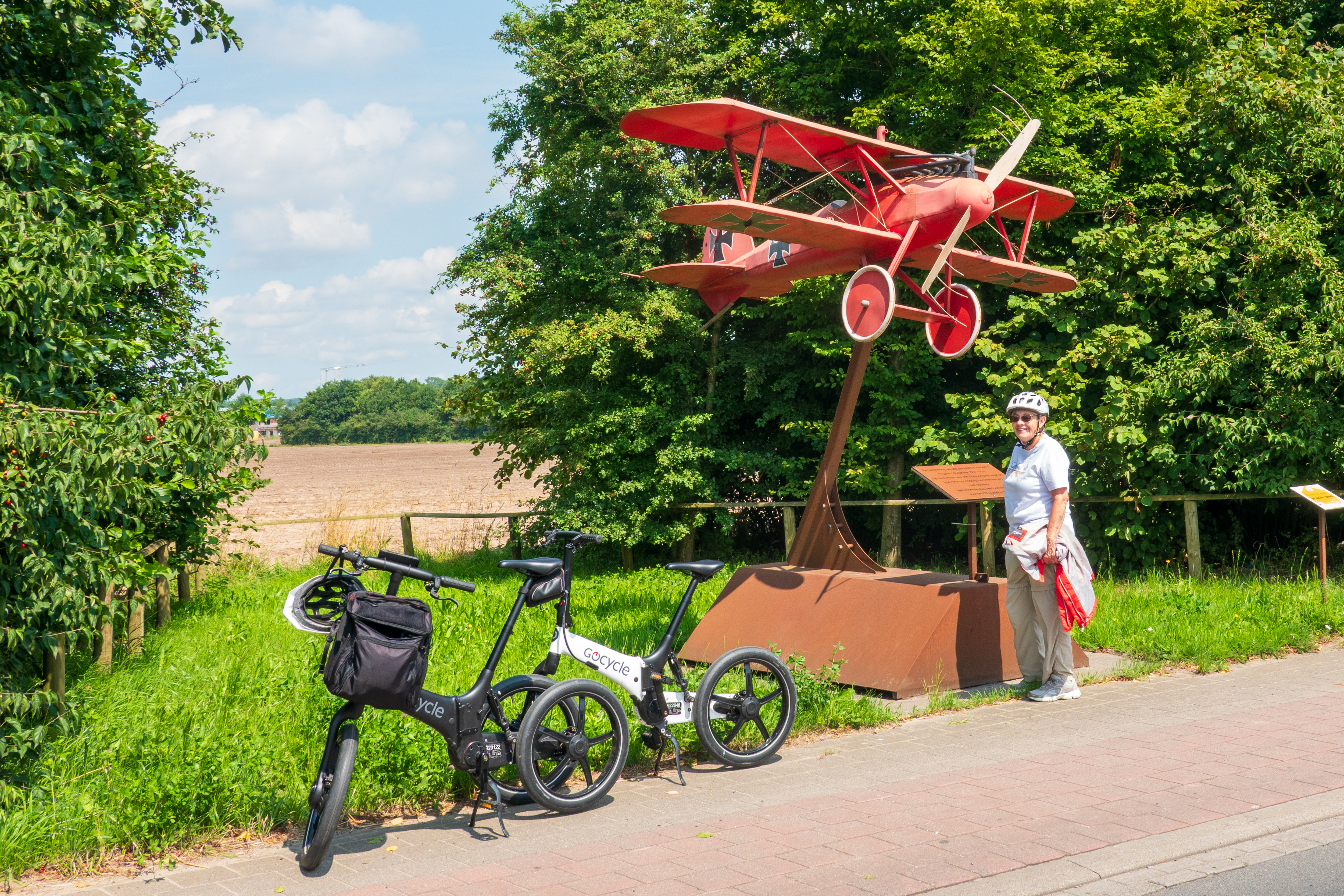
A replica of the Albatros aircraft that flew from this field. The US B-17 Herky Jerky II is said to have crashed nearby during WWII.

On the ride home, we stopped at a small monument at the site of a Great War German airfield.

Arriving back at the ice cream factory, we went to the restaurant for a really pleasant outdoor meal. It is always fun to eat out when we do not have to move the truck or head out on bicycles.

Ypres simply drips history and we learned a lot. Fred had a boss who was deeply into the Western Front association, but we have always concentrated on the Second World war. This was new territory for us, literally and historically. (https://en.wikipedia.org/wiki/Ypres_Salient) This map gives an idea. The Germans held to the right, the Allies to the left. And thousands upon thousands still lie in the beautiful fields all around.

We camped in an urban campground, in easy walking distance of the downtown. (https://urban-gardens.be/en/ypres/) We wandered along the river, into the pretty town center. Ypres was essentially flattened in the Great War but has been reconstructed in the original style. We bravely resisted the siren call of the chocolate stores, but stopped for more ice cream. After the cold and soggy start to our trip, it had turned sunny and warm – just lovely.

Arial photo from winter of 1917. Taken from an observation ballon?

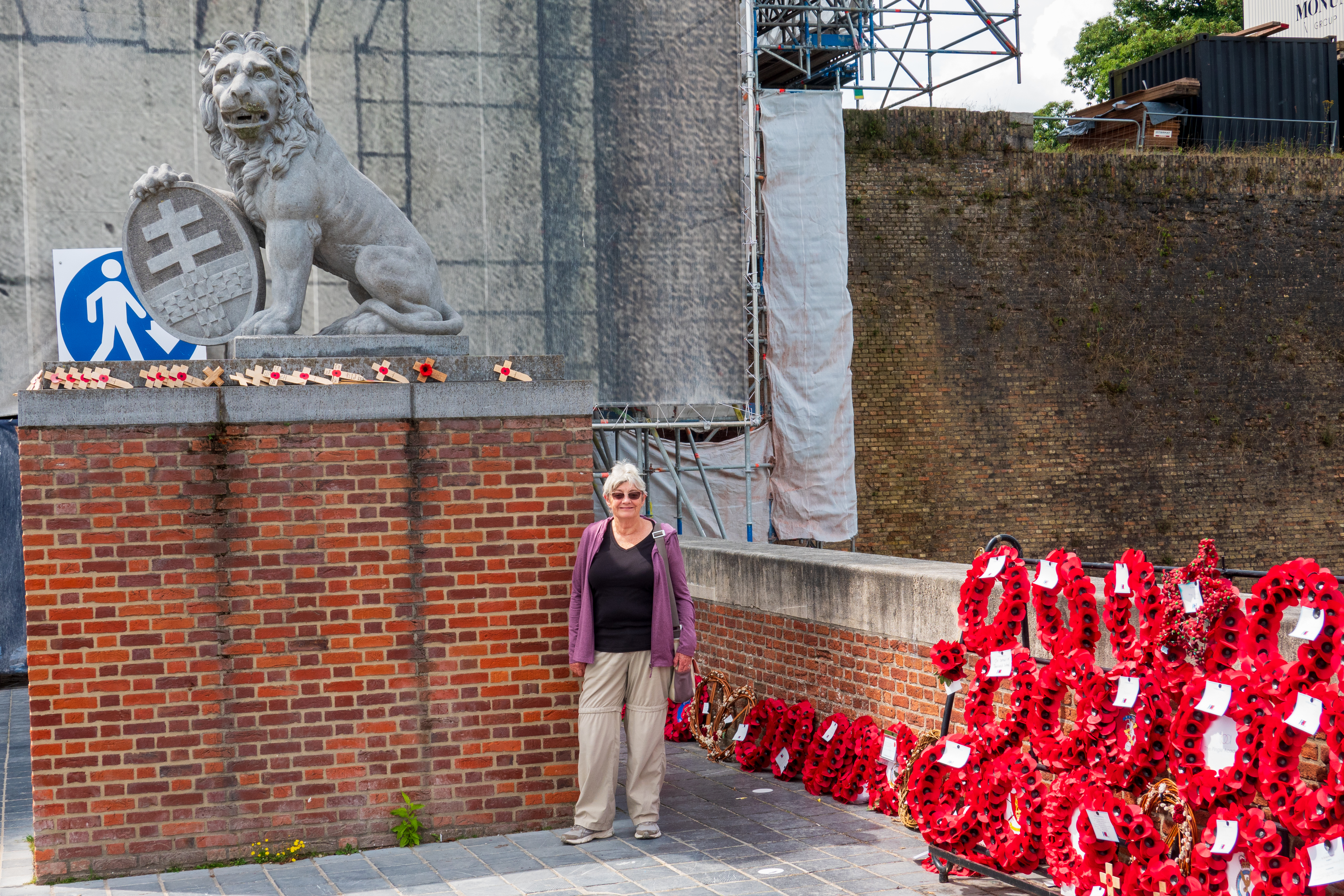
This photo is a map you can still use today. The Menin Gate is at the top center with Hellfire Corner beyond, out of the picture. Our campground was off to the top right. You can see the ruins of the towers in the central square. The Flanders Fields Museum (https://www.inflandersfields.be/en) is in the building at the center bottom. The Flanders Fields Museum is large and intense – it even has a section dedicated to all of the colonial troops, French and Commonwealth, who came to fight. There is a lion of India up in the memorial gardens on the city wall.

Picture taken across the open square in the photo above. Note the ’50’s Thunderbird, but one of the many classic American cars that we encountered.
Happier scenes today.
Pretty shrine to the Virgin, along the river.
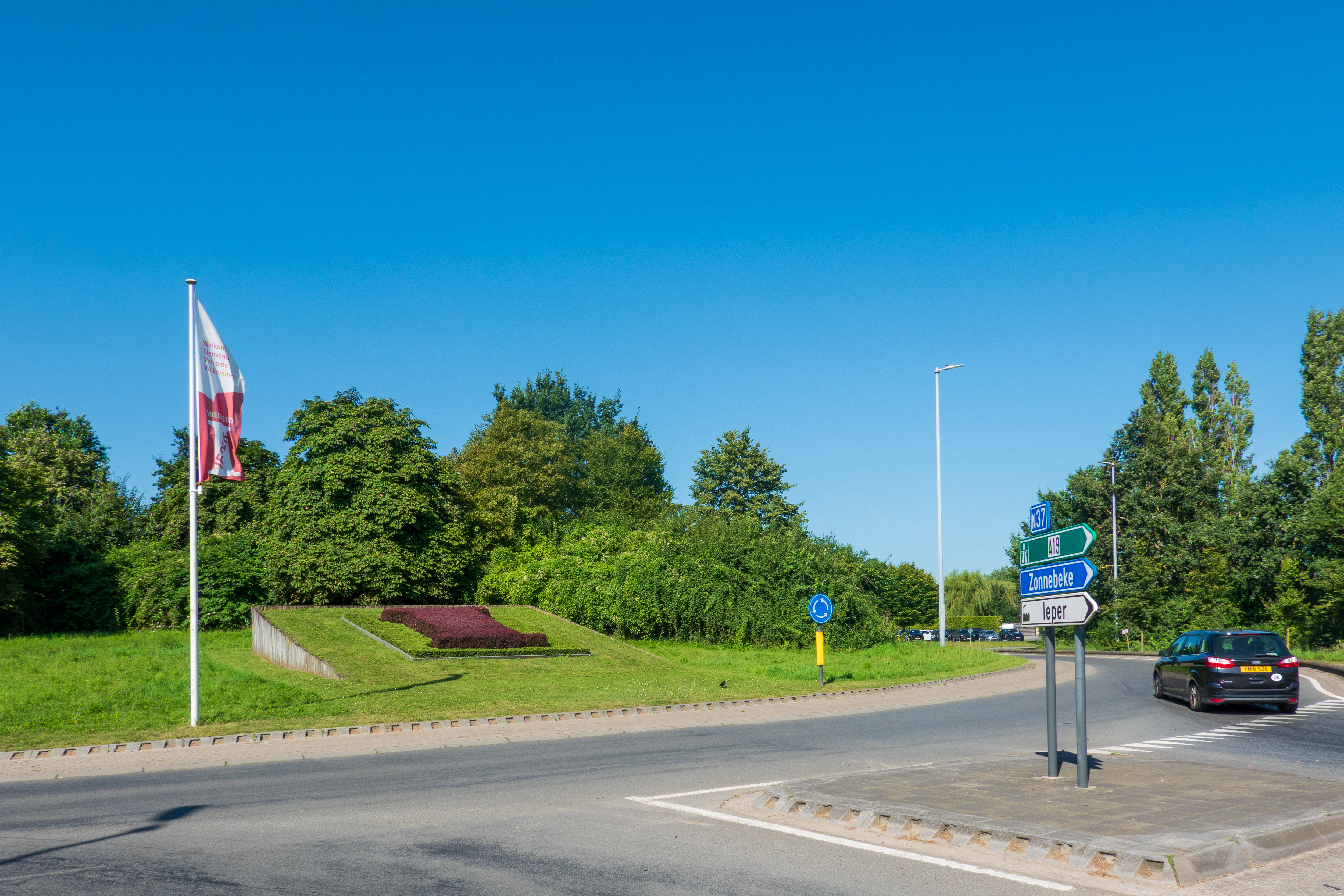
Hellfire Corner So called as the German artillery had it dialed in. Today the only challenge is drivers who don’t know how to negotiate a roundabout.
Denise admires a shell outside of the Museum. Yes, that is a marine caliber projectile.

We attended the Last Post ceremony at the Menin Gate War Memorial. This takes place at 8:00 PM each evening. The Last Post is the British equivalent of Taps. The Belgian police have performed the ceremony every night since 1928, stopping only during the German occupation in World War Two. (https://www.cwgc.org/our-work/blog/the-history-of-the-last-post/) Our European brothers and sisters have never forgotten the Anglo-American sacrifices in the wars. The Menin Gate is currently under reconstruction but the Last Post on three bugles is still poignant – listen to the video below.

Denise with poppies.
The gate building was built in the 1920’s as a war memorial.
What with the duration of the war and the power of explosives, many bodies were never recovered.
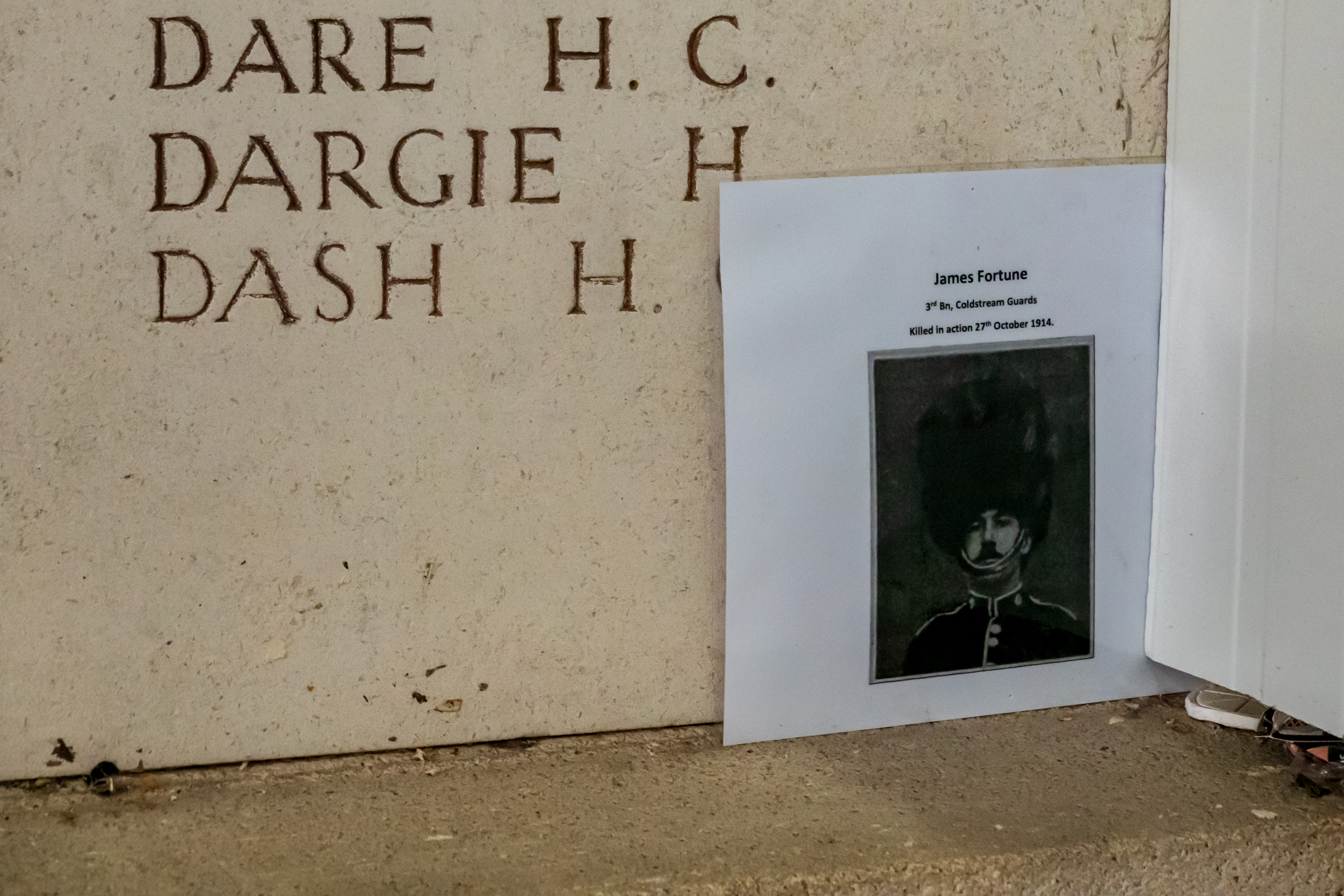
People still bring pictures of family members to place inside the gate. It is hard to avoid tears – an entire generation lost in Flanders Fields.

Then we took our bikes and set out to visit sites outside the city. Cultural difference – the United States makes an extreme effort to repatriate or at least consolidate remains. After the Great War, most of the bodies were buried in dozens of cemeteries scattered all around. Far too many for us to visit all, but each was remarkably well tended. (Some even had the odd German body as well.)

At a hotel, just out of town, you can still visit the remains of trenches and bunkers. One bunker was built by the British and then captured by the Germans, who promptly built a wall in front of it, as the entrance now faced the wrong way!

The bunker is to the right.
Looking at the water, you can understand trench foot.
Lots of shell casings and a lot of duds as well.

The whole scene is achingly beautiful today.

Just to the east and south of Ypres is Hill 60, the site of some insane fighting over the course of the entire war. (https://en.wikipedia.org/wiki/Hill_60_(Ypres)) With the help of a bunch of maps, we set out to visit. Our first stop was the Canadian memorial atop what is left of Hill 60.

Ypres from Hill 60.

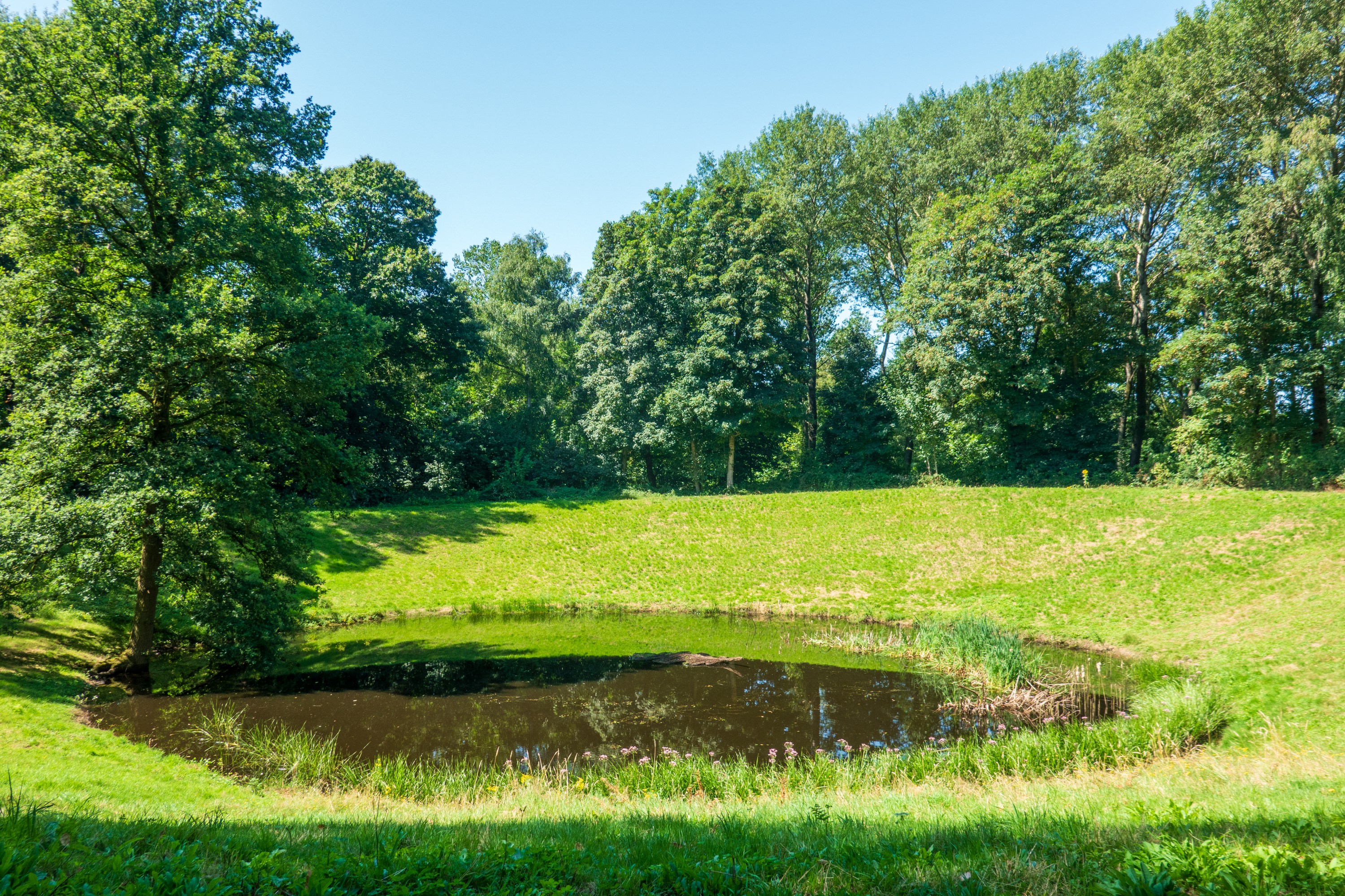
Sadly, the museum in the Sanctuary Woods was closed, but once atop Hill 60 it was easy to see why it was so important; you could see all the way back to Ypres. The other side of the railway line was the Caterpillar, where you can still see traces of a mine crater. When all of the mines were fired, some 990,000 pounds of explosives went off. German casualties were estimated at 10,000 dead. Said to be the largest non-nuclear explosion, loudest man-made noise (heard in London), and any number of other grisly superlatives. Ominously, one of the mines only exploded in 1955, when struck by lightning and one is said to be completely lost. And, it gets worse – this area saw many successful (??) gas attacks.

It is hard to believe that during the Great War there we absolutely no trees left standing for miles around. Today much of the area is preserved and the woods are full of the detritus of war and monuments to brave men and the stupidity of war.

Every ditch is a former trench.

It was a great, if sobering ride, so we enjoyed this quixotic roundabout.

It was time to pack up and head for the Channel.

More Horses

We headed next for Bruges, a very short distance.  We stayed at another hotel/camping aire, surrounded by horses again!  Including a cute foal!  We have stayed with lots of horses on this trip!

Bruges was a Hanseatic city  and the trading hub between the Hanseatic cities of the far North, England and Germany, and the main trading centers in France, Spain and Italy from the 13th to 15th centuries.  The Hanseatic League is actually a fascinating institution and did much to shape the modern history of Northern Europe: https://en.wikipedia.org/wiki/Hanseatic_League

Medieval architecture abounds in the main square and there are extensive canals.  We cycled in on the first afternoon so as to get our bearings and have a quick look at the town.  It was a rather cloudy, dark afternoon but we were able to explore a little and enjoy an ice-cream in the main square.  The next day was very wet so we stayed in the camper and enjoyed a quiet day.  We were parked in a large field and we could not believe the number of campers that came and parked right beside us, leaving the rest of the field empty! Magnetic personalities? Prurient interest? Who knows?

The next day dawned sunny and warm so we headed into the town to begin our visit at the Church of Our Lady, which is also a fascinating museum. (https://en.wikipedia.org/wiki/Church_of_Our_Lady,_Bruges) It has a tall brick church tower, the second tallest of the world, which illustrates the craftsmanship of the Bruges builders.

A LOT of bricks!
Note the bricks in the ceiling.
High altar.
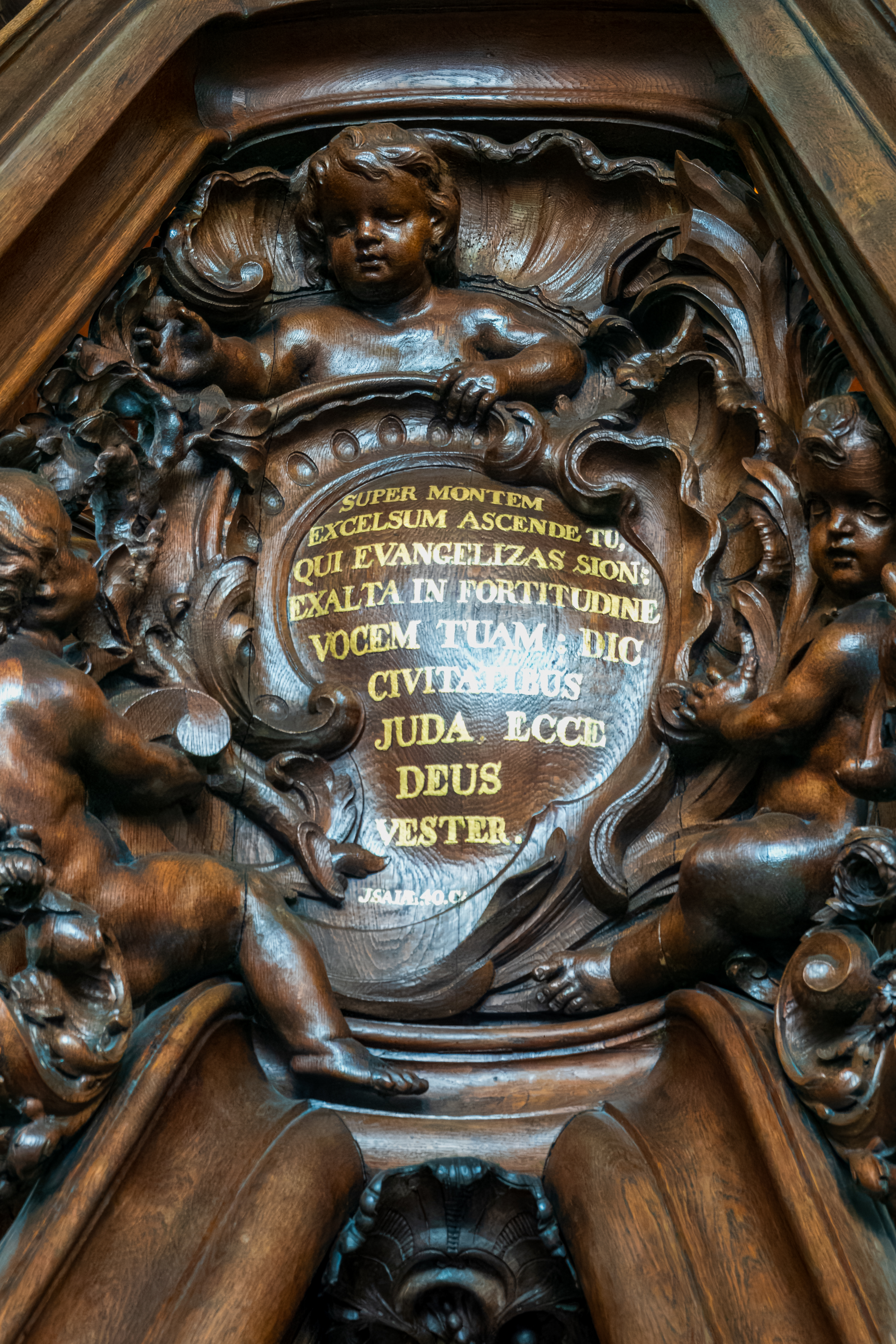
Steps to an insanely ornate pulpit. Amazingly, this is Protestant, not Catholic.
Wood carving detail.

Inside there is a selection of art, including Michelangelo’s world-famous Madonna and Child.

There are also numerous paintings, 13th and 14th century painted crypts, and the 15th and 16th century tombs of Mary of Burgundy and Charles the Bold. 

Amazing detail.
The iconography puts images like the cruxifixction at the head of the deceased.

We have never seen such ornate confessionals and, of course, there was an astronomical clock. 

We also saw books of music, written in medieval format. Try sight singing that!

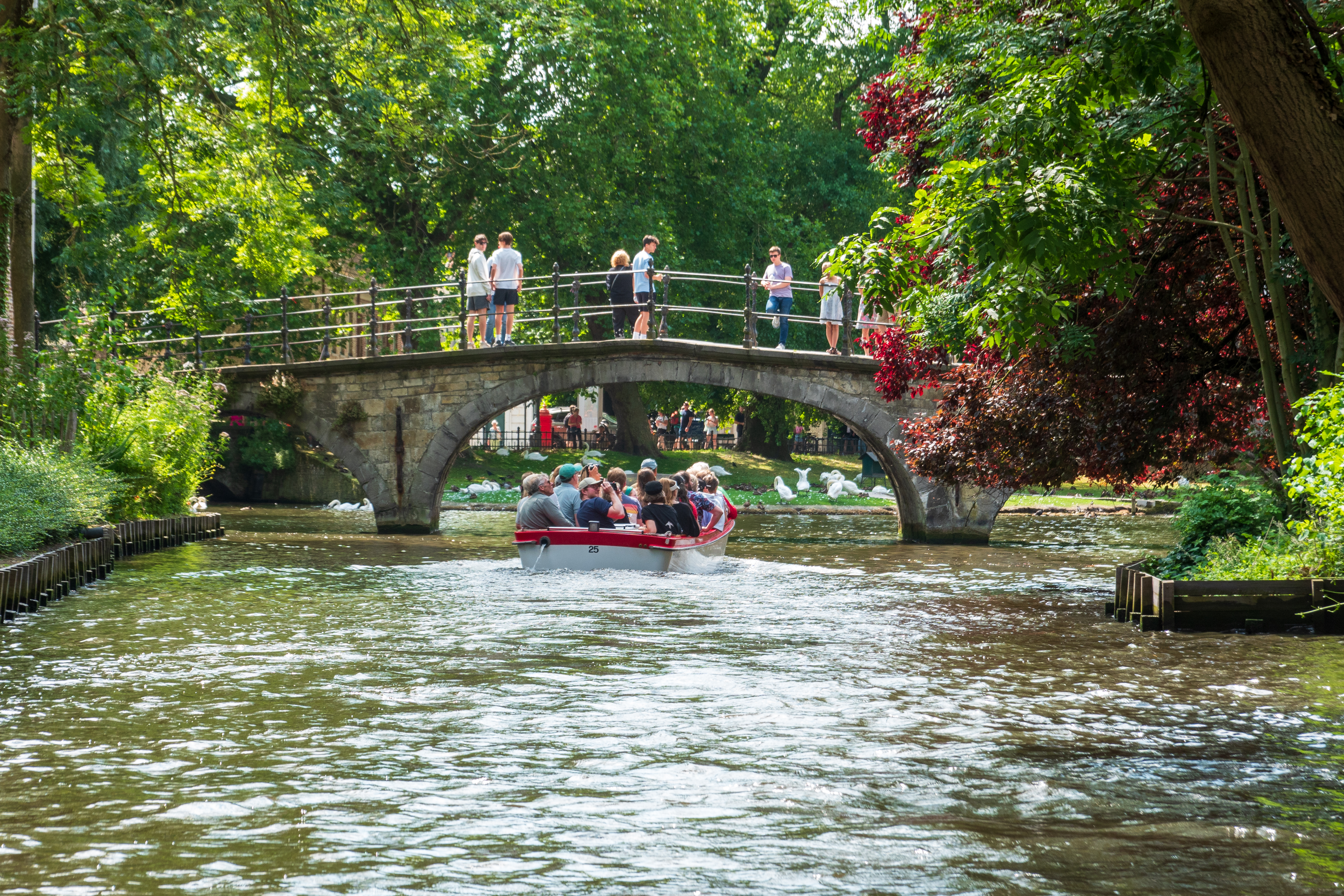
We then headed for a canal cruise as the number of tourists was quickly increasing.  It was very pleasant and gave us an overview of the town. 

We attempted to go to the Chocolate Museum but were turned away as too many tour groups had already booked entry. 

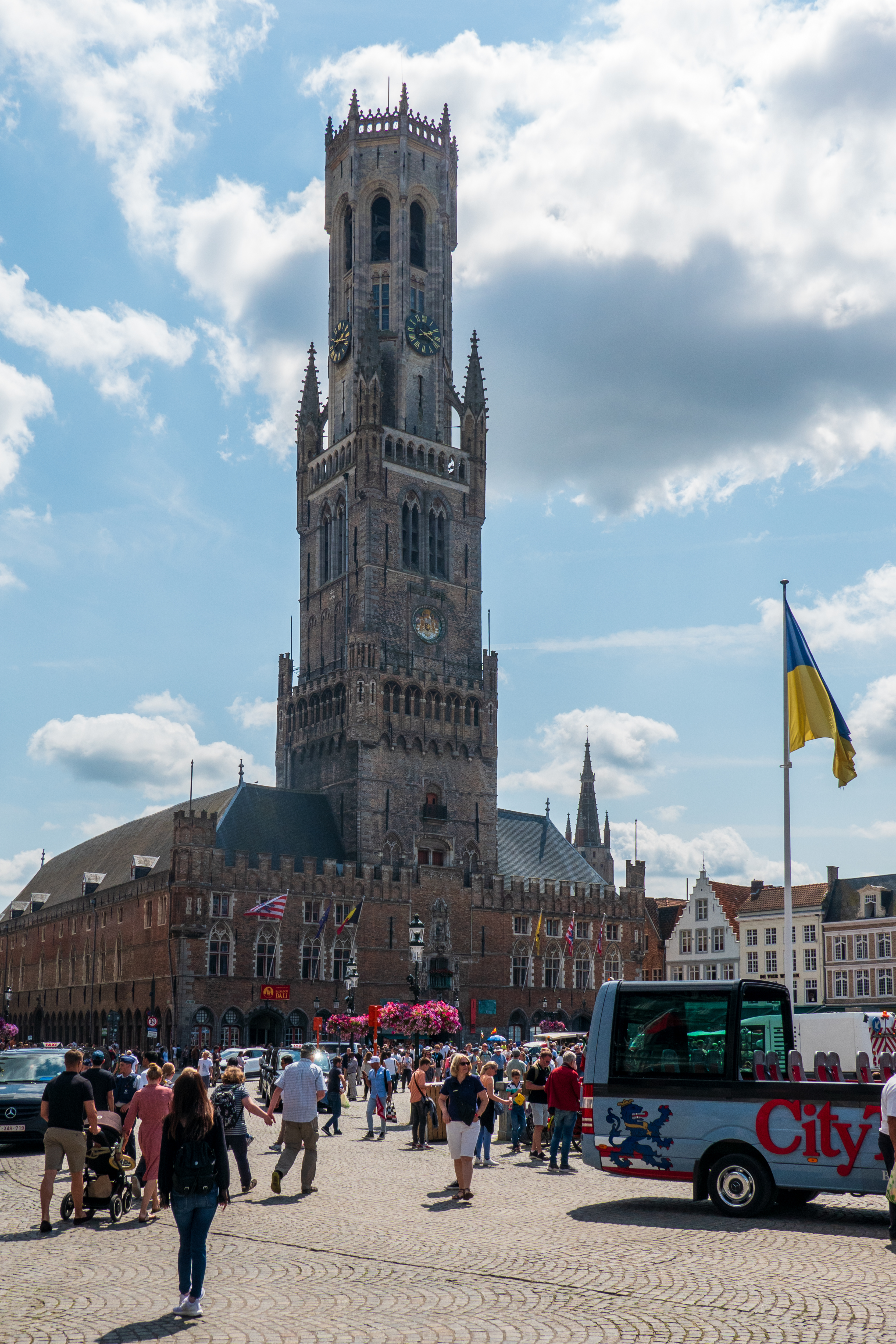
Saved from the calories of chocolate, we made our way back to the Markt to admire the crowds (https://en.wikipedia.org/wiki/Markt,_Bruges) and enjoy the rest of our visit. We even survived being stopped by the police for cycling the wrong way on a one way street. Should have believed Google maps!

Ghent

The garden near Ghent was on a horse farm. More horses! However these horses were mares undergoing artificial insemination. Once confirmed to be pregnant, the mares go to the farms of the future owners of the foals. After the foals are delivered and thriving, the mares return home to repeat the cycle. Never seen that before.

We settled in and the next day we unpacked the bikes and set off for the 40 minute ride into Ghent. We chose the sightly longer route which took us along the river. The downtown was heaving!

Ghent is a port city in northwest Belgium, at the confluence of the Leie and Scheldt rivers. During the Middle Ages it was a prominent city-state. Today it’s a university town and is known for medieval architecture.

We knew that Ghent was having its annual festival but we could not believe the number of tourists in town.  We at once felt the need for sustenance when faced with a mass of stages, tents. sound systems and live music in some of them, so we stopped for coffee and a cream and strawberry waffle (the wafting cooking smells were irresistible).  Yes, it was the very end of strawberry season but these were some of the best strawberries we have ever eaten!

Thus fortified, we parked the bicycles and set out to explore  a little.  The narrow, medieval streets led us to the river and a boat cruise on the river, the best way to see the sights given the hordes of tourists. 

We passed under the St. Michael’s Bridge, which is famous for the statue of St. Michael and the Dragon. 

Note dragon.

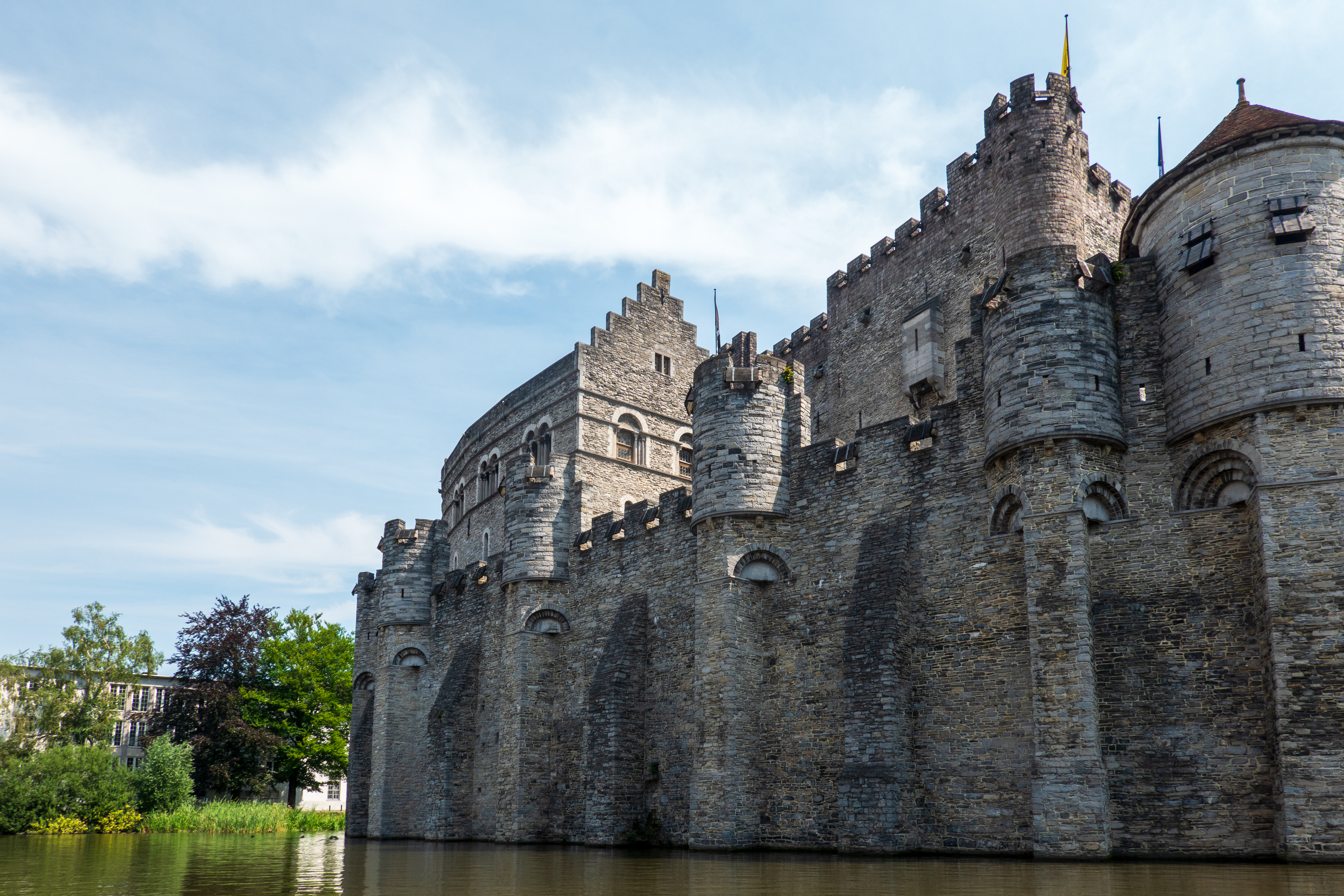
We also saw the twelfth century Gravensteen Castle. 

Musicians performing at a balcony cafe.
Yes, that is a pink elephant, the mascot of the well named Delirium Beer.

Lunch was at a Nepali restaurant on a side street with charming waiters and, most important of all, available tables.  We enjoyed dosas, momos, and a platter with a variety of dishes which we shared.  Doesn’t everyone go to a Nepali restaurant in Belgium?

If you have been following, you will remember the picture of Mons Meg, an enormous (25 inch) bombard (cannon/mortar) at Edinburgh Castle. (https://diplostrat.net/2023/06/23/into-scotland/) Her sister, Mad Meg, is in Ghent, at bit closer to home. The third bombard has been lost. And, if you were wondering, the IJN battleship Yamato had 18 inch guns; the USS Missouri, 16 inch. Amateurs! The stone cannon ball weighs over 375 pounds.

We then decided that we had had enough of the madding crowds and retrieved our bicycles and headed for the camper.

We remained an extra day as the weather was decent and Fred wanted to finish the painting of the roof rack, which he had begun in Denmark.  Our host loaned us a ladder and the painting was successfully completed. We even had two dogs to supervise.

Fries are not always French

It is easy to find fried potatoes in Belgium. You can even get them with mayonnaise. (Don’t know why you would want them that way, but that is another discussion.) And don’t call them French Fries – it tends to annoy Belgian folks! Places to camp for the night, on the other hand, were a bit rare. We were coming up on a weekend and the Belgian national day and the options were few.

So we abandoned our faithful Park4Night and turned to iOverlander (https://ioverlander.com ) And thus we ended up on a pig farm an hour or so north of the Waterloo battlefield.  The hosts were charming, super helpful, and we enjoyed chatting to them. (They even had geese.)

Our kind of campsite!

The Battle of Waterloo was “the nearest-run thing you ever saw in your life”, according to the Duke of Wellington, and he ought to know, he was there. (https://en.wikipedia.org/wiki/Battle_of_Waterloo) We have never been great Napoleonic Wars students, but they set the stage for much of modern Europe. So we had to visit the site.

The best formula appeared to be to drive to the battlefield, visit, and then continue on to another iOverlander site near Ghent. After some GPS futzing around, we found a large, legal lot. We took the path to the new underground Visitors Center so as to learn some of the history of the battle.  It was very well done and very informative.  (https://www.waterlooassociation.org.uk/resources/visitor-guide-to-waterloo/) After lunch in the restaurant, we went to work off the calories by climbing the 265 steps to the Butte de Lion, the artificial hill in the middle of the former British lines.

The view from the top was quite spectacular.  It made the step climbing worthwhile! 

Denise, watching for the French advance.

We also visited the huge diorama. These were a big thing at one time; there is a similar diorama at Gettysburg.

The farm, La Haye Sainte, was a critical part of the battle. Today it is a private farm, with signs requesting tourists not to enter.
The building housing the diorama.
We concluded our visit with a cannon firing.

Then on to Ghent, to another I-Overlander site, this time the garden of a fellow overlander, who had just completed a multi year trip to Saudi Arabia in a Mercedes even older than ours. But before we left we had to give a tour to two highway patrol officers who stopped when they saw me climbing into the camper, not using the steps! They loved the tour and could not understand why the GPS had marked the road to the parking lot as restricted. Sigh. GPS – can’t live without it, but occasionally it gets a bee in its bonnet about something.

The Bridge that Isn’t There

Next stop was a Fred stop, the Bridge at Remagen. The bridge was built during the First World War to speed supplies to the Western Front. The war ended before the bridge could make a difference. During the Second World War it was famously captured intact by the US Ninth Armored Division. There is an excellent fictionalized film about the capture, The Bridge at Remagen.  (https://en.wikipedia.org/wiki/The_Bridge_at_Remagen) Much less reported is the tremendous efforts by the Germans to destroy the bridge after the US captured it – V2 rockets, Arado jet bombers, frogmen, etc. and the successful effort by the US forces to protect it. (https://en.wikipedia.org/wiki/Battle_of_Remagen)

Fred had tried to visit the bridge ruins once before, in the 1980’s while on temporary duty in Bonn. He got off the train in Remagen, but unfortunately ran out of time and did not actually find the ruins because of the need to make a flight from Frankfurt. He did manage a great lunch in Remagen. This time around, we were not rushed; we found a Stellplatz right beside the bridge and settled in. The Stellplatz is on the site of a huge POW camp to hold German soldiers at the end of the war.

Look through the trees on the right – that is the bridge! Camping in history.

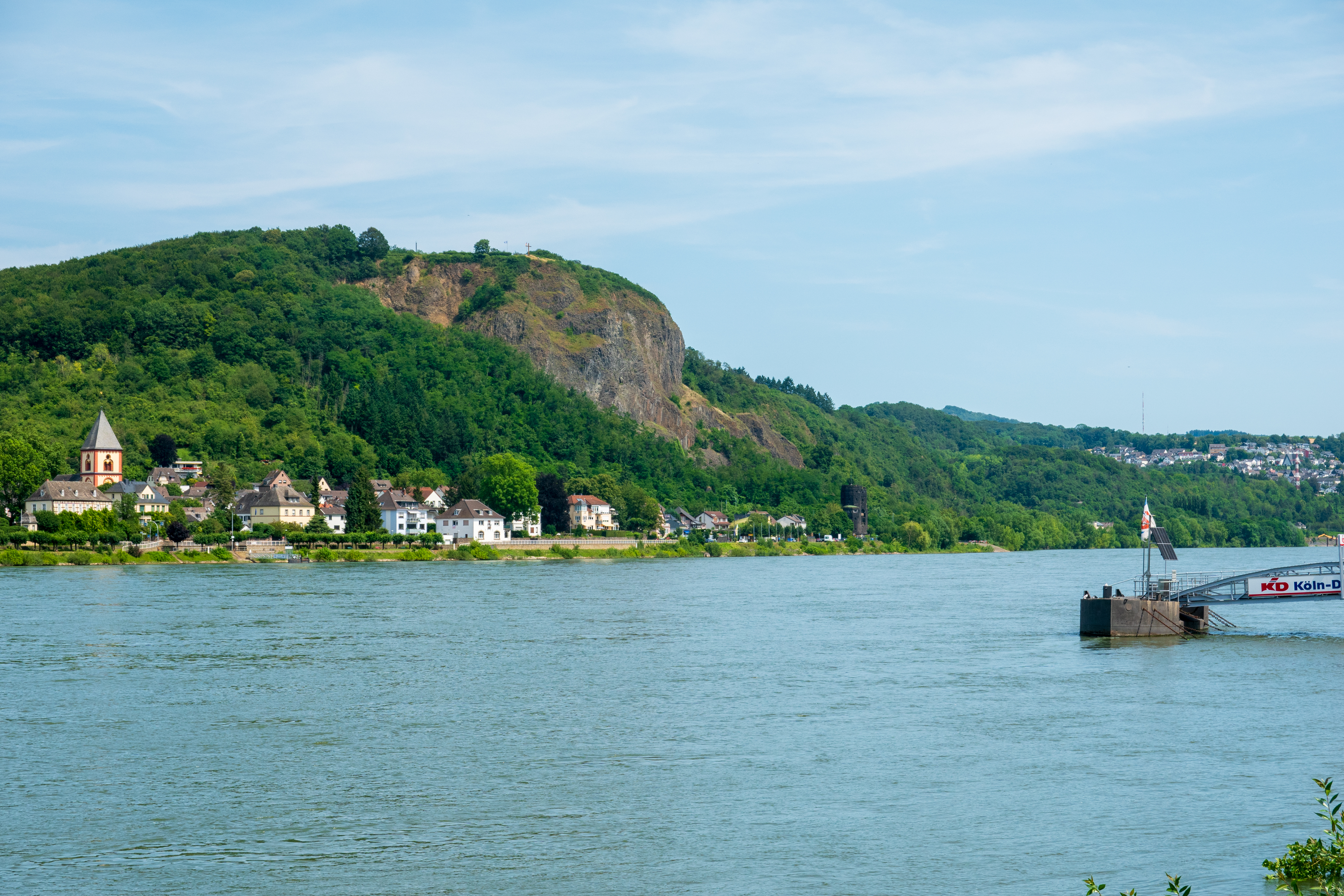
Once on our bikes, we went to admire the bridge.  We then cycled along the banks to the restaurants and enjoyed an ice cream as we watched the odd barge going by.

Beautiful view of where the bridge used to be.

We continued to cycle towards Bonn along the bank for a pleasant bike ride.

The following day we visited the Bridge museum.

Site of the anti-aircraft battery on the other side of the river.
The museum is in the iconic towers.
Denise admires the ruins of the approach road.

After Remagen, we traveled back into the Netherlands and stayed at a Stellplatz in Maastricht.

The Oldest City in Germany

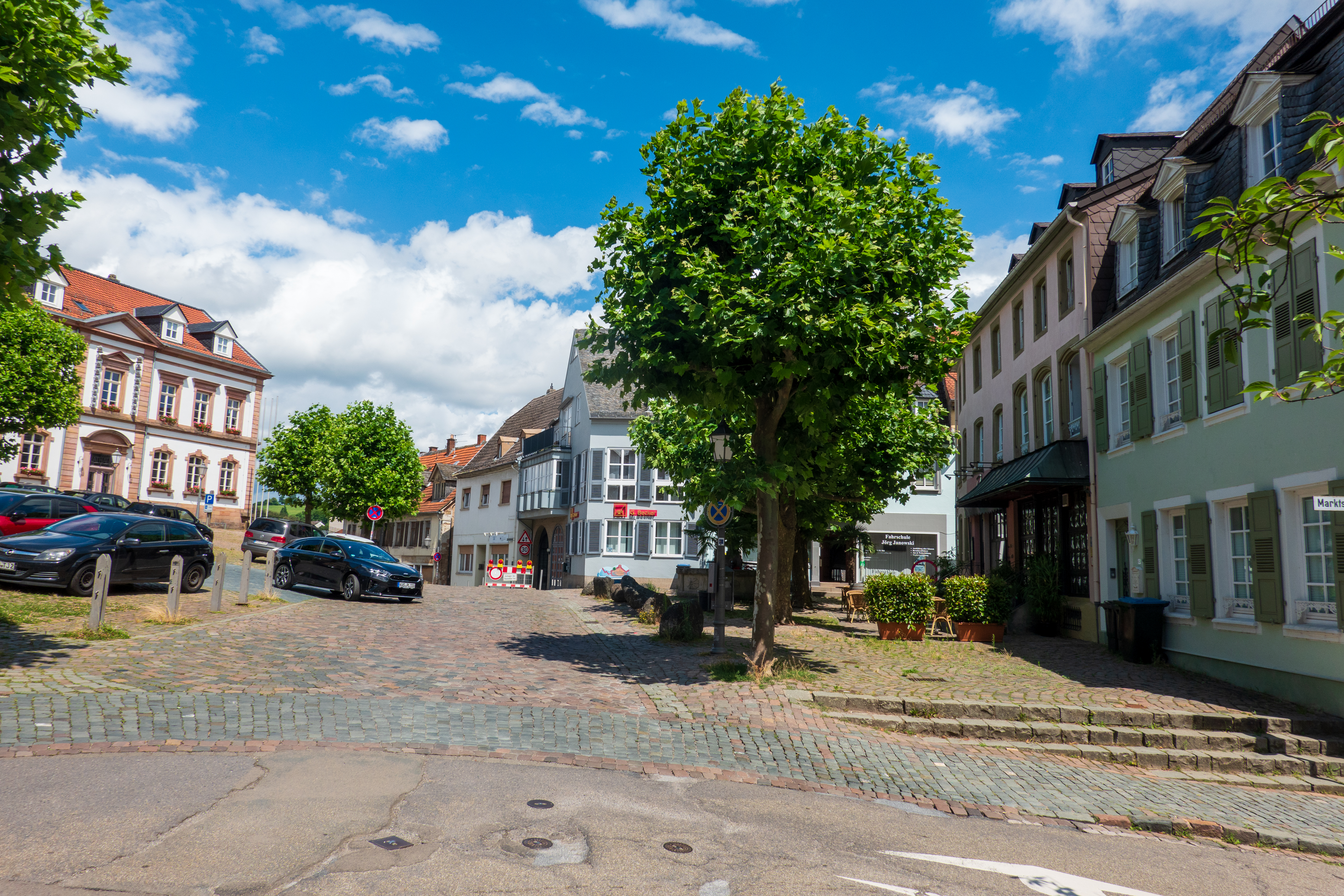
No one goes to Kusel except to burn it. First the Croatians in 1635 and finally the French in 1794. But as our son had lived in a second floor apartment there, for four years as an officer in the US Army, we had a sacred pilgrimage to see it again. Denise spent several weeks in Kusel while Trevor was recovering from an injury and was on crutches.

Denise at the front door.
Stairs to the upper street.
The market square at the top of the street.

It turned into just a drive by visit as it was Saturday, and everything was closed in preparation for an Italian Festival.  Sadly, the town was showing the need for a little TLC. A number of shops were empty and an overall lack of maintenance was visible. Perhaps this is the result of some of the nearby US bases closing or drawing down. Even Trevor’s favorite doner kebab shop was closed at lunch. And for those who have yet to experience the sublime joys of doner kebab, see here: https://en.wikipedia.org/wiki/Doner_kebab#:~:text=A%20typical%20kebab%20consists%20of,stuffed%20into%20the%20bread%20itself.

Trevor’s balcony.
THE kebab house.
Kusel has several charming streets.

We took the necessary photos and decided to move on to Trier.

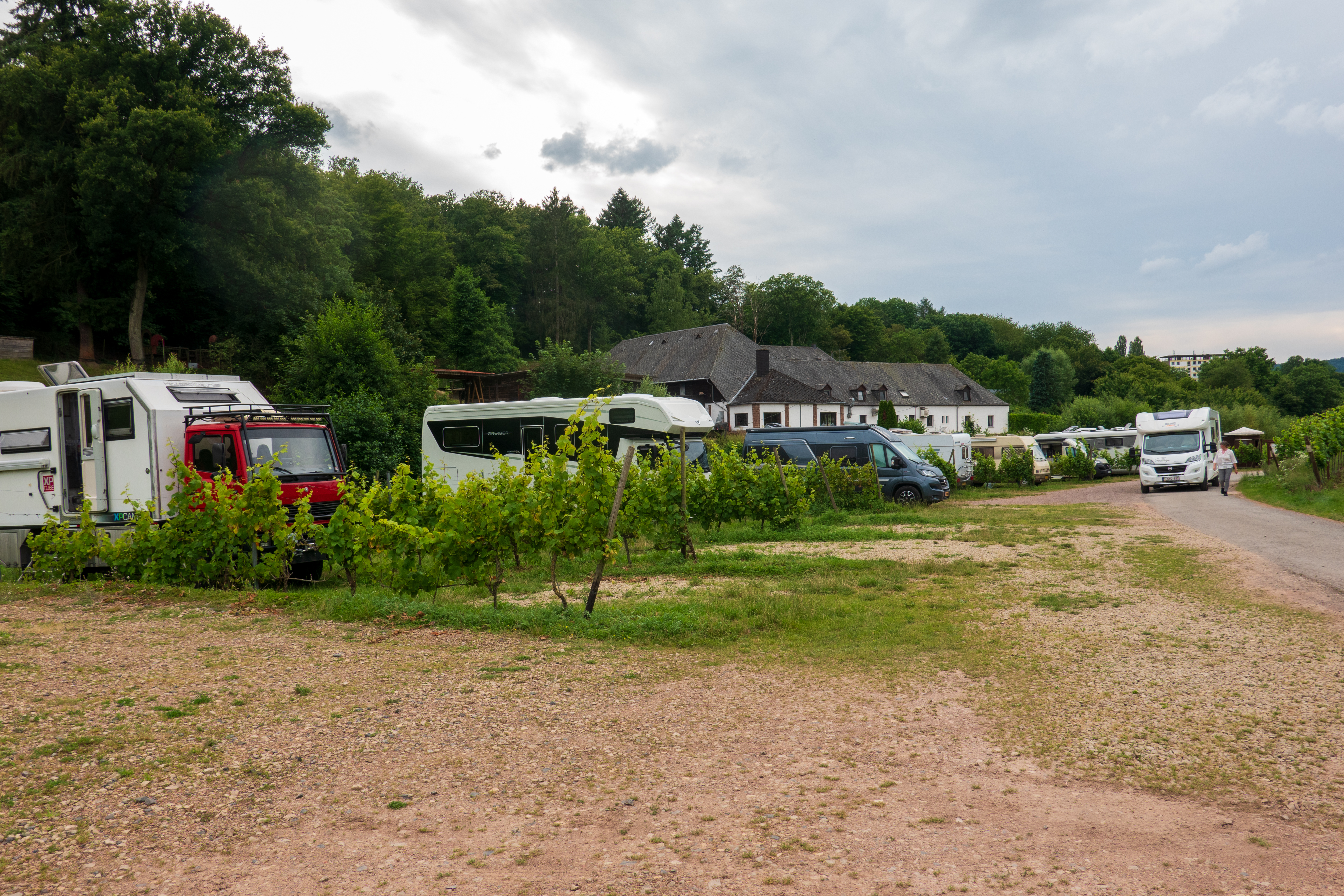
On arrival, we settled into a winery, just outside of town.

Not often that there are grape vines between the campers. We got one of the last sites.

The winery was advertising wine tasting and a restaurant. For some reason tasting was not available, but we did have an interesting evening meal. Fred is not going to be looking for pork neck recipes, but the leftovers made good Chinese food.

The next day we biked into Trier. We had visited briefly, years before, and were not sure about another visit. We found that visiting on bikes and being able to wander, rather than visit in a tour bus, made a big difference. 

Trier was known as Augusta Treverorum and had about 80,000 inhabitants in 300 AD. It is considered the oldest city in Germany. Fred rather suspects that this is not quite fair to the ancient Germans. They may not have build in stone, but undoubtedly had several large settlements. Trier has a lot for history hounds: https://en.wikipedia.org/wiki/Trier It was very easy to see the Roman foundations of the present city.

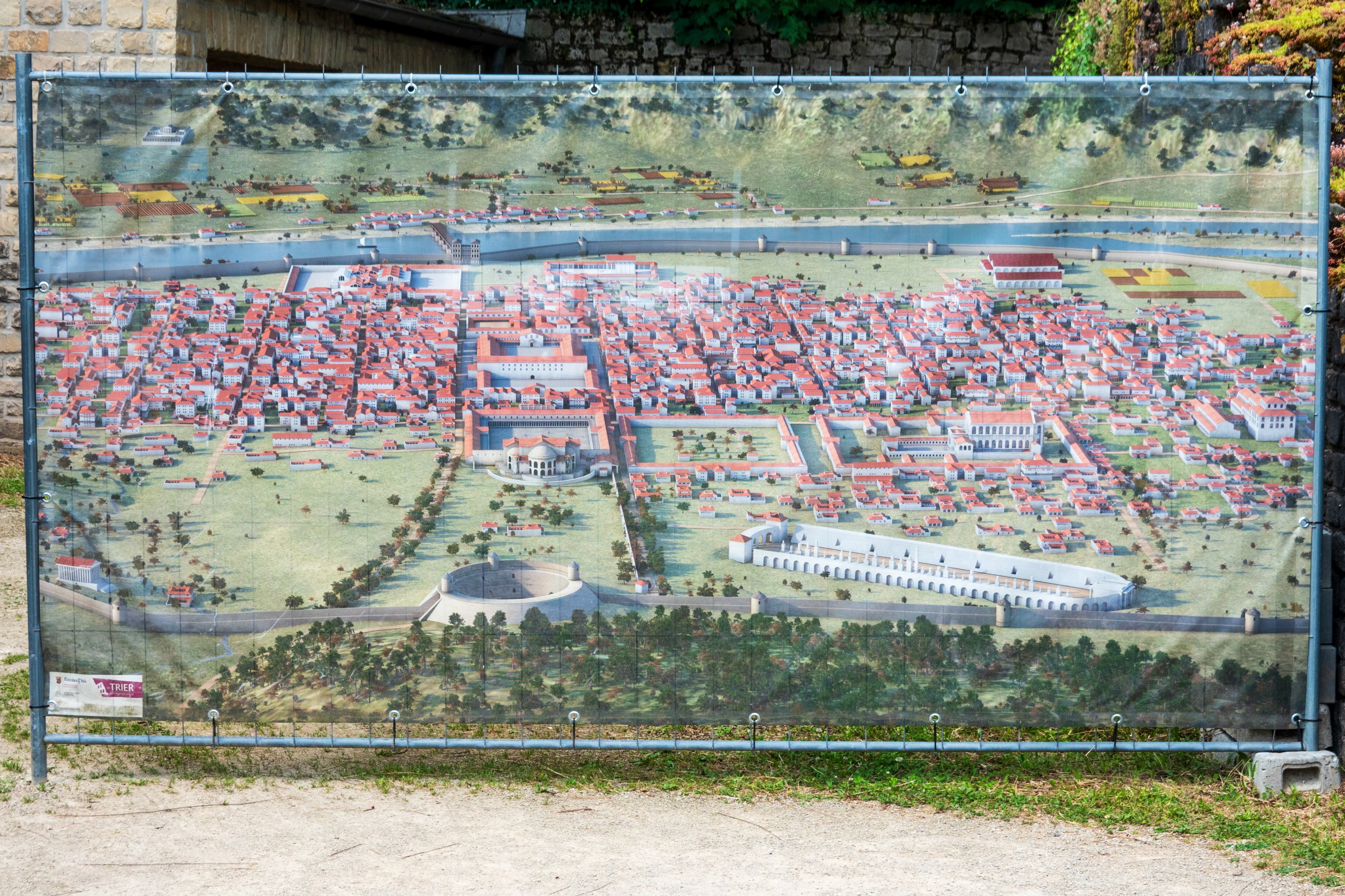
Our campsite was just off to the right of the map, we rode into town on the road marked Olleweg.

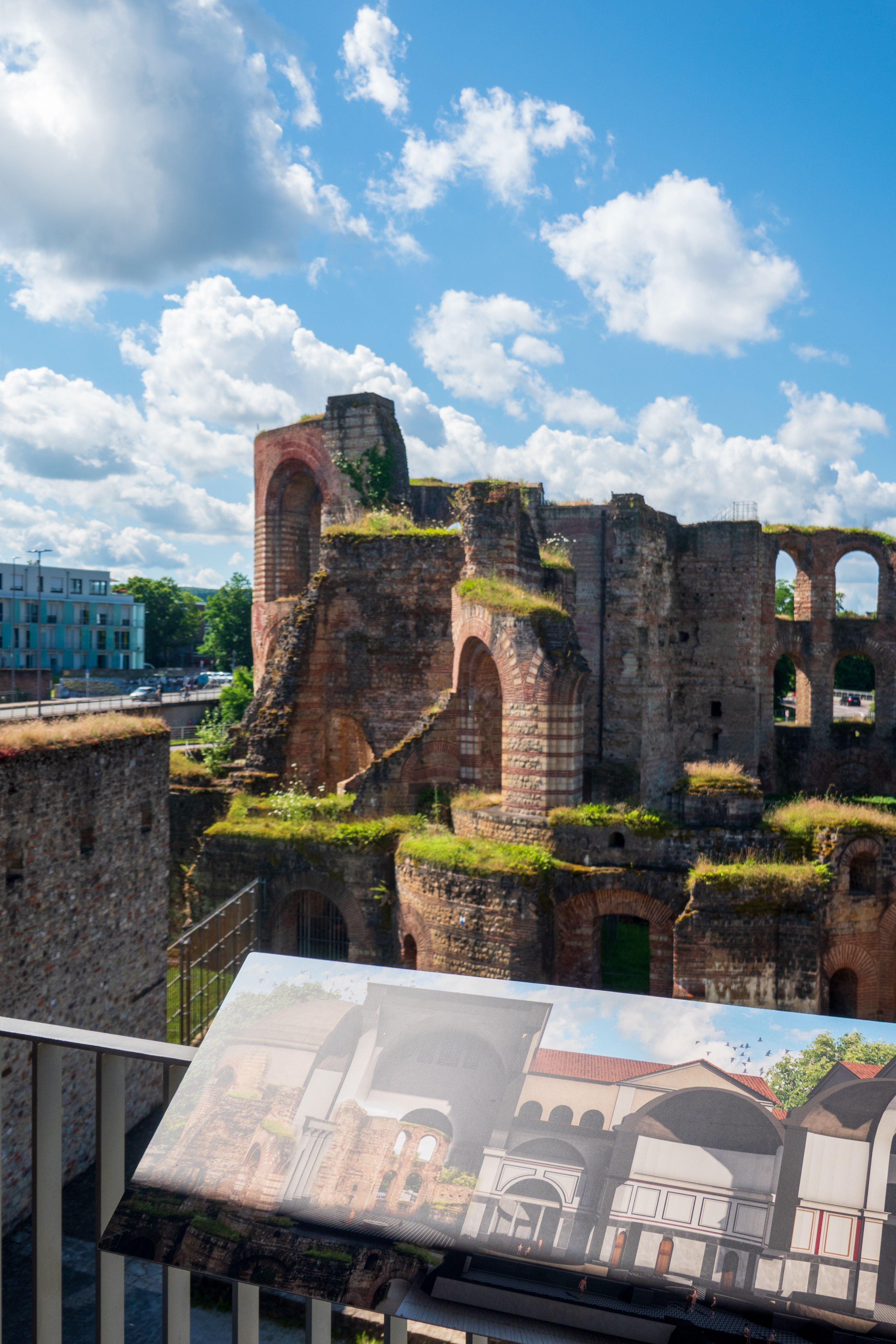
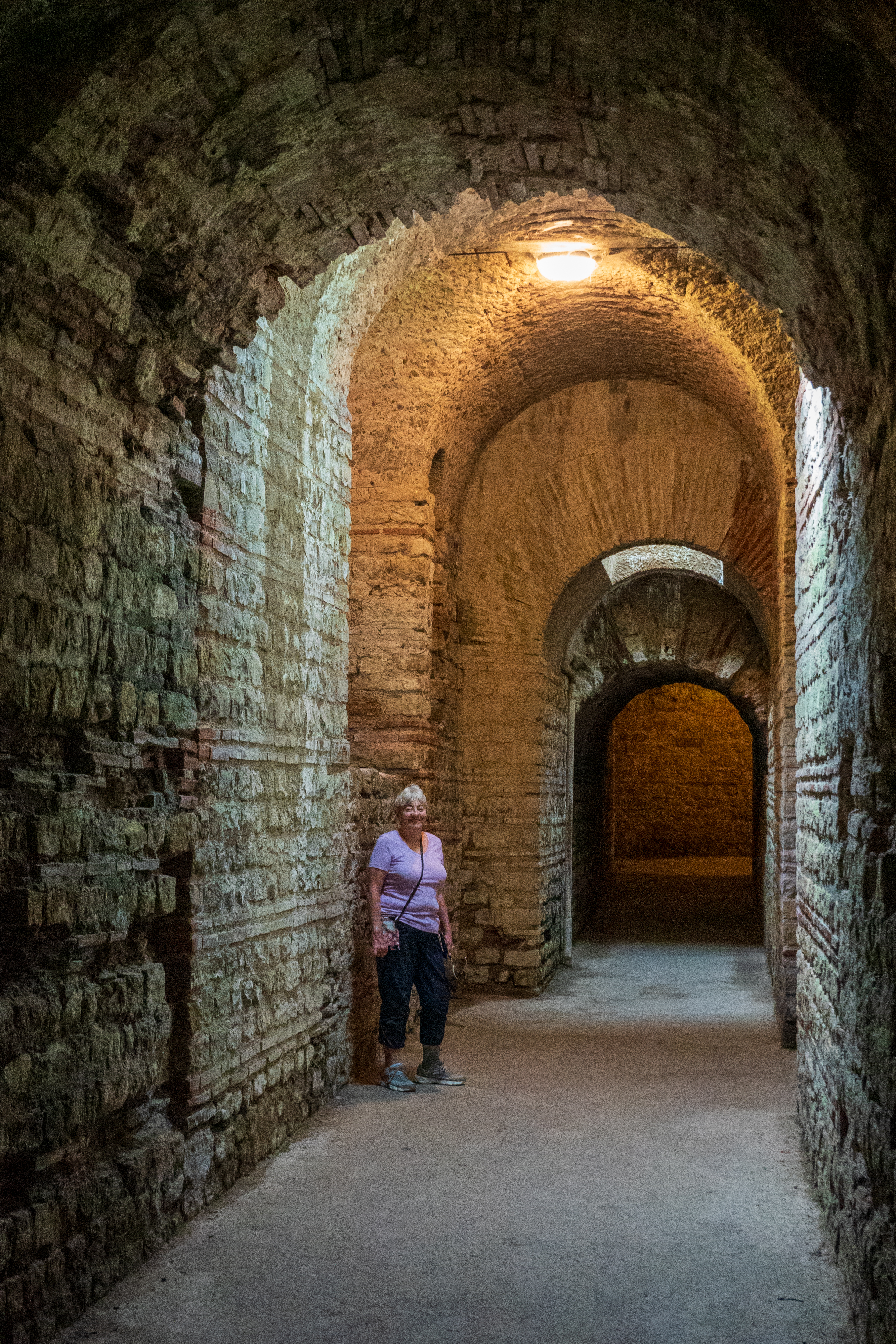
We started our visit with the Kaiserthermen or Imperial Baths.  At the start of the 4th century, Trier became an imperial residence. Part of the western Roman Empire, which included Britannia, Gaul, and the Iberian Peninsula, was administered from Trier. Thus construction began on several prestigious imperial buildings, including the baths complex.  Built as baths, work came to a halt when Emperor Constantine shifted towards the east.  The baths were partly torn down and partly completed as a reception and parade hall with  barracks was created, but enough of the structure remains for a most interesting visit.  It is possible to wander the underground passageways with the hypocaust in full view. Great fun!

Down in the underground passages. They are quite extensive.

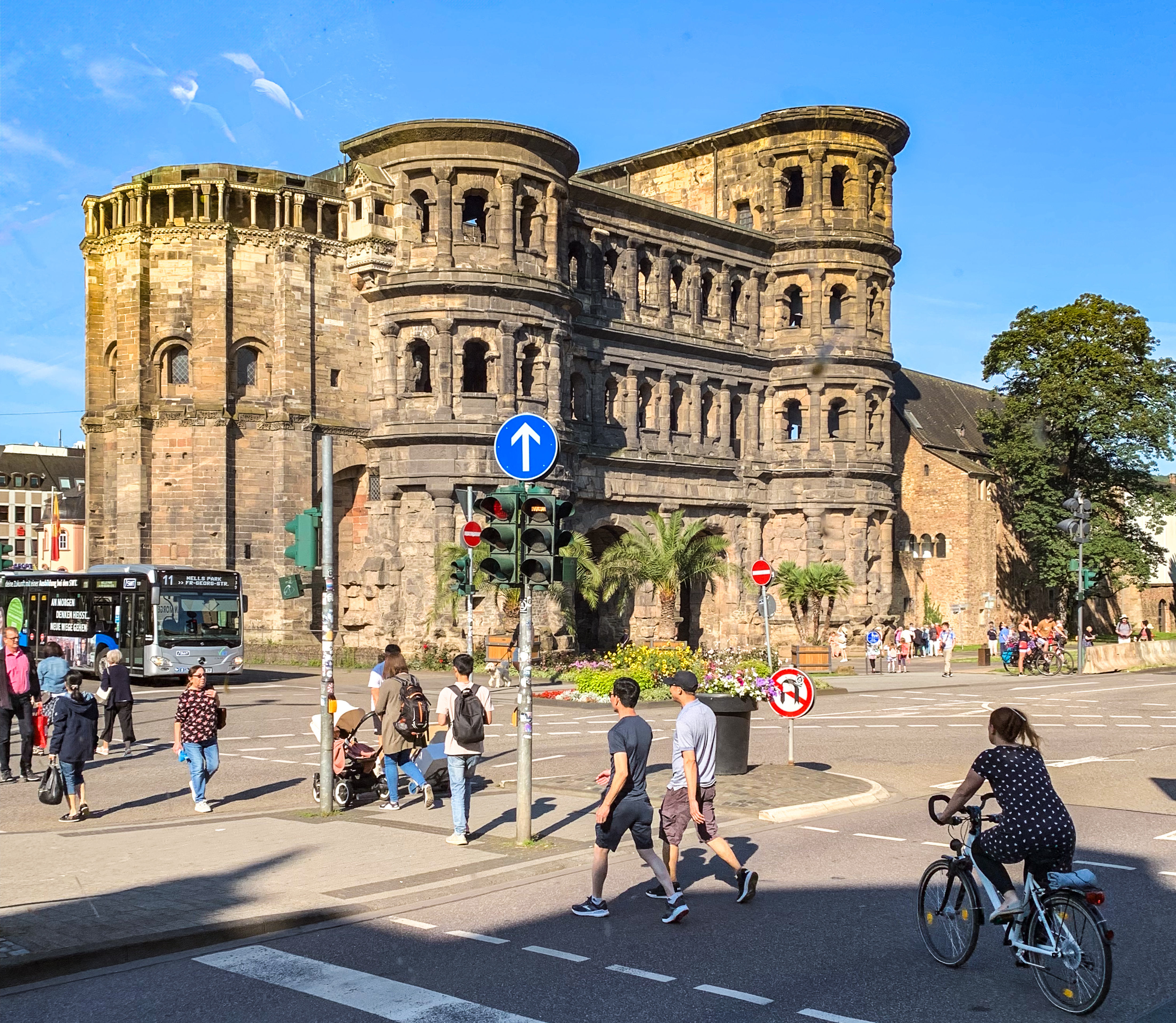
We then biked to the Porta Nigra, or at least we tried to. We got there, but the town was packed and there was a huge market on both sides of the gate. 

So we gave up on attempting a visit and went for lunch.  Since we had missed our doner kebab in Kusel, we ate one in Trier, right on the main square. 

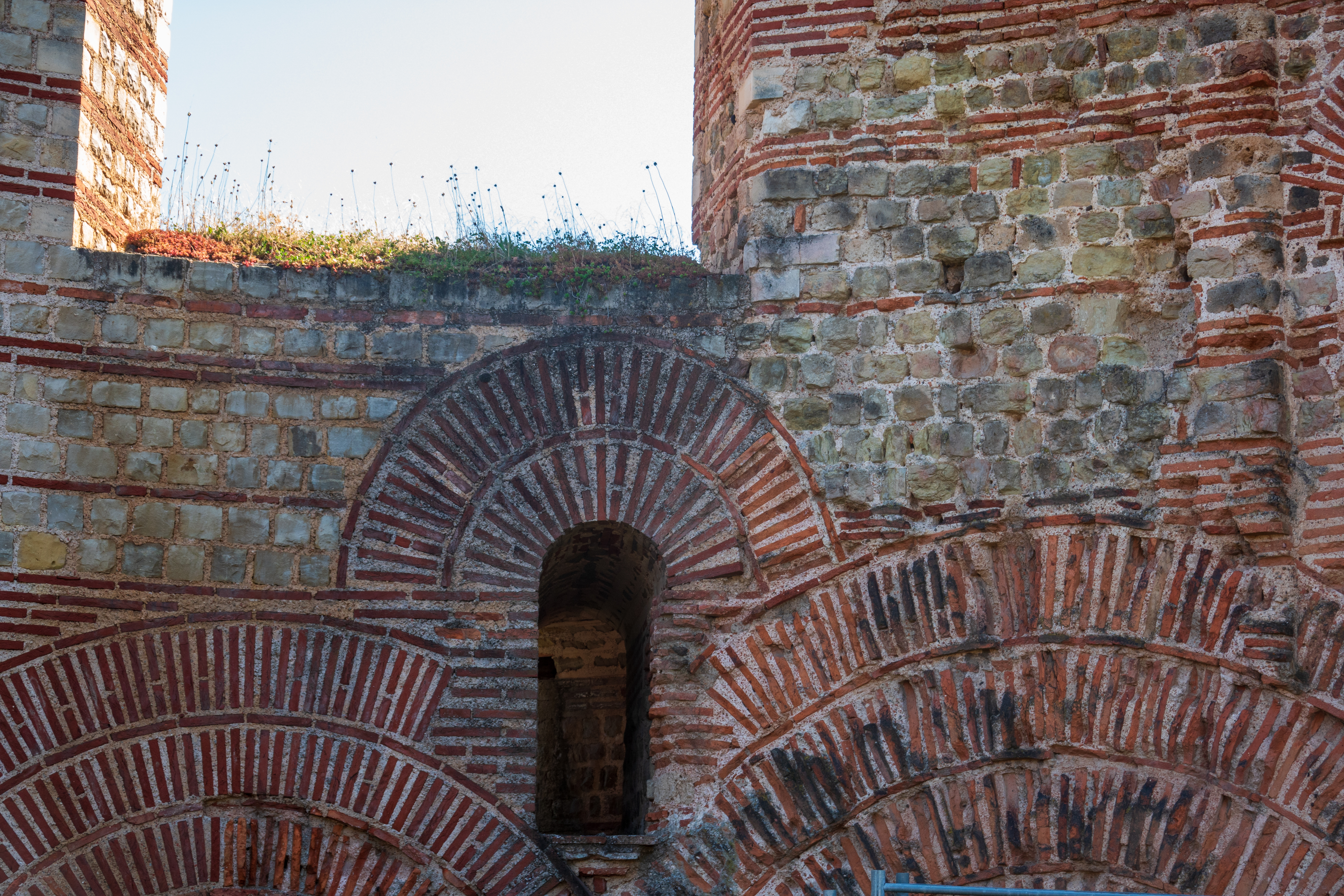
Beautiful brick work.
Looking over the whole site.

Central square.
Yes, the kebabs were good. The entrance to the left of the photo leads to St. Gandolf’s church.

We then headed to the Amphitheater, after a quick visit with our old friends Ecclesia and Synagoga – they are everywhere, this time on the Liebfrauenkirche. (https://en.wikipedia.org/wiki/Ecclesia_and_Synagoga)

On one side, the trifecta of goodness. The church, Saint Peter, and Adam, the father of man.

And, on the other side, the temptation of Eve, John the Baptist, and, turning away from St. John, Synagoga, the symbol of the Jewish faith.

All of this is as subtle as a brick through the window, and, in a world where people could not read Scripture for themselves, bred generations of hate and persecution. The roots of anti-semitism go way back, with terrible consequences to this day.

It is believed that the amphitheater was built between 160 and 200 AD, at the same time as the city walls. Oddly, it could also be used as a city gate, as the city wall went across the hill to the left of the photo. All of the seats were removed long ago to reuse the stones. A pity as the site is so well preserved.

There isn’t much of the circus left, but you can see the alignment of the amphitheater and the baths in this poster. The Porta Nigra would hbe been off to the right of the image.

It is believed to have held about 20,000 spectators. It is possible to see the cells, below the seating, where the animals, comdemned prisoners, or contestants were kept before entry into the arena.

This passage actually leads under the city walls into the city.
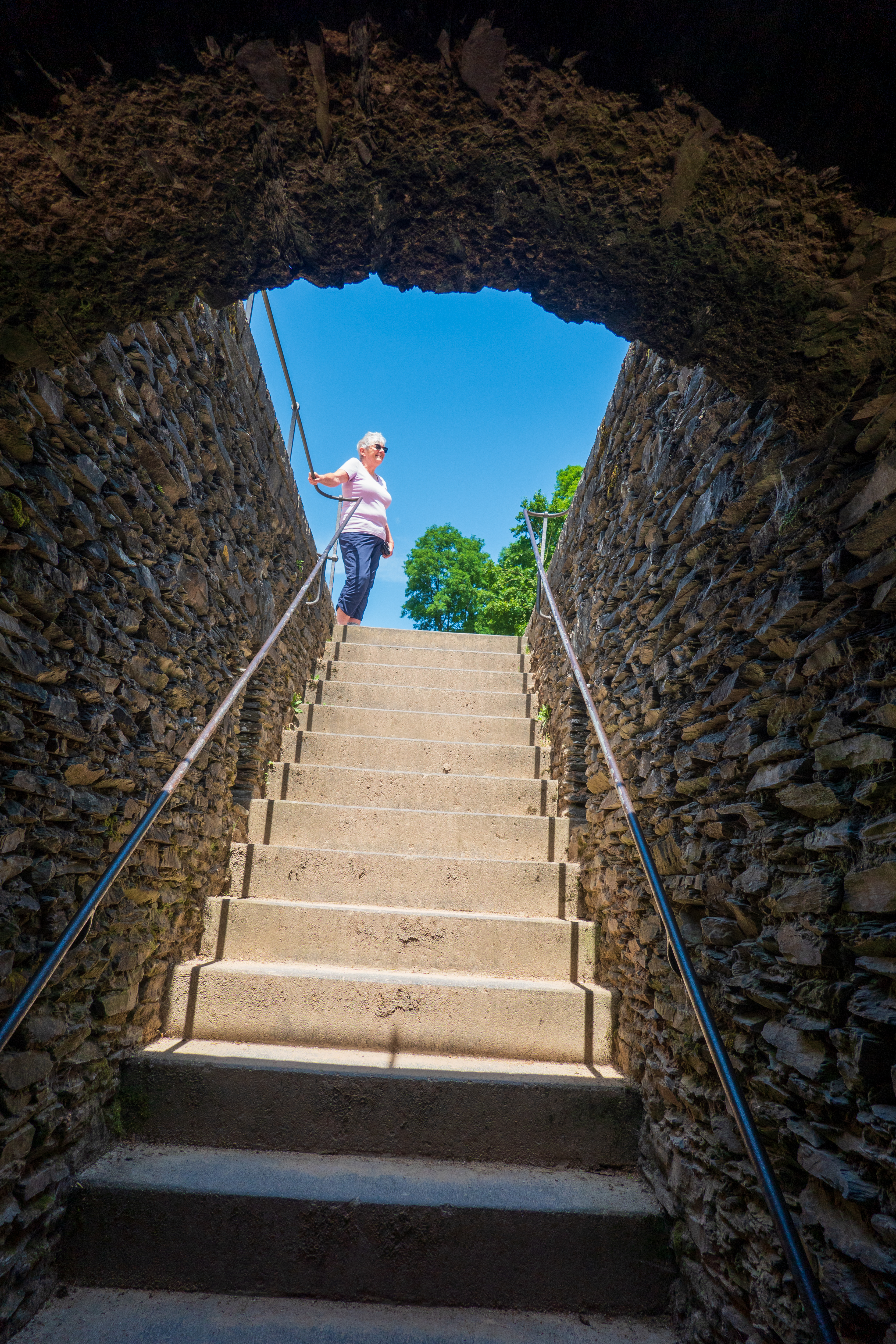
Think of all of the people who have climbed these steps. For the last time.

This is the only Roman amphitheater that we have visited with an intact wooden floor. This is probably because of the Bread and Circus festival that used to be held in Trier. Prowling under the floor of the arena made it especially chilling. Fans of movies like Spartacus and Barabbas will love it. (And keep yer Airplane! jokes to yourselves!)

Denise for the win! The market made it impossible to get a decent picture of the Porta Nigra, but then driving out of town we stopped at a traffic light and Denise scored this with an iPhone! (https://en.wikipedia.org/wiki/Porta_Nigra)

Organic and Mechanical Music

When we last saw our heroes …

They were taking the alternate route, which involved going north, almost to Karlsruhe, before heading south, a much greater distance. After our great dinner in Warnau, we reached a Stellplatz in Bad Krozingen, just to the south, and right on a train route in to the main station in Freiburg.

Why Freiburg? Denise studied there as a student in 1971 and Fred wanted to hear the organs in the Freiburg Minster (there are four) as he has long had a surround sound recording of them. (http://www.windsorlatinmass.org/wtnews/220626.pdf) And, of course, it is a wonderful, historic city.

We noted that there was a regular Tuesday evening concert, so that became our goal.  We set out from the Stellplatz after lunch and walked the 15 minutes through a park to the train station. The train was a bit late, but, a short ride took us to the Freiburg Hauptbahnhof, where we hopped a tram to the old town. Gotta love real public transport.

Classic street scene.

Our first stop was the Augustiner Museum, which was showing a large display of early Italian religious art and paintings as a special exhibit. Not what we were expecting but we jumped in.

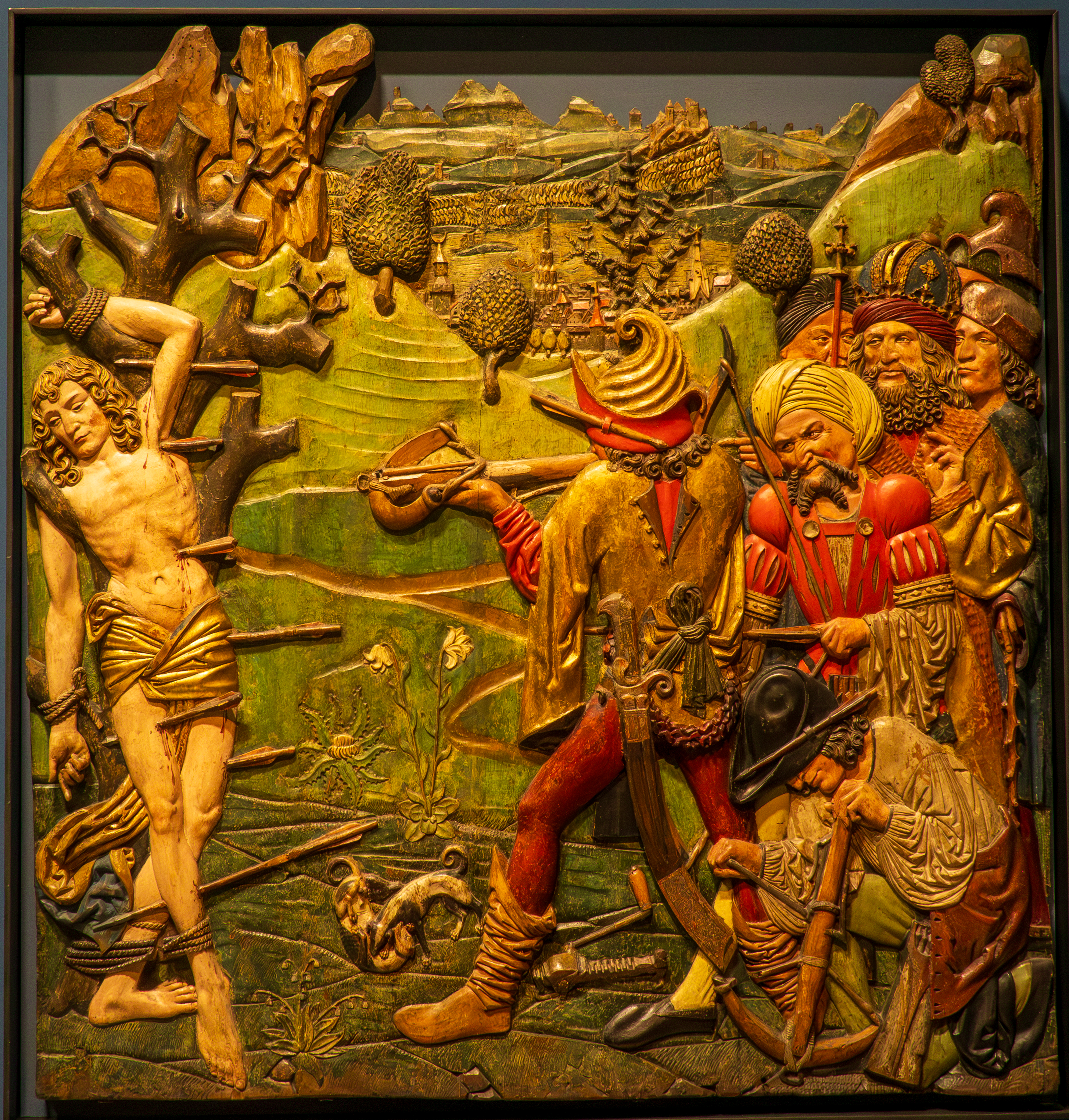
All of the art was beautiful but one piece jumped out – an almost photo realistic carving of the martyrdom of Saint Sebastian. (https://en.wikipedia.org/wiki/Saint_Sebastian) Somebody had way too much time on their hands. Look at those snarky faces! And the two fighting dogs. The cross bows are probably anachronistic, but incredibly detailed, even to the winders. And, for the rest of the story, the saint survived being shot with arrows and, after recovering from his wounds, went back to preaching. This time the emperor Diocletian ordered that he be beaten to death. He did not recover a second time.
Sadly, I did not note the author of this amazing work.

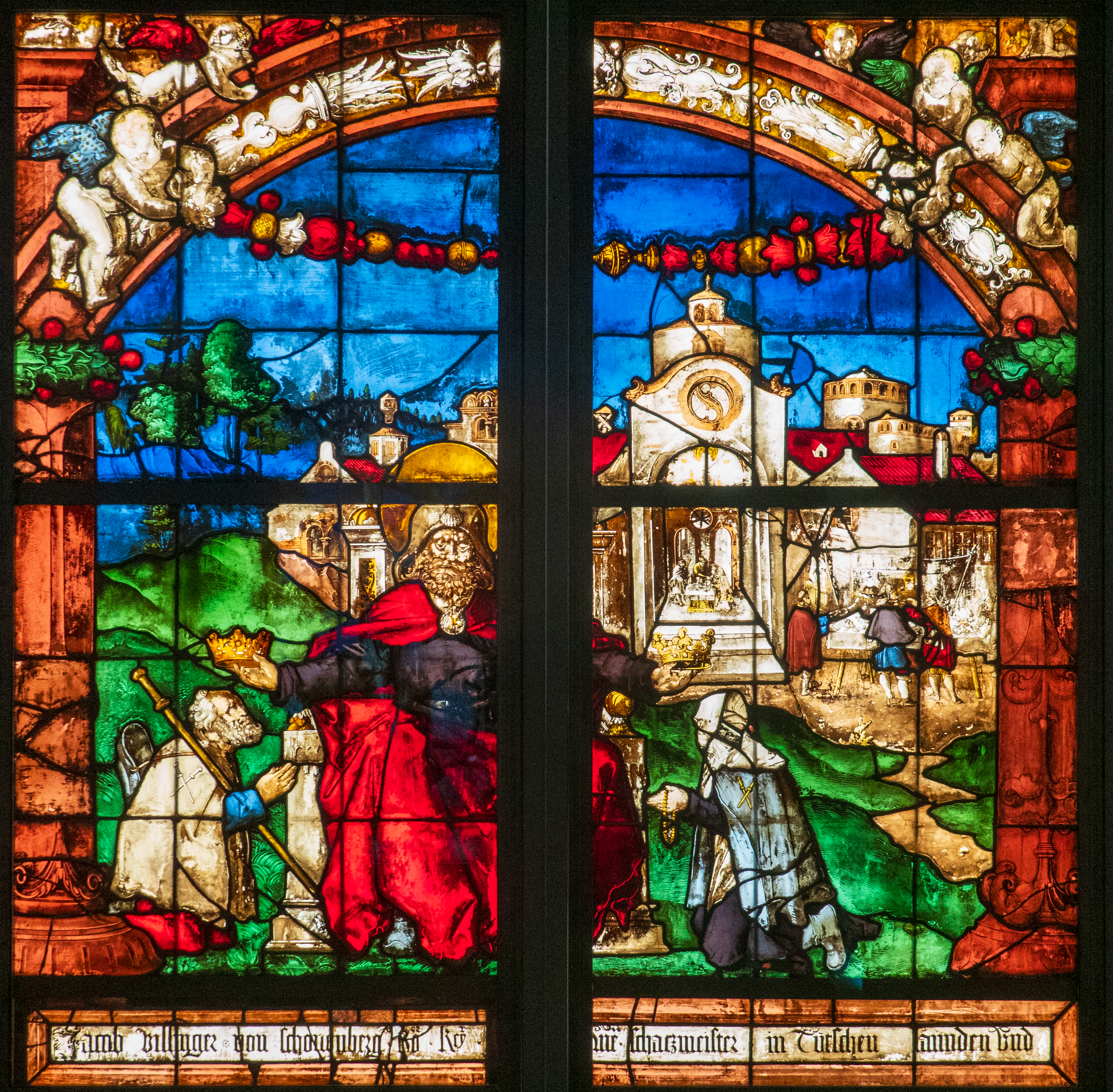
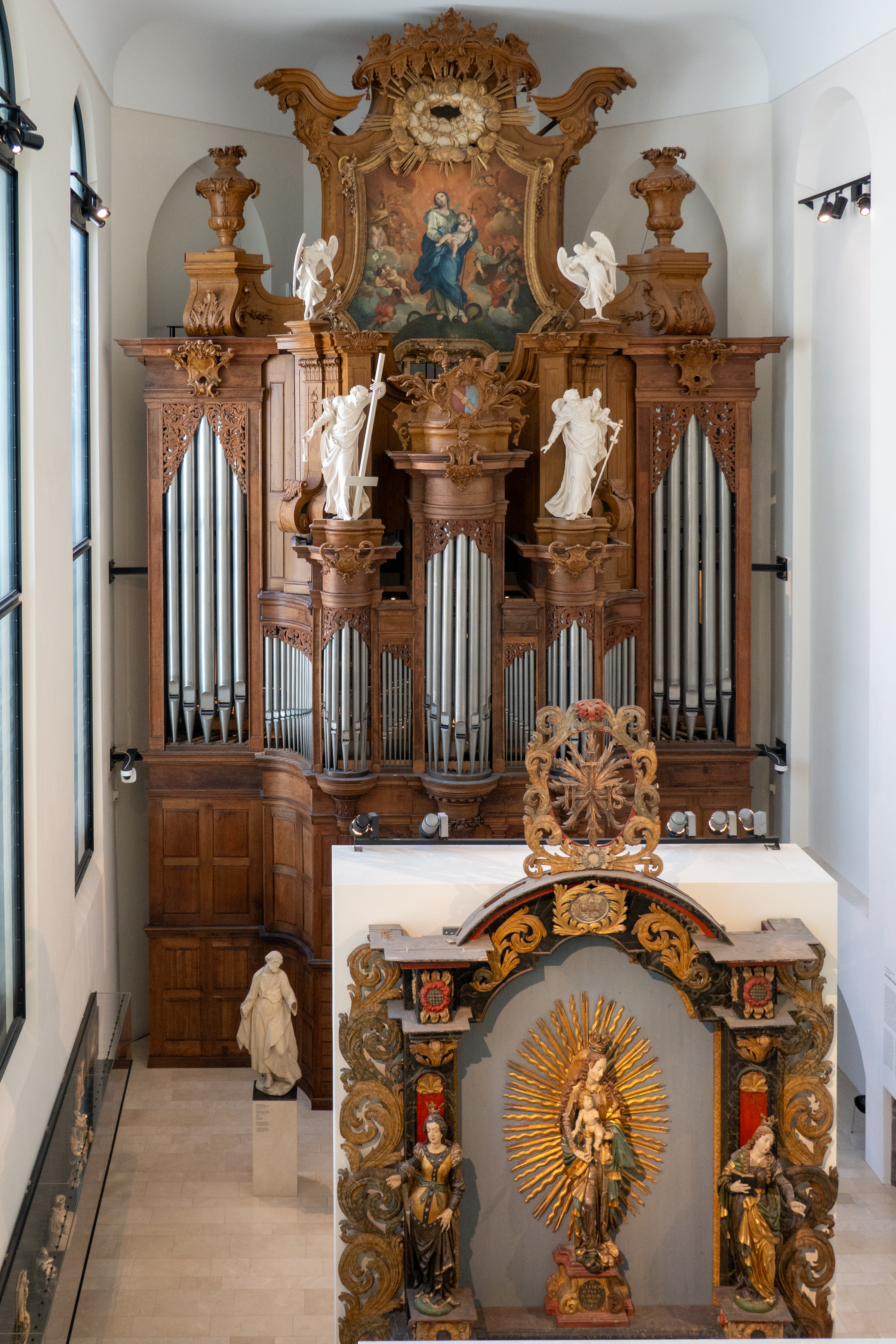
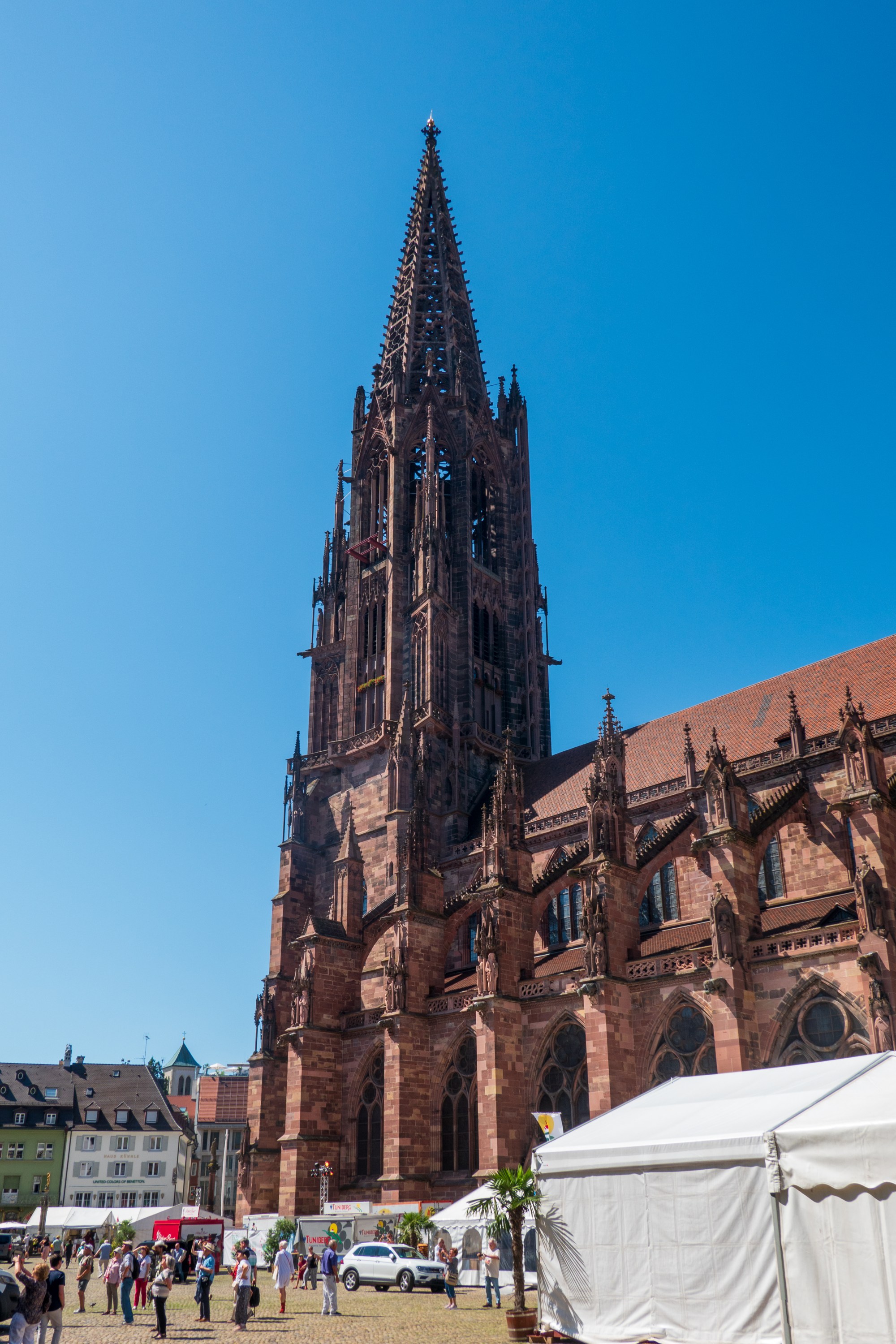
The Freiburg Minster is famously always under repair and many of the original stained glass windows and statues have been removed to the museum for display. (Local wags insist that if you see a picture of the Minister without scaffolding, it is Photoshop.) Duplicates of the statues and windows are now in the Minster and the originals are safe in the museum.  The museum was air conditioned which also felt delightful on a hot day.

Figures removed from the Minster. Note that they are carved with exaggerated perspective to make them look more natural to someone on the ground.
Rafters
Why you would want this in the house escapes me, but it is beautiful wood and ivory work.
Organ

We headed for the Schlossberg (castle rock), a hill overlooking the city, which gives a fine views of the Minster and the two large gates remaining from medieval times; St. Martin’s Tor and the Schwabentor. The more energetic can hike further to Roman ruins and other attractions.

The city from the Schlossberg.

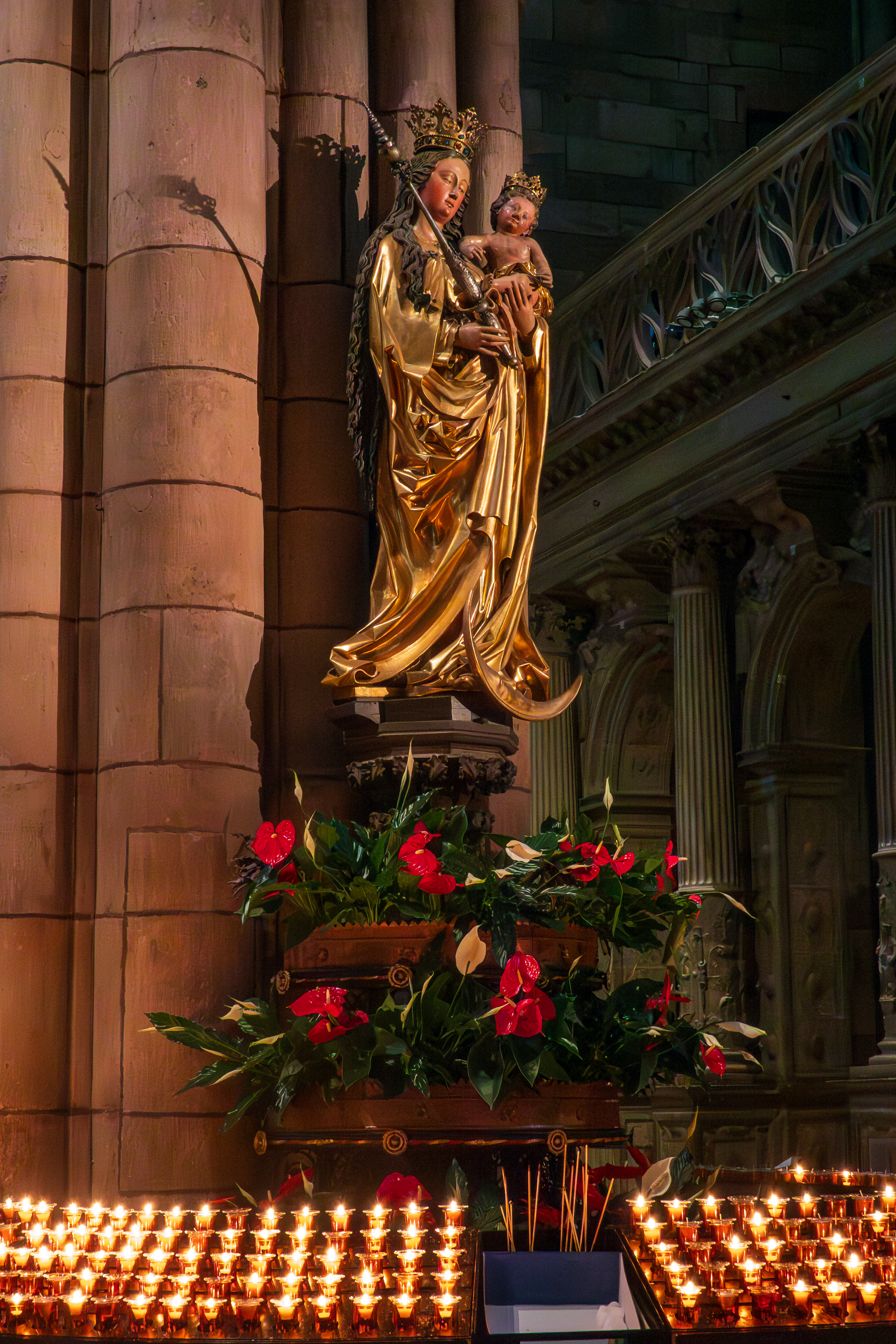
We then visited the Minster and scanned all the statues! We started with the old anti-semitic trope of Ecclesia and Synagoga flanking the entrance. (We had lamented this theme at a previous church.) The former represents Christianity and holds all of the symbols of salvation. The latter represents Judaism and is shown as blind and powerless. Sadly, we have not fully outgrown this stupidity, even in our own country, today. (The lines in the photos are a mesh to protect the statues from pigeons.)
Notice the chalice and the staff topped with a cross.
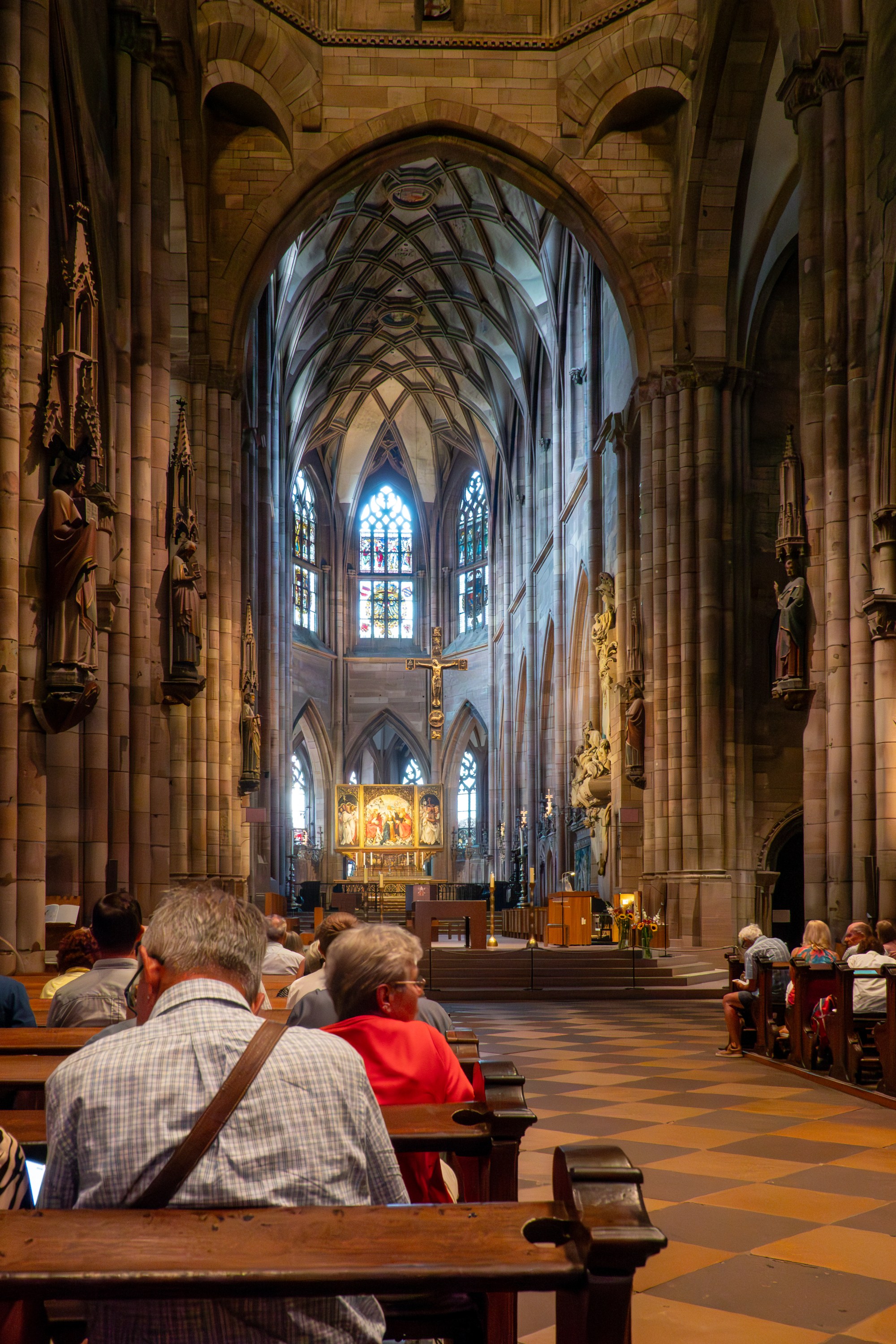
The nave, home to the four organs.
Had dinner at a great Middle Eastern restaurant.
Here the two are in a window, one on a white steed and one on a donkey, But didn’t the Christ enter Jerusalem on a donkey? Hmmm.
The famous obscene, scatological gargoyle.
(On the left.)
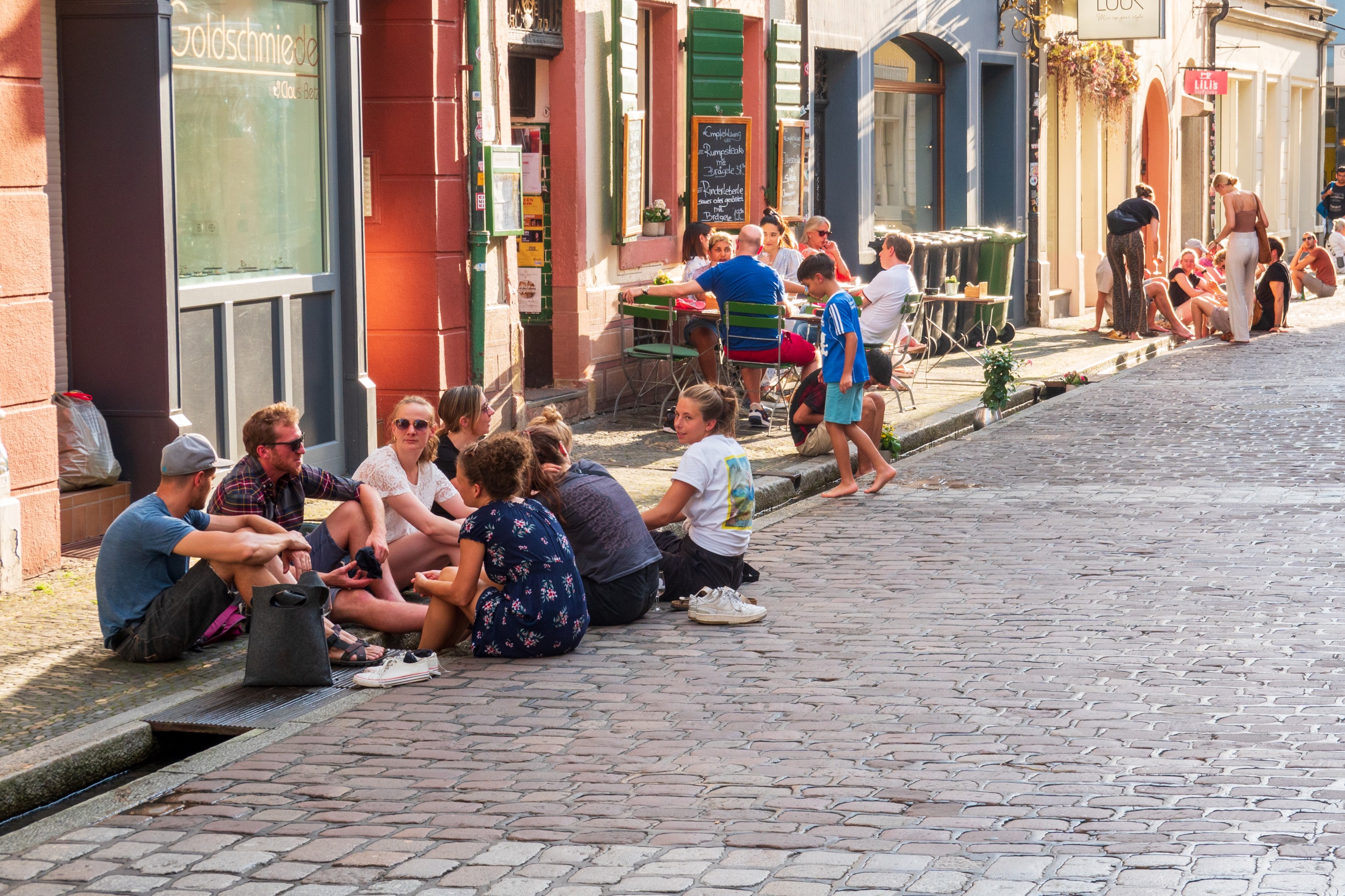
Freiburg, like some other medieval cities has water channels through the streets. People used them to cool their feet and their wine.
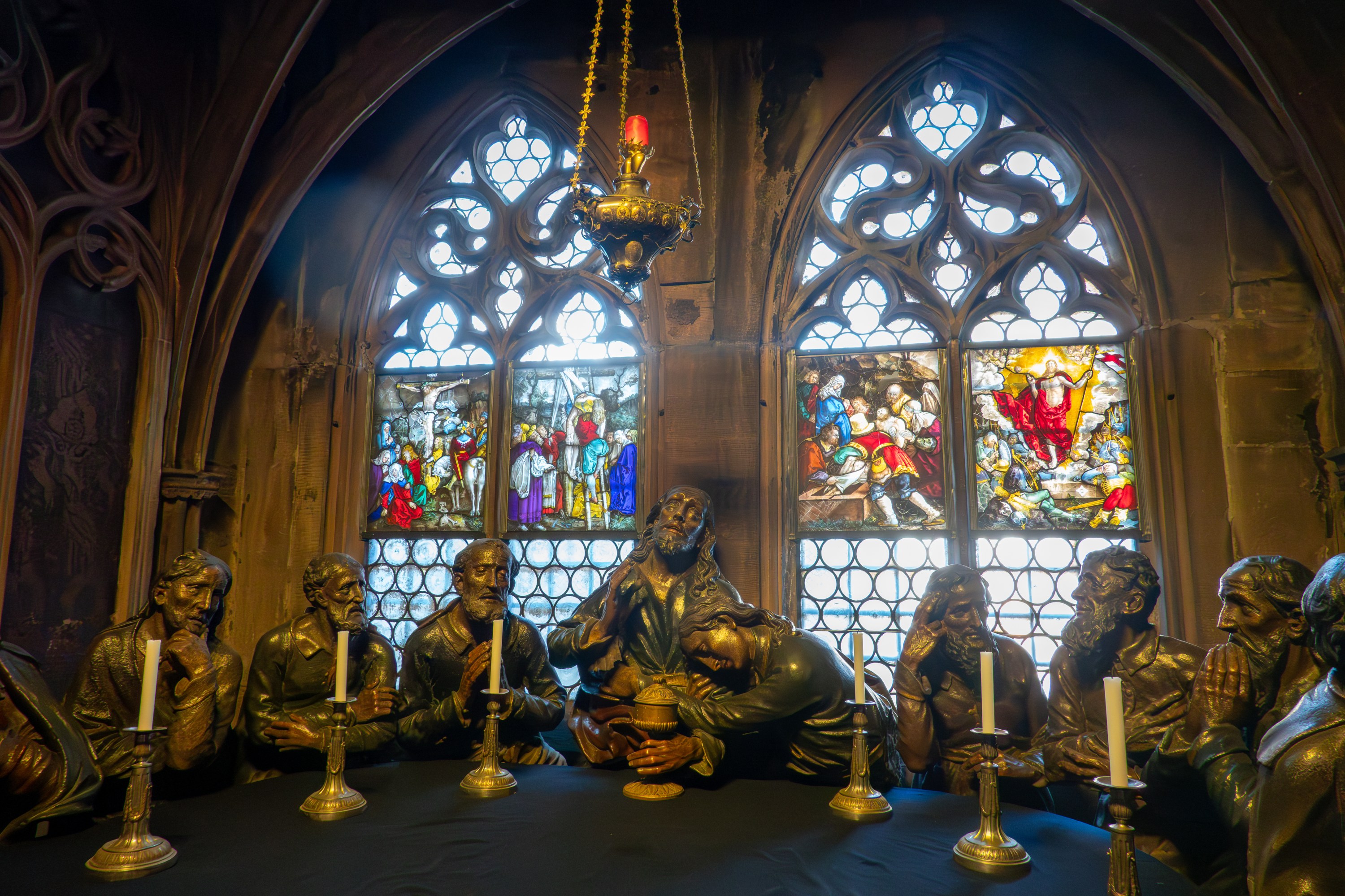
Magnificent Last Supper carving.
Blindfolded and holding a broken staff. Worse, St. Peter is crucified under her feet.
Madonna on the wall of a building. Bavaria is a bit Catholic.

We found out where to buy tickets for the organ concert and returned to the Minster as a Wine Festival was in full swing. 

We had a glass, or two.

After enjoying our wine, we moved into the Minster for the concert. The organ(s) date from the 17th century and are magnificent instruments. There are actually four organs in different locations around the church. They can be played from individual consoles at each instrument or from one central one.

Taking our seats for the concert. The main console is to the right.
One of the organs, at the left of the crossing.

We enjoyed the concert, which finished about 10:00 PM.  The crowds in the square had not diminished and the wine festival was still in full swing. As we walked away from the square, looking for the tram line, we saw a taxi waiting.  The driver was willing to take us back to Bad Krozingen! An expensive but welcome way to get home to the camper and a great end to the day.

The following day, we set out on our bikes to cycle to the nearby village of Staufen, to admire the ruins of a hill fort (burgruine Staufen) and to visit to a vineyard. (https://www.weingut-wiesler.de) We also hoped to miss the evening thunderstorm.

The Weingut Wiesler had an excellent selection of house made white wines, grown right on the slopes below the ruins. They did not have a license for a tasting – you had to buy. So we had a good chat with the owner and we managed to fit three bottles into the front bicycle bag before cycling back to the camper. And we did miss the storm!

We could have spent more time in Staufen, a town famously associated with Faust. (https://www.staufen-im-breisgau.de/staufen-en.html)

We had hoped to visit more of the Black Forest but as the main road was blocked to us by a Low Emission Zone, that was not going to work.  So we headed north to a Stellplatz at Bruchsal. Turned out to be very nice and we admired a smart expo truck. Can’t love the color, but we did admire the protective skids on the cab and roof – just what you need to protect against trees, etc. Liked the roomier DOKA (double cab) but, like a lot of Euro campers, there are nowhere near enough windows for hot weather use. And they make us look so small!

You can order your own: https://excap.de

We walked to the Schloss Bruschsal, the former palace of the Prince-Bishop.

And this is just the back approach.
Somehow, he just fits.
Impressive as it is, much of the detail is trompe d’oeil painting.

Prince-Bishops seem a most unchristian abomination, but medieval Europe had a lot of them. The Prince-Bishops certainly knew how to live well – their palaces were huge and obscenely ornate. And we keep finding more of them.

But the real reason for our visit is that the palace now contains a museum of mechanical musical instruments. (https://www.dmm-bruchsal.de) We took a tour (in German!) to discover the different instruments there.  They ranged from tiny music boxes to moving figures, and from organs to player pianos to monster fairground instruments. As a techie aside, these incredible instruments are prime examples of early programming techniques. In most cases you could load any number of different programs to play different songs. Precursors of modern sound systems. They don’t, however, play MP-3’s.

It all comes back to this. Put the pegs on the wheel and turn.
Some of the different instruments you can place in your device.
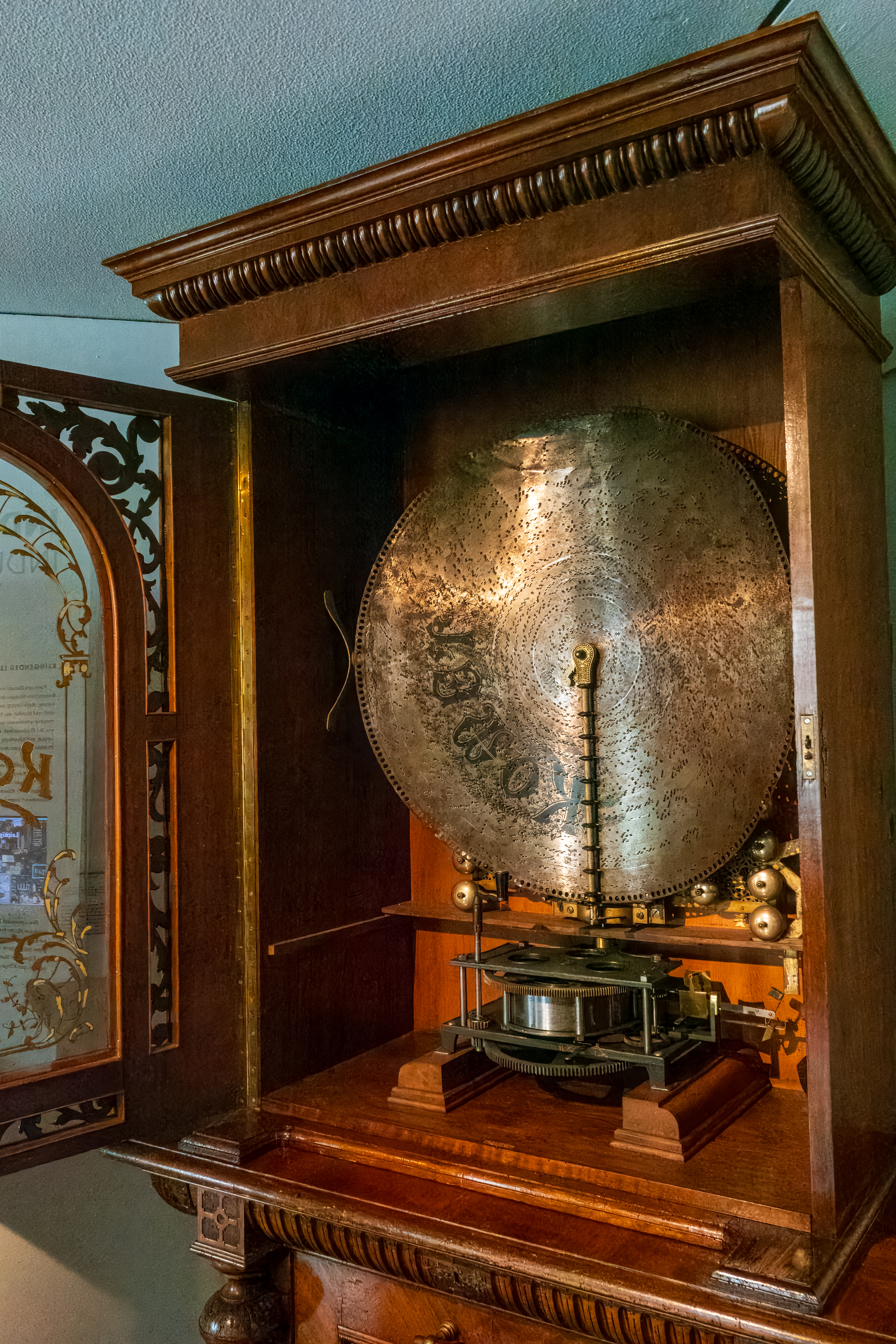
And you thought your vinyl LP’s were big? The motor at the bottom turns the brass disk which is read by the pins on the vertical arm.
This one reads the pinned drum, at the left of the picture, blowing the trumpets.
OK, all of you string players take note. At least three violin style instruments. Mechanical fingers to stop the string. That’s right, string. Only one string per instrument is actually played. The circular bow wraps around and plays all of them. The real question is, will it fit in the parlor?
The all American model.

The Sousa band is on a wagon, intended for fairgrounds and markets. All in all, a fascinating study in the congruence of technologies – programming, mechanical timing devices, and musical instruments.

Down to the Very Tip of Germany

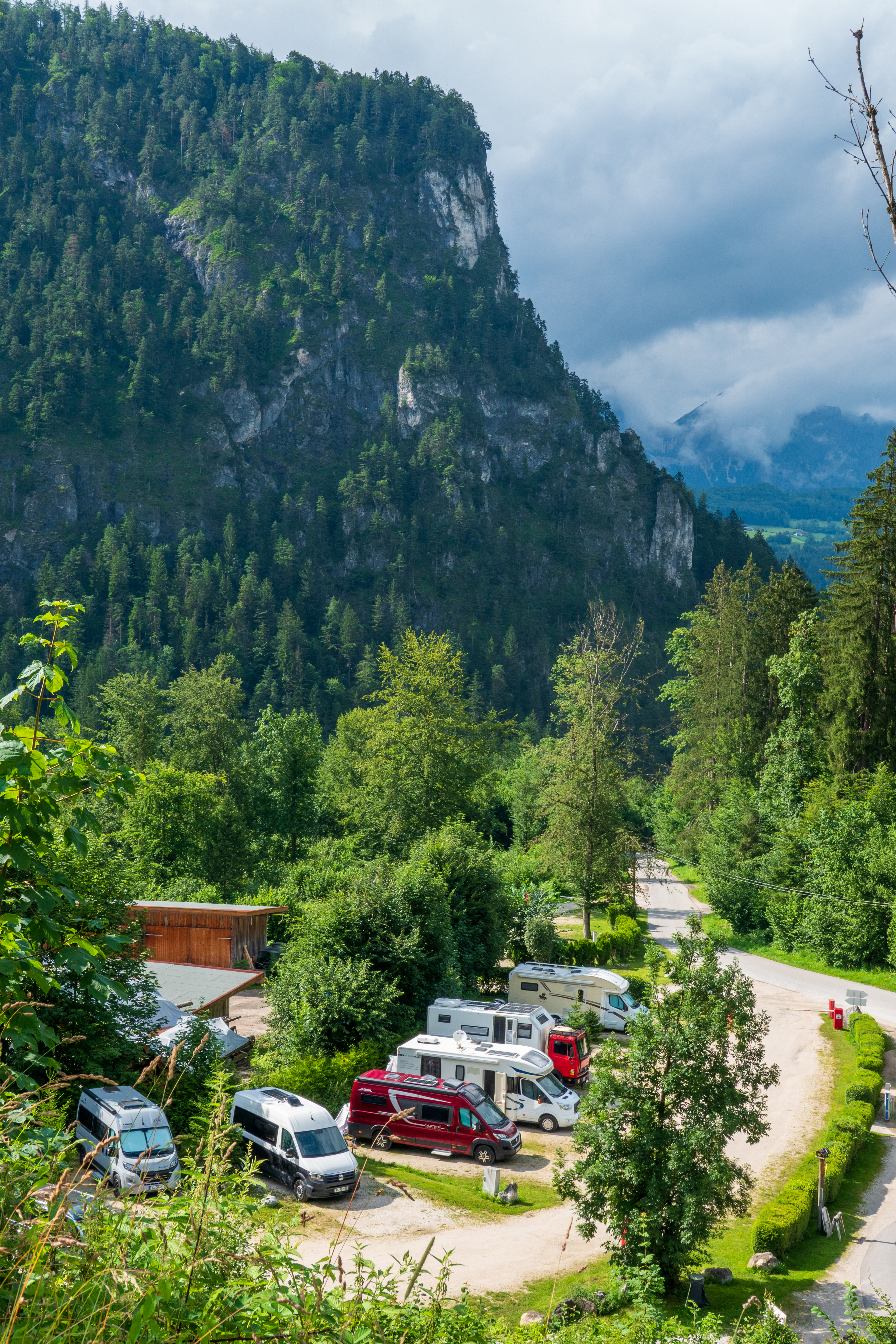
Our next stop was Berchtesgaden, famous as Hitler’s Bavarian playground. Although he and his cronies all had houses in Obersalzberg, Hitler himself had a fear of heights and did not like going up to his “Eagle’s Nest.” After riding up and down the road, we decided that he was not entirely wrong. We found space in a most pleasant Stellplatz, surrounded by high cliffs, and settled in for a visit. A visit to Berchtesgaden actually has three components; Berchtesgaden the town, the smaller town of Obersalzberg above it, and, finally, the Eagle’s Nest on the mountain overlooking everything.

View from the campground reception. Had to hike up here to dump trash. Breathtaking!
When the clouds lifted, the Eagle’s Nest was visible.

It is an easy bike ride to the town, although the steep road down to the main road was off-putting!

The next day, we set out to visit Obersalzberg and the Eagle’s Nest. Given the distance and the grades on the road, we decided not to attempt the trip by bicycle. The weather was not great but the forecast was not any better for the following day, so, we headed to the bus stop near the campsite to take the bus into the bus station at Berchtesgaden.  There we would change buses to head up the mountain to Obersalzberg, and then take the special bus to the Eagle’s Nest.  It did not work out quite like that! 

In a hint of what was to come, the first bus to Berchtesgaden was full and did not stop. Then, when we got into town, the bus to Obersalzberg, was absolutely full and left without us. The next bus would leave in an hour. This was frustrating to say the least, but there was a convenient taxi rank nearby so we shared a taxi with a young man from Switzerland who was going to hike to Eagles Nest!  Brave, and fit, lad! And so, ten minutes later we were at the bus station in Obersalzberg. We decided to go all the way to the Eagle’s Nest as it did not look likely to rain in the immediate future, so we hopped on that bus. The road is narrow and only one lane, so all of the buses go up and down in convoy. The all electric buses have an advantage on the descent as they have electric motor braking! It was spectacular. The Eagle’s Nest was never anything but a party room/lodge for holding receptions or, if you were in with the in crowd on a sunny day, sun bathing. So once you get there, there is not a lot to do. The primary purpose of the Eagle’s Nest was diplomatic, to impress foreign dignitaries, so it is mostly dramatic reception rooms, now turned into dining and event rooms.

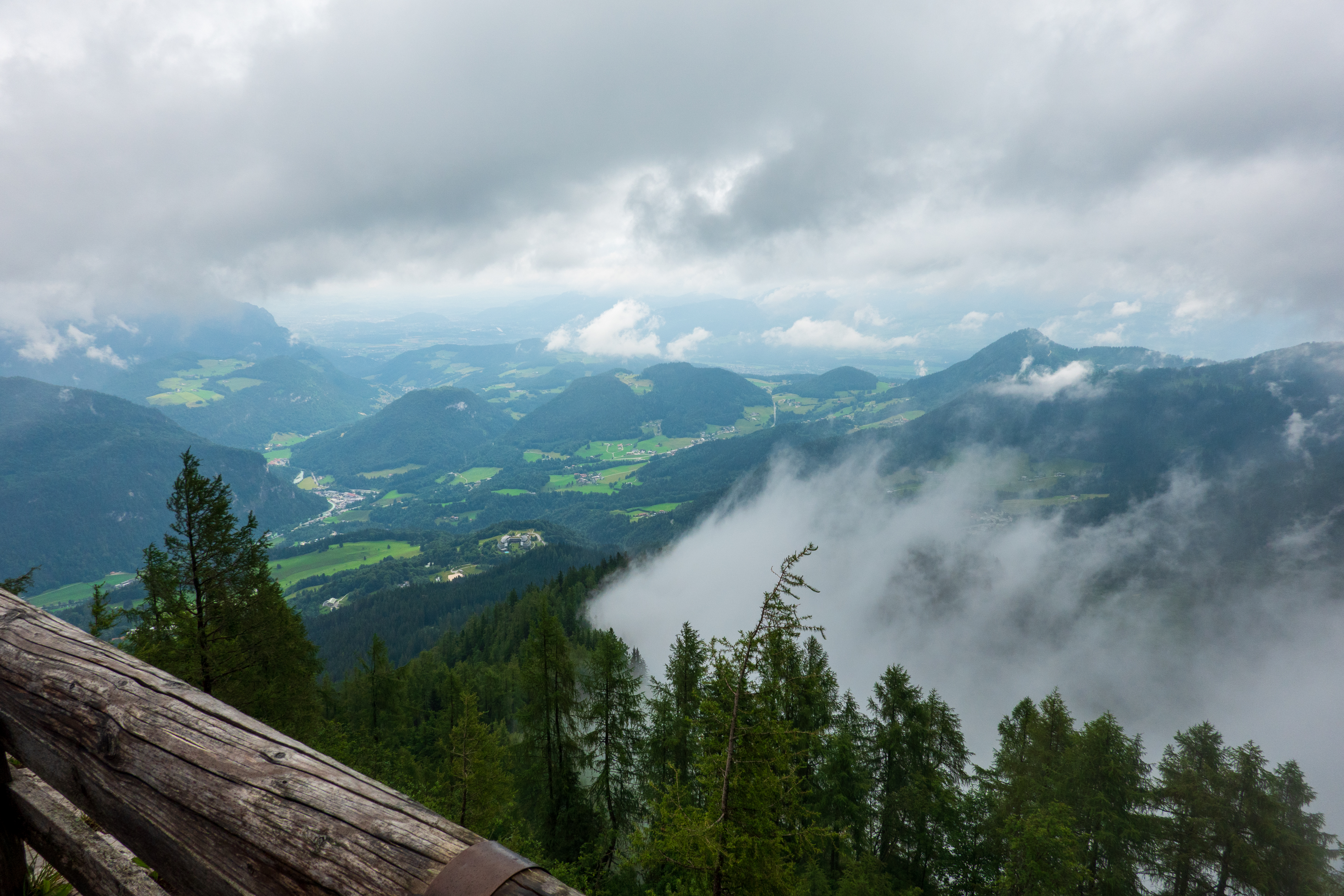
A bit cloudy!

With no sun, we headed into the restaurant, which was of course full.  A very nice couple invited us to join them at their well placed table in front of a window.  We ordered soup and enjoyed it while watching the clouds occasionally break to give a view for a moment or two.  We were able to get a couple of views of the valley, somewhat obscured by clouds but still spectacular.

When the clouds parted, the view was, indeed, amazing.
The last part of the trip is from this upper parking lot, through the tunnel, to an elevator which takes you up to the building on top.

Back down to Obersalzberg, we spent a couple of hours in the Documentation Center.  It was a somewhat depressing visit as it was clear that the Nazi interest in the area was not beneficial to the original inhabitants. While great numbers were fervent supporters, many were moved out of large areas of the town to make a special, secure village for high Nazi officials. But we learned a lot.  At a time when Americans are whining about “erasing history” by taking down Confederate monuments from the 1920’s, the Germans are making sure that today’s school kids get a good view of the Nazi era, up close and personal. It is sobering – both in how easily people got sucked in, and the tremendous price they paid in the end. For example, letters from a soldier at the front span the range of giddy triumph through to total despair. And a lot never came back.

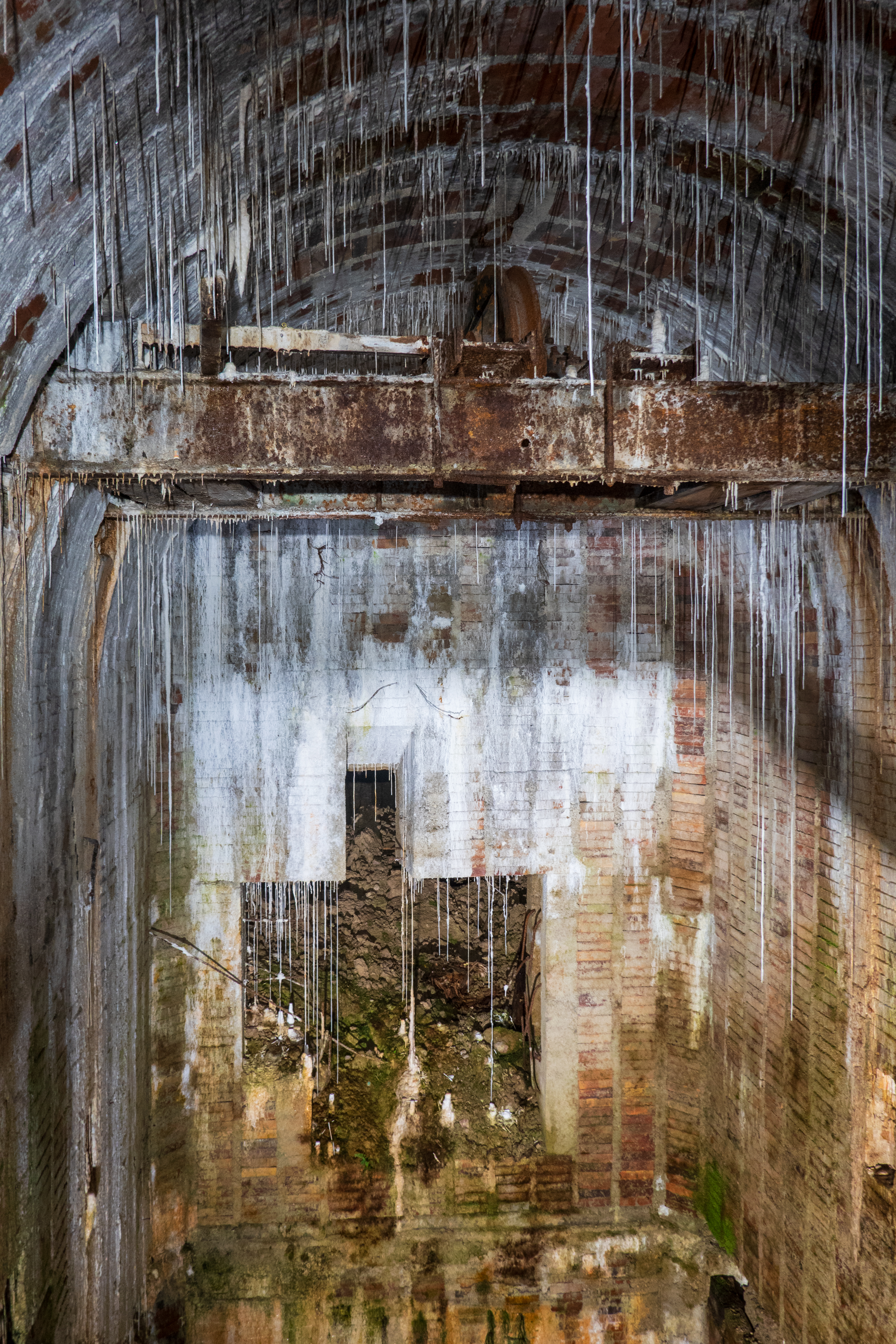
In 1943 the Nazis panicked about the danger of air raids and started a network of tunnels, several kilometers long,. You can visit a few of them. (The US air force actually made the decision not to bomb the area – by the time they could actually reach this deep into Germany, General Arnold did not want to try to kill Hitler as “he was making so many mistakes.”) The tunnels connected everybody’s houses, the SS barracks, and provided a complete alternate capital from which to continue the Third Reich after the fall of Berlin. Fortunately, they were never quite completed or used. There is a deep dive website here: https://www.thirdreichruins.com/bunkers.htm We saw only a tiny part but it was impressive.

This unfinished section of the blast doors shows the massive scale of the works,
Denise showing the elaborate finishing of the tunnels. Once they were done, you had no sense of being underground.
There were offices, kitchens, latrines, showers, and everything else.
Multi-story equipment room, now filled with cement stalactites.
The tunnels have service tunnels under them. A US soldier used a hand grenade to break into the lower tunnel.
The grenade fragments damaged the tunnel wall.
French graffiti. “2nd Armored Division” and the date, May 5, 1945, flanked by two Lorraine crosses. Middle line may be three initials?
Eagle’s Nest from Obersalzberg.

We then took the bus back to Berchtesgaden and connected with our bus back to the camper. Much easier this time.

The next day we biked into Berchtesgaden and went to the Salt Mine to book at tour.  The next tour was in a couple of hours, so after a quick supermarket visit we went for lunch at the restaurant at the Salt Mine.

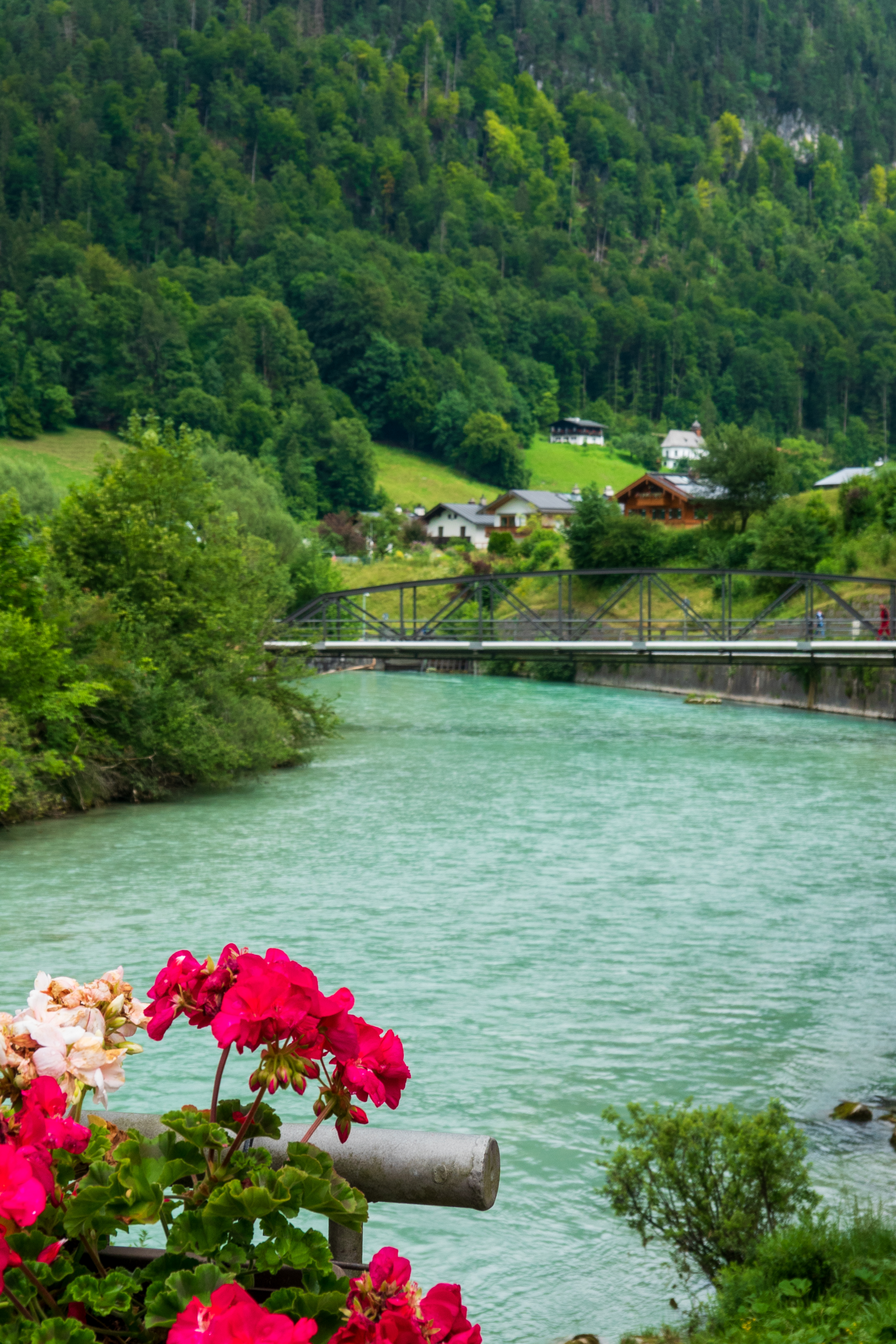
The river has the pretty jade color of glacial runoff.
Tourist shot of the pretty Bavarian architecture.

After lunch we garbed ourselves in coveralls and off we went on a little train with mere centimeters of clearance on every side.  The tour included two slides (great fun!), some walking and finally another train to take us back to the start.  (https://www.salzbergwerk.de/en)

The tour was very informative, explaining how the salt was mined. The mine has been active since 1517 and by the 1800’s they were using water, which is pumped in to dissolve the salt. The brine is then pumped out and taken to plants for drying and packaging.   A great tour and well worth it. An interesting contrast to the sea salt collection at Aigues Mortes or the lake collection at Lac Assal, in Djibouti. (https://pbase.com/diplostrat/image/76376469)

A Night at the Opera

More History and Culture, with a tip of the hat to the Marx Brothers.

We left Wittenberg and headed south to our next stop in Bayreuth.  The Stellplatz had a great location, only about 10 minutes away from the old town by bicycle.  

The town was quite small and had a pleasant pedestrian walking street lined with shops and cafes. 

Across the street from the opera house.

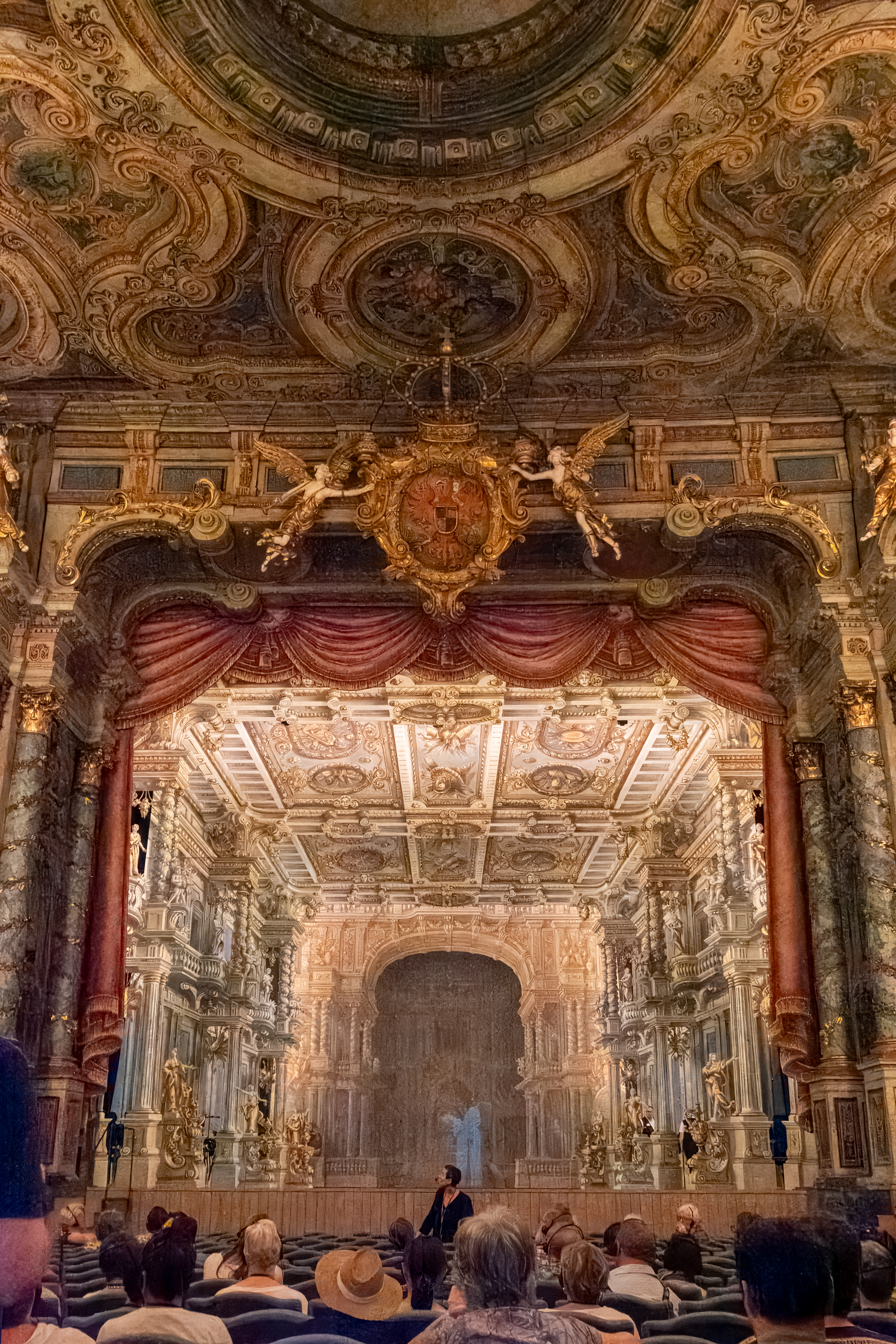
The highlight of the old town, from our point of view, was the Margräfliches Opernhaus. It was built from 1744 to 1748, by Margravine Wilhelmine, wife of the Margrave Friedrich III.  She was a great music lover and a musician herself.  The exterior building was built of stone, but the actual opera house was built of wood and painted canvas, and set inside the outer structure. (And you thought it would be nice to have your own band room!)

The opera house is inside the structure to the left. The outside structure is completely separate.

It was intended as a temporary structure, built just like a stage set inside the outer building. It looks like an ornate Italian palace, but it is really just painted wood with trompe d’oeil paintings on broad canvases everywhere. The whole effect is stunning.

Note the projected figures moving around the stage.

The stage area consisted of four zones of different sizes which gave the impression of distance from the front of the stage. By placing actors at different distances on the stage, you could create giants and monsters. Again, none of this is real, even the curtains are simply paintings.

Crest over center stage.
Be not deceived, this is not a painting in a frame, even the frame is a painting.
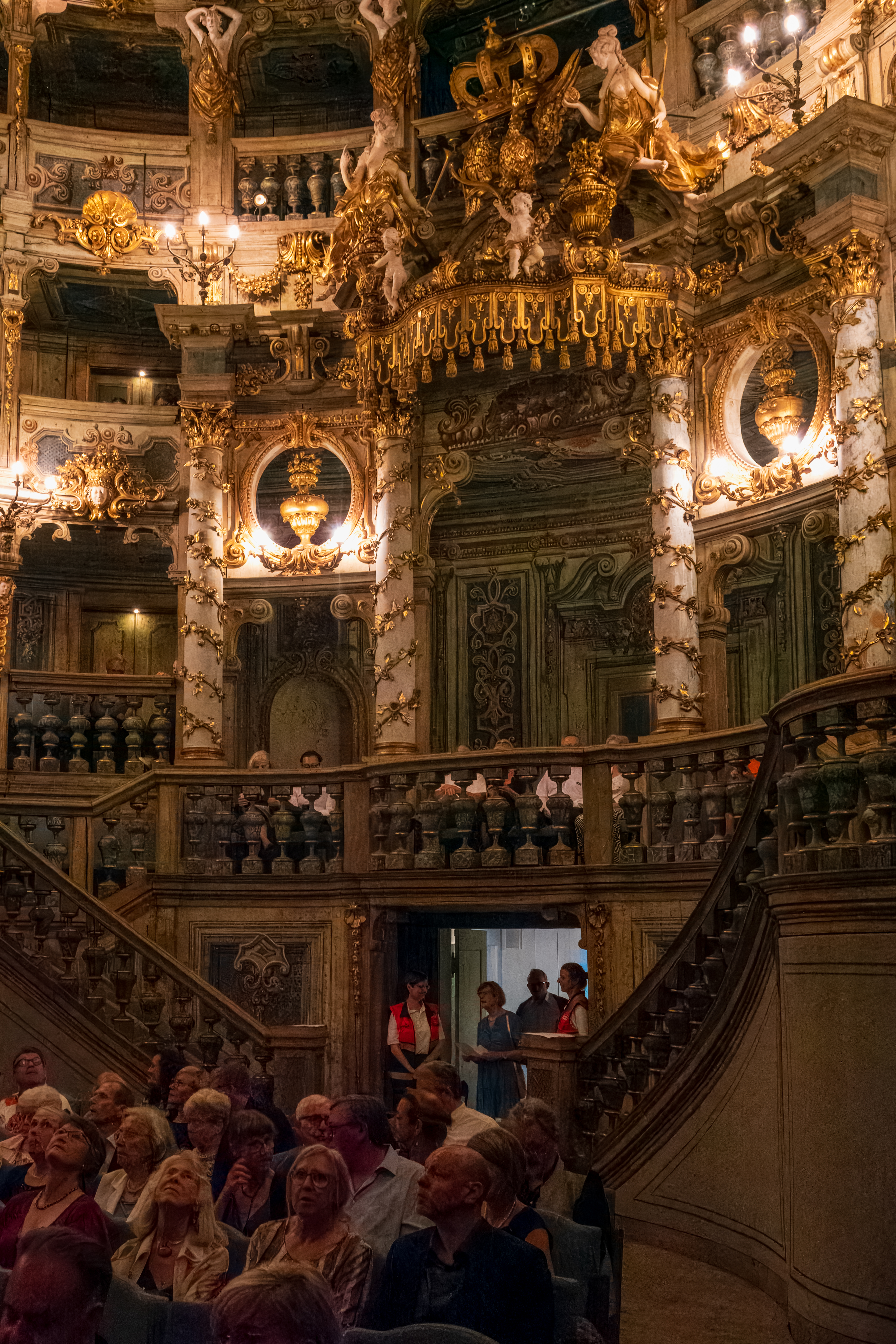
Beautiful box seats.

We asked an attendant if there was any music planned for the evening and were told that there was a Wagner Opera Gala that very night.  We had to buy tickets before 1:00 PM when the ticket office closed, so at 12:50 PM we went rushing off to the ticket office! Success! We would be back.

Famous prior inhabitants of Bayreuth were Richard Wagner and Franz Liszt.  We also went to the Wagner Museum, which we found interesting.  (https://www.wagnermuseum.de/en/) Wagner was married to Liszt’s daughter!

Felt odd waiting for a concert not wearing a suit.

The concert, a series of overtures and arias, sung by soloists from all over the world and by a local men’s choir, was excellent.  The orchestra was from Prague.  We suspected the soloists (eight or so) were there to rehearse for the Wagner Festival which was due to take place a couple of weeks hence.

And we’re off, with the Flying Dutchman overture.
Everybody was photographing the hall.
The hall from the not-so-cheap seats.
Looks like the Muppet Show.
Denise finding our seats.
The royal box.
Curtain call.

The performance was excellent, with the singers even better than the orchestra. The acoustics were interesting. The wooden hall did not ring like a stone cathedral, and this made for a rather articulate sound – easy to identify individual instruments. Voices projected very well so somebody knew what they were doing.

Note for Foto Phools: Haven’t got a good way to carry the full frame Nikon on the bike, so all of these pictures are from a one inch sensor in the little Sony, mostly at ISO 64k. A LOT of magic software involved here! Amazing how well some of these cleaned up.

Wagner actually hated this hall and built his own theater to better portray his works, a distance away. One of his innovations was to hide the orchestra under the stage so that the audience could not see the musicians and be distracted from the singers on stage.

While the actual festival is held in Wagner’s theatre, we thoroughly enjoyed our concert in the Opera House. 

And the projected thunderstorm held off until we made it back to the camper just after 10 pm, abandoning the crowds watching Germany play in the EU Soccer Tournament on the big screen down town!

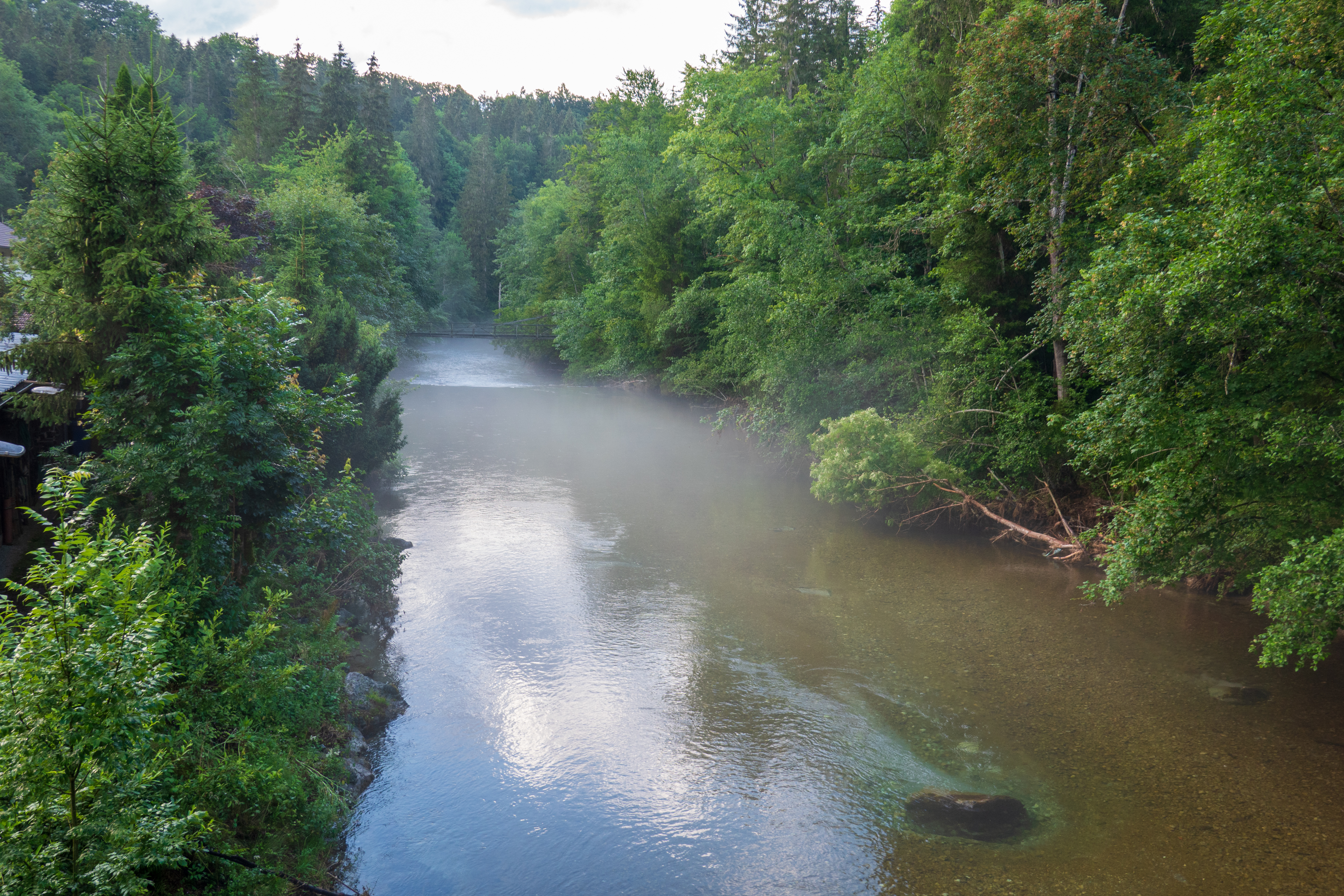
We continued our route south and stopped for the night at the Maxlmuhle Wald Restaurant.  (https://maxlmuehle.de) It was a lovely spot beside a river and we enjoyed dinner there. 

Some of our favorite campsites are not campsites.
Mist on the river.

We admired the beautiful flowering window boxes, which we then saw all over Bavaria.  In fact, many of the towns, in which we have stopped, have had the most beautiful flower displays along the roads, in roundabouts, in gardens and in the window boxes of the houses.  It is a pleasure to view them.