Author Archives: DiploStrat

Volcanic Violence

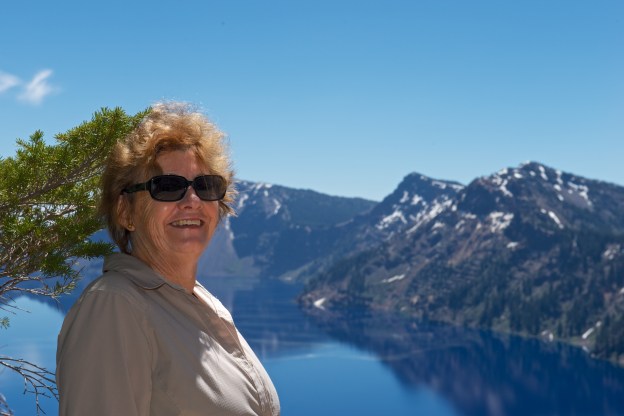
We then started a series of visits to sites of great violence, volcanic violence, that is, beginning with Crater Lake.  We were still early in the season and part of the East Rim was closed as it was still under snow and we were too early for any boat rides on the lake or tours of the rim road, as June 26 is the start up date for those.  But after educating ourselves at the Visitor Center, we began visiting the various viewpoints, walking along the rim.  It is a most beautiful and awe inspiring sight and the color of the lake is a deep blue. We were interested to see a considerable amount of algae bloom in one section of the lake, presumably due to the light snowfall of the winter.  A mere 16 feet instead of the more usual 45 feet!
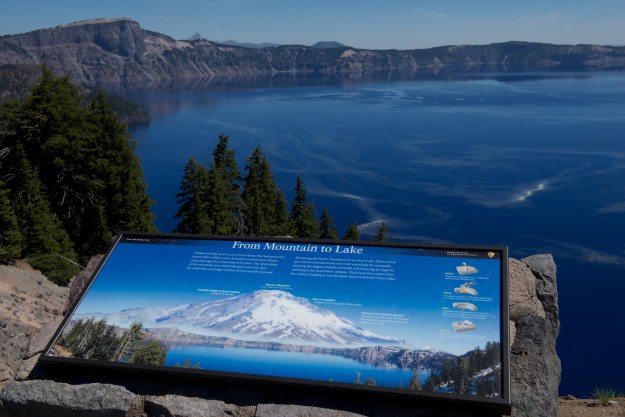
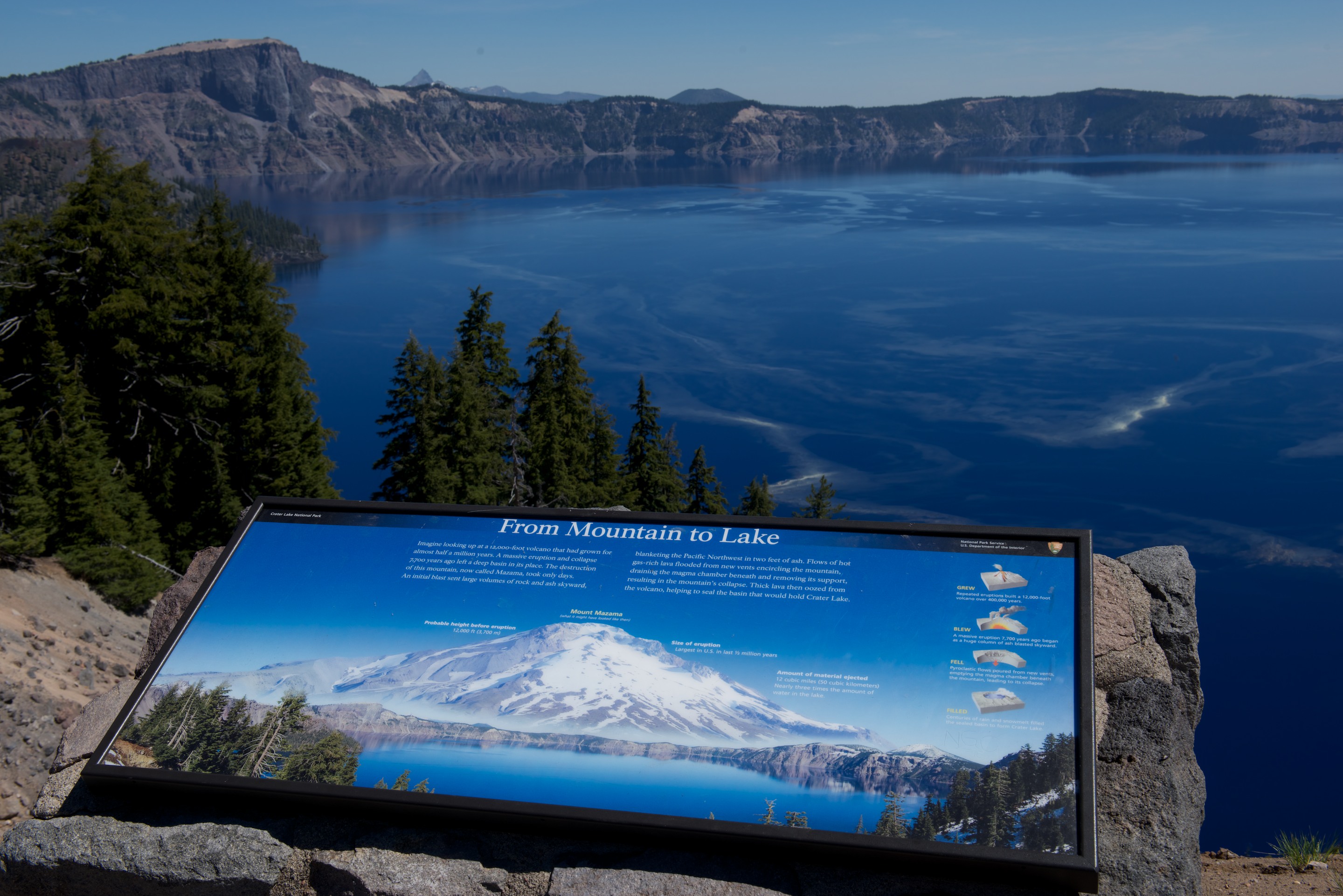
_ND84352As most know, Crater Lake is a caldera left after the explosion of Mount Mazama, just over 7,000 years ago. Interestingly enough, the traditions of the native Americans who live in the area are very accurate in describing the eruption. Native American artifacts, found under the Mazama ash, confirm that they were living in the area prior to the eruption. The Mazama eruption is unusual in that subsequent eruptions sealed the bottom of the crater and thus trapped the rain and snow melt water. There are no rivers that flow either in or out of the lake and thus the water is of extreme purity. There are, of course, many such caldera in the United States, Mount Saint Helens being one of the most recent and Yellowstone being the largest. Fred first discovered a volcanic caldera at Gunung Bromo in east Java and has been fascinated by them ever since. (https://en.wikipedia.org/wiki/Mount_Bromo) A visit to Crater Lake was a lifetime dream. We drove the West Rim road and then left, heading north to Bend, Oregon, where we had a great pizza for dinner!
_ND84354

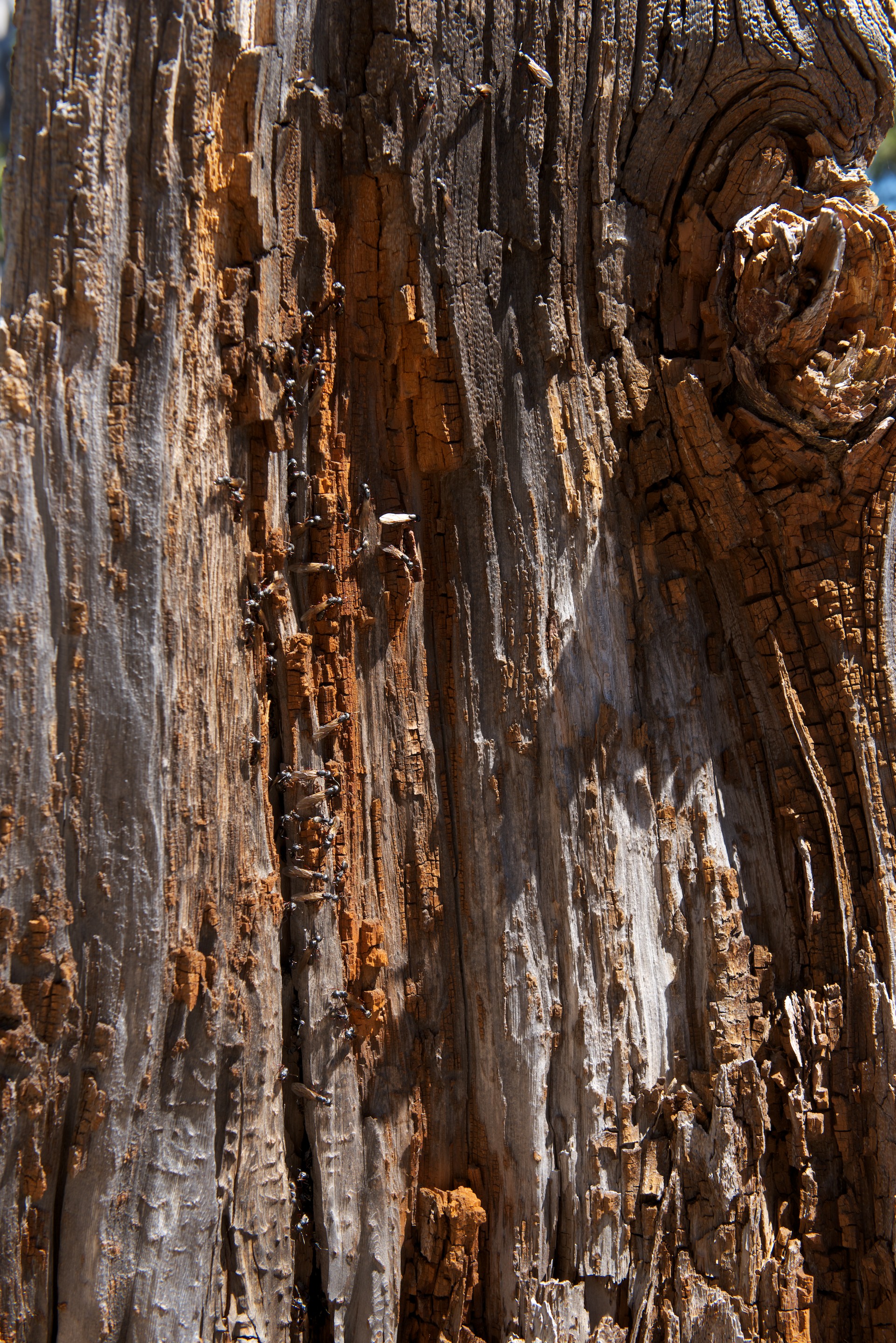
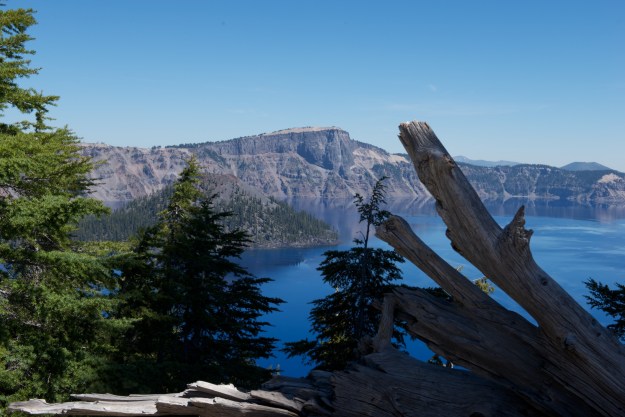
Ants chewing their way through a stump. (Click twice to expand.)_ND84360

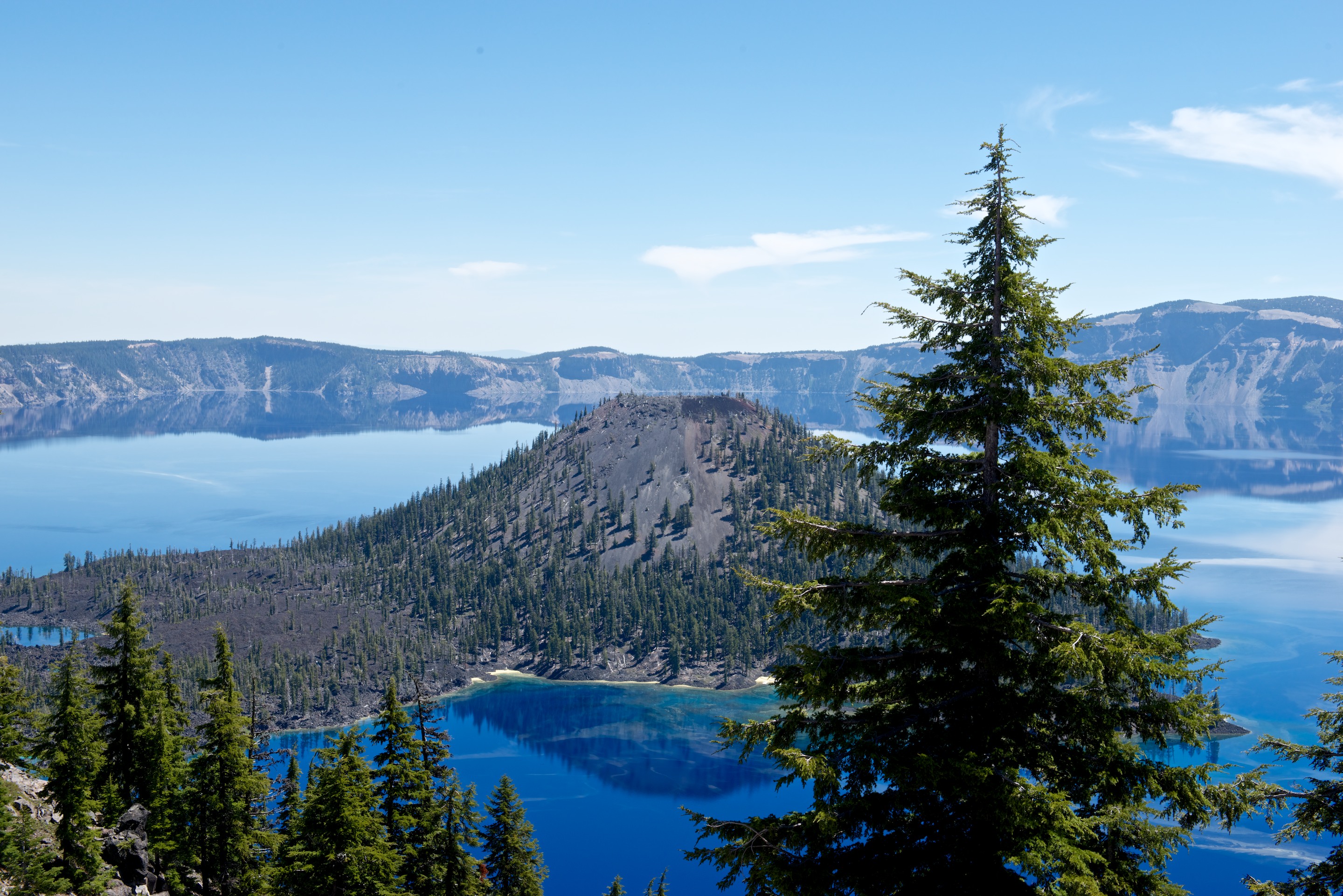
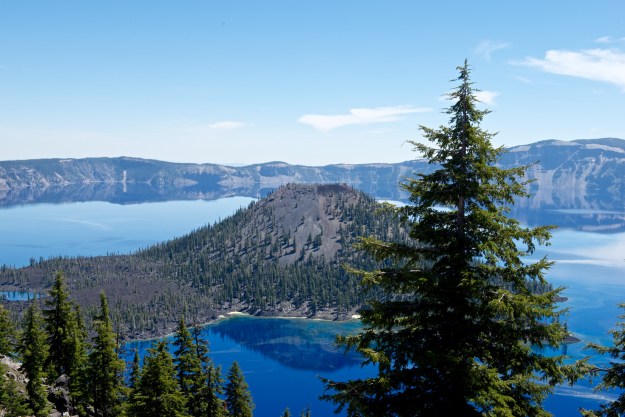
Wizard Island is a cinder cone that grew up through the lake._ND84366_ND84357
While near Bend we visited the High Desert Museum, a fascinating spot with historical displays and some native animals (most of whom had been wounded or were unable to be released for some reason).  (http://www.highdesertmuseum.org) The exhibit on the Oregon Trail was fascinating with a wide selection of photos and clothing as well as artifacts.  The Indian exhibit was interesting but we most enjoyed the river otters.  We had not seen river otters since we lived in Coral Springs and it was such fun to see them swimming and racing around.  Fred also liked the raccoon and the bobcat.

Heading back across the Cascade Mountains we drove through beautiful slopes of pine trees.  The scenery in this part of the United States is amazing; it keeps getting better and better.  But the temperature kept rising and it was getting hotter and hotter.  Passing a Ranger Station, it read 98F!  We decided that a night of air conditioning was in order, so we stopped at an RV Park on the Mackenzie River.  It was not an evening for a primitive site; Denise demanded her air conditioning!   It proved to be a delightful spot and we were given a site right on the river, which was quite loud at that point due to rapids, and under shade trees.  We spent a delightful evening watching rafters shoot by and then slept well in our cool Tiger.

Tiger Adventure Vehicles source their solar equipment from a company named AM Solar, in Springfield, Oregon. We took advantage of the opportunity to stop in and see their facility and to look at their new line of Lithium batteries. We nearly missed the shop as their sign is tiny, but the grounds are a glorious garden overlooking a stream. Fred had a great conversation with one the the technicians and admired the mockup of their new batteries. There are many tempting advantages to Lithium batteries, but the existing batteries on Ndeke Luka work so well and have the advantage of being fully paid for. Also, the demand for AM Solar’s new Lithium batteries is so great that they are backlogged several months on installations. There may be other companies in the business that can be trusted to sell you good solar equipment and more importantly, instal it correctly, but AM Solar is the one we always recommend. (http://amsolar.com)

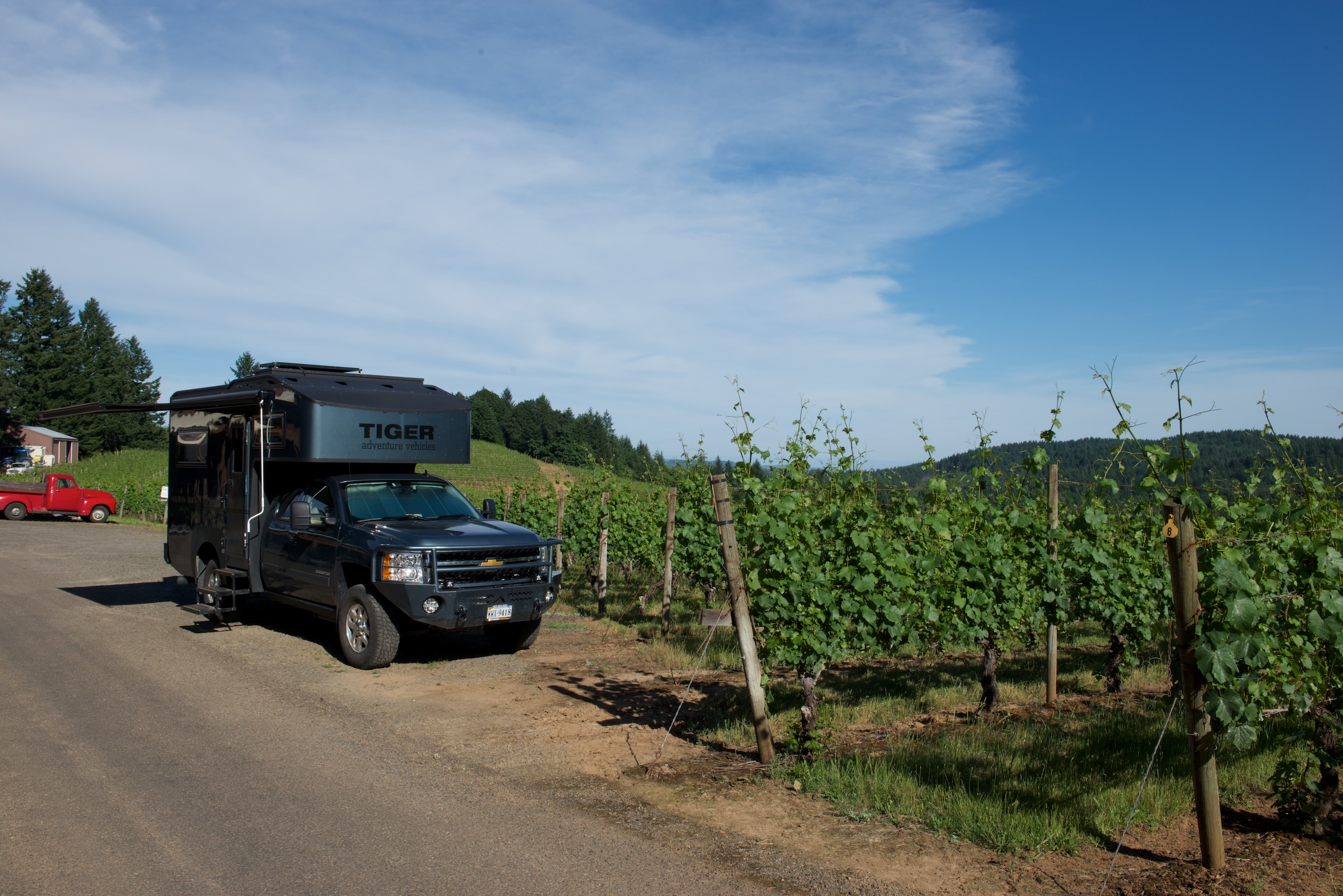
We camped at the Kramer winery, another Harvest Host member, not too far from Portland, Oregon. (http://www.kramervineyards.com) We had a wonderful evening chatting with staff and a couple of intrepid bicyclists who had found their way up the hill, and getting to know Cosmo, the black lab cross, who lives there.  Ignoring Cosmo, Norlina Bleu enjoyed a wild, off leash ramble and went to bed a happy cat. Another beautiful spot to enjoy and of course, we purchased some more, OK, a lot more, wine!
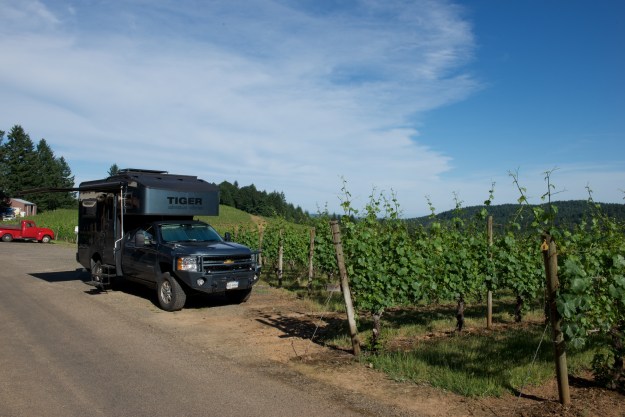
_ND84374

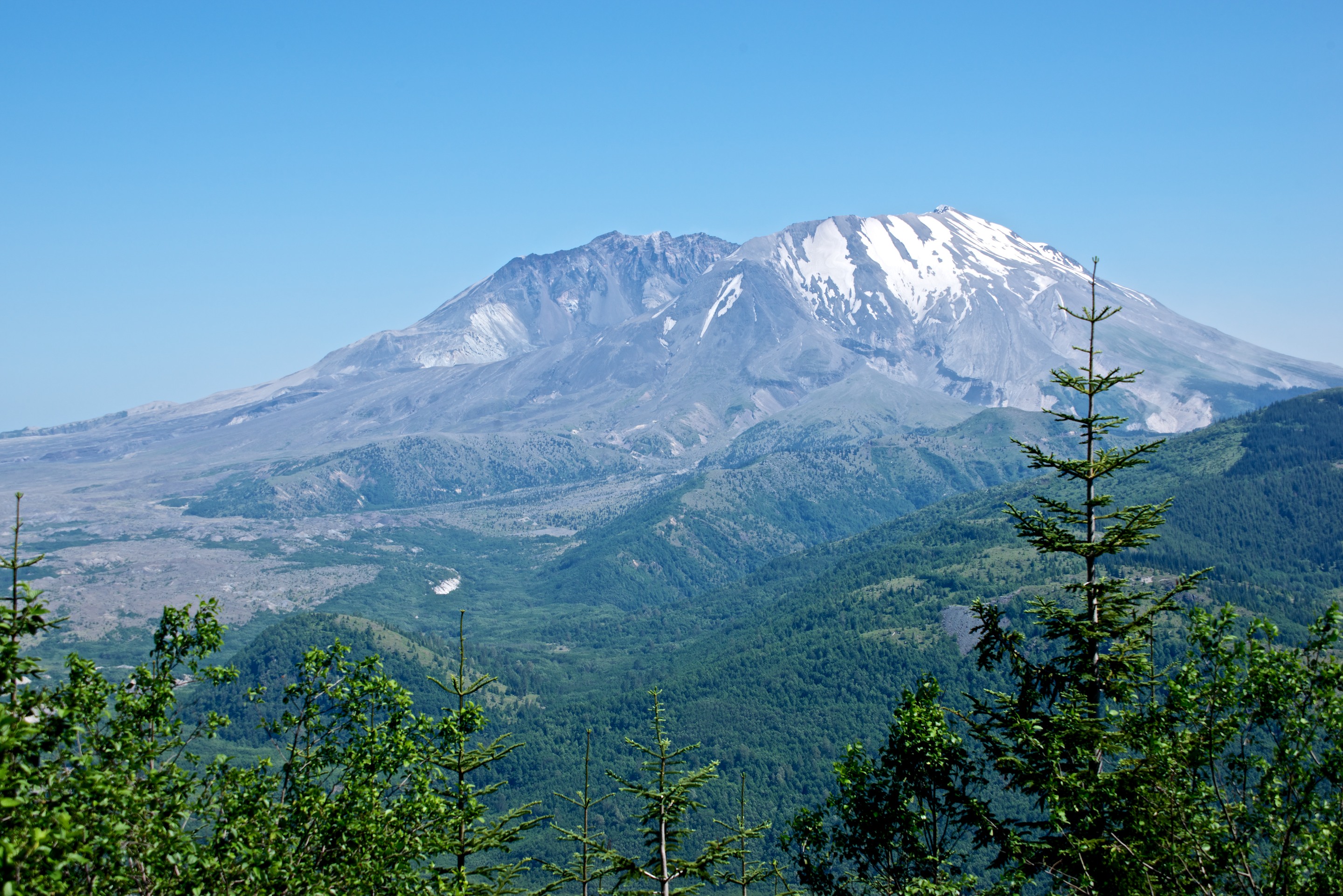
Following our violence theme, we headed next to Mt. St. Helens;  after learning about the actual event and reading some of the poignant stories, we headed up the mountain itself through the blast area to the Johnson Observatory where we took photo after photo and climbed a short trail to get the best views.

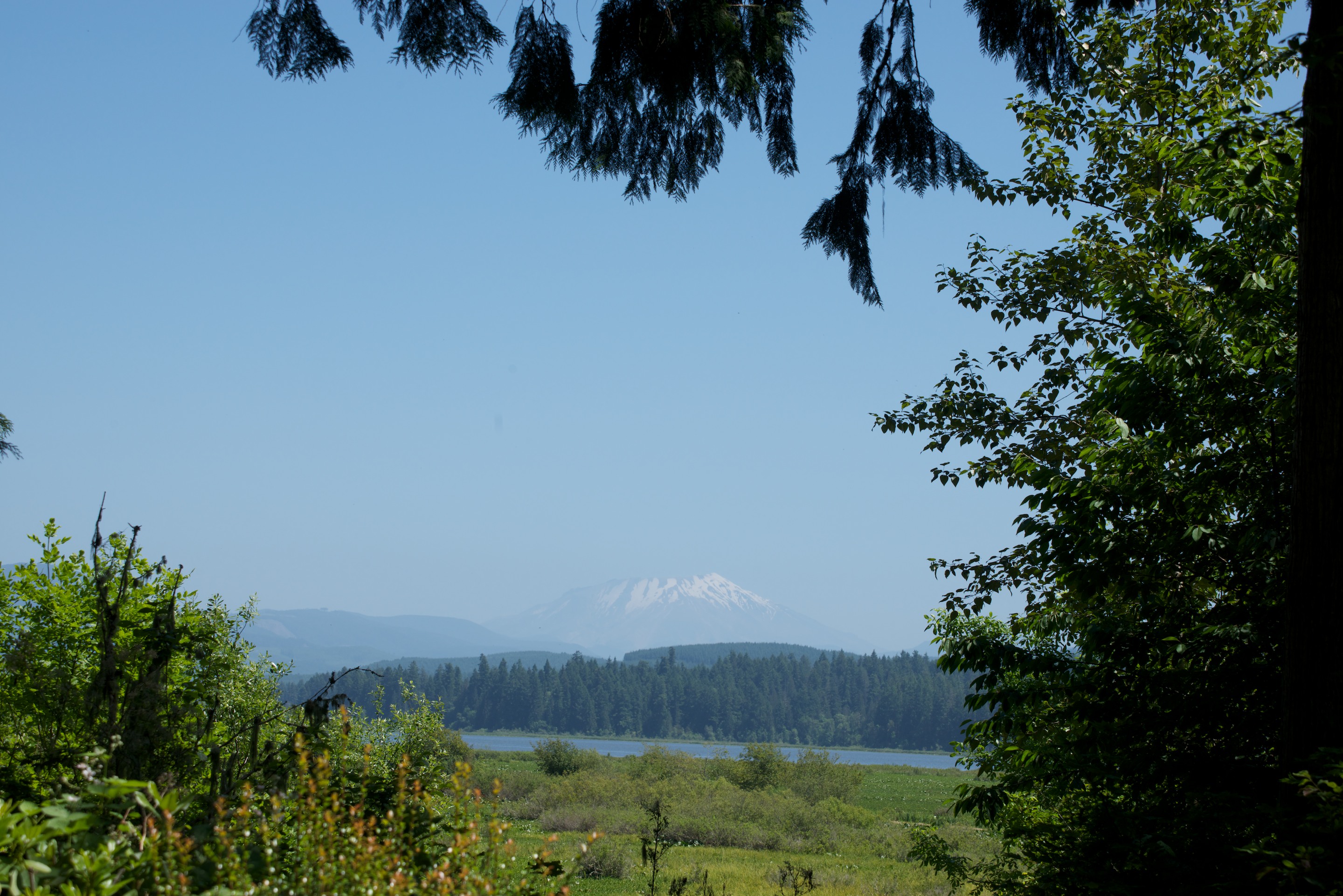
First view of the mountain in the distance._ND84385
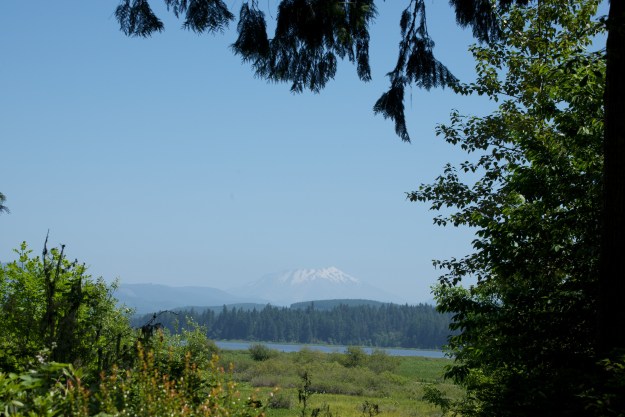
As you get closer, the mountain gets bigger and appears to be surrounded by forests._ND84394
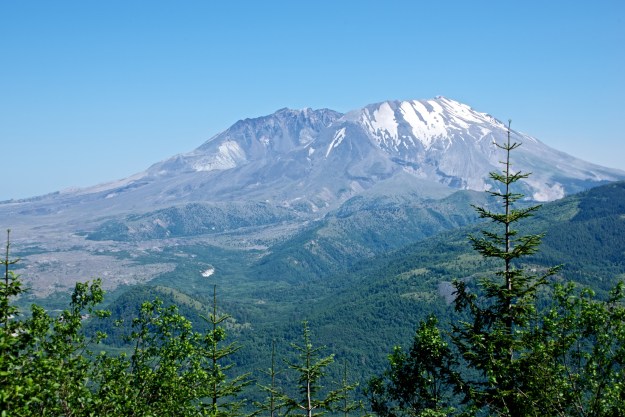
 

Get closer still, and you notice the vast areas that are still denuded of trees, thirty years later. The new crater is also clearer._ND84396
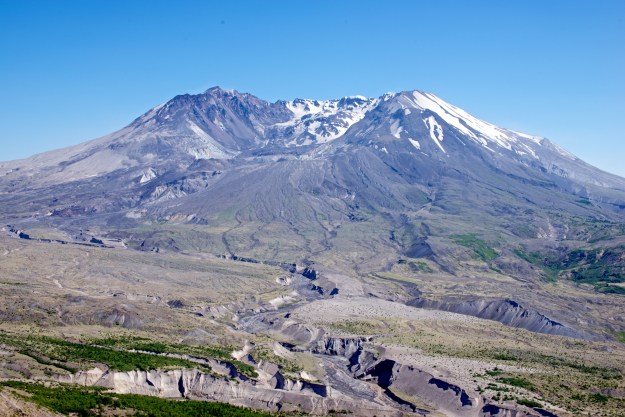


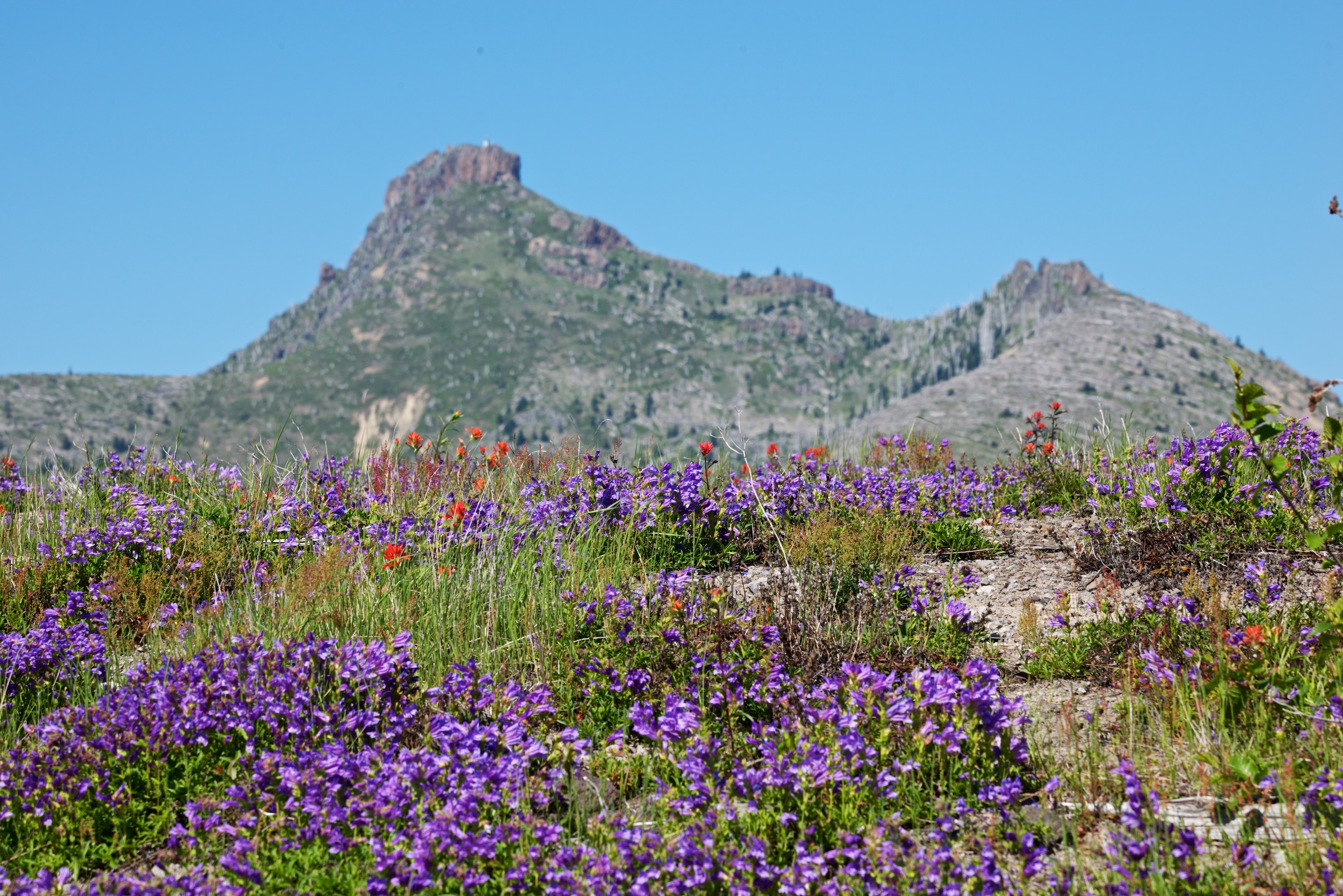
There were riots of wild flowers everywhere._ND84401 _ND84407

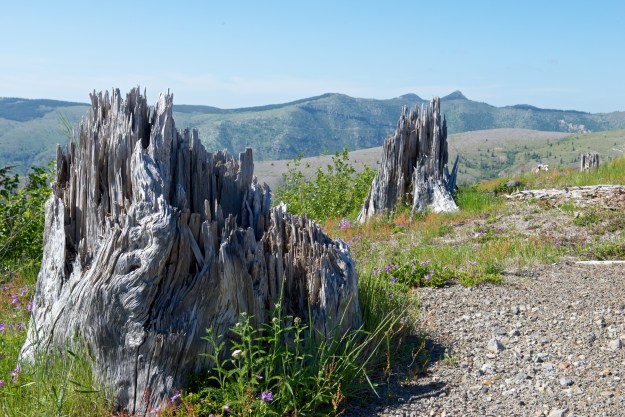
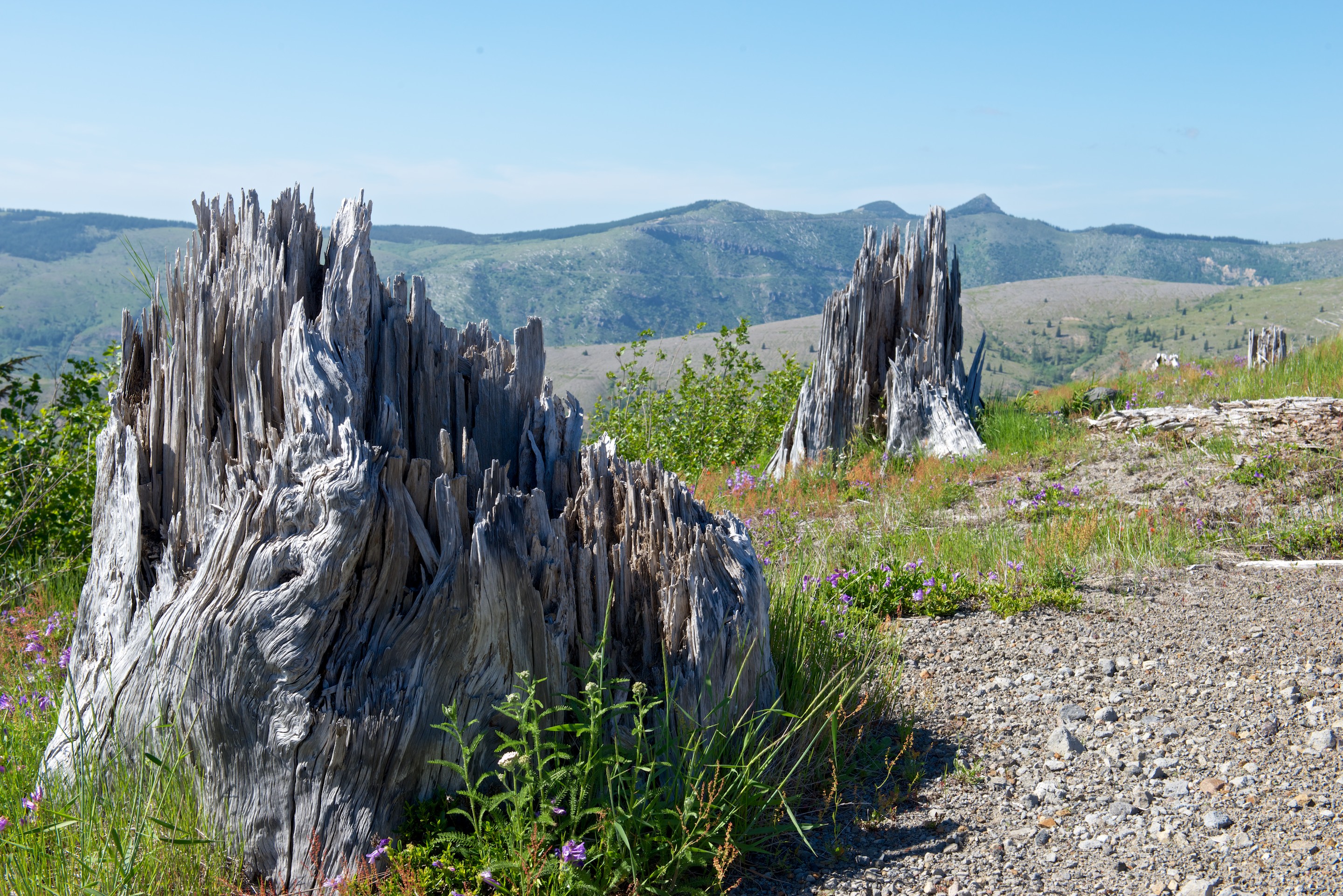
And lots of destroyed trees._ND84409 _ND84412

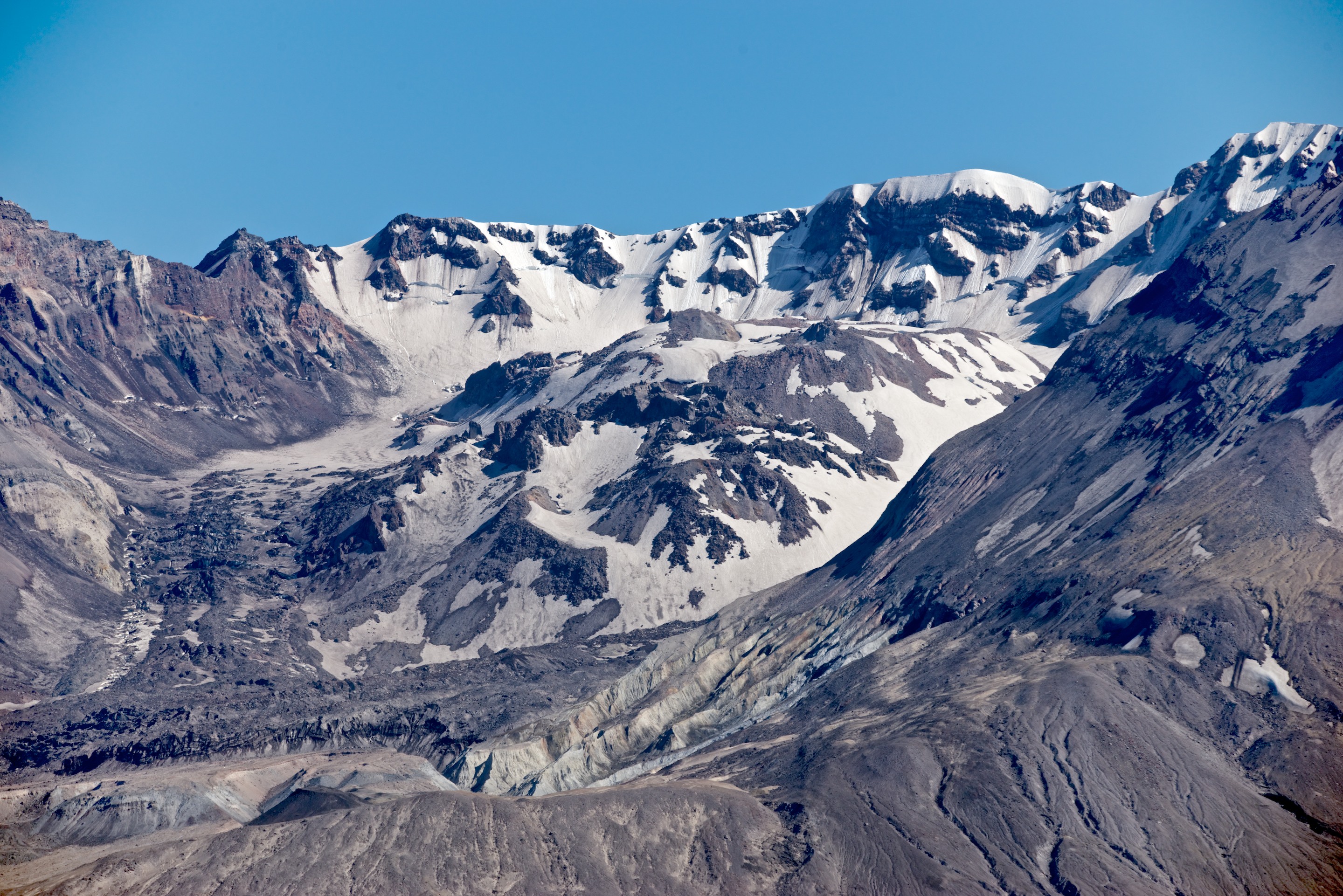
A telephoto lens provides a view into the crater, where the central lava dome is now over 1,000 feet tall; awaiting the next blast._ND84411

The mountain and the blast area are both amazing, both made a great impression on us. The Johnson Observatory is named for David A. Johnson, who was on the ridge reporting by radio when the volcano erupted. He was never found. (https://en.wikipedia.org/wiki/David_A._Johnston) Fred, who has enjoyed visiting volcanoes for many years, found the visit especially moving and fascinating.

And on to Mount Ranier, Denise’s choice.  (Fred was struck by the fact that, at the Mount Saint Helen’s Visitor Center they noted that Mount Ranier is projected to be the next Cascades volcano to erupt.) We are still enjoying cool, cloudless days with bright sunshine and deep blue skies and we could see the volcano from afar.  We stopped in Morton on the way, for some needed items (fuses, a new sewer hose and a multimeter, the latter being Fred’s birthday gift to himself) and enjoyed a coffee and goodie at a great coffee shop.   The owner of the NAPA auto parts store had to come and inspect the Tiger of course! A quick note on customer service. We had stopped at a Camping World store (where we get a discount) to buy a new sewer hose, but left without buying a thing as we could not get anyone other than the receptionist to spare us the time to explain the different hoses and mounts. The NAPA store may have be a bit more expensive but they got the sale as the owner was so helpful and welcoming. (http://www.whitepages.com/business/eds-morton-auto-parts-napa-morton-wa)

There was some delay on the road due to roadworks, but we made it up to the Visitor Center and found a place to park, not always easy!_ND84419
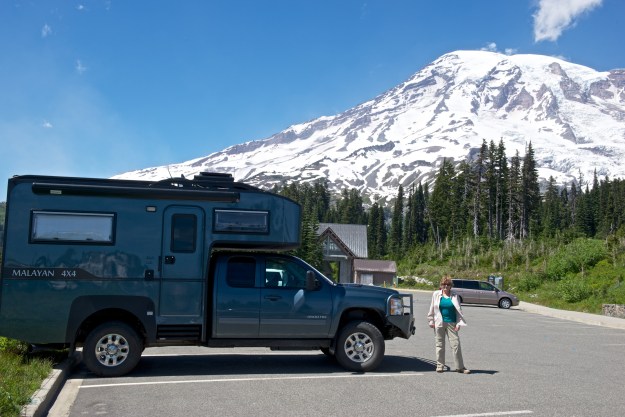
We decided to treat ourselves to lunch in the Lodge, a most attractive log building. Sadly though, we found the food good but not wonderful.  We then walked the trail to the view points for the glacier.  Denise enjoyed the wildflowers, especially the alpine lilies that carpeted the meadows like snow.  In fact, the flowers have been beautiful on this trip, from the mountain meadows to the gardens in California and Oregon, and even fields of blue along the highways in Montana and Wyoming.

_ND84421

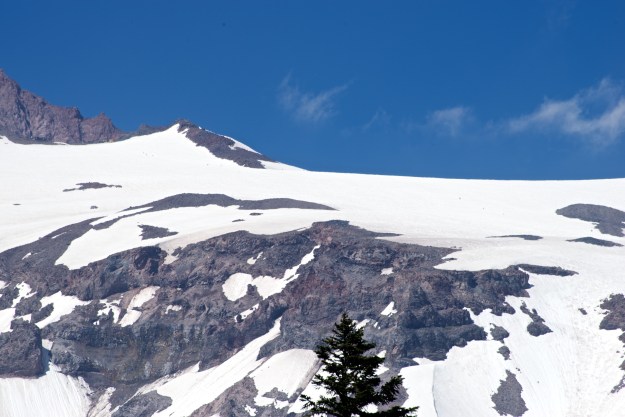
The views over the glacier were well worth the walk and Fred managed to photograph skiers taking advantage of the snow, way up on the glaciers. (Click twice to expand; those tiny dots in the first picture are skiers. Really.)_ND84430_ND84428
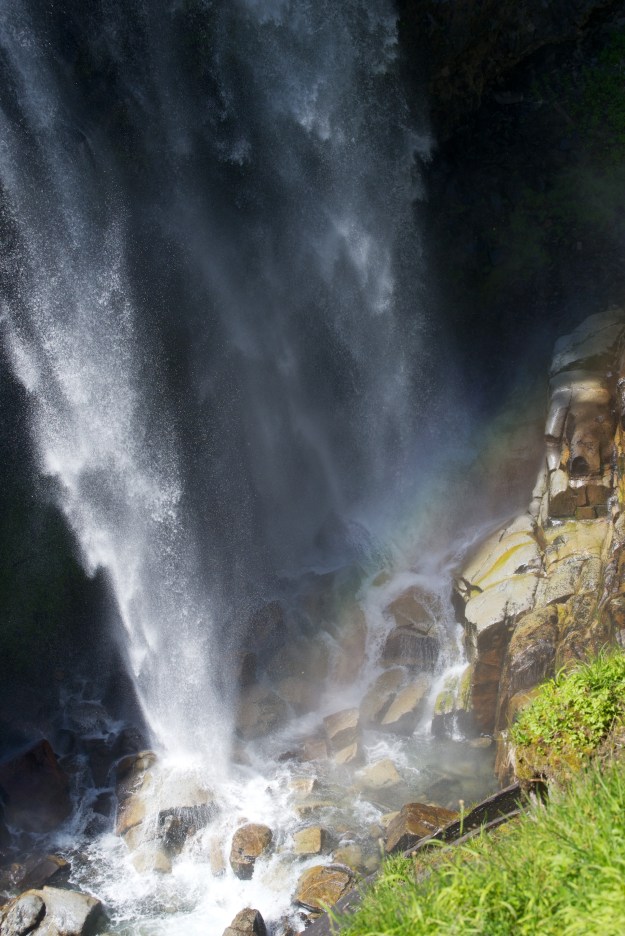
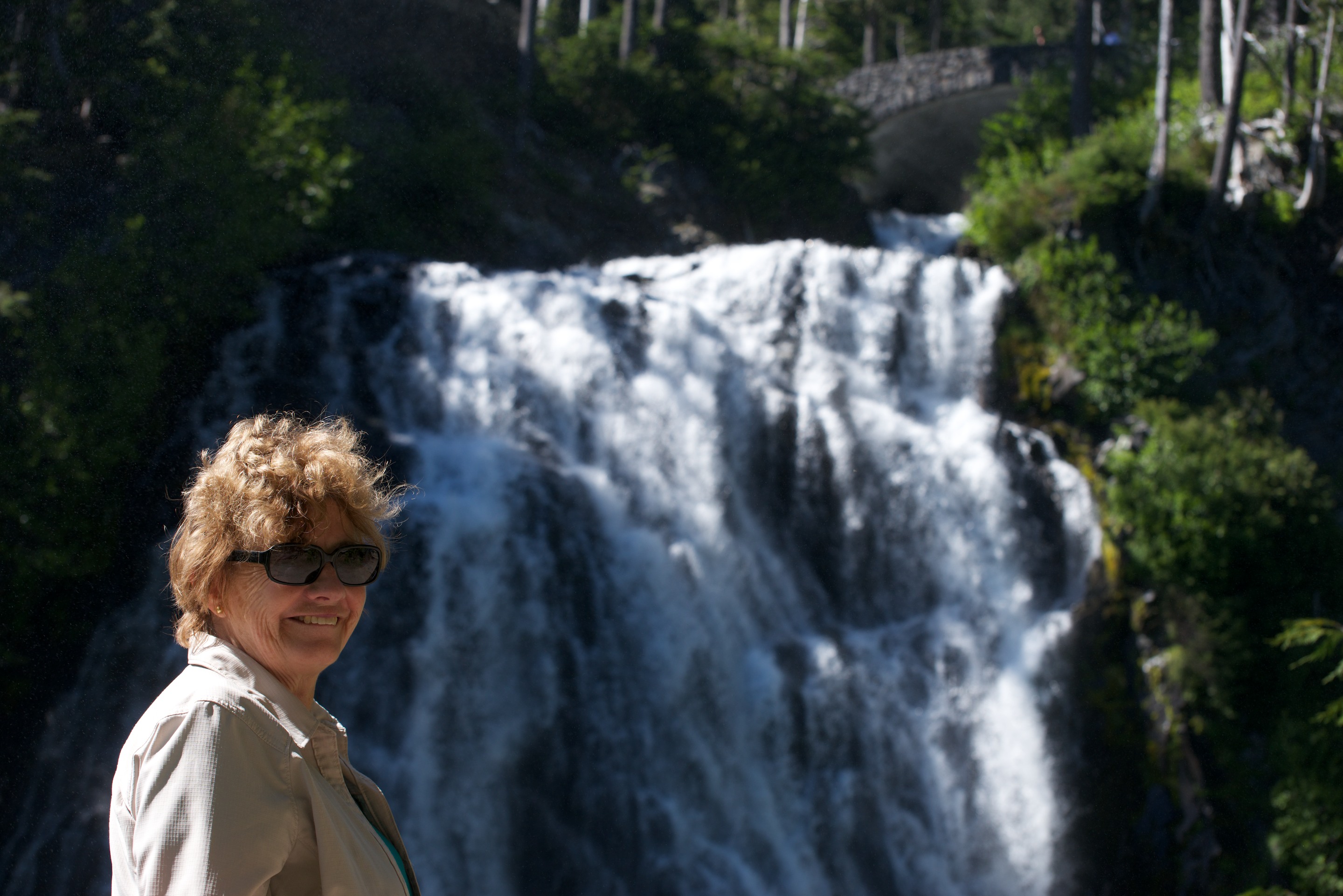
We stopped at the Narada waterfall on the way out and climbed the path down to the base.  It was quite spectacular with snow melt.  _ND84435

_ND84432

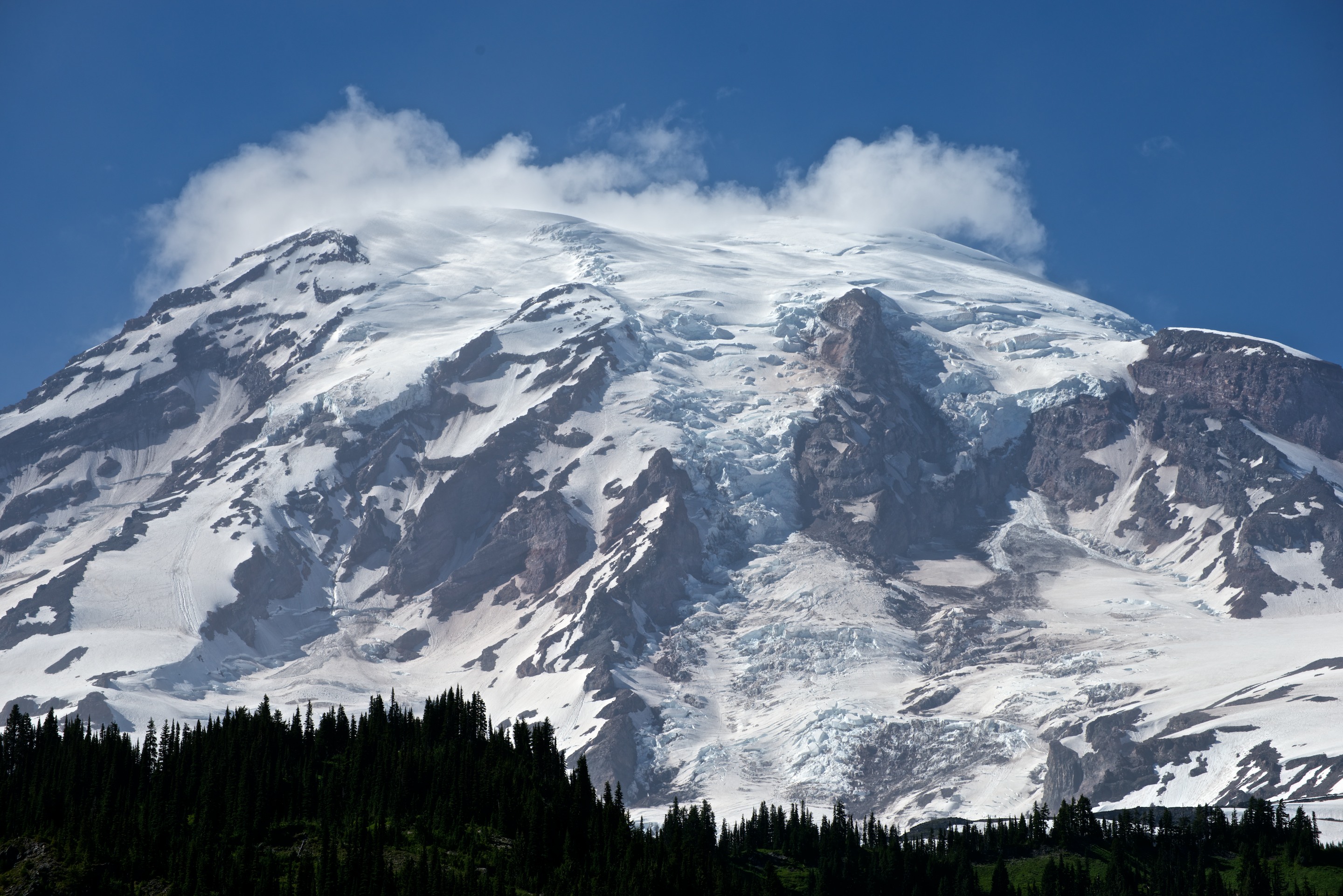
A last view of the mountain as we left the park._ND84437

We then took the Steven Canyon Road through the park to the eastern side where we were able to camp in the National Park Service Campground, deep in the woods. Fred noted that the campground had a big warning panel entitled “Safety Precautions for Camping on a Volcano”. Who knew that camping could be so exciting?

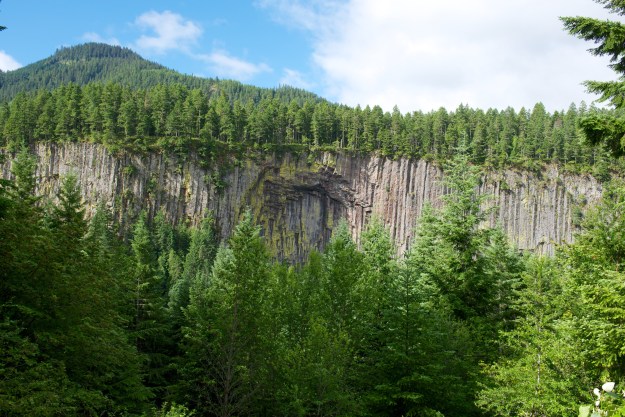
As we continued down the road we came to an incredible set of palisades, an ancient lava flow._ND84438
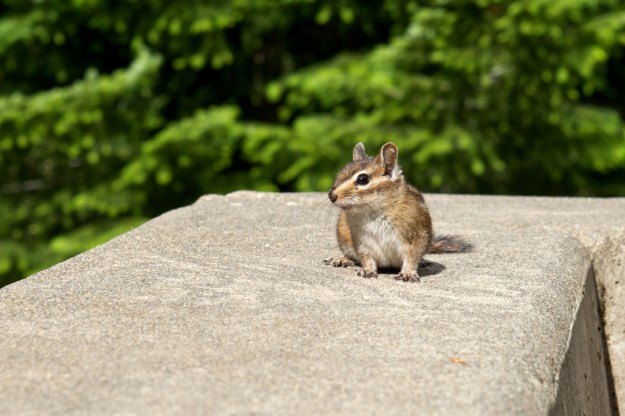
The scenic turnout featured several “hosts.”_ND84440
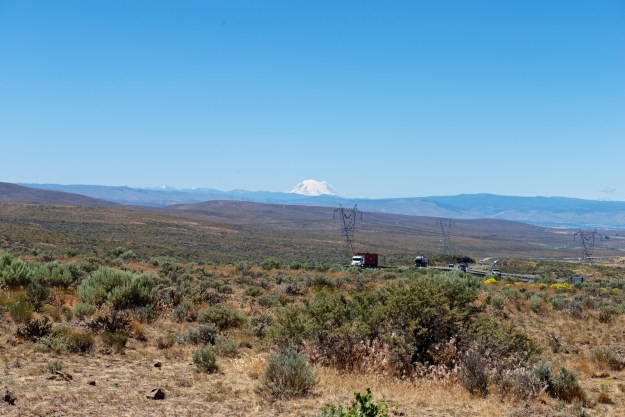
Climbing away from Yakima we had one last view of Mount Ranier on the horizon, as we headed towards Coeur d’Alene, Idaho._ND84443They certainly turn the scenery on here.  Arlington is going to look positively staid after all this!
Pacific Coast Road

The Pacific Coast Road was one of our goals so we set out on Route 1 north of San Francisco.  We did not visit San Francisco on this trip as we had previously stayed there for several days two years ago, before taking the train back to Washington DC.

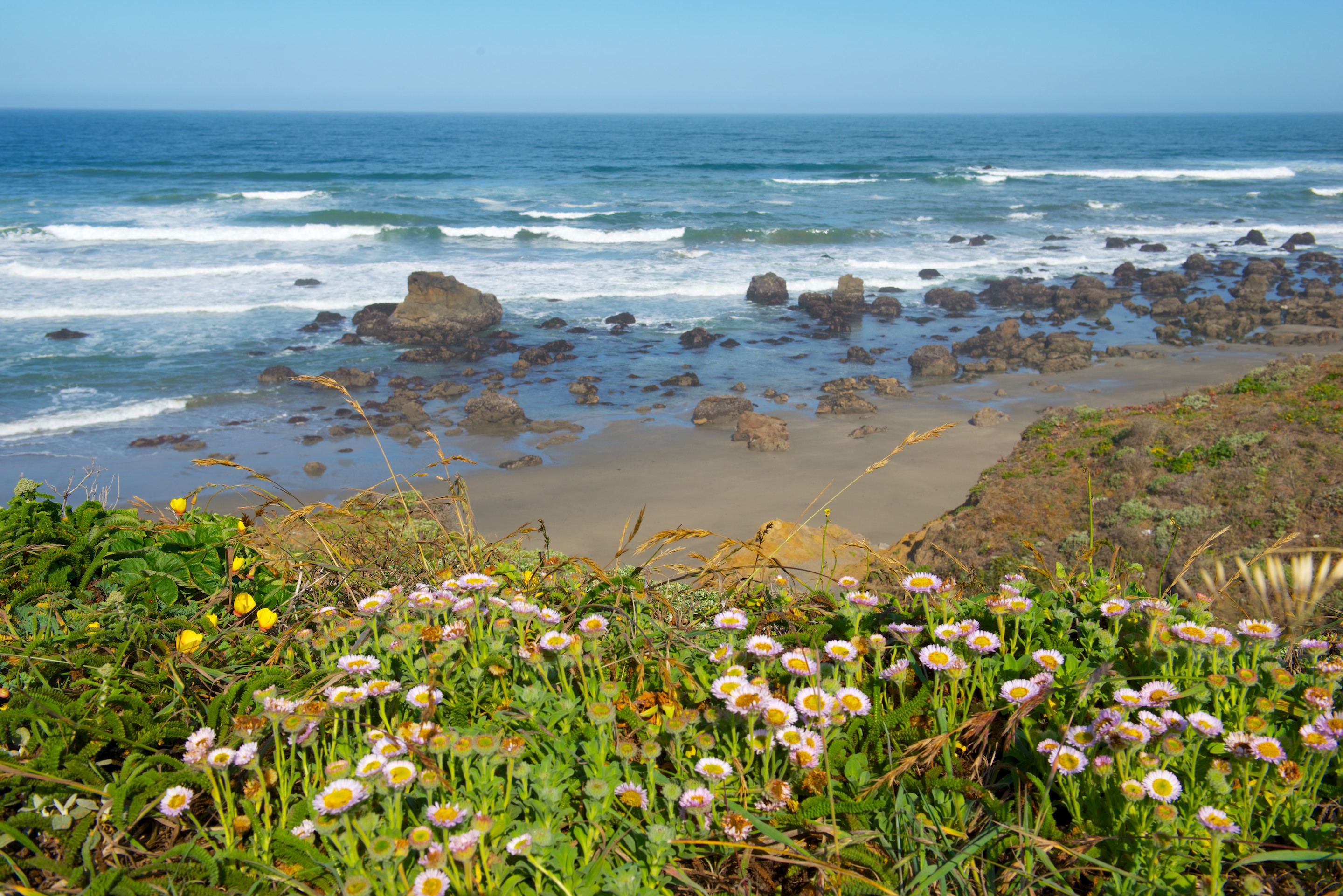
We had a gloomy first afternoon when we walked over the dunes for our first view of a grey and very windy Pacific Ocean at Bodega Bay. Thereafter, however, we had days of glorious sunshine with which to view rock arches and rocky promontories and a beautiful blue ocean. Working our way up the coast, we stopped in the little town of Jenner at the Jenner Inn for coffee and found the most amazing fruit muffins.  After voraciously consuming one, we had to buy a second!  We also admired the seals (from a distance) basking on the sandy mouth of the river.  It is a popular breeding ground and has been somewhat blocked off to provide the seals with some privacy from walkers.

_ND84331 _ND84327 _ND84334 _ND84344


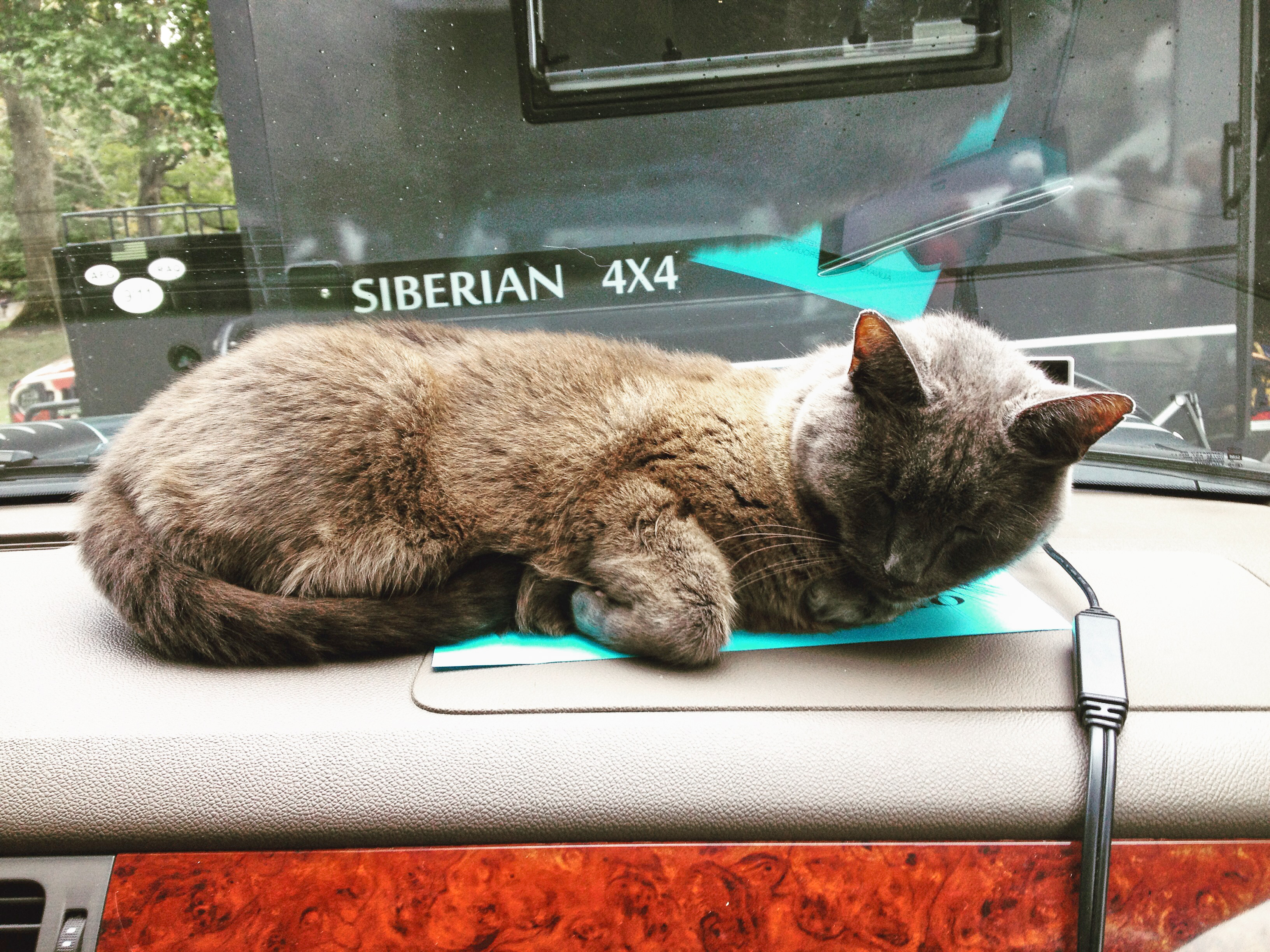
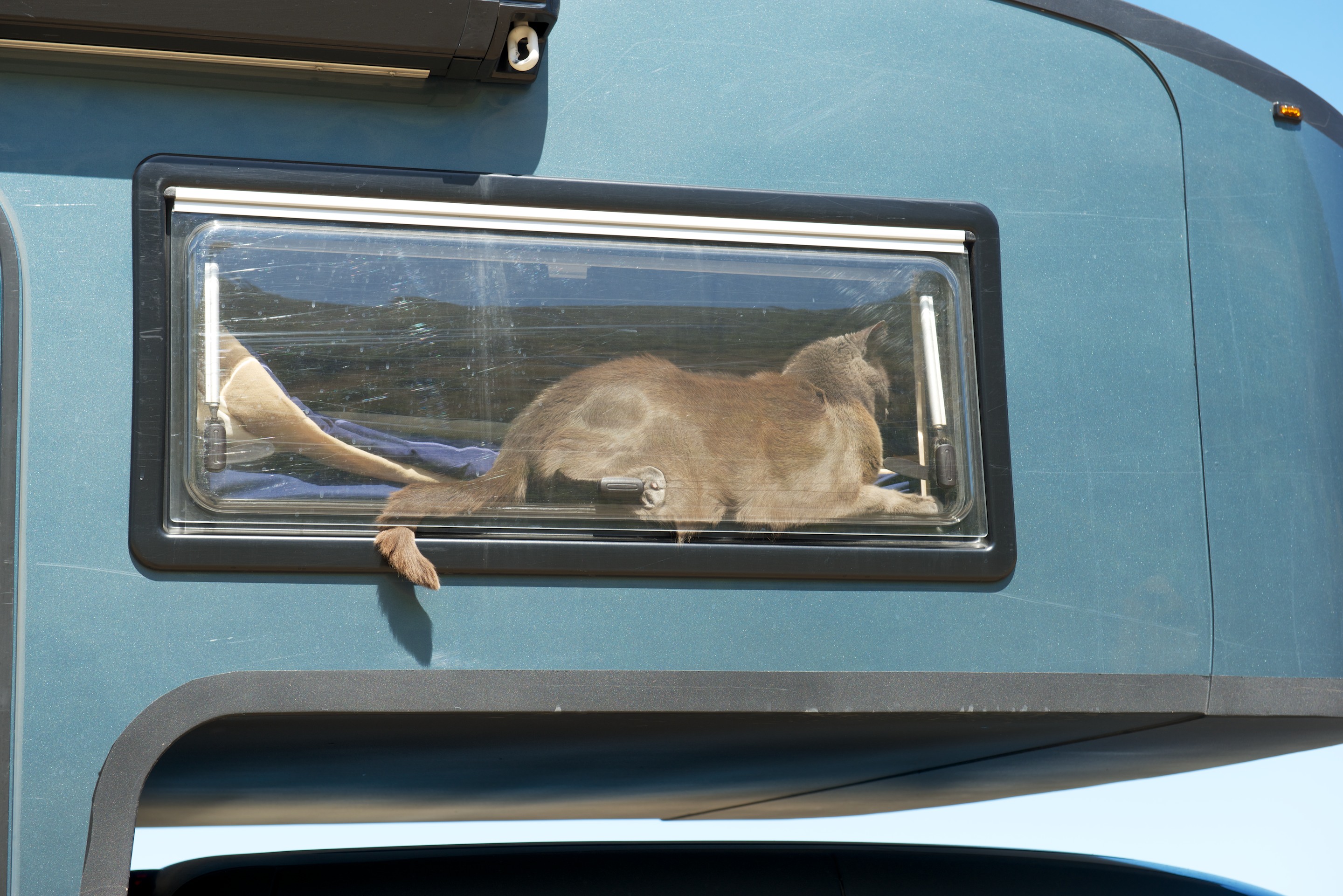
The Blue Cat was a bit less impressed by the scenery, but he did like toasting in his window, with his tail casually blowing out the window. (This is known as Cat-Under-Glass.)

_ND84346

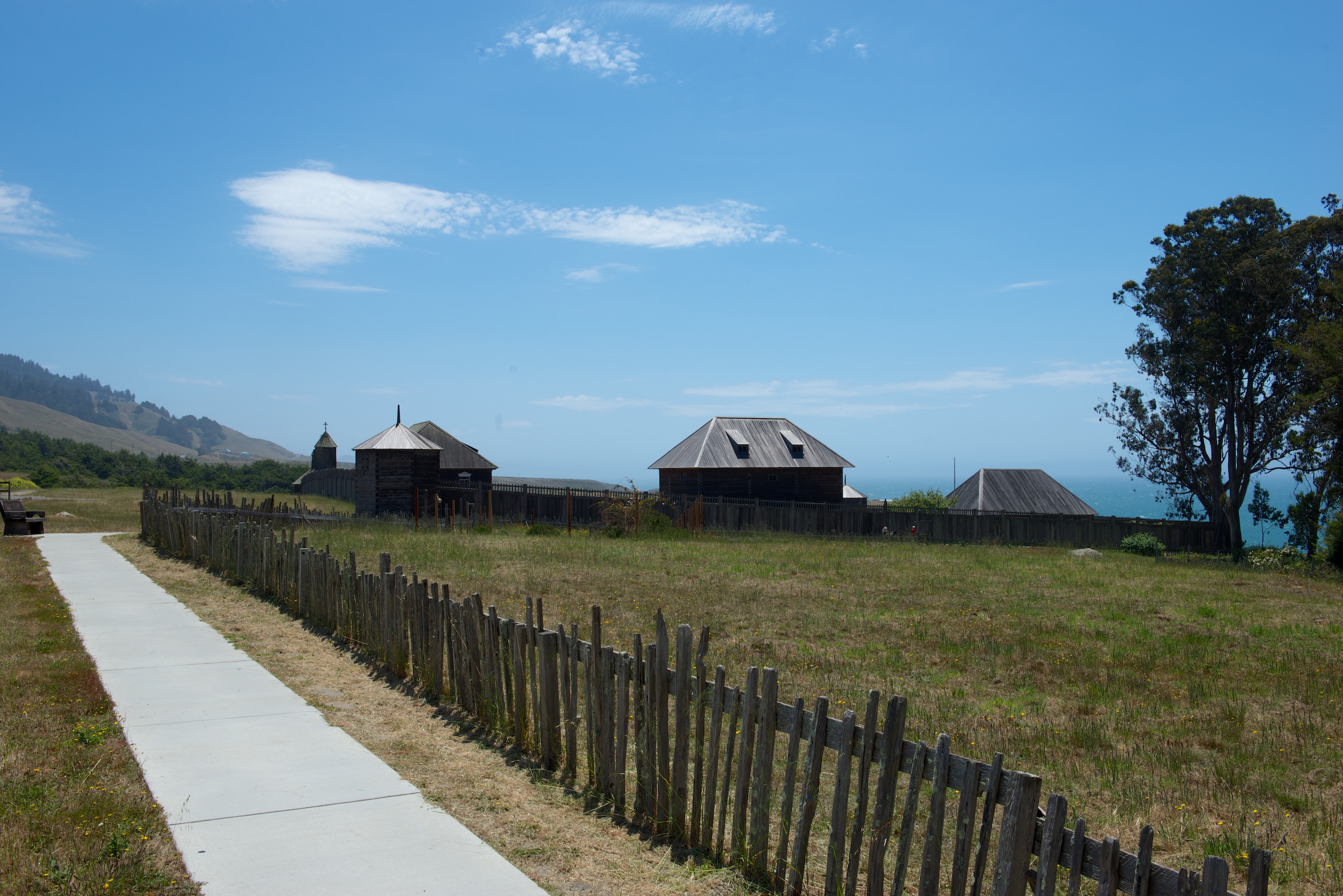
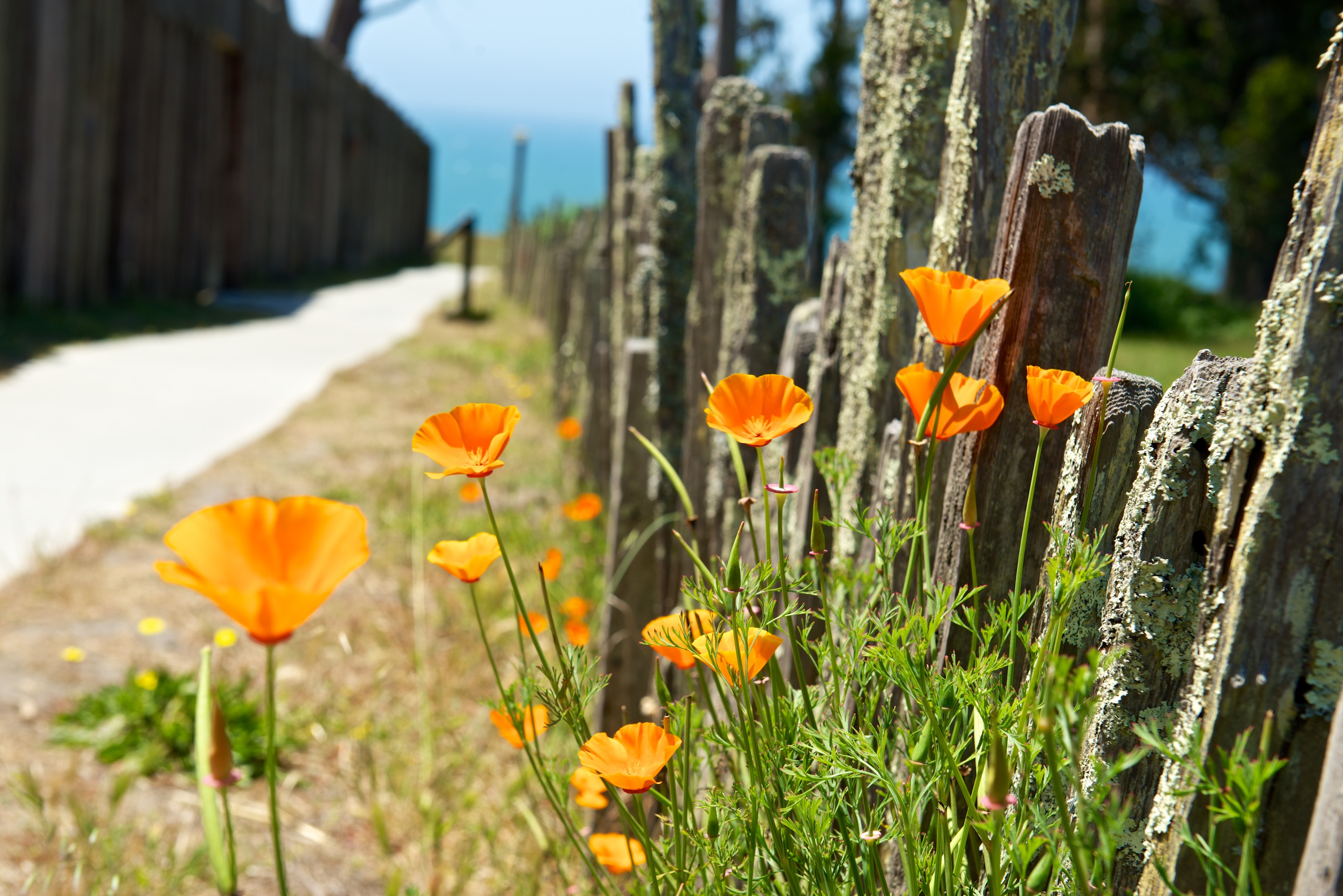
We were disappointed by the Fort Ross Historic Park, which was closed.  We were able to walk the grounds and see the buildings on the outside but the Visitor Center and all interior access, event the parking, was closed.  Fred was fascinated by this little known Russian colony which farmed and cut timber along some twenty miles of coast to support Russian colonization in Alaska in the early 1800’s.  (http://www.fortross.org) We shall have to do more research on Wikipedia.

_ND84343 _ND84342 _ND84341 _ND84340 _ND84338

We then headed to our next Harvest Host winery, Handleys Wine Cellar.  (http://www.handleycellars.com) An older winery, we liked several of their wines and made our purchases in exchange for a night on the hillside with views of vineyards stretching in all directions.  The winery was on Route 128 which meandered through a redwood forest, and driving there gave us our first views of the coastal giant redwoods, and proved a delightful shady drive.  We completed our tree education by taking the Avenue of the Giants, through the Humboldt National Park, with its stands of giant redwoods.  These are taller than the Giant Sequoia of the Sierra Nevada, though do not live as long.  To be quite honest, tall is relative, especially when the trees as so tall you cannot see the top even staring up!  We continued  heading north and stopped for the evening at the Prairie Creek Redlands State Park, where we had the fortune to take the last space at the Elk campground.  Fred saw elk in the distance but Denise did not.  She has hopes of seeing some as we continue our travels north.

Still heading north, we crossed into Oregon heading for Crater Lake.  Fred had a yearn for ice-cream and we stopped at an amazing ice-cream stand, Phil’s Frosty in Shady Grove, OR.  Fred ordered a small sundae which turned out to be huge!  (http://www.yelp.com/biz/phils-frosty-shady-cove) Denise contented herself with a small cone!  As it was Saturday evening, we started checking for a campsites and found the last site in a small primitive campsite.  It was cool and pleasant if a little noisy.  The temperatures were slowly climbing and being shaded was becoming important!

There’s Gold in them thar hills …

Having been warned that we might be asked to surrender previously purchased fruits at the California state line, Denise dutifully made applesauce from our eating apples and as a result we successfully crossed into California without fuss.  We had no plants to declare, no firewood, and not much of anything else.  We had decided to spend a little time in Gold Country or Eldorado County, home of much gold rush history and full of quiet backroads, so we headed towards the Sonora Pass.

We started out by taking Route 108 across the Sierra Nevada. The views were spectacular and it was a most pleasant drive albeit with 26% grades! If you zoom in and look to the left of the image, you can see the Marine Corps mountain warfare center._ND84271
As the road was sporty it was packed with motorcycles and expensive sports cars,  Lamborghinis and Maseratis for example, were seen within a few minutes of each other.  We stopped counting Porsches!   We looked at several Forestry campsites which were unpleasantly full and were just beginning to despair when we stopped at Boulder Flats.  Almost empty when we arrived, we ended up as the only campers overnighting; a private campsite with a number of boulders and enormous trees.

_ND84277

The next morning our first stop was at the Columbia State Historic Park, near Sonora.  An authentic gold rush town, it was greatly reduced in population after the rush ended but never actually became a ghost town.  Thus it was a prime candidate for renovation and life as a state historic park.  (http://www.parks.ca.gov/?page_id=5520 The usual variety of mid eighteenth century buildings were filled with a wide range of authentic items for view and less authentic ones for sale.  There were lots of costumed interpreters and in fact one of the choice views of the day was a costumed interpreter using the ATM on the side of “ye olde banke”.  We had a great time riding the stagecoach and indeed got held up by a masked bandit!  But it was most interesting to ride behind the four horses as they pulled the coach up and down grades.  It felt very authentic.  We enjoyed a long chat with the driver, while waiting for the next ride to begin.  Purely by chance, we were there during the “Diggins” weekend, a weekend when the tent camp which had existed outside town during the gold rush, is recreated.  We paid our entry fee and wandered through, admiring the men practicing their rifle fire, others prospecting with pickaxes and still more sluicing to find gold.  All the other services, dentists, lawyers and doctors for example, each had their tent.  It was our first day in the eighties since leaving Florida so we retired to an air conditioned restaurant in the historic town for lunch.

_ND84281 _ND84287 _ND84290 _ND84291 _ND84292 _ND84296 _ND84298

Our next stop was the Calaveras Big Tree Park, so Denise could do her tree hugging.  Home to two groves of giant sequoia, we walked the trail to one grove, admiring the huge trees and sad to see the damage caused by tourism during the 1880’s when the trees were first discovered and promoted.  Two large trees are dead or dying because of losing bark or being hollowed out.  We spent the night in the campsite there, surrounded by younger and smaller sequoia and pine, a beautiful spot.

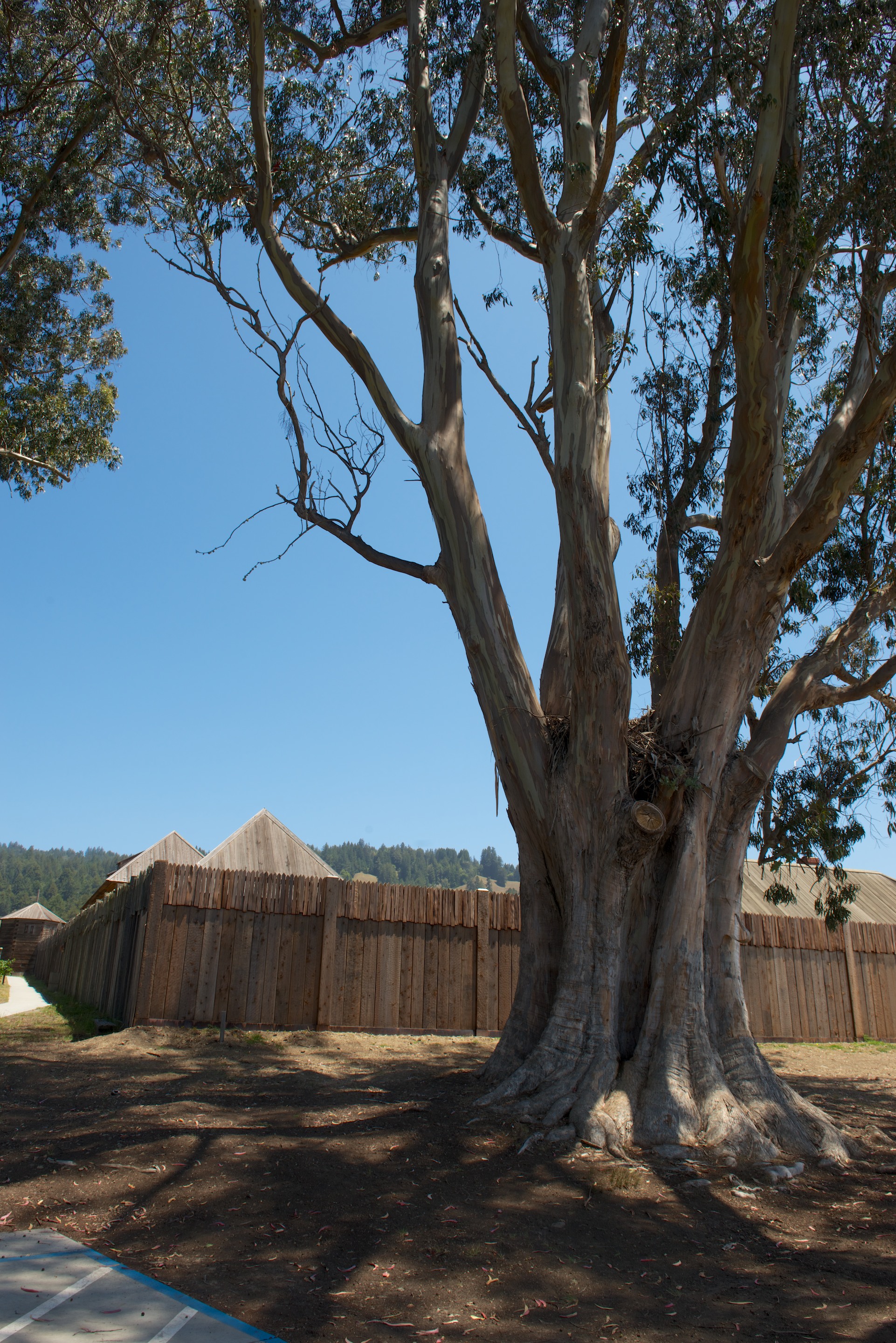
Denise posed on the stump of the “Discovery Tree.” This is the tree that first confirmed the existence of the giant Sequoias, and so, naturally, it was abused and finally felled. The picture gives at least some idea of the size of this mammoth tree._ND84299

It is almost impossible to capture the scale of these tremendous trees. (So Fred gave up trying; you will simply have to visit for yourself.)_ND84307

We paid a visit to the Indian Grinding Rock State Historic Park and enjoyed the museum of Indian life.  There were a few bark houses and the ceremonial round house was being rebuilt.  A short trail around the park did allow for us to stretch our legs.

The site was most unusual, literally thousands of holes worn into the rock._ND84320 _ND84323

Then, as we moved into the winery country, we  decided it was time for a wine tasting.  We quickly learned one basic fact and that is that most wineries are not open on Mondays.  In fact, if you plan to visit the smaller wineries in any of the wine areas, you should plan on going on Friday, Saturday or Sunday.  We researched our Harvest Host listing and found one that looked quite close that was open on a Monday.  So, off we went after putting the address into the GPS.  We drove and we drove down narrow country roads which twisted and turned over hills and down dales (as they say in the UK).  Sometimes the road was so narrow there was no line down the middle and there were appropriate pull off spaces to pass another vehicle.  Practice for UK (especially Devon) country roads!  We did meet the propane gas truck, though fortunately not in the worst part!  The 18 miles probably took us two hours to drive, but we saw some lovely scenery, and finally found our winery, DK Cellars, sitting on top of a mountain with a lovely view.  The owner was there, so we had a great tasting, great discussions, and bought three bottles of wine.  And of course we set ourselves up and spent the night. (http://dkcellars.com)

The Loneliest Road

We have camped at over 8,000 feet for ten days or more and have been rained on, hailed on, and snowed on! So instead of heading further north, we decided the time had come to head west.  California has a drought at the moment, so maybe if we bring only a little rain, they will be happy.  Maybe we shall see the sun also!  So, we set off on the Loneliest Road, US Highway Route 50.  Nevada here we come!

Our road out of the campsite at Cathedral Valley proved to be very rocky in places but we made it without difficulty and found our way to Route 50 and our first stop, the Great Basin National Park.  Crossing the desert, the landscape seemed amazingly green.  Obviously it has been raining here also, in fact, there was some water in Lake Sevier, shown on the map as a dry lake bed.  So we stopped to take a photo!

_ND84146

As we drove west, we watched fascinating thunderstorms developing all around us and we finally drove through one, which helped to remove some of the mud from the truck (remnants of the Hell’s Backbone drive).

_ND84147

After a quick stop at the Visitor Center for camping advice, we found ourselves a lovely spot in one of the more primitive campgrounds at about 7,500 feet, for two nights.  We settled in with one small problem.  The electric steps up to the camper no longer worked.  Fortunately we hauled out our trusty step ladder and got ourselves organized as another thunderstorm hit.  So much for arid desert. And so much for clear, starry skies. (http://www.nps.gov/grba/index.htm)

As it was sunny the next morning, we headed up the Mt. Wheeler Scenic Drive to the trailhead of the Bristlecone Pine Trail, which Denise wanted to hike.  Ndeke Luka is shorter than the 24 foot limit fortunately, although the road was not, in fact, difficult. There were stunning views of the mountain and across the Basin on every curve.  Mt. Wheeler is 13,065 feet and was well snow capped, and, to Denise’s disappointment, the Bristlecone Pine Trail was equally snow covered.  We would have needed snow spikes to feel comfortable in the snow and ice, so we headed back down, stopping to make espresso at one overlook and taking photos as we went.

_ND84154

Our next stop was the Lehman Caverns Visitors Center.  Rangers lead guided tours of the caverns under the mountain and we signed up for the next available 90 minute tour.  (There are also 60 minute tours.)  Having visited Carlsbad Caverns last year, Denise had to have her shoes disinfected, (a minor procedure), and Fred wiped his camera with disinfecting wipes.  Then we set off.  It was a fascinating tour with lots of information provided by a knowledgeable ranger.  We saw the “shield” formations, which are rare, though apparently Luray in Virginia has them!  It was also low key, lacking the enormous scale of Carlsbad. The passageways were narrow and it was hard to avoid touching a formation or hitting one’s head.  It felt very personal and low key and allowed one to get much closer to the flowstone.

Needless to say, it was pouring with rain when we came out. We compensated by bolting to the tiny cafe for a piece of pie and a chat with the ladies who worked there.

Our next stop was Ely, Nevada for some essential camper steps maintenance, in order:

— Auto parts store for a new fuse for the steps. (We now have a lifetime selection.)

— Car wash. ($15 to spray most of Utah off of the truck.)

— Diesel station to top up.

— Coffee (and flower) shop for an espresso. (To restore the soul.)

— And finally, supermarket (the only one for 250 miles) for veggies and a re-grease of the steps and retractable running boards.

With our camper steps fully functional again, we took a wander down Ely’s main street. Like many small western towns, this was a flashback to the 1950’s and the end of the big mining operations in the area. Purely by accident, we stumbled upon a gem of a Chinese restaurant, the “Happy Garden.” Expectations to the contrary, all of the dishes were very fresh and served piping hot. (http://www.yelp.com/biz/happy-garden-ely) Chatting with the owner, we were reminded of the tremendous, but oft underreported, role of the Chinese in the development of the American west, especially the construction of the Central Pacific railroad. All in all Ely was a wonderful stopover.

The rest of our time on the Loneliest Road proved to be interesting!  At times there was quite a lot of traffic so it was not lonely at all.  At other times, it seemed like we were the only people on it.  We camped at the Hickison Petroglyph BLM Recreation Area where we took the trail to see the petroglyphs and enjoyed a lovely free campsite.

_ND84180


Looking west from Hickison Summit. Frémont crossed very near here._ND84184


Historical grafitti? Look closely at the picture. You can just see a “JR” and “1858” inscribed in the stone. Believed to be original._ND84182

We also saw the petroglyphs at Grimes Point Archeological Site, all inscribed on boulders and some dating back multiple thousand years.  All are weathering.  One wonders how long they will be visible. Grimes Point is right next to the Fallon Naval Air Station and there is quite a juxtaposition between ancient petroglyphs and modern jet fighters.

_ND84206 _ND84207 _ND84209

Everyone has heard of the fabled Pony Express, the Butterfield stage coaches, and finally, Wells Fargo and Company. (Remember all of those Westerns from the ’50’s and ’60’s, “Tales of Wells Fargo” and the rest?) We stopped at two sites to view remains of the stations dealing with the Pony Express and the Butterfield Stage at Cold Springs and Sand Springs.

_ND84189

Ruins of Butterfield Stage station and repair facility at Cold Springs. Looking West along US 50._ND84193

The ruins at the Sand Springs site were especially interesting as they were not fenced off and you can see the individual rooms.  Sir Richard Burton, the famous African and Middle Eastern explorer had several uncomplimentary comments about the Sand Springs station. The amazing sounds of the Sand Mountain, a huge dune standing all by itself about a mile away, were inaudible as it was full of ATVs.  (The dune is supposed to sing when vibrations are at the correct level.)

_ND84197_ND84200  _ND84199

Our final visit in Nevada was to Virginia City, known for its gold and silver and as one of the settings for “Bonanza”, the TV show.  Now a major tourist attraction, it still retains a certain amount of charm with wooden sidewalks, original buildings and saloons. At the same time, despite a population of under 700 (down from 28,000 at its peak), Virginia City boasts very impressive and modern looking schools and a public swimming pool. All in all, a fascinating visit, especially when you realize that the town is not a movie set, but was the epicenter of an enormous mining enterprise. All of the mountains for miles around are marked with piles of spoil and there are even mines right on the city streets.


Virginia City is the terminus of a short line, the Virginia and Truckee, opened in 1869 to take the ore down the mountain. (http://www.virginiatruckee.com) It ran 45 trains a day during the boom and the Virginia City sector was closed in the 1930’s. Reopened in 1975 they run tourist trains to Gold Hill, three miles down the track, using diesels, steam engines and 100 year old carriages.

_ND84232

Denise sees the light at the end of the tunnel._ND84251

The train runs to Gold Hill._ND84243

Our train was pulled by a diesel, but the steam engine arrived shortly after our return after pulling a train from Carson City.  N.B. The steam run to or from Carson City is the trip you REALLY want to take. Worth the effort to research the schedule._ND84263 _ND84265

After a great barbecue sandwich for lunch, (http://www.vcjerky.com) we headed for California.

A last view on the road back down to the valley. Everywhere you look there are great views, and huge piles of spoil from the mines._ND84270


Playing in the Mud

The next day dawned with a bright sun in the sky and so we decided to head for Capitol Reef after all, via  Hell’s Backbone. The Hell’s Backbone road turned out to be particularly ill named. It was, in fact, a lovely drive through the woods. The road was built in 1933 by the Civilian Conservation Corps to connect the towns of Escalante and Boulder. (In the summer only; the road was closed when it snowed.) Up until that time, Boulder received its mail by pack mule in the summer and in the winter not at all. Today it is a winding, mostly single lane road, but even with the snow, it was not too slick for a heavy 4×4 and a bit of care. The Hell’s Backbone ridge narrows to a knife edge at one point, spanned by a one lane bridge. The original wooden bridge, which lies in ruins below the present structure was started by a local tractor driver nicknamed “Sixty” for his love of speed. In this case, he drove his Caterpillar tractor across the gap, towing a compressor, on two leveled logs. (Somehow, a safety rope around his midsection doesn’t seem that reassuring.) We had no such troubles and crossed the bridge with ease.

N.B. These are large images and will expand, in two steps, when clicked.

_ND84102 _ND84097 _ND84106

Rejoining Utah 12, we continued down to the main highway, enjoying spectacular views of the Capitol Reef from above.

_ND84107

_ND84110

We enquired at the visitor center about visiting the famous temples of the Sun and Moon in the northern part of the park, and thence continuing on to the campground, but were told that the road was impassible. So we headed off down the paved sixteen mile scenic route. The road and parking lots were all packed for the Memorial Day holiday. We turned off on one of the dirt spurs to the Grand Wash, but it, too, was busy. There was no room to park at the turnaround; indeed, there were cars and RV’s scattered everywhere. We decided to give up and headed back to the asphalt, carefully obeying the speed limit and trying to avoid puddles. This earned us a horn bleat from a motor cycle that decided to zoom past just as Fred moved left. So much for speed limits!

We turned east and were joined for lunch by three deer._ND84111

After lunch, we decided to ignore the dire warnings and try the Caineville Wash road heading north, which lies just outside the Park. This turned out to be remarkably easy dirt and in about an hour we came to a sign that confirmed that we were, indeed, on the right road.

_ND84117 _ND84118

It was very exciting to see the famous monoliths in the distance. We soon arrived at the turnoff for the Temples of the Sun and Moon. We turned in and were treated to some wonderful views of two mud monoliths.

The Temple of the Moon is the smaller of the two. Looking at the background, you can see that they are parts of an eroded cliff; a form of large hoodoo, if you will._ND84131

Temple of the Sun, backlighted._ND84130Lovely little rock table, near the Temple of the Moon._ND84124

The smaller, Temple of the Moon, in all its glory._ND84120

While the road was easy, we only saw four cars, including one SUV parked in the middle of the road. He was heading south and we wondered if he had broken down. While at the Temples we received the compliment of the day from a gentleman driving a Toyota Forerunner, “That’s one badass motorhome!” (We tend to agree.) From there the road got much better, if punctuated by muddy water crossings. It is clear that it will be very hard for us to get usable information on road conditions. Clearly, at 11,500 pounds, we are heavier than a common 4×4, but, at the same time, we are much, much more capable than an normal car or RV. Fred was wary of the mud, but, in the end, we did not even need to air down the tires.

We continued and turned in to view the Gypsum Sinkhole. Denise found it and it turned out to be exactly what you would expect, a huge hole at the base of a cliff wall. We noted that one of the washes seemed to flow into a hole in the ground so the sinkhole will probably get bigger in the future.

_ND84132

All of the scenery was just lovely._ND84134

We continued to the end of the valley, passing beautiful scenery and enormous monoliths. Finally, there was a steep grind up the wall and a last view of the valley. (Sadly, the Chevrolet does not have the tightest turning circle, so one switchback required us to back and fill to get around the corner.)

_ND84137

The Cathedral Valley Campground had six sites and incredible views back towards Colorado. Stopping for the night was an easy decision. (And besides, the cat was tired of rough roads.)

_ND84138

A Tale of Two Parks

Provisioned, cleaned and warmer, we set off north to Utah, planning to visit the National Parks in  Southern Utah (or at least as many of them as we could manage).  Our big problem was the imminent Memorial Day holiday, which we knew would bring a lot of tourists to the region. So we decided to pay at least slight attention to the two most known parks, Zion and Bryce, as we wended our way towards Capitol Reef and Arches.  Well, the best laid plans of mice and men …

Our stop at Zion was interesting.  We drove in on State Route 9, and having established that we could fit through the tunnel with no additional charges, we crossed the southern section.  The scenery is indeed quite spectacular and we stopped at a couple of overlooks to admire, take photos and generally appreciate.  _ND83976 _ND83979 _ND83980 _ND83982

The tunnel itself was an amazing engineering/construction accomplishment and is all the more unusual for having five “windows” along its length.

_ND83986

_ND83995

These were used to provide ventilation and to expel construction debris. We also watched some climbers as they made their way up a stone face. (See if you can find them in the first photo.)

_ND83988

This may be a bit easier.

_ND83996

The sun even came out for a while, which helped the photos and our enjoyment level!

_ND83998

The main tourist area was a mess, the RV parking area was jammed with cars and a few campers, even at 4.30 PM.  We were not inspired by parking in town and taking two shuttles to see the glories of Zion tourist scenery, so we moved on, spending the night at a very pleasant campsite, the Zion River Resort in Virgin. While not inexpensive, this camp easily makes it into the top five nicest RV parks that we have visited. (http://www.zionriverresort.com) Fred wanted to drive the Kolob Terrace Road, which starts in Virgin but it was unfortunately closed for rebuilding.  So the next morning we heading to the Kolob Canyons section of Zion NP.   Again it was a cloudy day. What happened to the southwestern sunshine we enjoyed last year? We drove the five miles of tourist route and we took various photos on the way up.  We hiked the short trail at the top and appreciated the view, though we wore rain jackets as it looked very threatening.  We ate lunch there because Denise thought it might be clearing a little and indeed it did.  The sun almost came out a few times so we took another photo or two.

_ND84018 _ND84008

Continuing towards Bryce National Park, we took State Route 148 to 143, stopping at Cedar Breaks National Monument.  It was very closed but had some good views of an amphitheater filled with hoodoos.  Memories of Bolivia were upon us as we were back at 10,500 feet!  We stopped for the night just short of Panguitch in the Dixie National Forest at about 8,000 feet. We may be SOB’s (Survivors of Bolivia), but this obsession with altitude is getting old.

_ND84040

Our departure the next morning was somewhat delayed by a bird who somehow got into the air conditioner enclosure.  Fred had to take one of the grills off and encourage it to exit.  We never actually saw it fly off but the scratchings stopped, so our fingers are crossed that it did indeed leave.  (A tip of the hat to Dan Rehack, who gave us a Number 2 square drive when we got the Tiger, noting that it was the one, essential tool for all purposes on a Tiger!) We replaced the grill and headed to Bryce via Route 12,  which took us through some spectacular scenery.  Once in Bryce, we drove the full 18 miles to the end of the tourist scenic drive and took photos of the various sites.  We had some sunshine at last though it was still quite chilly.  We were unable to park at Bryce Overlook, but at Inspiration Overlook we not only climbed to all three levels but walked a section of the Rim Trail.  Denise’s ankle, though still weak, is doing a little better. The combination of clouds, rain squalls, and sun made for a couple of lovely photos.


We headed to Kodachrome Basin State Park hoping to camp but found “Camp Full” signs up.  So, we checked in with the Visitor Center for the Grand Staircase Escalante National Monument regarding camping permits.  We were dissuaded from dispersed camping in the Monument as yet another winter storm was approaching. We were told horror stories of Bentonite clay and told that camping permits were not available unless you could specify where you were going to camp, a bit challenging as we could not assess the road conditions in advance and thus had no idea where we might camp.  Apparently the roads in the Dixie National Forest are gravel and better than those in the Monument and one is less likely to get stuck.  So, here we are with a 36 hour storm approaching and campgrounds full for the Memorial Day Weekend.  We decided to head deeper into the Dixie National Forest on the promised gravel road and arrived at the Posey Lake campground (8,500 feet) just as it started hailing.  It was time to regroup and reevaluate what was going to happen next.  Somehow Capitol Reef National Park did not seem that appealing in the rain. We settled in for the night and happily cooked on the diesel stove, the extra heat being most welcome. We woke the next morning to a couple of inches of snow and it continued snowing until about 3.00 PM.

_ND84091

Needless to say, this seemed an excellent reason to stay put for a second night.  The campsite is lovely with pines, aspens and a lovely view of the lake (through the snow!), plus the usual chipmunks and a selection of wild turkeys.  So far no bears or mountain lions although there are food safes at all the campsites.

Let it Snow, Let it Snow, Let it Snow! (Overland EXPO West 2015)

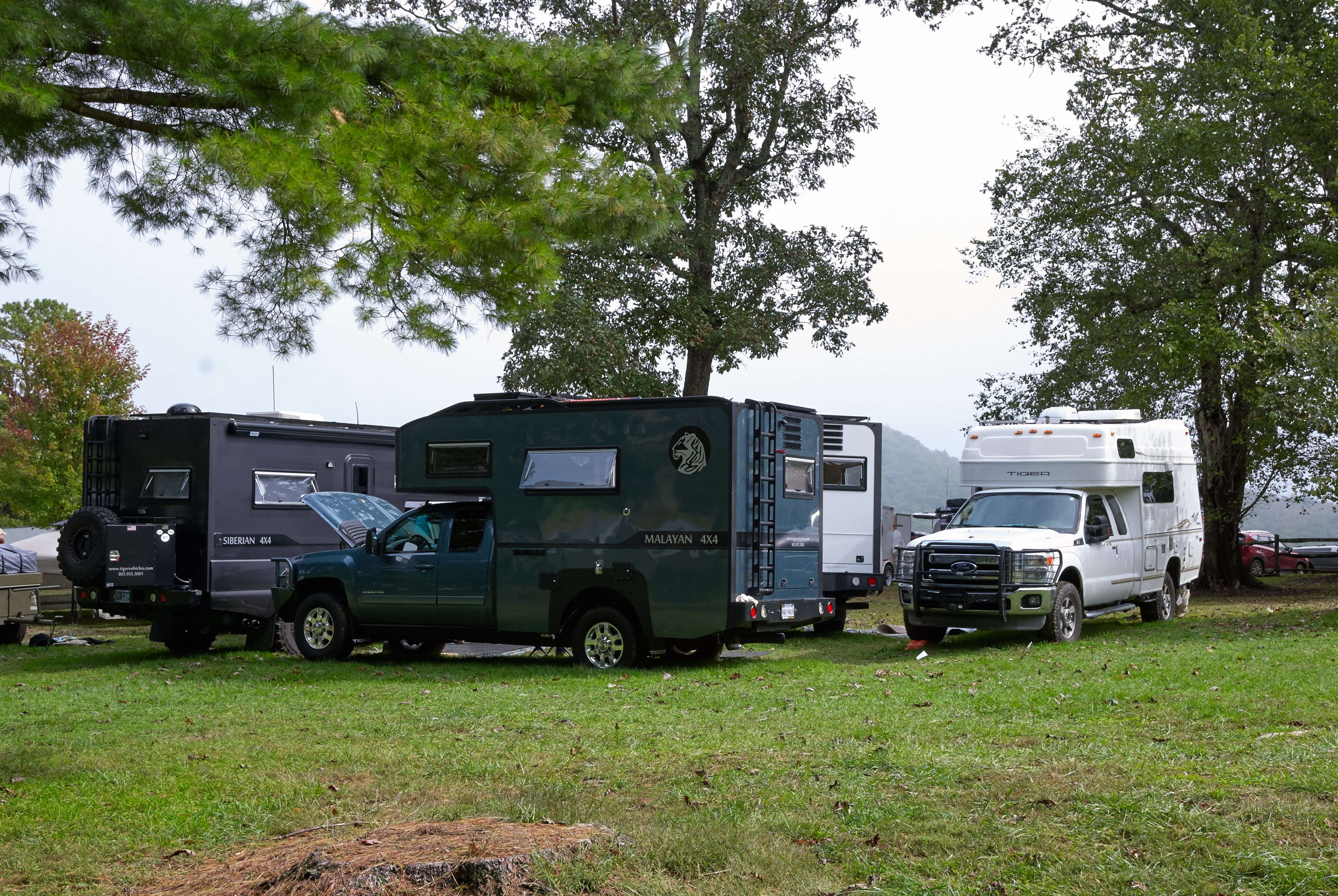
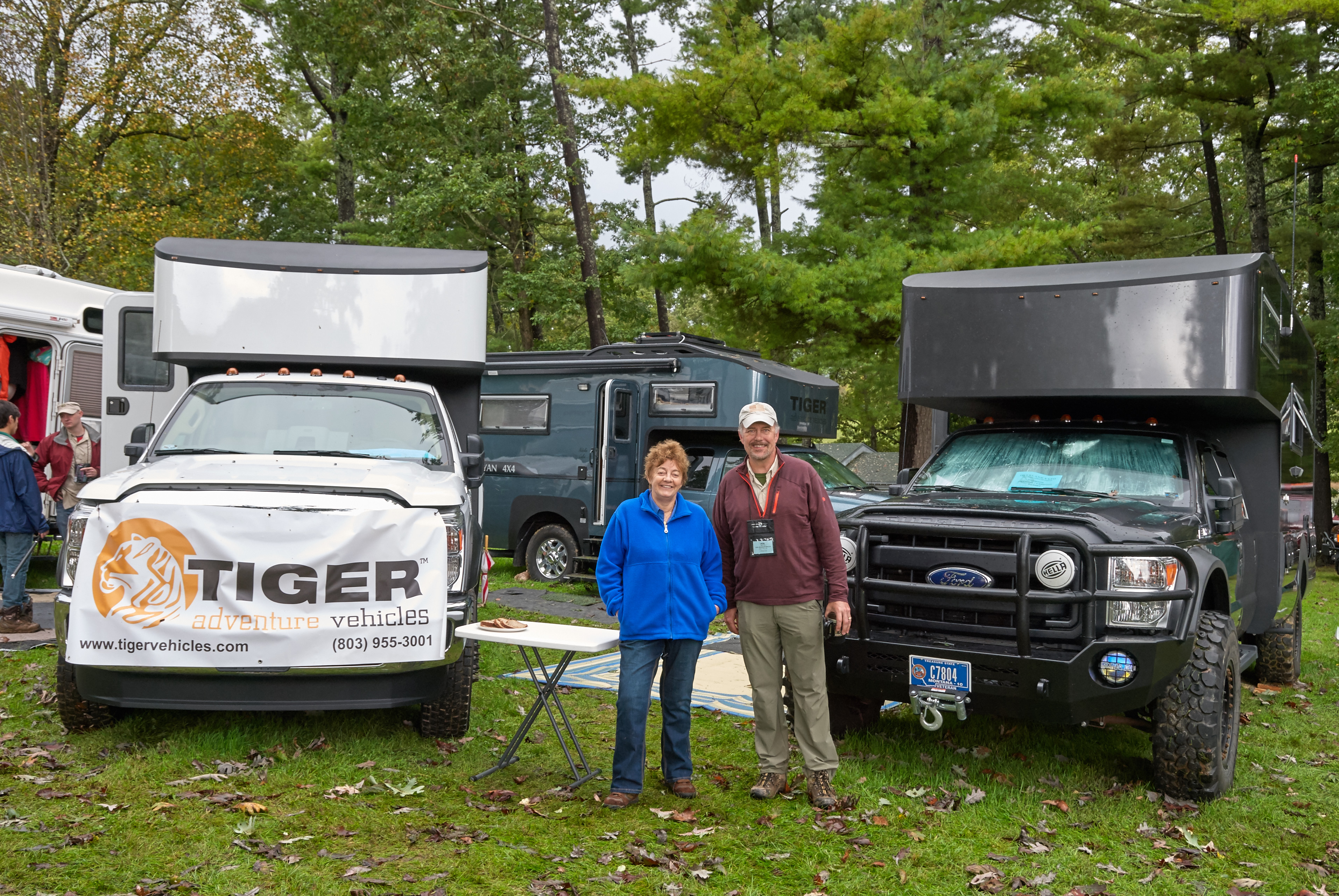
This Overland Expo (http://www.overlandexpo.com will go down in history as the “difficult” and “different” one.  To put it mildly, the weather was not kind at all, and we all suffered.  We arrived on a chilly afternoon and settled Ndeke Luka into the Tiger spot.  We were soon joined by the the second Tiger show vehicle, a Bengal owned by Don, Barbie, and Mate Borinski, aka, “The Wanderers.” This was a thrill as Fred had perused their website for years during the design of Ndeke Luka. Donnie and Barbie produced mats and tents and all matter of things to make the site look better while Mate, the Australian Shepherd, supervised all aspects of the set up. It was windy and cold by evening, a foretaste of the weather to come. Mark Guild, the owner of Tiger Adventure Vehicles and his family arrived and it was fun to meet them and chat.

The Borinski's beautiful Bengal in the foreground.

The Borinski’s beautiful Bengal in the foreground.

Friday dawned cloudy and cold and then after a little morning sunshine, the heavens opened and reduced the parking and camping areas to quagmires. We were warm and dry in the Tiger, but the floor soon disappeared under a layer of mud.

Misty, Moisty Morning

We swept when we could but it was a losing battle. The mud and weather were too much for many, and we noted a steady stream of cars departing early. (In some cases, only after being towed or colliding with other vehicles.) Saturday was worse, adding snow to the mix and the weather didn’t really clear up until Sunday. (Blue cat was unimpressed and retreated to his cabover bed. Needless to say, jailbreaks were not a problem!)

And it felt just as miserable as it looks.

And it felt just as miserable as it looks.

This is when you are glad that you are camping inside, as opposed to beside, your vehicle!

This is when you are glad that you are camping inside, as opposed to beside, your vehicle!

Due to some cross communications, Fred’s dual battery course was conducted in an open tent without audio visual support. The attendees moved in close, both to hear better and to keep warm. The second session was much better; moving out of the tent into a moment of sunlight and lining up the participants to play the roles of “Starter Battery,” “Camper Battery,” “Relay” and other exciting characters. (Those who may wish to learn more on this subject will find information at the “Documents” page of this Blog.) Fred also gave a course, “Know Before You Go”, that deals with preparation for international travel and what can be expected when it all goes wrong. (aka, How not to get arrested/sick/robbed overseas.) Fred was also a discussant on panels on “Bribes and Border Crossings” and travel in Africa.

Fred also slipped away to attend Rick Howe’s session on shipping an overland camper while Denise enjoyed the Rob Blackwell’s presentation on travel in Iran and Turkey.

Beyond being a trade show, Overland Expo is a gathering of the tribes and an opportunity to meet many of what Denise calls Fred’s “imaginary friends.” This year we caught up with:

The Howes (http://www.travelin-tortuga.com/Travelin-Tortuga/index.html)

The Blackwells (http://www.whiteacorn.com)

Lance and Michelle of EarthCruiser (http://earthcruiser.com)

The Turners (http://robinsonfuso.com)

Cam Stone and Kris (http://www.mojoegriddle.com)

And we met many new ones. Many hours were spent in deep (and, according to Denise, sometimes pedantic) discussions of all aspects of travel and vehicle design.

Pretty XPCampers in the background.

Pretty XPCampers in the background.

Jon and Emily offer their reportage and photos here: http://robinsonfuso.com/2015/06/04/flagstaff-may-12-13/

On Monday we retreated to Flagstaff to do laundry, clean out the Tiger, and generally collapse, and not necessarily in that order! We got some nice photos on the way out.

Mountains above Flagstaff, Arizona. http://en.wikipedia.org/wiki/San_Francisco_Peaks

Mountains above Flagstaff, Arizona.
http://en.wikipedia.org/wiki/San_Francisco_Peaks

Note the mouse or vole in the talons.

Note the mouse or vole in the talons.

And Onwards to New Mexico

Once out of Florida, we knew we had a target date for arrival in Flagstaff so it was “pedal to the metal” time.  That said, we did manage to linger a few times along the way, though not as many as we would have liked.  We found a lovely National Park Service campground on Davis Bayou at the Gulf Islands National Seashore, near Biloxi,  in Mississippi and spent a very pleasant evening and night there.  We think that Blue stayed up too late there, checking out the wildlife!  He slept like a log all the next day!

We then headed into Louisiana on 1-10 but tried to cut across too far north.  All the charm and wonderful seafood we remember from our previous visit to Louisiana last year, was absent.  Oh well, we shall know better for the future … stay by the coast in Louisiana!  And then on to Dallas.  We had requested a driveway and some Texas brisket from an internet friend of Fred’s and indeed we received both!  A wonderfully large and effective washing machine solved our dirty laundry problem and a dinner at Spring Creek Barbecue produced brisket so tender you could cut it with a fork.  (http://www.springcreekbarbeque.com/garland.htm) To say that we ate too much is putting it mildly!  There is a lot to see and do in the Dallas Fort Worth area so we shall most definitely stay longer next time, but the weather was iffy the next day and storms were forecast, so we headed out. We did take a moment to view the ranch used as “South Fork” in the television, “Dallas.” (Ironically, neither of us has ever watched the show.)

And indeed we drove through a spectacular storm with sheeting rain and lots of thunder and lightning.  Fortunately for us, the tornadoes stayed north so we did not have to deal with those.  Two cars that had passed us at speed did end up in the ditch (KARMA!) and there was considerable standing water/flooding around the road.  We decided that we needed a dose of nature so headed to the Palo Duro State Park and obtained a space in the primitive camping area for two nights. The landscape around Palo Duro is a bit flat:

_ND83859

But then the canyon opens up:

_ND83804

Blue is getting much better at going outside on his leash and he enjoyed the smells of the campsite.  We had several wild turkeys near us, preening, fighting and just plain eating.  Mating season perhaps?  We also heard coyotes fairly close by, both in the evening and during the night.  The next day dawned decidedly “misty and moisty” so we headed out of the park and went to Canyon where there was a well recommended museum to see and a coffee shop to enjoy.

Both turned out to be excellent choices.  We sipped cappuccino and checked on  our lunch options, before heading to the Panhandle Plains Historic Museum at West Texas A & M University.  The girl at the coffee shop (http://www.palacecoffee.co/canyon/) did warn us that another severe weather front was heading in and indeed it was just starting to rain when we approached the museum and found that we would not fit in the museum reserved parking.  Fred asked a WTAMU policeman for advice and he gave us permission to use one of the university permit only parking lots.  He even drove us to the front door of the museum as it was raining hard at this point.  Denise’s first ever ride in a police car!

The Museum provided a thorough background to life in the Plains in all its aspects from Aboriginal Indians through Plains Indians to the early Spanish explorers an all those who followed.  It covered local paleontology, the petroleum industry, windmills, water use, dry farming and ranching and included a fully reconstructed pioneer town.  All items were original to the area and each had its origins and ownership displayed.  Great display of old cars as well, some with historic pictures with their owners. Definitely recommended. (http://www.panhandleplains.org/pages/home.asp)

For lunch we treated ourselves to a feast at Pepito’s Used Cars and Restaurant. No cars for sale, but the staff was charming and the food was quite good, all of the flavors being distinct. (No website: http://www.tripadvisor.com/Restaurant_Review-g55580-d2180144-Reviews-Pepito_s_Mexican_Restaurant-Canyon_Texas.html)

IMG_0353

The weather had cleared by the time we returned to Palo Duro so we took a short walk. Denise’s ankle is still bothering her, especially on rough surfaces so we could not hike.  We woke the next morning at 5.30 AM to the sounds of sheeting rain, thunder and lightning, again.  It was too loud to sleep, so in the end we gave up, got up and prepared for the road.  By the time we left it was sunny again as the front had passed.

From Canyon, we turned south to Lubbock. Denise is a great Buddy Holly fan so we went to visit the little museum/shrine. Other than having Buddy Holly’s last Strat, (For guitar geeks only: http://www.superoldies.com/buddyholly/guitar.html) the museum is a bit underwhelming. (http://www.mylubbock.us/departmental-websites/departments/buddy-holly-center/home)

_ND83860

On the other hand, the less known National Ranch Heritage Museum is simply wonderful, much like Weald and Downland Museum in England, or the museum of the American frontier in Staunton, Virginia. (http://www.depts.ttu.edu/ranchhc/) We had a great wander.

An impromptu stop at the Very Large Array, the National Radio Astronomy Observatory, also proved to be well worth it.  The array consists of 3 arms of antenna dishes, totaling 27 dishes, positioned on railway lines so that they can be moved around and extending up to 11 miles from the center.  All data is then fed into a supercomputer and such topics as black holes and galaxies are studied by astronomers all around the world.  The self guided tour was most interesting and we were lucky enough to watch some of the dishes being rotated.  (http://www.vla.nrao.edu) You will have seen the Very Large Array as a backdrop in several movies, including, “2010”, “Contact”, and “Independence Day”. For us it made a great backdrop for lunch.


The Adventure Begins…on the road again and the wonderful 60 to 80’s!!

It was April, spring was beautiful in Arlington this year and it was hard to leave, especially as French friends were stopping by and we would not be there to see them.  But leave we did, as we had commitments in the south and to be honest, it would be nice to be warm after the winter we had experienced.  It had been one of the chillier ones in the Northeast and it was not made any warmer by visits to New York State and Maine with multiple feet of snow on the ground.  (Diesel heat in the Tiger is a wonderful thing!) So, we set off in fine form except for Denise who had sprained her ankle!

First stop was South Carolina, where we spent a morning at Tiger getting a couple of quick adjustments made, and then visited friends in Taylors, SC, a suburb of Greenville.  We had a wonderful visit (even Blue enjoyed visiting a new house and seeing a new dog!) and enjoyed a stroll down by the river in Greenville, followed by lunch with a view of the river.  The stroll was short as Denise’s ankle was still bothering her but it was a beautiful day and much too nice to be inside.

_DSC1538

Then onto Savannah, GA where we visited a friend from Panamá and Liberia and discovered the Skidaway Island Campsite, where we camped in a wonderful shady spot.  (http://gastateparks.org/SkidawayIsland) The weather was kind, sunny and not too hot, and knowing nothing about Savannah, we signed up for the hop on hop off bus ride.  We barely scratched the surface of what Savannah had to offer but we did get a feel for the history and the charm of the city so it is on our “must return” list. Preview for the history buffs, Savannah was established as an English military colony to protect the rich plantations of South Carolina from the Spanish. Savannah’s old downtown is famed for its many lovely parks, each dedicated to an historic personage or theme.

We then headed into Florida with rain and storms predicted for the day and night.  And storm it did, but despite downpours we made it safely to our campsite in the Ocala National Forest at Lake Delancy.  A charming Forestry Commission site, we were the only people there!  We dutifully paid our fee and dropped it in the box.  (http://www.fs.usda.gov/recarea/ocala/recarea/?recid=32360) It was soggy and humid all night but we were comfortable and headed south the next day to St. Petersburg, FL where we had reservations at Fort DeSoto Park campground for three nights.  Ft. DeSoto is on Mullet Key, a barrier island at the mouth of Tampa Bay and we had lovely views of the bay and a chorus line of mullets jumping out of the water for us and providing hours of entertainment as we sat by our camper and enjoyed the view.  (http://www.pinellascounty.org/park/05_ft_desoto.htm)

_DSC1577

Despite calling St. Petersburg home for decades, Fred had rarely visited the park. Denise’s ankle was improving so we were able to do couple of shortish walks, one on the beach and one in a nature trail, and also to visit the fort.  Fred was fascinated by one inlet which had hundreds of fiddler crabs all moving in unison.  We also saw multiple nesting ospreys with young in the nest.

Then, on to Orlando and our son’s MBA graduation.  We enjoyed a lovely family weekend, some excellent meals and the presence of both our children (and our son-in-law) as well as friends of our son’s.  Again the weather was determined to charm us with balmy temperatures and sunshine.

_ND83789

Our last stop in Florida was at a Harvest Host site, Golden Acres, where we camped for the night.  Golden Acres is a small farm which specializes in goats and sheep, though there are an assortment of chickens and guinea fowl running around the yard.  All the animals are guarded by big white fluffy Pyrenean dogs, who apparently excel at that and keep away other dogs, coyotes etc.  We bought some Mayhaw jelly, made from the wild may haw trees in the lake and look forward to enjoying it. (http://www.goldenacresranchflorida.com)

N.B. Any camper owner likes wine and is not a member of Harvest Hosts is missing a trick. (http://harvesthosts.com)

So what are the 60 to 80’s? That is the temperature range, in Fahrenheit, for some lovely camping weather. Warm enough to go out without a coat (a nice change from this winter) and cool enough overnight to be comfortable without air conditioning.

The Lion and Lamb Tour

The old adage is that March “comes in like a lion and goes out like a lamb.” We have just returned from a trip that began with camping in temperatures down to about 10F and ended with us running the air conditioner. We spent at lot of energy and money to create a true, four season camper, precisely so that we would not be limited in the winter, but we do have to confess though that we can see why more people do not travel in the northern USA in the winter. With apologies to W.C. Fields – it is basically closed, even in March.

We started in the Hudson Valley of New York State and headed into Connecticut for our first stop. We were not in the mood for interstates so we ambled across country on state roads enjoying the scenery and spent our first night at the New England Air Museum, near Bradley International Airport north of Hartford, Connecticut. (https://www.neam.org) We had visited the museum years ago and wanted a return visit as it is well worth an hour or three if you like planes as Fred does. He especially likes the Sikorsky flying boat and fully restored B-29. We could not see the outside planes unfortunately as they were still under snow but the inside sections kept us busy for several hours. As a bonus, the Museum also belongs to the Harvest Hosts camping group and we were able to spend the night in their parking lot, which was nice and flat and very convenient! (http://harvesthosts.com)

Lion-Lamb 1We had managed to find a KOA campsite near Plymouth, Massachusetts that is open year round so the following day we headed there first under beautiful blue skies and freezing temperatures to see if we did indeed have a reservation. We checked in and found them plowing our space so we left them to it and headed to Plimouth Plantation about 30 minutes away.

The Plimouth Platation had just opened and we were so glad that it had; it is a really magnificent display, much like Colonial Williamsburg or Olde Sturbridge Village. We passed a fascinating afternoon learning about the Pilgrims and the colony that was founded there and chatting to the costumed interpreters who were thrilled to chat, as there were very few visitors. It was another sunny but chilly day and we were happy to warm ourselves by their fires and hear about the hard winter they experienced after landing in November. Especially fascinating was the use of Original Pronunciation, which is a theme we had met before in Shakespearean plays and other works from the era. After warming up with a much-needed cappuccino, we went to admire the Plymouth Rock and then headed back to our campsite, which was now ready for our use. Our water access tap was still frozen but they found a hose to get us water from the next site over (still under snow) which was working.

The next day also dawned sunny and cold and we headed this time to Cape Cod. As we expected it was quite closed, but we enjoyed our day. We visited the Glass Museum at Sandwich and enjoyed the glass blowing demonstration, though managed not to buy anything! ) http://www.sandwichglassmuseum.org) Then back on the road through a series of quaint little towns with charming architecture. We ventured as far as the remnants of the Marconi transmission station tourist site (the actual station and site has since fallen into the sea) and went down onto the Marconi beach just to say that we had. Then we were back into Ndeke Luka to warm up and head back to our campsite.

Lion-Lamb 9The final leg of a trip was a visit to some friends in Cape Elizabeth, Maine. Unfortunately, the weather deteriorated (it even snowed on one day) but that only made us more determined to return to see it in better conditions, perhaps with leaves on the trees? But we visited Fort William and saw the most photographed light house in Maine, had a wonderful day shopping in Freeport and a wonderful meal at the Boat House, where the Maine lobster was fresh and much enjoyed.

Lion-Lamb

Next visit, we shall see more of Portland and her museums, all of which were (wait for it!) closed! We would also very much like to explore Maine further in future trips.

Lion-Lamb 11 Lion-Lamb 10

Hate to admit it, but these are even louder than the new air horns on Ndeke Luka. ;-(

Lion-Lamb 12

There really is a lake here, you just have to come back in the spring to see it.